Results by title
22279 books match the query 'Social Science' and 1819 start with a
Against Academia
The History of the Popular Culture Association/American Culture Association and the Popular Culture Movement 1967-1988Ray B. Browne
University of Wisconsin Press, 1989
The history of the study of popular culture in American academia since its (re)introduction in 1967 is filled with misunderstanding and opposition. From the first, proponents of the study of this major portion of American culture made clear that they were interested in making popular culture a supplement to the usual courses in such fields as literature, sociology, history, philosophy, and the other humanities and social sciences; nobody proposed that study of popular culture replace the other disciplines, but many suggested that it was time to reexamine the accepted courses and see if they were still viable. Opposition to the status quo always causes anxiety and opposition, but when the issues are clarified, often opposition and anxiety melt away, as they now are doing.
Anxiety and opposition were generated on another level when people in academic and curricular power felt that voices were being raised that questioned their credentials and control. They flailed out with every argument at their command, generally thinking only of their self interest and not that of the students and the future of academic education. Generally this wall of opposition has also been breached.
The Popular Culture Association and its many friends and backers in academia, in the United States and abroad, has demonstrated that the study of our everyday and dominant culure should be taken seriously, understandingly and analytically, just as all other aspects of culture should be. Taken that way the study can be useful in developing better educated and responsible citizens from the cradle to the grave. The humanities and social sciences are too important for any portion—especially the majority portion—to be ignored or downplayed. The study of popular culture constitutes a significant and important element, one that can be ignored only at peril.

Against Austerity
How we Can Fix the Crisis they MadeRichard Seymour
Pluto Press, 2014
Five years into capitalism's deepest crisis, which has led to cuts and economic pain across the world, Against Austerity addresses a puzzling aspect of the current conjuncture: why are the rich still getting away with it? Why is protest so ephemeral? Why does the left appear to be marginal to political life?
In an analysis which challenges our understanding of capitalism, class and ideology, Richard Seymour shows how ‘austerity’ is just one part of a wider elite plan to radically re-engineer society and everyday life in the interests of profit, consumerism and speculative finance.
But Against Austerity is not a gospel of despair. Seymour argues that once we turn to face the headwinds of this new reality, dispensing with reassuring dogmas, we can forge new collective resistance and alternatives to the current system. Following Brecht, Against Austerity argues that the good old things are over, it's time to confront the bad new ones.
Against Citizenship
The Violence of the NormativeAmy L. Brandzel
University of Illinois Press, 2016
Brandzel's focus on three legal case studies--same-sex marriage law, hate crime legislation, and Native Hawaiian sovereignty and racialization--exposes how citizenship confounds and obscures the mutual processes of settler colonialism, racism, sexism, and heterosexism. In this way, Brandzel argues that citizenship requires anti-intersectionality, that is, strategies that deny the mutuality and contingency of race, class, gender, sexuality, and nation--and how, oftentimes, progressive left activists and scholars follow suit.
Against Citizenship is an impassioned plea for a queer, decolonial, anti-racist coalitional stance against the systemized human de/valuing and anti-intersectionalities of citizenship.
Against Exclusion
Disrupting Anti-Chinese Violence in the Nineteenth CenturyAudrey Wu Clark
The Ohio State University Press, 2024
In Against Exclusion, Audrey Wu Clark dramatically reframes Asian American resistance via the lives of five early Chinese American public figures. In contrast to later activists who sought to defy stereotypes, Ah Toy, Mary Tape, Wong Chin Foo, Yan Phou Lee, and Yung Wing deployed the model minority and yellow peril tropes to make themselves visible during a period of rampant anti-Chinese violence and legal exclusion. In making themselves visible, they sought to expose and dismantle the contradictory exceptionalism of nineteenth-century US liberalism that both required and “disavowed” the deaths of Chinese Americans. In examining these figures and the ways in which they fought their exclusion as Chinese Americans—via court cases, autobiographical writings, journalism, and other forms of activism—Clark contributes to prevailing scholarly conversations about stereotypes of Asian Americans but contextualizes them in the nineteenth century. She traces the twinned emergences of the model minority and the yellow peril, excavating the exceptionalism with which Chinese Americans were racialized and subject to death—whether by lynching, other forms of driving out, or loss of citizenship or rights—and mapping its reverberations into the present day.
Against Extraction
Indigenous Modernism in the Twin CitiesMatt Hooley
Duke University Press, 2024
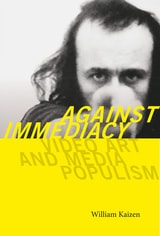
Against Immediacy
Video Art and Media PopulismWilliam Kaizen
Dartmouth College Press, 2016
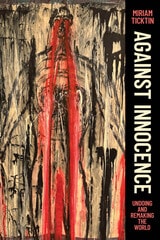
Against Innocence
Undoing and Remaking the WorldMiriam Ticktin
University of Chicago Press, 2025
In this timely and bold book, Miriam Ticktin explores how a concept that consistently appears as a moral good actually ends up creating harm for so many. Claims to innocence protect migrant children, but often at the expense of their parents; claims to the innocence of the fetus work to punish women. Ticktin shows how innocence structures political relationships, focusing on individual victims and saviors, while foreclosing forms of collective responsibility. Ultimately, she wants to understand how the discourse around innocence functions, what gives it such power, and why we are so compelled by it, while showing that alternative political forms already exist. She examines this process across various domains, from migration, science, and environmentalism to racial and reproductive justice.
Throughout the book, Ticktin shows how the concept of innocence intimately shapes why, how, and for whom we should care and whose lives matter—and how this can have devastating consequences when only an exceptional few can qualify as innocent. A politics grounded on innocence justifies a world built on inequality, designating most people—especially the racialized poor—as unworthy, undeserving, and less than human. As an alternative, she explores the aesthetics and politics of “commoning”—a collective regime of living that refuses a liberal politics of individual identity and victimhood.

Against Marriage
The Correspondence of La Grande MademoiselleAnne-Marie-Louise d'Orléans, Duchesse de Montpensier
University of Chicago Press, 2002
In the daring letters presented in this bilingual edition, Montpensier condemns the alliance system of marriage, proposing instead to found a republic that she would govern, "a corner of the world in which . . . women are their own mistresses," and where marriage and even courtship would be outlawed. Her pastoral utopia would provide medical care and vocational training for the poor, and all the homes would have libraries and studies, so that each woman would have a "room of her own" in which to write books.
Joan DeJean's lively introduction and accessible translation of Montpensier's letters—four previously unpublished—allow us unprecedented access to the courageous voice of this extraordinary woman.

Against Prediction
Profiling, Policing, and Punishing in an Actuarial AgeBernard E. Harcourt
University of Chicago Press, 2006
From random security checks at airports to the use of risk assessment in sentencing, actuarial methods are being used more than ever to determine whom law enforcement officials target and punish. And with the exception of racial profiling on our highways and streets, most people favor these methods because they believe they’re a more cost-effective way to fight crime.
In Against Prediction, Bernard E. Harcourt challenges this growing reliance on actuarial methods. These prediction tools, he demonstrates, may in fact increase the overall amount of crime in society, depending on the relative responsiveness of the profiled populations to heightened security. They may also aggravate the difficulties that minorities already have obtaining work, education, and a better quality of life—thus perpetuating the pattern of criminal behavior. Ultimately, Harcourt shows how the perceived success of actuarial methods has begun to distort our very conception of just punishment and to obscure alternate visions of social order. In place of the actuarial, he proposes instead a turn to randomization in punishment and policing. The presumption, Harcourt concludes, should be against prediction.

Against The Romance Of Community
Miranda Joseph
University of Minnesota Press, 2002
An unexpected and valuable critique of community that points out its complicity with capitalism
Community is almost always invoked as an unequivocal good, an indicator of a high quality of life, caring, selflessness, belonging. Into this common portrayal, Against the Romance of Community introduces an uncommon note of caution, a penetrating, sorely needed sense of what, precisely, we are doing when we call upon this ideal.
Miranda Joseph explores sites where the ideal of community relentlessly recurs, from debates over art and culture in the popular media, to the discourses and practices of nonprofit and nongovernmental organizations, to contemporary narratives of economic transformation or "globalization." She shows how community legitimates the social hierarchies of gender, race, nation, and sexuality that capitalism implicitly requires. Joseph argues that social formations, including community, are constituted through the performativity of production. This strategy makes it possible to understand connections between identities and communities that would otherwise seem disconnected: gay consumers in the United States and Mexican maquiladora workers; Christian right "family values" and Asian "crony capitalism." Exposing the complicity of social practices, identities, and communities with capitalism, this truly constructive critique opens the possibility of genuine alliances across such differences.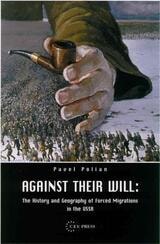
Against Their Will
The History and Geography of Forced Migrations in the USSRPavel Polian
Central European University Press, 2003
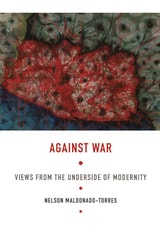
Against War
Views from the Underside of ModernityNelson Maldonado-Torres
Duke University Press, 2008
Considering Levinas’s critique of French liberalism and Nazi racial politics, and the links between them, Maldonado-Torres identifies a “master morality” of dominion and control at the heart of western modernity. This master morality constitutes the center of a warring paradigm that inspires and legitimizes racial policies, imperial projects, and wars of invasion. Maldonado-Torres refines the description of modernity’s war paradigm and the Levinasian critique through Fanon’s phenomenology of the colonized and racial self and the politics of decolonization, which he reinterprets in light of the Levinasian conception of ethics. Drawing on Dussel’s genealogy of the modern imperial and warring self, Maldonado-Torres theorizes race as the naturalization of war’s death ethic. He offers decolonial ethics and politics as an antidote to modernity’s master morality and the paradigm of war. Against War advances the de-colonial turn, showing how theory and ethics cannot be conceived without politics, and how they all need to be oriented by the imperative of decolonization in the modern/colonial and postmodern world.
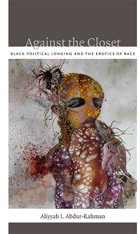
Against the Closet
Black Political Longing and the Erotics of RaceAliyyah I. Abdur-Rahman
Duke University Press, 2012
Abdur-Rahman brings black feminist, psychoanalytic, critical race, and poststructuralist theories to bear on literary genres from slave narratives to science fiction. Analyzing works by African American writers, including Frederick Douglass, Pauline Hopkins, Harriet Jacobs, James Baldwin, and Octavia Butler, she shows how literary representations of transgressive sexuality expressed the longings of African Americans for individual and collective freedom. Abdur-Rahman contends that those representations were fundamental to the development of African American forms of literary expression and modes of political intervention and cultural self-fashioning.
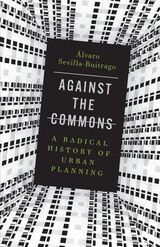
Against the Commons
A Radical History of Urban PlanningÁlvaro Sevilla-Buitrago
University of Minnesota Press, 2022
An alternative history of capitalist urbanization through the lens of the commons
Characterized by shared, self-managed access to food, housing, and the basic conditions for a creative life, the commons are essential for communities to flourish and protect spaces of collective autonomy from capitalist encroachment. In a narrative spanning more than three centuries, Against the Commons provides a radical counterhistory of urban planning that explores how capitalism and spatial politics have evolved to address this challenge.
Highlighting episodes from preindustrial England, New York City and Chicago between the 1850s and the early 1900s, Weimar-era Berlin, and neoliberal Milan, Álvaro Sevilla-Buitrago shows how capitalist urbanization has eroded the egalitarian, convivial life-worlds around the commons. The book combines detailed archival research with provocative critical theory to illuminate past and ongoing struggles over land, shared resources, public space, neighborhoods, creativity, and spatial imaginaries.
Against the Commons underscores the ways urbanization shapes the social fabric of places and territories, lending particular awareness to the impact of planning and design initiatives on working-class communities and popular strata. Projecting history into the future, it outlines an alternative vision for a postcapitalist urban planning, one in which the structure of collective spaces is ultimately defined by the people who inhabit them.
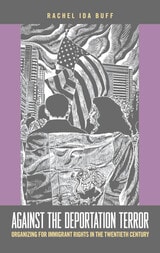
Against the Deportation Terror
Organizing for Immigrant Rights in the Twentieth CenturyRachel Ida Buff
Temple University Press, 2017
Despite being characterized as a “nation of immigrants,” the United States has seen a long history of immigrant rights struggles. In her timely book Against the Deportation Terror, Rachel Ida Buff uncovers this multiracial history. She traces the story of the American Committee for the Protection of the Foreign Born (ACPFB) from its origins in the 1930s through repression during the early Cold War, to engagement with “new” Latinx and Caribbean immigrants in the 1970s and early 1980s.
Functioning as a hub connecting diverse foreign-born communities and racial justice advocates, the ACPFB responded to various, ongoing crises of what they called “the deportation terror.” Advocates worked against repression, discrimination, detention, and expulsion in migrant communities across the nation at the same time as they supported reform of federal immigration policy. Prevailing in some cases and suffering defeats in others, the story of the ACPFB is characterized by persistence in multiracial organizing even during periods of protracted repression.
By tracing the work of the ACPFB and its allies over half a century, Against the Deportation Terror provides important historical precedent for contemporary immigrant rights organizing. Its lessons continue to resonate today.
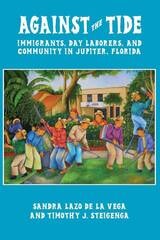
Against the Tide
Immigrants, Day Laborers, and Community in Jupiter, FloridaSandra Lazo de la Vega and Timothy J. Steigenga
University of Wisconsin Press, 2013
At the beginning of the twenty-first century, Jupiter was in the throes of immigration debates. A decade earlier, this small town had experienced an influx of migrants from Mexico and Guatemala. Immigrants seeking work gathered daily on one of the city’s main streets, creating an ad-hoc, open-air labor market that generated complaints and health and human safety concerns. What began as a local debate rapidly escalated as Jupiter’s situation was thrust into the media spotlight and attracted the attention of state and national anti-immigrant groups. But then something unexpected happened: immigrants, neighborhood residents, university faculty and students, and town representatives joined together to mediate community tensions and successfully moved the informal labor market to the new El Sol Neighborhood Resource Center.
Timothy J. Steigenga, who helped found the center, and Lazo de la Vega, who organized students in support of its mission, describe how El Sol engaged the residents of Jupiter in a two-way process of immigrant integration and helped build trust on both sides. By examining one city’s search for a positive public policy solution, Against the Tide offers valuable practical lessons for other communities confronting similar challenges.
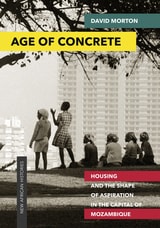
Age of Concrete
Housing and the Shape of Aspiration in the Capital of MozambiqueDavid Morton
Ohio University Press, 2019
Age of Concrete is a history of the making of houses and homes in the subúrbios of Maputo (Lourenço Marques), Mozambique, from the late 1940s to the present. Often dismissed as undifferentiated, ahistorical “slums,” these neighborhoods are in fact an open-air archive that reveals some of people’s highest aspirations. At first people built in reeds. Then they built in wood and zinc panels. And finally, even when it was illegal, they risked building in concrete block, making permanent homes in a place where their presence was often excruciatingly precarious.
Unlike many histories of the built environment in African cities, Age of Concrete focuses on ordinary homebuilders and dwellers. David Morton thus models a different way of thinking about urban politics during the era of decolonization, when one of the central dramas was the construction of the urban stage itself. It shaped how people related not only to each other but also to the colonial state and later to the independent state as it stumbled into being.
Original, deeply researched, and beautifully composed, this book speaks in innovative ways to scholarship on urban history, colonialism and decolonization, and the postcolonial state. Replete with rare photographs and other materials from private collections, Age of Concrete establishes Morton as one of a handful of scholars breaking new ground on how we understand Africa’s cities.
Age of Globalization
John M. Hoberman, Instructor
University of Texas Press, 2014
Aged by Culture
Margaret Morganroth Gullette
University of Chicago Press, 2003
In this illuminating book, Margaret Morganroth Gullette reveals that aging doesn't start in our chromosomes, but in midlife downsizing, the erosion of workplace seniority, threats to Social Security, or media portrayals of "aging Xers" and "greedy" Baby Boomers. To combat the forces aging us prematurely, Gullette invites us to change our attitudes, our life storytelling, and our society. Part intimate autobiography, part startling cultural expose, this book does for age what gender and race studies have done for their categories. Aged by Culture is an impassioned manifesto against the pernicious ideologies that steal hope from every stage of our lives.
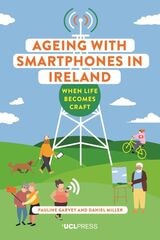
Ageing with Smartphones in Ireland
When Life Becomes CraftPauline Garvey and Daniel Miller
University College London, 2021
This volume documents a radical change in the experience of aging. Based on two ethnographies in Dublin, Ireland, the book illustrates how smartphones enable old people to focus on crafting a new life in retirement. For some, the smartphone is an intimidating burden linked to being on the wrong side of a new digital divide. But for most, however, it has become integral to a new trajectory towards a more sustainable life, both for themselves and their environment. The smartphone has reunited extended family and old friends, helped resolve intergenerational conflicts though new forms of grandparenting, and has become a health resource. This is a book about acknowledging late middle age in contemporary Ireland and examines how older people in Ireland experience life today.
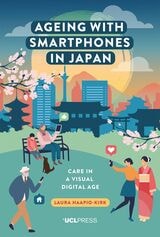
Ageing with Smartphones in Japan
Care in a Visual Digital AgeLaura Haapio-Kirk
University College London, 2024
Ageing with Smartphones in Japan examines sixteen months of ethnographic research following older adults, age fifty and up, in urban Kyoto and rural Kochi Prefecture, Japan as they navigate social and personal shifts post-retirement in the age of the smartphone. It attempts to answer what this transition means for friendship, gendered labor, multigenerational living, internal migration, health, as well as life purpose for older adults. This book closely investigates how the smartphone challenges gender-based norms and how older adults creatively navigate them. Using comics, drawings, and fieldwork sketches it also explores how they use digital visual communication to socialize with friends and family.

Ageing with Smartphones in Uganda
Togetherness in the Dotcom AgeCharlotte Hawkins
University College London, 2023
Ageing with Smartphones in Uganda is based on a sixteen-month ethnography about experiences of aging in a neighborhood in central Kampala, Uganda. Taking a convivial approach, which celebrates multiple ways of knowing about social life, Charlotte Hawkins draws from these expressions about cooperative morality and modernity to consider the everyday mitigation of profound social change. “Dotcom” is understood to encompass everything from the influence of information and communications technologies to urban migration and lifestyles in the city to shifts in ways of knowing and relating. At the same time, dotcom tools such as mobile phones and smartphones facilitate elder care through, for example, regular mobile money remittances.
This book explores how dotcom relates to older people’s health, their care norms, their social standing, their values of respect and relatedness, and their intergenerational relationships—both political and personal. It also re-frames the youth-centricity of research on the city and work, new media and technology, and politics and service provision in Uganda. Through ethnographic consideration of everyday life and self-formation in this context, this monograph seeks to contribute to an ever-incomplete understanding of how we relate to each other and to the world around us.
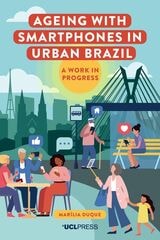
Ageing with Smartphones in Urban Brazil
A Work in ProgessMarília Duque
University College London, 2022
With people living longer all over the world, aging has begun to be framed as a socioeconomic problem. In Brazil, older people are expected to remain healthy and autonomous while actively participating in society. Based on ethnographic research in São Paulo, this book shows how older people in a middle-class neighborhood try to reconcile these expectations with the freedom and pleasures reserved for old age by using smartphones. Smartphones have become of great importance to the residents as they search for and engage in new forms of work and hobbies. Connected by a digital network, they work as content curators, sharing activities that fill their schedules. Managing multiple WhatsApp groups is a job in itself, as well as a source of solidarity and hope. Friendship groups help each to download new apps, search for medical information and guidance, and navigate the city. Together, the author shows, older people are reinventing themselves as volunteers, entrepreneurs, and influencers, or they are finding a new interest that gives their later life a purpose. The smartphone, which enables the residents to share and discuss their busy lives, is also helping them, and us, to rethink aging.
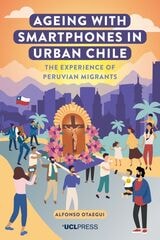
Ageing with Smartphones in Urban Chile
The Experience of Peruvian MigrantsAlfonso Otaegui
University College London, 2023
What does it mean to be aging in Chile as a migrant? Drawing on extensive ethnographic fieldwork, Ageing with Smartphones in Urban Chile analyzes the experience of aging for Peruvian migrants aged around sixty who have lived in Chile for more than twenty years. Their lives, we discover, are informed by a series of experiences of being ‘in between’. They live between two countries, two generations, and two different stages in life, between giving care and not wanting care, and between a continuing legacy and not transmitting legacy. By focusing on the entanglement of aging, migration, and technology, this book is an ethnographic contribution to an unexplored subject in the vast literature on migration studies in Chile.
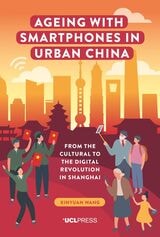
Ageing with Smartphones in Urban China
From the Cultural to the Digital Revolution in ShanghaiXinyuan Wang
University College London, 2023
The current oldest generation in Shanghai was born at a time when the average household could not afford electric lights, but today they can turn their lights off using smartphone apps. Grounded in extensive ethnographic fieldwork in Shanghai, Ageing with Smartphones in Urban China tackles the intersection between the “two revolutions” experienced by the older generation in Shanghai: the contemporary smartphone-based digital revolution and the earlier communist revolutions and argues that we can only understand the smartphone revolution if we first appreciate the long-term consequences of these people’s experiences during the communist revolutions. Supported by detailed ethnographic material, the observations and analysis here provide a panorama view of the social landscape of contemporary China, addressing such topics the digital and everyday life, aging and healthcare, intergenerational relations and family development, community building and grassroots organizations, collective memories, and political attitudes among ordinary Chinese people.
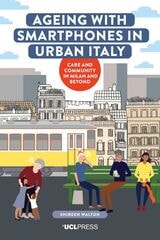
Ageing with Smartphones in Urban Italy
Care and Community in Milan and BeyondShireen Walton
University College London, 2021
This book is an anthropological account of the experience of age and ageing in an inner-city neighborhood in Milan, exploring the relationship between ageing and technology amidst a backdrop of rapid global technological innovation, including the advent of mobile health, smart cities, and a number of wider socioeconomic and technological transformations. Through extensive urban and digital ethnographic research in Milan, Shireen Walton shows how the smartphone has become a “constant companion” in contemporary life, accompanying people throughout the day and through individual and collective experiences. The volume argues that ageing with smartphones in the contemporary urban Italian context is about living with ambiguity, change, and contradiction, as well as developing curiosities about a changing world, our changing selves, and changing relationships with others.
Agency in African History
Lauren V. Jarvis, Rachel M. Petrocelli, and Wallace Teska
Ohio University Press, 2027
Agency in African History is the first edited volume of African history to offer sustained engagement with the idea of agency. Agency is ubiquitous and invisible, contested and yet foundational to the field. These contradictory qualities contribute to the polarization of the term and a stalemate in debates surrounding its use. This volume proposes a way forward by breaking agency down into parts, disaggregating the terms and concepts often associated with agency, and reckoning with historians’ uses and misuses of the term. The book explores how agency has shaped the field of African history and the historical discipline more broadly. Tracing the concept back to the contributions of Black abolitionists and intellectuals in the eighteenth century, the volume challenges popular genealogies of agency in Western academe. Simultaneously, it suggests productive future possibilities for the framework.
The volume contributes to lively debates on the concept of agency in adjoining fields. Recent works in cultural theory, including Naminata Diabate’s Naked Agency (Duke University Press, 2020) and Olúf?´mi Táíwò’s Against Decolonisation (Hurst, 2022), have reinvigorated discussions within African studies about the applicability of agency. In the broader historical discipline, special issues of the Journal of Social History and the American Historical Review (both 2023) have centered on the problems and promises of agency as a historiographical framework, mostly from a Euro-American perspective. This volume makes an urgent intervention in these important conversations, arguing that historians of Africa must both adapt to new scholarly insights and contribute their unique perspectives from a field typically ignored in the formulation of world-historical concepts.
Agency in African History is addressed to historians of Africa and to a broader interdisciplinary audience interested in agency. This interdisciplinary audience includes scholars of African studies—cultural theorists, political scientists, anthropologists, and others—as well as historians of world regions beyond Africa. Individual contributions cover the seventeenth century to the present day and range in subject matter from histories of decolonization and international relations to the Atlantic slave trade, art history, urban studies, sports studies, and cultural theory.
Contributors
Mathew Ayodele
Felicitas Becker
Emily S. Burrill
Robin P. Chapdelaine
Kate Cowcher
Naminata Diabate
Walter Hawthorne
Lauren V. Jarvis
Rachel M. Petrocelli
Ian Read
Jodie Yuzhou Sun
Wallace Teska
Chepchirchir Tirop
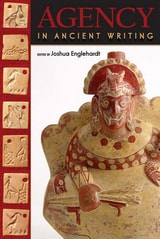
Agency in Ancient Writing
Joshua Englehardt
University Press of Colorado, 2012
Individual agents are frequently evident in early writing and notational systems, yet these systems have rarely been subjected to the concept of agency as it is traceable in archeology. Agency in Ancient Writing addresses this oversight, allowing archeologists to identify and discuss real, observable actors and actions in the archaeological record.
Embracing myriad ways in which agency can be interpreted, ancient writing systems from Mesoamerica, Mesopotamia, Egypt, Crete, China, and Greece are examined from a textual perspective as both archaeological objects and nascent historical documents. This allows for distinction among intentions, consequences, meanings, and motivations, increasing understanding and aiding interpretation of the subjectivity of social actors. Chapters focusing on acts of writing and public recitation overlap with those addressing the materiality of texts, interweaving archaeology, epigraphy, and the study of visual symbol systems.
Agency in Ancient Writing leads to a more thorough and meaningful discussion of agency as an archaeological concept and will be of interest to anyone interested in ancient texts, including archaeologists, historians, linguists, epigraphers, and art historians, as well as scholars studying agency and structuration theory.
Agency, Updated Edition
The Four Point Plan (F.R.E.E.) for ALL Children to Overcome the Victimhood Narrative and Discover Their Pathway to PowerIan V. Rowe
Templeton Press, 0
Some children thrive where others do not. Why? Are there personal behaviors and institutional supports that make a difference in helping young people chart a course for their futures? Agency answers with a loud and clear “yes!”
This book describes the FREE framework, four pillars that can uplift every young person as they make the passage into adulthood: Family, Religion, Education, and Entrepreneurship.
With this framework in place, children are empowered to develop agency, which Ian V. Rowe defines as the force of one’s free will, guided by moral discernment.
Rowe champions a game plan for creating new agents of agency and shows them the path that will set them FREE. Revised and expanded, this updated edition includes a new introduction and supplementary material, including a study guide for educators, sample lesson plans, and a student self-assessment.
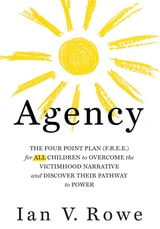
Agency
The Four Point Plan (F.R.E.E.) for ALL Children to Overcome the Victimhood Narrative and Discover Their Pathway to PowerRowe, Ian V.
Templeton Press, 2021
Every child in America deserves to know that a path to a successful life exists and that they have the power to follow it. But many never set foot on that path because they grow up hearing the message that systemic forces control their destinies, or that they are at fault for everything that has gone wrong in their lives.
These children often come from difficult circumstances. Many are raised by young, single parents, live in disadvantaged neighborhoods, attend substandard schools, and lack the moral safeguards of religious and civic institutions. As a result, they can be dispirited into cycles of learned helplessness rather than inspired to pursue their own possibilities.
Yet this phenomenon is not universal. Some children thrive where others do not. Why? Are there personal behaviors and institutional supports that have proven to make a difference in helping young people chart a course for their futures? Agency answers with a loud and clear “yes!”
This book describes four pillars that can uplift every young person as they make the passage into adulthood: Family, Religion, Education, and Entrepreneurship. Together, these pillars embody the true meaning of freedom, wherein people are motivated to embrace the ennobling responsibilities of building healthy social structures and shaping the outcomes of their own lives.
For that reason, Ian Rowe calls the four pillars the FREE framework. With this framework in place, children are empowered to develop agency, which Rowe defines as the force of one’s free will, guided by moral discernment. Developing agency is the alternative to the debilitating ‘blame-the-system’ and ‘blame-the-victim’ narratives. It transcends our political differences and beckons all who dare to envision lives unshackled by present realities.
In addition to making the case for agency, Rowe shares his personal story of success coming from an immigrant family. He defends America as an ever-improving country worthy of our esteem. He corrects misguided calls for “anti-racism” and “equity,” and champions a game plan for creating new agents of agency, dedicated to promoting the aspirational spirit of America’s children, and showing them the path that will set them FREE.
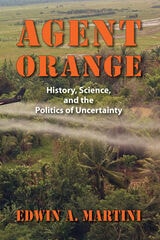
Agent Orange
History, Science, and the Politics of UncertaintyEdwin A. Martini
University of Massachusetts Press, 2012
Taking on what one former U.S. ambassador called “the last ghost of the Vietnam War,” this book examines the far-reaching impact of Agent Orange, the most infamous of the dioxin-contaminated herbicides used by American forces in Southeast Asia. Edwin A. Martini's aim is not simply to reconstruct the history of the “chemical war” but to investigate the ongoing controversy over the short- and long-term effects of weaponized defoliants on the environment of Vietnam, on the civilian population, and on the troops who fought on both sides.
Beginning in the early 1960s, when Agent Orange was first deployed in Vietnam, Martini follows the story across geographical and disciplinary boundaries, looking for answers to a host of still unresolved questions. What did chemical manufacturers and American policymakers know about the effects of dioxin on human beings, and when did they know it? How much do scientists and doctors know even today? Should the use of Agent Orange be considered a form of chemical warfare? What can, and should, be done for U.S. veterans, Vietnamese victims, and others around the world who believe they have medical problems caused by Agent Orange?
Martini draws on military records, government reports, scientific research, visits to contaminated sites, and interviews to disentangle conflicting claims and evaluate often ambiguous evidence. He shows that the impact of Agent Orange has been global in its reach affecting individuals and communities in New Zealand, Australia, Korea, and Canada as well as Vietnam and the United States. Yet for all the answers it provides, this book also reveals how much uncertainty—scientific, medical, legal, and political—continues to surround the legacy of Agent Orange.
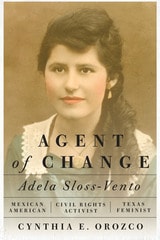
Agent of Change
Adela Sloss-Vento, Mexican American Civil Rights Activist and Texas FeministBy Cynthia E. Orozco
University of Texas Press, 2020
Liz Carpenter Award for Research in the History of Women, Texas State Historical Association
The essayist Adela Sloss-Vento (1901–1998) was a powerhouse of activism in South Texas’s Lower Rio Grande Valley throughout the Mexican American civil rights movement beginning in 1920 and the subsequent Chicano movement of the 1960s and 1970s. At last presenting the full story of Sloss-Vento’s achievements, Agent of Change revives a forgotten history of a major female Latina leader.
Bringing to light the economic and political transformations that swept through South Texas in the 1920s as ranching declined and agribusiness proliferated, Cynthia E. Orozco situates Sloss-Vento’s early years within the context of the Jim Crow/Juan Crow era. Recounting Sloss-Vento’s rise to prominence as a public intellectual, Orozco highlights a partnership with Alonso S. Perales, the principal founder of the League of United Latin American Citizens. Agent of Change explores such contradictions as Sloss-Vento’s tolerance of LULAC’s gender-segregated chapters, even though the activist was an outspoken critic of male privilege in the home and a decidedly progressive wife and mother. Inspiring and illuminating, this is a complete portrait of a savvy, brazen critic who demanded reform on both sides of the US-Mexico border.
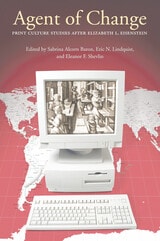
Agent of Change
Print Culture Studies after Elizabeth L. EisensteinSabrina Alcorn Baron
University of Massachusetts Press, 2007
Inspiring debate since the early days of its publication, Elizabeth L. Eisenstein's The Printing Press as an Agent of Change: Communications and Cultural Transformations in Early-Modern Europe (1979) has exercised its own force as an agent of change in the world of scholarship. Its path-breaking agenda has played a central role in shaping the study of print culture and “book history”—fields of inquiry that rank among the most exciting and vital areas of scholarly endeavor in recent years.
Joining together leading voices in the field of print scholarship, this collection of twenty essays affirms the catalytic properties of Eisenstein's study as a stimulus to further inquiry across geographic, temporal, and disciplinary boundaries. From early modern marginalia to the use of architectural title pages in Renaissance books, from the press in Spanish colonial America to print in the Islamic world, from the role of the printed word in nation-building to changing histories of reading in the electronic age, this book addresses the legacy of Eisenstein's work in print culture studies today as it suggests future directions for the field.
In addition to a conversation with Elizabeth L. Eisenstein, the book includes contributions by Peng Hwa Ang, Margaret Aston, Tony Ballantyne, Vivek Bhandari, Ann Blair, Barbara A. Brannon, Roger Chartier, Kai-wing Chow, James A. Dewar, Robert A. Gross, David Scott Kastan, Harold Love, Paula McDowell, Jane McRae, Jean-Dominique Mellot, Antonio Rodriguez-Buckingham, Geoffrey Roper, William H. Sherman, Peter Stallybrass, H. Arthur Williamson, and Calhoun Winton.
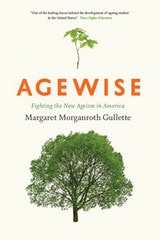
Agewise
Fighting the New Ageism in AmericaMargaret Morganroth Gullette
University of Chicago Press, 2011
Let’s face it: almost everyone fears growing older. We worry about losing our looks, our health, our jobs, our self-esteem—and being supplanted in work and love by younger people. It feels like the natural, inevitable consequence of the passing years, But what if it’s not? What if nearly everything that we think of as the “natural” process of aging is anything but?
In Agewise, renowned cultural critic Margaret Morganroth Gullette reveals that much of what we dread about aging is actually the result of ageism—which we can, and should, battle as strongly as we do racism, sexism, and other forms of bigotry. Drawing on provocative and under-reported evidence from biomedicine, literature, economics, and personal stories, Gullette probes the ageism thatdrives discontent with our bodies, our selves, and our accomplishments—and makes us easy prey for marketers who want to sell us an illusory vision of youthful perfection. Even worse, rampant ageism causes society to discount, and at times completely discard, the wisdom and experience acquired by people over the course of adulthood. The costs—both collective and personal—of this culture of decline are almost incalculable, diminishing our workforce, robbing younger people of hope for a decent later life, and eroding the satisfactions and sense of productivity that should animate our later years.
Once we open our eyes to the pervasiveness of ageism, however, we can begin to fight it—and Gullette lays out ambitious plans for the whole life course, from teaching children anti-ageism to fortifying the social safety nets, and thus finally making possible the real pleasures and opportunities promised by the new longevity. A bracing, controversial call to arms, Agewise will surprise, enlighten, and, perhaps most important, bring hope to readers of all ages.
Aggregate Analysis in Chipped Stone
Christopher T Hall
University of Utah Press, 2004
Less than two decades ago, archaeologists considered lithic debitage, the flakes and debris left from the manufacture of stone tools, little more than uninformative waste. Since then, fieldworkers have increasingly recognized that stone flakes can provide information both singly and in aggregate.
Many methods are now available for analyzing lithic debitage, yet no single method is entirely reliable as a vehicle to meaningful interpretation of past behavior. Part of the problem lies in the disparity between tightly controlled experimental conditions and the difficulty of sorting individual sequences out of the masses of stone found in many archaeological sites. Contributors to this volume seek to identify the strengths and weaknesses in the more widespread and competing analytical forms while arguing for the use of multiple lines of evidence. As the title indicates, their primary focus is on mass analysis of aggregates rather than individual flakes. Thus several chapters also address problems of subdividing aggregates to better deal with the “mixed assemblages” generated by multiple factors over time.
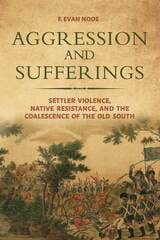
Aggression and Sufferings
Settler Violence, Native Resistance, and the Coalescence of the Old SouthF. Evan Nooe
University of Alabama Press, 2024
WINNER OF THE FRANCIS B. SIMKINS AWARD, SOUTHERN HISTORICAL ASSOCIATION
WINNER OF THE 2024 BEST FIRST BOOK AWARD FROM PHI ALPHA THETA, THE NATIONAL HISTORY HONOR SOCIETY
A bold reconceptualization of how settler expansion and narratives of victimhood, honor, and revenge drove the conquest and erasure of the Native South and fed the emergence of a distinct white southern identity.
In 1823, Tennessee historian John Haywood encapsulated a foundational sentiment among the white citizenry of Tennessee when he wrote of a “long continued course of aggression and sufferings” between whites and Native Americans. According to F. Evan Nooe, “aggression” and “sufferings” are broad categories that can be used to represent the framework of factors contributing to the coalescence of the white South.
Traditionally, the concept of coalescence is an anthropological model used to examine the transformation of Indigenous communities in the Eastern Woodlands from chieftaincies to Native tribes, confederacies, and nations in response to colonialism. Applying this concept to white southerners, Nooe argues that through the experiences and selective memory of settlers in the antebellum South, white southerners incorporated their aggression against and suffering at the hands of the Indigenous peoples of the Southeast in the coalescence of a regional identity built upon the violent dispossession of the Native South. This, in turn, formed a precursor to Confederate identity and its later iterations in the long nineteenth century.
Geographically, Aggression and Sufferings prioritizes events in South Carolina, Florida, Tennessee, Georgia, and Alabama. Nooe considers how divergent systems of violence and justice between Native Americans and white settlers (such as blood revenge and concepts of honor) functioned in the region and examines the involved societies’ conflicting standards on how to equitably resolve interpersonal violence. Finally, Nooe explores how white southerners constructed, propagated, and perpetuated harrowing tales of colonizers as both victims and heroes in the violent expulsion of the region’s Native peoples from their homelands. This constructed sense of regional history and identity continued to flower into the antebellum period, during western expansion, and well through the twentieth century.
Aging Issues in the United States and Japan
Edited by Seiritsu Ogura, Toshiaki Tachibanaki, and David A. Wise
University of Chicago Press, 2001
Given the undeniable global importance of the Japanese and U.S. economies, these innovative essays shed welcome new light on the complex correlations between aging and economic behavior. This insightful work not only deepens our understanding of the Japanese and American economic landscapes but, through careful examination of the comparative social and economic data, clarifies the complex relation between aging societies, public policies, and economic outcomes.
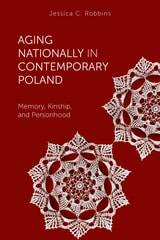
Aging Nationally in Contemporary Poland
Memory, Kinship, and PersonhoodJessica C. Robbins
Rutgers University Press, 2021
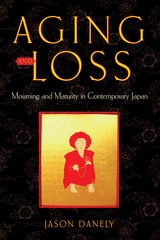
Aging and Loss
Mourning and Maturity in Contemporary JapanDanely, Jason
Rutgers University Press, 2015
Based on nearly a decade of research, Aging and Loss examines how the landscape of aging is felt, understood, and embodied by older adults themselves. In detailed portraits, anthropologist Jason Danely delves into the everyday lives of older Japanese adults as they construct narratives through acts of reminiscence, social engagement and ritual practice, and reveals the pervasive cultural aesthetic of loss and of being a burden.
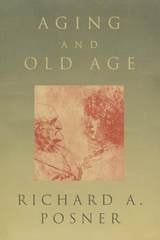
Aging and Old Age
Richard A. Posner
University of Chicago Press, 1995
Aging and Old Age offers fresh insight into a wide range of social and political issues relating to the elderly, such as health care, crime, social security, and discrimination. From the dread of death to the inordinate law-abidingness of the old, from their loquacity to their penny-pinching, Posner paints a surprisingly rich, revealing, and unsentimental portrait of the millions of elderly people in the United States. He explores issues such as age discrimination in employment, creativity and leadership as functions of age, and the changing social status of the elderly. Why are old people, presumably with less to lose, more unwilling to take risks than young people? Why don't the elderly in the United States command the respect and affection they once did and still do in other countries? How does aging affect driving and criminal records? And how does aging relate to creativity across different careers?
Aging and Society
A Sociology of Age StratificationMatilda White Riley
Russell Sage Foundation, 1972
Aging and Society
Aging and the ProfessionsMatilda White Riley
Russell Sage Foundation, 1969
Aging and Society
An Inventory of Research FindingsMatilda White Riley
Russell Sage Foundation, 1968
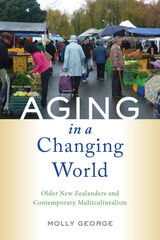
Aging in a Changing World
Older New Zealanders and Contemporary MulticulturalismMolly George
Rutgers University Press, 2022
Aging in the Church
How Social Relationships Affect HealthNeal M. Krause
Templeton Press, 2008
A growing number of studies indicate that older people in the church form social ties that have a significant positive impact on their physical and mental health. In Aging in the Church, Neal Krause comprehensively assesses the various relationships that stem from church involvement.
Among the many types of relationships Krause explores are close companion friendships, social-support structures (such as assistance provided by fellow church members during difficult times), and interactions that arise from Bible study and prayer groups. Through his thorough investigation of the underlying links between these relationships and the ways they relate to attributes like forgiveness, hope, gratitude, and altruism, the author hopes to explain why older adults who are involved in religious activities tend to enjoy better physical and mental health than those who are not engaged in religious communities. Going beyond merely reviewing the existing research on this subject, Aging in the Church provides a blueprint for taking research on church-based social relationships and health to the next level by identifying conceptual and methodological issues that investigators will confront as they delve more deeply into these connections.
Though these are complex issues, readers will find plain language and literature drawn from a wide array of disciplines, including sociology, psychology, public health, medicine, psychiatry, nursing, social work, gerontology, and theology. Literature, poetry, philosophy, and ethical ideas supplement the insights from these diverse fields. As a result, Aging in the Church takes on a genuinely interdisciplinary focus that will appeal to various scholars, researchers, and students.
Aging in the United States and Japan
Economic TrendsEdited by Yukio Noguchi and David A. Wise
University of Chicago Press, 1994
With essays on labor force participation and retirement, housing equity and the economic status of the elderly, budget implications of an aging population, and financing social security and health care in the 1990s, this volume covers a broad spectrum of issues related to the economics of aging. Among the book's findings are that workers are retiring at an increasingly earlier age in both countries and that, as the populations age, baby boomers in the United States will face diminishing financial resources as the ratio of retirees to workers sharply increases.
The result of a joint venture between the National Bureau of Economic Research and the Japan Center for Economic Research, this book complements Housing Markets in the United States and Japan (1994) by integrating research on housing markets with economic issues of the aged in the United States and Japan.
Agitated States
Performance in the American Theater of CrueltyAnthony Kubiak
University of Michigan Press, 2002
Beginning with the writings of John Winthrop and others, through the Federalist and "romantic" stages of American cultural life, and into the modern and contemporary periods, Anthony Kubiak finds an America not usually discovered by traditional or materialist approaches to history. He deploys the psychoanalytic theory of Jacques Lacan, the cultural theory of SlavojZizek, and the performance theory of Herbert Blau in an unparalleled reappraisal of dominant American identity, culture, and history.
Anthony Kubiak is Associate Professor of English, University of South Florida. He is also author of Stages of Terror: Terrorism, Ideology, and Coercion as Theatre History.
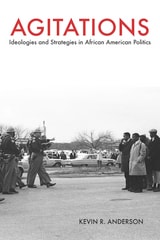
Agitations
Ideologies and Strategies in African American PoliticsKevin R. Anderson
University of Arkansas Press, 2010
Though the activities of the National Association for the Advancement of Colored People (NAACP), the Southern Christian Leadership Conference (SCLC), and the Student Nonviolent Coordinating Committee (SNCC) were unified in their common idea of resistance to oppression, these groups fought their battles on multiple fronts. The NAACP filed lawsuits and aggressively lobbied Congress and state legislatures, while Martin Luther King Jr. and SCLC challenged the racial status quo through nonviolent mass action, and the SNCC focused on community empowerment activities. In Agitations, Kevin Anderson studies these various activities in order to trace the ideological foundations of these groups and to understand how diversity among African Americans created multiple political strategies.
Agitations goes beyond the traditionally acknowledged divide between integrationist and accommodationist wings of African American politics to explore the diverse fundamental ideologies and strategic outcomes among African American activists that still define, influence, and complicate political life today.

Agnes Varda
Kelley Conway
University of Illinois Press, 2015
Agony for Others
On Literature and PainJessica Colangelo
University of Michigan Press, 2026
Agony for Others investigates the phenomenological, rhetorical, and political challenges of representing pain in literature. Pain cries vary between cultural and linguistic groups, and pain expression (such as grimacing or crying) can likewise vary in quality and intensity from person to person, affected by disability, temperament, and past experiences with pain, as well as the experiencer’s own understanding of what that pain is and what it means. Jessica Colangelo explores pain's role as a subjective indication of objective damage; that, contrary to claims of its subjective privacy, the feeling of pain is always felt in terms of an objectively existing entity (one’s physical body) which is perceivable by others. Thus, pain enters into intersubjectivity through the physical body—one's expressions, words, actions, presence—which then mediates between the self and the other.
Drawing on disability studies, phenomenology, philosophy, and literary studies, Colangelo examines works by Virginia Woolf, James Baldwin, Sarah Kane, Elie Wiesel, and Margaret Edson to argue that the belief that pain is incommunicable and thought-destroying obscures its central role in relationships and community formation. Agony for Others demonstrates that pain is not excluded from, but rather constitutive of, intersubjectivity, and argues that the aesthetic dimension of interpretation is essential to understanding the ethical and political role of pain.