Results by title
18284 books match the query 'United States' and 1653 start with a
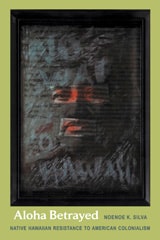
Aloha Betrayed
Native Hawaiian Resistance to American ColonialismNoenoe K. Silva
Duke University Press, 2004
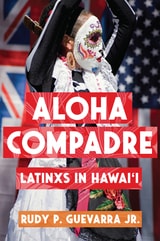
Aloha Compadre
Latinxs in Hawai'iRudy P. Guevarra
Rutgers University Press, 2023
Aloha Compadre: Latinxs in Hawaiʻi is the first book to examine the collective history and contemporary experiences of the Latinx population of Hawaiʻi. This study reveals that contrary to popular discourse, Latinx migration to Hawaiʻi is not a recent event. In the national memory of the United States, for example, the Latinx population of Hawaiʻi is often portrayed as recent arrivals and not as long-term historical communities with a presence that precedes the formation of statehood itself. Historically speaking, Latinxs have been voyaging to the Hawaiian Islands for over one hundred and ninety years. From the early 1830s to the present, they continue to help shape Hawaiʻi’s history, yet their contributions are often overlooked. Latinxs have been a part of the cultural landscape of Hawaiʻi prior to annexation, territorial status, and statehood in 1959. Aloha Compadre also explores the expanding boundaries of Latinx migration beyond the western hemisphere and into Oceania.
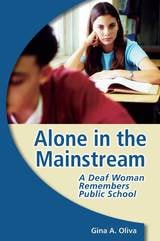
Alone in the Mainstream
A Deaf Woman Remembers Public SchoolGina A. Oliva
Gallaudet University Press, 2004
When Gina Oliva first went to school in 1955, she didn’t know that she was “different.” If the kindergarten teacher played a tune on the piano to signal the next exercise, Oliva didn’t react because she couldn’t hear the music. So began her journey as a “solitary,” her term for being the only deaf child in the entire school. Gina felt alone because she couldn’t communicate easily with her classmates, but also because none of them had a hearing loss like hers. It wasn’t until years later at Gallaudet University that she discovered that she wasn’t alone and that her experience was common among mainstreamed deaf students. Alone in the Mainstream recounts Oliva’s story, as well as those of many other solitaries.
In writing this important book, Oliva combined her personal experiences with responses from the Solitary Mainstream Project, a survey that she conducted of deaf and hard of hearing adults who attended public school. Oliva matched her findings with current research on deaf students in public schools and confirmed that hearing teachers are ill-prepared to teach deaf pupils, they don’t know much about hearing loss, and they frequently underestimate deaf children. The collected memories in Alone in the Mainstream add emotional weight to the conviction that students need to be able to communicate freely, and they also need peers to know they are not alone.
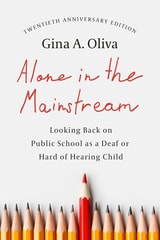
Alone in the Mainstream
Looking Back on Public School as a Deaf or Hard of Hearing ChildGina A. Oliva
Gallaudet University Press, 2024
In Alone in the Mainstream, author Gina A. Oliva documents her experience as a “solitaire,” the only deaf or hard of hearing student in her school. Oliva felt alone because she couldn’t communicate easily with her classmates and because she had no peers who shared a similar experience. As an adult, when she began her career at Gallaudet University, she realized that she wasn’t alone and that her experience was widely shared with other mainstreamed students. She decided to write about this commonality and invited other solitaires to reflect on their own experiences in emails and essays. Collective themes of isolation, low expectations, and low self-esteem emerged. Alone in the Mainstream blends Oliva’s personal narrative with the reflections of sixty other solitaires and makes the case that deaf and hard of hearing children need each other.
This twentieth anniversary edition is a reminder that little has changed for deaf and hard of hearing students in public school settings. Oliva brings this new edition up to date with observations, resources, and discussion questions that accompany her appeal for all deaf and hard of hearing children and their families to have access to sign language, to develop a deaf identity, and to be part of a deaf community.
Alone in the Stacks
Christina Zamon
Society of American Archivists, 2024
Alone on the Colorado
Harold H. Leich
University of Utah Press, 2019
Alone on the Colorado takes readers on the adventure of running rivers and riding the rails, while painting a unique and optimistic portrait of Depression-era America.
Along Lake Michigan
Shipwreck Stories of Life and LossMichael Schumacher
University of Minnesota Press, 2025
Notable shipwrecks of Lake Michigan throughout a century of enterprise, industry, heroism, and disaster on the Great Lakes
The Great Lakes are graveyards of a vast number of shipwrecks (30,000 by some estimates), and Lake Michigan has more than the other four lakes combined. The stories of those wrecks tell the history of that mighty lake in its endless, mercurial challenge to human endeavor.
Surveying the wreckage throughout the decades, from the fiery end of the twin propeller–driven Phoenix in 1847 to the failure of the Anna Minch to outrun the infamous 1940 Armistice Day storm, Michael Schumacher charts the course of shipping disasters great and small on Lake Michigan. He illuminates the details of maritime weather and shipcraft, the lives devoted to and lost on the water, and the mistakes and monumental failures that led to these ships’ watery ends.
Schumacher’s deft storytelling, drawing from deep research and comprehensive knowledge, brings forth the vivid details of the last minutes of these doomed ships, along with the circumstances surrounding their voyages. Here are tragic tales like that of the Eastland, the deadliest shipwreck in Great Lakes history, lost while docked in the Chicago River; the Rouse Simmons, a wooden schooner loaded with Christmas trees; the train ferry Milwaukee and the Wisconsin, a package freighter, gone within one week of each other in October 1929; and the passenger vessel the Lady Elgin, a devastating loss met with incredible heroism.
Liberally illustrated with historical photographs, the stories of these shipwrecks, spanning a full century of commercial traffic on Lake Michigan, document the myriad forms of bravery and misfortune that mark our encounters with the Great Lakes.
Along Navajo Trails
Recollections of a Trader 1898-1948Will Evans edited by Susan E. Woods and Robert McPherson
Utah State University Press, 2005
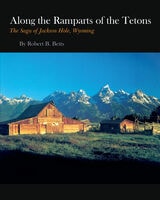
Along the Ramparts of the Tetons
The Saga of Jackson Hole, WyomingRobert B. Betts
University Press of Colorado, 1991
In these pages, the reader will witness the dramatic creation of the Tetons; the arrival of the first humans, bands of fur-clad Early Hunters who ventured into the valley some 10,000 years ago; the coming and going of the later Indian tribes; and the nearly incredible journey of John Colter, who back in 1807 is said to have been the first white man to have found his way through the wilderness and into Jackson Hole.
Here, too, the reader will meet the boisterous mountain men, trappers such as Jim Bridger and the former slave, Jim Beckwourth, who roamed the Rockies when St. Louis was still a frontier village; a little Mormon boy who ran away from home and lived with the Indians before becoming a Pony Express rider; a most unusual Englishman who describes a terrible tragedy that befell his Indian wife and half-breed children; a glory-seeking lieutenant who led six cavalrymen on a foolhardy expedition that almost cost them their lives; and a nineteenth-century president of the United States who took a pack trip through Jackson Hole, allegedly leaving a trail of empty bottles behind.
And there is more, much more--the story of the pioneers, those hardy few who dared to settle in this high and inhospitable land; the story of outlaws, a shoot-out, vigilance committees and an Indian "massacre" that embarrassed the New York Times; the story of the deliverance of the world's largest elk herd from the many perils that threatened it with extinction; and, finally, the story of the long and angry controversy over the preservation of the Tetons and Jackson Hole as a national park, a struggle called "one of the most remarkable conservation fights of the twentieth century."
All these and still other episodes in the long and colorful cavalcade of Jackson Hole are woven together to form a work of Western Americana rich in anecdotes and portraits of delightfully eccentric characters.
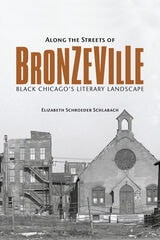
Along the Streets of Bronzeville
Black Chicago's Literary LandscapeElizabeth Schroeder Schlabach
University of Illinois Press, 2017
In this significant recovery project, Elizabeth Schroeder Schlabach investigates the institutions and streetscapes of Black Chicago that fueled an entire literary and artistic movement. She argues that African American authors and artists--such as Gwendolyn Brooks, Richard Wright, Langston Hughes, painter Archibald Motley, and many others--viewed and presented black reality from a specific geographic vantage point: the view along the streets of Bronzeville. Schlabach explores how the particular rhythms and scenes of daily life in Bronzeville locations, such as the State Street "Stroll" district or the bustling intersection of 47th Street and South Parkway, figured into the creative works and experiences of the artists and writers of the Black Chicago Renaissance. She also covers in detail the South Side Community Art Center and the South Side Writers' Group, two institutions of art and literature that engendered a unique aesthetic consciousness and political ideology for which the Black Chicago Renaissance would garner much fame.
Life in Bronzeville also involved economic hardship and social injustice, themes that resonated throughout the flourishing arts scene. Schlabach explores Bronzeville's harsh living conditions, exemplified in the cramped one-bedroom kitchenette apartments that housed many of the migrants drawn to the city's promises of opportunity and freedom. Many struggled with the precariousness of urban life, and Schlabach shows how the once vibrant neighborhood eventually succumbed to the pressures of segregation and economic disparity. Providing a virtual tour South Side African American urban life at street level, Along the Streets of Bronzeville charts the complex interplay and intersection of race, geography, and cultural criticism during the Black Chicago Renaissance's rise and fall.
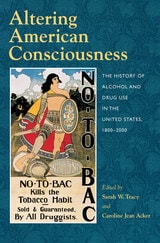
Altering American Consciousness
The History of Alcohol and Drug Use in the United States, 1800-2000Sarah W. Tracy
University of Massachusetts Press, 2004
Virtually every American alive has at some point consumed at least one, and very likely more, consciousness altering drug. Even those who actively eschew alcohol, tobacco, and coffee cannot easily avoid the full range of psychoactive substances pervading the culture. With many children now taking Ritalin for Attention Deficit Hyperactivity Disorder, professional athletes relying on androstenidione to bulk up, and the chronically depressed resorting to selective serotonin reuptake inhibitors such as Prozac, the early twenty-first century appears no less rife with drugs than previous periods.
Yet, if the use of drugs is a constant in American history, the way they have been perceived has varied extensively. Just as the corrupting cigarettes of the early twentieth century ("coffin nails" to contemporaries) became the glamorous accessory of Hollywood stars and American GIs in the 1940s, only to fall into public disfavor later as an unhealthy and irresponsible habit, the social significance of every drug changes over time.
The essays in this volume explore these changes, showing how the identity of any psychoactive substance—from alcohol and nicotine to cocaine and heroin—owes as much to its users, their patterns of use, and the cultural context in which the drug is taken, as it owes to the drug's documented physiological effects. Rather than seeing licit drugs and illicit drugs, recreational drugs and medicinal drugs, “hard” drugs and “soft” drugs as mutually exclusive categories, the book challenges readers to consider the ways in which drugs have shifted historically from one category to another.
In addition to the editors, contributors include Jim Baumohl, Allan M. Brandt, Katherine Chavigny, Timothy Hickman, Peter Mancall, Michelle McClellan, Steven J. Novak, Ron Roizen, Lori Rotskoff, Susan L. Speaker, Nicholas Weiss, and William White.
Alternative Alcott
Showalter, Elaine
Rutgers University Press, 1988
Alternative Alcott includes works never before reprinted, including "How I Went Out to Service," "My Contraband," and "Psyche's Art." It also contains Behind a Mask, her most important sensation story; the full and correct text of her last unfinished novel, Diana and Persis; "Transcendental Wild Oats"; Hospital Sketches; and Alcott's other important texts on nineteenth-century social history. This anthology brings together for the first time a variety of Louisa May Alcott's journalistic, satiric, feminist, and sensation texts. Elaine Showalter has provided an excellent introduction and notes to the collection.

Alternative Dispute Resolution in the Regulatory Process
Deirdre McCarthy Gallagher
Michigan State University Press, 2020

Alternative Health Care
Michael S. Goldstein
Temple University Press, 1999
Michael S. Goldstein's Alternative Health Care is the first comprehensive account of the growing presence of alternative medicine in American society. Beginning with the basic premises of alternative medicine, Goldstein's book examines the clinical, economic, and political realities of the broad range of alternative care options and practices in the United States and explains why alternative medicine has become a viable choice for so many people who are ill or who seek to remain healthy.
Bringing history, policy, practice, personal experience, and in-depth sociological analysis together into one comprehensive volume, Goldstein -- one of the first recipients of funding from the National Institute of Health for research on alternative medicine -- also studies the complexities of the relationship between spirituality and alternative medicine and the changing role of alternative medicine in the larger context of American health care. Probing such issues as the corporatization of medicine, the role of alternative medicine in health care, and the dynamic relationship between conventional and alternative treatments, Goldstein's Alternative Health Care is more than the long-awaited introduction to the many forms of alternative medicine. It is also the measure of the implications of such care for practitioners, businesses, policymakers, and patients alike.
Alternative Health Care is the definitive guide for the millions of Americans interested in alternative medicine and treatment, American health care, the sociology of medicine, and American social issues.

Alternative Models of Sports Development in America
Solutions to a Crisis in Education and Public HealthB. David Ridpath
Ohio University Press, 2017
In the United States, the entanglement of sports and education has persisted for over a century. Multimillion-dollar high school football stadiums, college coaches whose salaries are many times those of their institutions’ presidents, psychological and educational tolls on student-athletes, and high-profile academic scandals are just symptoms of a system that has come under increasing fire. Institutions large and small face persistent quandaries: which do they value more, academic integrity or athletic success? Which takes precedence: prioritizing elite teams and athletes, or making it possible for all students to participate in sports? How do we create opportunities for academic—not just athletic—development for players?
In Alternative Models of Sports Development in America, B. David Ridpath—a leading sports development researcher who has studied both the US system and the European club model—offers clear steps toward creating a new status quo. He lays out four possible alternative models that draw various elements from academic, athletic, and European approaches. His proposals will help increase access of all young people to the benefits of sports and exercise, allow athletes to also thrive as students, and improve competitiveness. The result is a book that will resonate with sports development professionals, academic administrators, and parents.
Alternatives to Assimilation
The Response of Reform Judaism to American Culture, 1840–1930Alan Silverstein
Brandeis University Press, 1995

Alutiiq Villages under Russian and U.S. Rule
Sonja Luehrmann
University of Alaska Press, 2009
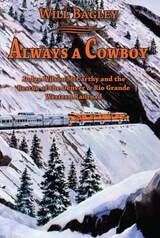
Always a Cowboy
Judge Wilson McCarthy and the Rescue of the Denver & Rio Grande Western RailroadWill Bagley
Utah State University Press, 2008
Cowboy, judge, federal official, then business executive, Wilson McCarthy mirrored change and growth in the twentieth-century West. Leading the Denver & Rio Grande back from the brink saved a vital link in the national transportation system. The D&RGW ran over and through the scenic Rockies, developing mineral resources, fighting corporate wars, and helping build communities. The Depression brought it to its knees. Accepting federal assignment to save the line, McCarthy turned it into a paragon of mid-century railroading, represented by the streamlined, Vista-Domed California Zephyr, although success hauling freight was of more economic importance. Prior to that, McCarthy’s life had taken him from driving livestock in Canada to trying to drive the national economy as a director of the Reconstruction Finance Corporation, the first line of federal attack on the Depression. Always a Cowboy positions McCarthy’s story in a rich historical panorama..
Will Bagley is the author of Blood of the Prophets: Brigham Young and the Massacre at Mountain Meadows
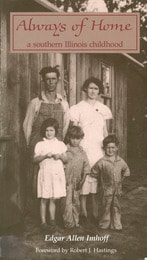
Always of Home
A Southern Illinois ChildhoodEdgar Allen Imhoff. Foreword by Robert J. Hastings
Southern Illinois University Press, 1992
Edgar Allen Imhoff renders a series of touching, colorful vignettes about growing up in southern Illinois during the Great Depression. He writes poignantly of his family and their struggles (including his father’s exhausting but successful effort at self-education) as he revisits his early childhood years in the country and his eventual move to the town of Murphysboro, where he encountered school bullies, outstanding teachers, first love, World War II, and adolescence.
Imhoff contrasts these memories of his youth with events, incidents, and thoughts from his more recent past. While writing a government check with six figures to the left of the decimal, he remembers how his mother once scrounged together thirty cents so Imhoff and his brother and sister could go to the circus with their classmates. Listening to President Carter give a speech in the Rose Garden reminds him of the contrasting elocutionary style of the Reverend William Boatman, the pastor at his country church, which was built by Imhoff’s great-great-grandfather and others.
Through such contrasts, Imhoff not only paints a loving picture of his past, he also comments on the alienation and emptiness that mark many lives in the United States, especially those of modern nomads. Imhoff has himself become a nomad, living far from the land of his birth, enjoying a successful and rewarding career. Yet he is drawn repeatedly to his past, his family, his childhood home, and the intricate combination of events, attitudes, values, and loyalties that influenced and molded him.
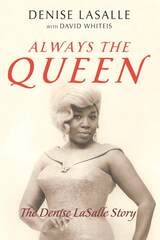
Always the Queen
The Denise LaSalle StoryDenise LaSalle, with David Whiteis
University of Illinois Press, 2020
As honest and no-nonsense as the artist herself, Always the Queen is LaSalle's in-her-own-words story of a lifetime in music. Moving to Chicago as a teen, LaSalle launched a career in gospel and blues that eventually led to the chart-topping 1971 smash ”Trapped by a Thing Called Love” and a string of R&B hits. She reinvented herself as a soul-blues artist as tastes changed and became a headliner on the revitalized southern soul circuit and at festivals nationwide and overseas. Revered for a tireless dedication to her music and fans, LaSalle continued to tour and record until shortly before her death.
Amalgamation Schemes
Antiblackness and the Critique of MultiracialismJared Sexton
University of Minnesota Press, 2008
Despite being heralded as the answer to racial conflict in the post–civil rights United States, the principal political effect of multiracialism is neither a challenge to the ideology of white supremacy nor a defiance of sexual racism. More accurately, Jared Sexton argues in Amalgamation Schemes, multiculturalism displaces both by evoking long-standing tenets of antiblackness and prescriptions for normative sexuality.
In this timely and penetrating analysis, Sexton pursues a critique of contemporary multiracialism, from the splintered political initiatives of the multiracial movement to the academic field of multiracial studies, to the melodramatic media declarations about “the browning of America.” He contests the rationales of colorblindness and multiracial exceptionalism and the promotion of a repackaged family values platform in order to demonstrate that the true target of multiracialism is the singularity of blackness as a social identity, a political organizing principle, and an object of desire. From this vantage, Sexton interrogates the trivialization of sexual violence under chattel slavery and the convoluted relationship between racial and sexual politics in the new multiracial consciousness.
An original and challenging intervention, Amalgamation Schemes posits that multiracialism stems from the conservative and reactionary forces determined to undo the gains of the modern civil rights movement and dismantle radical black and feminist politics.
Jared Sexton is assistant professor of African American studies and film and media studies at the University of California, Irvine.
Amasa Mason Lyman, Mormon Apostle and Apostate
A Study in DedicationEdward Leo Lyman
University of Utah Press, 2009
Having spent more than thirty years in the service of his church, Lyman began to move away from its teachings after a series of conflicts with its second leader, Brigham Young. Lyman was one of the first Mormons to criticize the Mountain Meadows Massacre, which led to his dismissal as an apostle. He was excommunicated in 1870 and became one of the foremost spokesmen of the Godbeite Church of Zion movement before his death in 1877. Author Edward Leo Lyman chronicles Amasa Lyman’s life and interactions with Mormon history with an honesty true to his ancestor’s freethinking spirit.
Winner of the Francis Armstrong Madsen Best Utah History Book Award from the Utah Division of State History.
Ambassadors at Sea
The High and Low Adventures of a DiplomatBy Henry E. Catto, Jr.
University of Texas Press, 1998
In 1969, Henry Catto was selling insurance in San Antonio, Texas. Just twenty years later, he presented his credentials as ambassador to the Court of St. James's to Her Majesty, Queen Elizabeth II, at Buckingham Palace. In this engaging memoir, he retraces his journey from Texas outsider to Washington insider, providing a fascinating look at the glamour, day-to-day work, and even occasional danger that come with being a high-level representative of the United States government.
Catto's posts brought him into contact with the world's most powerful leaders and left him with a wealth of stories, which he recounts amusingly in these pages. He was the official host for Queen Elizabeth's visit to America during the Bicentennial year—and one of José Napoleon Duarte's protectors after his failed 1972 coup attempt in El Salvador. Catto accompanied Richard Nixon on his historic trip to Russia, sparred with Bill Moyers and the producers of "60 Minutes" as Caspar Weinberger's spokesman at the Pentagon, and hosted George Bush's planning meeting with Margaret Thatcher at the beginning of the Persian Gulf War. In telling these and other stories, he offers behind-the-scenes glimpses into how political power really works in Washington, London, and other world capitals.
Ambiguous Borderlands
Shadow Imagery in Cold War American CultureErik Mortenson
Southern Illinois University Press, 2016
After contextualizing the postwar use of shadow imagery in the wake of the atomic bomb, Ambiguous Borderlands looks at shadows in print works, detailing the reemergence of the pulp fiction crime fighter the Shadow in the late-1950s writings of Sylvia Plath, Amiri Baraka, and Jack Kerouac. Using Freudian and Jungian conceptions of the unconscious, Mortenson then discusses Kerouac’s and Allen Ginsberg’s shared dream of a “shrouded stranger” and how it shaped their Beat aesthetic. Turning to the visual, Mortenson examines the dehumanizing effect of shadow imagery in the Cold War photography of Robert Frank, William Klein, and Ralph Eugene Meatyard. Mortenson concludes with an investigation of the use of chiaroscuro in 1950s film noir and the popular television series The Twilight Zone, further detailing how the complexities of Cold War society were mirrored across these media in the ubiquitous imagery of light and dark.
From comics to movies, Beats to bombs, Ambiguous Borderlands provides a novel understanding of the Cold War cultural context through its analysis of the image of the shadow in midcentury media. Its interdisciplinary approach, ambitious subject matter, and diverse theoretical framing make it essential reading for anyone interested in American literary and popular culture during the fifties and sixties.
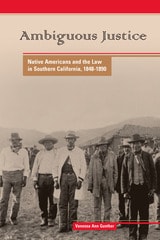
Ambiguous Justice
Native Americans and the Law in Southern California, 1848-1890Vanessa Ann Gunther
Michigan State University Press, 2006
In 1769, Spain took action to solidify control over its northern New World territories by establishing a series of missions and presidios in what is now modern California. To populate these remote establishments, the Spanish crown relied on Franciscan priests, whose role it was to convince the Native Californian population to abandon their traditional religious practices and adopt Catholicism. During their tutelage, the Indians of California would be indoctrinated into Spanish society, where they would learn obedience to the church and crown.
The legal system of Southern California has been used by Anglo populations as a social and demographic tool to control Native Americans. Following the Mexican-American War and the 1849 Gold Rush, as California property values increased and transportation corridors were established, Native Americans remained a sharply declining presence in many communities, and were likely to be charged with crimes. The sentences they received were lighter than those given to Anglo offenders, indicating that the legal system was used as a means of harassment. Additionally, courts chronicled the decline of the once flourishing native populations with each case of drunkenness, assault, or rape that appeared before the bench. Nineteenth-century American society had little sympathy for the plight of Indians or for the destruction of their culture. Many believed that the Indians of Southern California would fade from history because of their inability to adapt to a changing world. While many aspects of their traditional culture have been irreparably lost, the people of southern California are, nevertheless, attempting to recreate the cultures that were challenged by the influx of Europeans and later Americans to their lands.
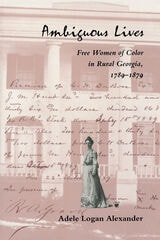
Ambiguous Lives
Free Women of Color in Rural Georgia, 1789–1879Adele Logan Alexander
University of Arkansas Press, 1992
1992 Myers Center Outstanding Book on Human Rights
Historians have produced scores of studies on white men, extraordinary white women, and even the often anonymous mass of enslaved Black people in the United States. But in this innovative work, Adele Logan Alexander chronicles there heretofore undocumented dilemmas of one of nineteenth-century America’s most marginalized groups—free women of color in the rural South.
Ambiguous Lives focuses on the women of Alexander’s own family as representative of this subcaste of the African-American community. Their forbears, in fact, included Africans, Native Americans, and whites. Neither black nor white, affluent nor impoverished, enslaved nor truly free, these women of color lived and died in a shadowy realm situated somewhere between the legal, social, and economic extremes of empowered whites and subjugated blacks. Yet, as Alexander persuasively argues, these lives are worthy of attention precisely because of these ambiguities—because the intricacies, gradations, and subtleties of their anomalous experience became part of the tangled skein of American history and exemplify our country’s endless diversity, complexity, and self-contradictions.
Written as a “reclamation” of a long-ignored substratum of our society, Ambiguous Lives is more than the story of one family—it is a well-researched and fascinating profile of America, its race and gender relations, and its complex cultural weave.

Ambition and Accommodation
How Women View Gender RelationsRoberta S. Sigel
University of Chicago Press, 1996
By juxtaposing the voices of women and men from all walks of life, Sigel finds that women's perceptions of gender relations are complex and often contradictory. Although most women see gender discrimination pervading nearly all social interactions—private as well as public—they do not invariably feel that they personally have been its victims. They want to see discrimination ended, but believe that men do not necessarily share this goal. Women are torn, according to Sigel, between the desire to improve their positions relative to men and the desire to avoid open conflict with them. Their desire not to jeopardize their relations with men, Sigel holds, helps explain women's willingness to accommodate a less-than-egalitarian situation by, for example, taking on the second shift at home or by working harder than men on the job. Sigel concludes that, although men and women agree on the principle of gender equality, definitions as well as practice differ by gender.
This complex picture of how women, while not always content with the status quo, have chosen to accommodate to the world they must face every day is certain to provoke considerable debate.
Ambition, Competition, and Electoral Reform
The Politics of Congressional Elections Across TimeJamie L. Carson and Jason M. Roberts
University of Michigan Press, 2013
In Ambition, Competition, and Electoral Reform, Jamie L. Carson and Jason M. Roberts present an original study of U.S. congressional elections and electoral institutions for 1872-1944 from a contemporary political science perspective. Using data on late nineteenth and early twentieth century congressional elections, the authors test the applicability in a historical context of modern political science theories, assess the effects of institutional reforms, and identify the factors that shape the competitiveness of elections. They present several key findings: the strategic politicians theory is applicable in an era without candidate-centered campaigns; there was an incumbency advantage prior to the full development of candidate-centered campaigns; institutional reforms have had a significant effect on elections; and the degree of electoral competition frequently correlates with elected officials' responsiveness to citizens.
Ambivalent Childhoods
Speculative Futures and the Psychic Life of the ChildJacob Breslow
University of Minnesota Press, 2021
Explores childhood in relation to blackness, transfeminism, queerness, and deportability to interrogate what “the child” makes possible
The concept of childhood contains many contested and ambivalent meanings that have extraordinary implications, particularly for those staking their claim for belonging and justice on the wish for inclusion within it. In Ambivalent Childhoods, Jacob Breslow examines contemporary U.S. social justice movements (including Black Lives Matter, transfeminism, queer youth activism, and antideportation movements) to discover and reveal how childhood operates within and against them.
Ambivalent Childhoods brings together critical race, trans, feminist, queer, critical migration, and psychoanalytic theories to explore the role of childhood in shaping and challenging the disposability of young black life, the steadfastness of the gender binary, the queer life of children’s desires, and the precarious status of migrants. Through an engagement with“the psychic life of the child” that combines theoretical discussions of childhood, blackness, transfeminism, and deportability with critical readings of films, narrative, images, and social justice movements, Breslow demonstrates how childhood requires sustained attention as a complex and ambivalent site for contesting the workings of power, not only for the young.
Ambivalent Childhoods is a forward-thinking and intersectional analysis of how childhood affects activism, national belonging, and the violence directed against queer, trans, and racialized people.
Ambivalent Journey
U.S. Migration and Economic Mobility in North-Central MexicoRichard C. Jones
University of Arizona Press, 1995
Jones's study focuses on the ways in which U.S. migration affects the lives of families in these two subregions. Migrants from Zacatecas have traditionally come from rural areas and have gone to California and Illinois. Migrants from Coahuila, on the other hand, usually come from urban areas and have almost exclusively preferred locations in nearby Texas. The different motivations of both groups for migrating, and the different economic and social effects upon their home areas realized by migrating, form the core of this book. The comparison also lends the book its uniqueness, since no other study has made such an in-depth comparison of two areas.
Jones addresses the basic dichotomy of structuralists (who maintain that dependency and disinvestment are the rule for families and communities in sending areas) and functionalists (who believe that autonomy and reinvestment are the case of migrants and their families in home regions). Jones finds that much of the primary literature is based on uneven and largely outdated data that leans heavily on two sending states, Jalisco and Michoacan. His fresh analysis shows that communities and regions of Mexico, rather than families only, account for differing migration patterns and differing social and economic results of these patterns.
Jones's study will be of value not only to scholars and practitioners working in the field of Mexican migration, but also, for its innovative methodology, to anthropologists, sociologists, political scientists, and historians whose interests include human migration patterns in any part of the world
Amelia Gayle Gorgas
A BiographyMary Tabb Johnston
University of Alabama Press, 1978
The definitive biography Amelia Gayle Gorgas, one of the most influential people in the history of the University of Alabama
Amelia Gayle Gorgas: A Biography is a richly documented and deeply compelling portrait of one of Alabama’s most influential nineteenth‑century women. Drawing on the unparalleled depth of the Gayle‑Gorgas Collection—letters, journals, family papers, and contemporary accounts—this biography argues that Amelia’s life offers enduring insight into the resilience, intellect, and quiet leadership that shaped Southern society before, during, and after the Civil War.
Far more than the daughter of a governor, wife of Confederate ordnance chief Josiah Gorgas, or mother of famed physician William Crawford Gorgas, Amelia emerges here as a figure of remarkable adaptability and personal strength. The book traces her journey from a lively Greensboro childhood through the upheavals of war‑torn Richmond, the hardships of Reconstruction‑era Alabama, and her transformative service as librarian at The University of Alabama. Its chapters illuminate the themes that define her legacy: intellectual curiosity without formal schooling, deft management of family and community crises, a gift for nurturing students and soldiers alike, and an ability to thrive in environments as varied as Maine, Charleston, Sewanee, and Tuscaloosa.
Vivid storytelling blends seamlessly with meticulous scholarship, giving readers both an intimate family narrative and a sweeping social history of the nineteenth‑century South. This biography will appeal especially to readers of Southern history, women’s history, university and library heritage, Civil War studies, and anyone drawn to strong, quietly trailblazing figures whose lives illuminate broader cultural change. Amelia’s story endures because it speaks to the universal work of holding families, institutions, and communities together in times of profound upheaval.
America Beyond Black and White
How Immigrants and Fusions Are Helping Us Overcome the Racial DivideRonald Fernandez
University of Michigan Press, 2007
“This book is both powerful and important. Powerful for the testimony it provides from Americans of many different (and even mixed races) about their experiences. And important because there is a racial revolution underway that will upend race as we know it during the twenty-first century.”
—John Kenneth White, Catholic University of America
America Beyond Black and White is a call for a new way of imagining race in America. For the first time in U.S. history, the black-white dichotomy that has historically defined race and ethnicity is being challenged, not by a small minority, but by the fastest-growing and arguably most vocal segment of the increasingly diverse American population—Mexicans, Chinese, Japanese, Koreans, Indians, Arabs, and many more—who are breaking down and recreating the very definitions of race.
Drawing on interviews with hundreds of Americans who don’t fit conventional black/white categories, the author invites us to empathize with these “doubles” and to understand why they may represent our best chance to throw off the strictures of the black/white dichotomy.
The revolution is already underway, as newcomers and mixed-race “fusions” refuse to engage in the prevailing Anglo- Protestant culture. Americans face two choices: understand why these individuals think as they do, or face a future that continues to define us by what divides us rather than by what unites us.
America Lost and Found
An English Boy's Wartime Adventure in the New WorldAnthony Bailey
University of Chicago Press, 2000
"An original, sensitively told story in which the perspectives of the child are carefully remembered. . . . Bailey's book speaks, with gentle eloquence, not only to those who remember being boys, but to everyone who would seek to protect children from the hurts and ravagings that ordinary life can inflict, to say nothing of war." —Richard Montague, Newsday
"No doubt Tony Bailey owed America something for its hospitality during those anxious years, and with this book he has amply repaid the debt." —Joseph McLellan, Washington Post
"An exquisitely controlled, quietly amusing and moving story." —Publishers Weekly
"As tender as it is truthful, and as amusing as it is unpretentious." —John Russell, New York Times Book Review
America Works
Thoughts on an Exceptional U.S. Labor MarketRichard B. Freeman
Russell Sage Foundation, 2007
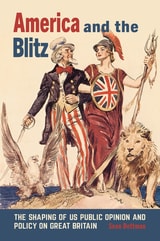
America and the Blitz
The Shaping of US Public Opinion and Policy on Great BritainSean Dettman
University of Missouri Press, 2026
In this work, Sean Dettman traces an observable correlation over the course of late summer 1940 between the bombings of London and other UK cities and the changing attitude of the American people towards adopting a moderate pro-aid position, and argues that these processes were aided by pro-aid US journalists who deployed a positive Blitz narrative centered on themes of resilience, courage, and fortitude. This shift in US public opinion allowed the Roosevelt Administration and pro-aid pressure groups to advance conversations in Washington towards aiding Britain, even at the risk of war.
Dettman also argues that this shift in opinion was caused by fear that a Nazi victory would threaten US national security and the American way of life, rather than an interest in expanding pro-democratic structures and institutions in Britain.
Whereas the vast body of literature examining US public opinion during the ‘Great Debate’ reduces the Blitz narrative to a minor cause, America and the Blitz demonstrates how the Blitz narrative influenced domestic conversations regarding US national security and the American way of life. The author reveals that when the events and themes of the Blitz come into dialogue with conversations about US aid to Britain and national security, the traditional narrative changes.
America and the Blitz offers a new framework for understanding the ‘Great Debate,’ revealing the relationship between US journalists’ Blitz narrative and its effect on US public opinion towards aiding Britain and the ascendancy of American global power.
America at Risk
Threats to Liberal Self-Government in an Age of UncertaintyRobert Faulkner and Susan Shell, Editors
University of Michigan Press, 2009
America at Risk gathers original essays by a distinguished and bipartisan group of writers and intellectuals to address a question that matters to Americans of every political persuasion: what are some of the greatest dangers facing America today? The answers, which range from dwindling political participation to rising poverty, and religion to empire, add up to a valuable and timely portrait of a particular moment in the history of American ideas.
While the opinions are many, there is a central theme in the book: the corrosion of the liberal constitutional order that has long guided the country at home and abroad. The authors write about the demonstrably important dangers the United States faces while also breaking the usual academic boundaries: there are chapters on the family, religious polarization, immigration, and the economy, as well as on governmental and partisan issues.
America at Risk is required reading for all Americans alarmed about the future of their country.
Contributors
- Traci Burch
- James W. Ceaser
- Robert Faulkner
- Niall Ferguson
- William A. Galston
- Hugh Heclo
- Pierre Manent
- Harvey C. Mansfield
- Peter Rodriguez
- Kay Lehman Schlozman
- Susan Shell
- Peter Skerry
- James Q. Wilson
- Alan Wolfe
Robert Faulkner is Professor of Political Science at Boston College. Susan Shell is Professor of Political Science at Boston College.
"America at Risk goes well beyond the usual diagnoses of issues debated in public life like immigration, war, and debt, to consider the Republic’s founding principles, and the ways in which they have been displaced by newer thoughts and habits in contemporary America. A critical book for understanding our present condition."
—Francis Fukuyama, Bernard L. Schwartz Professor of International Political Economy, Johns Hopkins School of Advanced International Studies
"In this penetrating book, the nation’s finest social and political thinkers from across the spectrum take a careful and no-holds-barred look at the dangers facing the American political system. The conclusions are more unsettling than reassuring---but that is because they are honest and real."
—Norm Ornstein, Resident Scholar, American Enterprise Institute
"In the midst of overwrought pundits, irate soccer moms, and outraged bloggers, it is difficult to distinguish genuine dangers from false alarms and special pleading. This book enables us to do so, in a way that helps us to actually think about, not just feel anxious about, threats to those features of American society that are worth cherishing. The authors range in ideology and expertise, but they are uniformly judicious, incisive, and informative. This is a fascinating book about issues that the political system usually ignores or exaggerates."
—Jennifer L. Hochschild, Henry LaBarre Jayne Professor of Government and Professor of African and African American Studies, Harvard University

America in the Forties
The Letters of Ole Munch RæderGunnar Malmin
University of Minnesota Press, 1929
America on the World Stage
A Global Approach to U.S. HistoryOrganization of American Historians. Edited by Gary Reichard and Ted Dickson
University of Illinois Press, 2007
Recognizing the urgent need for students to understand the emergence of the United States' power and prestige in relation to world events, Gary W. Reichard and Ted Dickson reframe the teaching of American history in a global context. Each essay covers a specific chronological period and approaches fundamental topics and events in United States history from an international perspective, emphasizing how the development of the United States has always depended on its transactions with other nations for commodities, cultural values, and populations. For each historical period, the authors also provide practical guidance on bringing this international approach to the classroom, with suggested lesson plans and activities. Ranging from the colonial period to the civil rights era and everywhere in between, this collection will help prepare Americans for success in an era of global competition and collaboration.
Contributors are David Armitage, Stephen Aron, Edward L. Ayers, Thomas Bender, Stuart M. Blumin, J. D. Bowers, Orville Vernon Burton, Lawrence Charap, Jonathan Chu, Kathleen Dalton, Betty A. Dessants, Ted Dickson, Kevin Gaines, Fred Jordan, Melvyn P. Leffler, Louisa Bond Moffitt, Philip D. Morgan, Mark A. Noll, Gary W. Reichard, Daniel T. Rodgers, Leila J. Rupp, Brenda Santos, Gloria Sesso, Carole Shammas, Suzanne M. Sinke, Omar Valerio-Jimenez, Penny M. Von Eschen, Patrick Wolfe, and Pingchao Zhu.
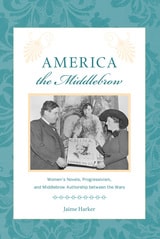
America the Middlebrow
Women's Novels, Progressivism, and Middlebrow Authorship between the WarsJaime Harker
University of Massachusetts Press, 2007
Between the two world wars, American publishing entered a “golden age” characterized by an explosion of new publishers, authors, audiences, distribution strategies, and marketing techniques. The period was distinguished by a diverse literary culture, ranging from modern cultural rebels to working-class laborers, political radicals, and progressive housewives. In America the Middlebrow, Jaime Harker focuses on one neglected mode of authorship in the interwar period—women's middlebrow authorship and its intersection with progressive politics.
With the rise of middlebrow institutions and readers came the need for the creation of the new category of authorship. Harker contends that these new writers appropriated and adapted a larger tradition of women's activism and literary activity to their own needs and practices. Like sentimental women writers and readers of the 1850s, these authors saw fiction as a means of reforming and transforming society. Like their Progressive Era forebears, they replaced religious icons with nationalistic images of progress and pragmatic ideology. In the interwar period, this mode of authorship was informed by Deweyan pragmatist aesthetics, which insisted that art provided vicarious experience that could help create humane, democratic societies.
Drawing on letters from publishers, editors, agents, and authors, America the Middlebrow traces four key moments in this distinctive culture of letters through the careers of Dorothy Canfield, Jessie Fauset, Pearl Buck, and Josephine Herbst. Both an exploration of a virtually invisible culture of letters and a challenge to monolithic paradigms of modernism, the book offers fresh insight into the ongoing tradition of political domestic fiction that flourished between the wars.
America's Battalion
Marines in the First Gulf WarOtto J. Lehrack
University of Alabama Press, 2008
Building from interviews with the members of the battalion, Otto Lehrack examines the nature of warfare in the Persian Gulf. The terrain of the Arabian Peninsula and the disposition of the enemy dictated conventional warfare requiring battalion and regimental assaults coordinated at the division level, so interviewees are primarily the officers and senior non-commissioned officers concerned.
The 3rd of the 3rd, also known as “America’s Battalion,” had just returned from deployment in the summer of 1990 when they were required to immediately re-deploy to a strange land to face a battle-hardened enemy after Iraq invaded Kuwait. Theirs was only the second Marine battalion to arrive in Saudi Arabia. They participated in the first allied ground operation of the war, played a key role in the battle for the city of Khafji, and were the first to infiltrate the Iraqi wire and minefield barrier in order to provide flank security for the beginning of the allied offensive.
Facing an enemy that had used some of the most fearsome weapons of mass destruction—chemical and biological agents—against its former opponents and against its own people, the Marines had been prepared for the worst. Lehrack has documented this unit’s remarkable performance through the accounts of those who participated in the historic events in the Persian Gulf and returned home to tell of them.
America's Blessings
How Religion Benefits Everyone, Including AtheistsRodney Stark
Templeton Press, 2013
A few years ago, a debate between atheists and religious believers spilled out from the halls of academia and the pews of America’s churches and into the public spotlight. A crop of atheist manifestos led the charge, surmounting and holding the tops of the nonfiction bestseller lists. This debate brought on an outpouring of religious rebuttals as both sides exchanged spirited volleys, accusations were leveled; myths, stereotypes, and strawmen arguments were perpetuated; and bitter hostility filled the air. Today many of these misconceptions and myths linger on, along with the generally acrimonious spirit of the debate.
In America’s Blessings, distinguished researcher Rodney Stark seeks to clear the air of this hostility and debunk many of the debate’s most widely perpetuated misconceptions by drawing from an expansive pool of sociological findings. Stark rises above the fray and focuses exclusively on facts by examining the measurable effects of religious faith and practice on American society. His results may surprise many atheists and believers alike.
Starting with a historical overview, Stark traces America’s religious roots from the country’s founding to the present day, showing that religiosity in America has never been consistent, static, or monolithic. Interestingly, he finds that religious practice is now more prevalent than ever in America, despite any claims to the contrary. From here, Stark devotes whole chapters to unpacking the latest research on how religion affects the different facets of modern American life, including crime, family life, sexuality, mental and physical health, sophistication, charity, and overall prosperity. The cumulative effect is that when translated into comparisons with western European nations, the United States comes out on top again and again. Thanks in no small part to America’s rich religious culture, the nation has far lower crime rates, much higher levels of charitable giving, better health, stronger marriages, and less suicide, to note only a few of the benefits.
In the final chapter, Stark assesses the financial impact of these religious realities. It turns out that belief benefits the American economy—and all 300 million citizens, believers, and nonbelievers alike—by a conservative estimate of $2.6 trillion a year. Despite the atheist outcry against religion, the remarkable conclusion is clear: all Americans, from the most religious among us to our secular neighbors, really ought to count our blessings.

America's Boardwalks
From Coney Island to CaliforniaLilliefors, James
Rutgers University Press, 2006
In America's Boardwalks, James Lilliefors takes us on a journey along the edges of the country to twelve of its most famous beach towns. Starting in the Northeast with Coney Island, Asbury Park, Atlantic City, Wildwood, and Cape May, we continue south to Rehoboth Beach; Ocean City, Maryland; Virginia Beach; Myrtle Beach; and Daytona Beach. In California, we explore the exotic scenes at Venice Beach and Santa Cruz. Lilliefors traces each town's history from the building of a boardwalk to what are frequently ambitious plans to revitalize and redevelop today. In every case, he shows how the boardwalk has been integral to the area's economic growth, status, and appeal.
This richly documented and illustrated tale, however, tells more than the story of the birth and development of boardwalks. Weaving together observations and conversations with business owners, planners, and strollers themselves, Lilliefors reveals the vitality of the boardwalk as an idea, rather than just as a place. Boardwalks, he argues, are living monuments to American enterprise, a young country's founding dreams, and its unwavering optimism.
Born at a time when the country was busy rebuilding and reinventing itself as an industrial and economic power, these lively seaside destinations seemed to herald a new life of relaxation, recreation, and middle-class prosperity. On the nation's first boardwalk in Atlantic City, you could find everything from a "home of the future," to diving horses, kangaroo boxing, and the world's largest typewriter. With no admission gate, boardwalks were also a thoroughly democratic idea, inviting visitors from all social and economic groups to join the same parade.
Even today, these glittering coastal hubs, with their always unique blends of people, sea spray, shops, inventions, and oddities remain a last frontier-a testament to the power of individuality in an increasingly homogenized world. From Thrasher's French fries in Ocean City to Mack's Pizza in Wildwood and Nathan's hot dogs in Coney Island, people still visit these resorts for products and pleasures that break the otherwise mundane stream of chain restaurants and retailers. Evoking the spirit, tastes, smells, and sounds that have become a beloved part of our nostalgia and that continue to lure new generations, this book is a deserved tribute to America's iconic seaside wonders.
America's Children
Resources from Family, Government, and the EconomyDonald J. Hernandez
Russell Sage Foundation, 1993
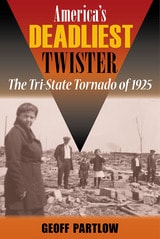
America's Deadliest Twister
The Tri-State Tornado of 1925Geoff Partlow
Southern Illinois University Press, 2014
Winner, ISHS Certificate of Excellence, 2015
Disaster relief as we know it did not exist when the deadliest tornado in U.S. history gouged a path from southeast Missouri through southern Illinois and into southwestern Indiana. The tri-state tornado of 1925 hugged the ground for 219 miles, generated wind speeds in excess of 300 miles per hour, and killed 695 people. Drawing on survivor interviews, public records, and newspaper archives, America’s Deadliest Twister offers a detailed account of the storm, but more important, it describes life in the region at that time as well as the tornado’s lasting cultural impact, especially on southern Illinois.
Author Geoff Partlow follows the storm from town to town, introducing us to the people most affected by the tornado, including the African American population of southern Illinois. Their narratives, along with the stories of the heroes who led recovery efforts in the years following, add a hometown perspective to the account of the storm itself.
In the discussion of the aftermath of the tornado, Partlow examines the lasting social and economic scars in the area, but he also looks at some of the technological firsts associated with this devastating tragedy. Partlow shows how relief efforts in the region began to change the way people throughout the nation thought about disaster relief, which led to the unified responses we are familiar with today.
America's Demographic Tapestry
Baseline for the New MillenniumEdited by James W. Hughes and Joseph J. Seneca
Rutgers University Press, 1999
Beneath the surface of public-policy concerns that seem temporary are powerful evolutionary forces with long-term effects. One of the most important of these is the profound demographic change taking place in America-change which has extraordinary social and economic consequences, and far-reaching public-policy implications for the future of the nation.
James W. Hughes and Joseph J. Seneca have assembled experts on demography, immigration, policy, and family life to explain and document both changes and prospects for changes. Contributors profile the contours of demographic change in America and identify select public-policy challenges arising from this change. They cover a wide range of demographic shifts-"baby booms" and "baby busts," rising immigration, increasing ethnic and racial diversity, the proliferation of different household configurations, economic upward mobility that stems from the information-age rather than the industrial economy, and suburban and sunbelt gains.
America's Early Whalemen
Indian Shore Whalers on Long Island, 1650–1750John A. Strong
University of Arizona Press, 2018
America’s Early Whalemen examines this early chapter of an iconic American historical experience. John A. Strong’s research draws on exhaustive sources, domestic and international, including little-known documents such as the whaling contracts of 340 Native American whalers, personal accounting books of whaling company owners, London customs records, estate inventories, and court records. Strong addresses labor relations, the role of alcohol and debt, the patterns of cultural accommodations by Native Americans, and the emergence of corporate capitalism in colonial America.
When Strong began teaching at Long Island University in 1964, he found little mention of the local Indigenous people in history books. The Shinnecocks and the neighboring tribes of Unkechaugs and Montauketts were treated as background figures for the celebratory narrative of the “heroic” English settlers. America’s Early Whalemen highlights the important contributions of Native peoples to colonial America.
America's First Adventure in China
Trade, Treaties, Opium, and SalvationJohn R Haddad
Temple University Press, 2014
In America's First Adventure in China, John Haddad provides a colorful history of the evolving cultural exchange and interactions between these countries. He recounts how American expatriates adopted a pragmatic attitude-as well as an entrepreneurial spirit and improvisational approach-to their dealings with the Chinese. Haddad shows how opium played a potent role in the dreams of Americans who either smuggled it or opposed its importation, and he considers the missionary movement that compelled individuals to accept a hard life in an alien culture.
As a result of their efforts, Americans achieved a favorable outcome—they established a unique presence in China—and cultivated a relationship whose complexities continue to grow.
America's First Network TV Censor
The Work of NBC's Stockton HelffrichRobert Pondillo
Southern Illinois University Press, 2010
While other books have cited Helffrich’s reports, none have considered them as a body of work, complemented by the details of Helffrich’s life and the era in which he lived. America’s First Network TV Censor explores the ways in which Helffrich’s personal history and social class influenced his perception of his role as NBC-TV censor and his tendency to ignore certain political and cultural taboos while embracing others.
Author Robert Pondillo considers Helffrich’s life in broadcasting before and after the Second World War, and his censorial work in the context of 1950s American culture and emerging network television. Pondillo discusses the ways that cultural phenomena, including the arrival of the mid-twentieth-century religious boom, McCarthyism, the dawn of the Civil Rights era, and the social upheaval over sex, music, and youth, contributed to a general sense that the country was morally adrift and ripe for communist takeover.
Five often-censored subjects—advertising, language, and depictions of sex, violence, and race—are explored in detail, exposing the surprising complexity and nuance of early media censorship. Questions of whether too many sadistic westerns would coarsen America’s children, how to talk about homosexuality without using the word “homosexuality,” and how best to advertise toilet paper without offending people were on Helffrich’s mind; his answers to these questions helped shape the broadcast media we know today.
America's First Olympics
The St. Louis Games of 1904George R. Matthews
University of Missouri Press, 2005

America's Founding Fruit
The Cranberry in a New EnvironmentSusan Playfair
University Press of New England, 2014