Results by title
3703 books match the query '19th Century' and 343 start with a
A Journey to Inner Africa
Egor Kovalevsky
Amherst College Press, 2020
Contributions by Egor Kovalevsky, Anna Aslanyan, Sergey Glebov, David Schimmelpenninck, Mukaram Hhana, and Michal Wasiucionek
A Just and Righteous Cause
Benjamin H. Grierson’s Civil War MemoirEdited by Bruce J. Dinges and Shirley A. Leckie
Southern Illinois University Press, 2008
General Benjamin H. Grierson is most widely known as the brilliant cavalryman whose actions in the Civil War's Mississippi Valley campaign facilitated Ulysses S. Grant's capture of Vicksburg. There is, however, much more to this key Union officer than a successful raid into Confederate-held Mississippi. In A Just and Righteous Cause: Benjamin H. Grierson's Civil War Memoir, edited by Bruce J. Dinges and Shirley A. Leckie, Grierson tells his story in forceful, direct, and highly engaging prose.
A Just and Righteous Cause paints a vivid picture of Grierson's prewar and Civil War career, touching on his antislavery views, Republican Party principles, and military strategy and tactics. His story begins with his parents' immigration to the United States and follows his childhood, youth, and career as a musician; the early years of his arriage; his business failures prior to becoming a cavalry officer in an Illinois regiment; his experiences in battle; and his Reconstruction appointment. Grierson also provides intimate accounts of his relationships with such prominent politicians and Union leaders as Abraham Lincoln, Richard Yates, Andrew Johnson, William T. Sherman, Ulysses S.
Grant, John C. Frémont, and Benjamin Prentiss.
Because Grierson wrote the memoir mainly with his family as the intended audience, he manages to avoid the self-promotion that plagues many of his contemporaries' chronicles. His reliance on military records and correspondence, along with family letters, lends an immediacy rarely found in military memoirs. His reminiscences also add fuel to a reemerging debate on soldiers' motivations for enlisting—in Grierson's case, patriotism and ideology—and shed new light on the Western theater of the Civil War, which has seen a recent surge in interest among Civil War enthusiasts.
A non-West Point officer, Grierson owed his developing career to his independent studies of the military and his connections to political figures in his home state of Illinois and later to important Union leaders. Dinges and Leckie provide a helpful introduction, which gives background on the memoir and places Grierson's career into historical context. Aided by fourteen photos and two maps, as well as the editors' superb annotations, A Just and Righteous Cause is a valuable addition to Civil War history.
A Lawless Breed
John Wesley Hardin, Texas Reconstruction, and Violence in the Wild WestChuck Parsons
University of North Texas Press, 2013
A Leaf of Voices
Stories of the American Civil War in the Words of Those Who Lived and Died, 1861-65Jennifer McSpadden
Indiana Historical Society Press, 2014
A Life of Albert Pike
Walter Lee Brown
University of Arkansas Press, 1997
Drawing on original documents, Pike’s copious writings, and interviews with Pike’s descendants, Walter Lee Brown presents a fascinating personal history that also serves as a rich compendium of Arkansas’s antebellum history.
A Life under Russian Serfdom
The Memoirs of Savva Dmitrievich Purlevskii, 1800–68Boris B. Gorshkov
Central European University Press, 2005
A Long March
The Lives of Frank and Alice BaldwinBy Robert H. Steinbach
University of Texas Press, 1990
During a distinguished military career, in which he rose to the rank of brigadier general and twice won the Medal of Honor, Frank Baldwin saw service in the Civil War, the Indian wars on the Great Plains, and the Spanish-American War. His wife, Alice Blackwood Baldwin, shared the "long march" with him, from his Plains service onward. In this first biography of the Baldwins, Robert Steinbach combines military and personal history to vividly portray a marriage that survived both the harshness of frontier army life and the restrictive Victorian concept of "separate spheres" for husband and wife.
Drawing on a wealth of diaries, letters, and other family papers, Steinbach re-creates the Baldwins' life on the Plains. Moving from post to post in Kansas, New Mexico, Montana, North Dakota, and Texas, they faced danger, excitement, separations, poverty, and many other hardships. Frequently they clashed over Alice's desire to be something more than "an ornament to society"—a wish eventually granted as Frank's long absences and chronic ill health required Allie to take responsibility for herself and their daughter.
With insights into military campaigns on the Great Plains in the years 1865–1890 and a revealing look at the human side of those campaigns, A Long March will appeal to a wide audience.
A Menorah for Athena
Charles Reznikoff and the Jewish Dilemmas of Objectivist PoetryStephen Fredman
University of Chicago Press, 2001
Stephen Fredman illuminates the relationship of Jewish intellectuals to modernity through a close look at Reznikoff's life and writing. He shows that when we regard the Objectivists as modern Jewish poets, we can see more clearly their distinctiveness as modernists and the reasons for their profound impact upon later poets, such as Allen Ginsberg and Charles Bernstein. Fredman also argues that to understand Reznikoff's work more completely, we must see it in the context of early, nonsectarian attempts to make the study of Jewish culture a force in the construction of a more pluralistic society. According to Fredman, then, the indelible images in Reznikoff's poetry open a window onto the vexed but ultimately successful entry of Jewish immigrants and their children into the mainstream of American intellectual life.
A Mighty Change
An Anthology of Deaf American Writing, 1816 - 1864Christopher Krentz
Gallaudet University Press, 2000
“I need not tell you that a mighty change has taken place within the last half century, a change for the better,” Alphonso Johnson, the president of the Empire State Association of Deaf-Mutes, signed to hundreds of assembled deaf people in 1869. Johnson pointed to an important truth: the first half of the 19th century was a period of transformation for deaf Americans, a time that saw the rise of deaf education and the coalescence of the nation’s deaf community.
This volume contains original writing by deaf people that both directed and reflected this remarkable period of change. It begins with works by Laurent Clerc, the deaf Frenchman who came to the United Sates in 1816 to help found the first permanent school for deaf students in the nation. Partially through is writing, Clerc impressed hearing Americans–most of whom had never met an educated deaf person before–with his intelligence and humanity.
Other deaf writers shared their views with society through the democratic power of print. Included here are selections by James Nack, a deaf poet who surprised readers with his mellifluous verse; John Burnet, who published a book of original essays, fiction, and poetry; Edmund Booth, a frontiersman and journalist; John Carlin, who galvanized the drive for a national college for deaf people; Laura Redden, a high-achieving student who would go on to become an accomplished reporter; and Adele Jewel, a homeless deaf woman living in Michigan.
The final sections contain documents related to deaf events and issues at mid-century: the grand reunion of alumni of the American Asylum for the Deaf in 1850; the dedication of the Thomas Hopkins Gallaudet monument in Hartford; the debate over the viability of a deaf state; and the triumphant inauguration of the National Deaf-Mute College (now Gallaudet University) in 1864, which in many ways culminated this period of change. Taken together, the individual texts in this remarkable collection provide a valuable historical record and a direct glimpse of the experiences, attitudes, and rhetoric of deaf Americans during this time of change.
A Narrative of Events, since the First of August, 1834, by James Williams, an Apprenticed Labourer in Jamaica
James Williams
Duke University Press, 2001
Describing the hard working conditions on plantations and the harsh treatment of apprentices unjustly incarcerated, Williams argues that apprenticeship actually worsened the conditions of Jamaican ex-slaves: former owners, no longer legally permitted to directly punish their workers, used the Jamaican legal system as a punitive lever against them. Williams’s story documents the collaboration of local magistrates in this practice, wherein apprentices were routinely jailed and beaten for both real and imaginary infractions of the apprenticeship regulations.
In addition to the complete text of Williams’s original Narrative, this fully annotated edition includes nineteenth-century responses to the controversy from the British and Jamaican press, as well as extensive testimony from the Commission of Enquiry that heard evidence regarding the Narrative’s claims. These fascinating and revealing documents constitute the largest extant body of direct testimony by Caribbean slaves or apprentices.
A Nation Wholly Free
The Elimination of the National Debt in the Age of JacksonCarl Lane
Westholme Publishing, 2014
“An engaging treatment of a topic of perennial concern and frequent misunderstanding, this lucid tale of the brief moment when the United States was debt-free should be on every Congress member’s bedside table.”—Peter J.Woolley, Professor of Comparative Politics, Fairleigh Dickinson University
When President James Monroe announced in his 1824 message to Congress that, barring an emergency, the large public debt inherited from the War for Independence, the Louisiana Purchase, and the War of 1812 would be extinguished on January 1, 1835, Congress responded by crafting legislation to transform that prediction into reality. Yet John Quincy Adams,Monroe’s successor, seemed not to share the commitment to debt freedom, resulting in the rise of opposition to his administration and his defeat for reelection in the bitter presidential campaign of 1828. The new president, Andrew Jackson, was thoroughly committed to debt freedom, and when it was achieved, it became the only time in American history when the country carried no national debt. In A Nation Wholly Free: The Elimination of the National Debt in the Age of Jackson, award-winning economic historian Carl Lane shows that the great and disparate issues that confronted Jackson, such as internal improvements, the “war” against the Second Bank of the United States, and the crisis surrounding South Carolina’s refusal to pay federal tariffs, become unified when debt freedom is understood as a core element of Jacksonian Democracy.
The era of debt freedom lasted only two years and ten months. As the government accumulated a surplus, a fully developed opposition party emerged—the beginning of our familiar two-party system—over rancor about how to allocate the newfound money. Not only did government move into an oppositional party system at this time, the debate about the size and role of government distinguished the parties in a pattern that has become familiar to Americans. The partisan debate over national debt and expenditures led to poorly thought out legislation, forcing the government to resume borrowing. As a result, after Jackson left office in 1837, the country fell into a major depression. Today we confront a debt that exceeds $17 trillion. Indeed, we have been borrowing ever since that brief time we freed ourselves from an oversized debt. A thoughtful, engaging account with strong relevance to today, A Nation Wholly Free is the fascinating story of an achievement that now seems fanciful.
A Nation of Speechifiers
Making an American Public after the RevolutionCarolyn Eastman
University of Chicago Press, 2009
In the decades after the American Revolution, inhabitants of the United States began to shape a new national identity. Telling the story of this messy yet formative process, Carolyn Eastman argues that ordinary men and women gave meaning to American nationhood and national belonging by first learning to imagine themselves as members of a shared public.
She reveals that the creation of this American public—which only gradually developed nationalistic qualities—took place as men and women engaged with oratory and print media not only as readers and listeners but also as writers and speakers. Eastman paints vibrant portraits of the arenas where this engagement played out, from the schools that instructed children in elocution to the debating societies, newspapers, and presses through which different groups jostled to define themselves—sometimes against each other. Demonstrating the previously unrecognized extent to which nonelites participated in the formation of our ideas about politics, manners, and gender and race relations, A Nation of Speechifiers provides an unparalleled genealogy of early American identity.
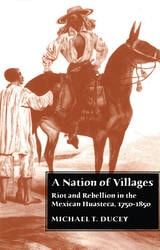
A Nation of Villages
Riot and Rebellion in the Mexican Huasteca, 1750-1850Michael T. Ducey
University of Arizona Press, 2004
He asks not just why villagers revolted but how their discontent fit into the political drama of early national Mexico. Ducey shows how the war offered opportunities for villagers to settle scores with members of the local elite as peasants discovered new ways of imagining the state. They were far from being the isolated traditionalists who occasionally rebelled against political or economic change described in older scholarship. At least until the 1848-1850 Caste War, political disputes were more important than land.
This region’s peasants were both remarkably diverse and politically astute. Villagers adapted colonial political culture and later republican ideas to fashion local institutions that fit their own needs. Over the course of a hundred years, peasant tactics and political discourse evolved in a constant dialogue with the changing political climate, shifting from rhetorical statements of loyalty to the king to proclamations of federalism and their rights as citizens. A Nation of Villages ably demonstrates that rural villagers were more aware of elite ideologies than urban rulers were of the villagers’ political ideas. This long-term analysis of one region illuminates how rural people helped shape the republican state.
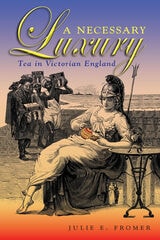
A Necessary Luxury
Tea in Victorian EnglandJulie E. Fromer
Ohio University Press, 2008
In A Necessary Luxury: Tea in Victorian England, Julie E. Fromer analyzes tea histories, advertisements, and nine Victorian novels, including Alice’s Adventures in Wonderland, Wuthering Heights, and Portrait of a Lady. Fromer demonstrates how tea functions within the literature as an arbiter of taste and middle-class respectability, aiding in the determination of class status and moral position. She reveals the way in which social identity and character are inextricably connected in Victorian ideology as seen through the ritual of tea.
Drawing from the fields of literary studies, cultural studies, history, and anthropology, A Necessary Luxury offers in-depth analysis of both visual and textual representations of the commodity and the ritual that was tea in nineteenth-century England.
A New England Prison Diary
Slander, Religion, and Markets in Early AmericaMartin J. Hershock
University of Michigan Press, 2012
In 1812, New Hampshire shopkeeper Timothy M. Joy abandoned his young family, fleeing the creditors who threatened to imprison him. Within days, he found himself in a Massachusetts jailhouse, charged with defamation of a prominent politician. During the months of his incarceration, Joy kept a remarkable journal that recounts his personal, anguished path toward spiritual redemption. Martin J. Hershock situates Joy's account in the context of the pugnacious politics of the early republic, giving context to a common citizen's perspective on partisanship and the fate of an unfortunate shopkeeper swept along in the transition to market capitalism.
In addition to this close-up view of an ordinary person's experience of a transformative period, Hershock reflects on his own work as a historian. In the final chapter, he discusses the value of diaries as historical sources, the choices he made in telling Joy's story, alternative interpretations of the diary, and other contexts in which he might have placed Joy's experiences. The appendix reproduces Joy's original journal so that readers can develop their own skills using a primary source.
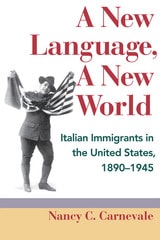
A New Language, A New World
Italian Immigrants in the United States, 1890-1945Nancy C. Carnevale
University of Illinois Press, 2012
A New Type of Womanhood
Discursive Politics and Social Change in Antebellum AmericaNatasha Kirsten Kraus
Duke University Press, 2008
Enabling Kraus’s retelling of the 1850s woman’s rights movement is her theory of “structural aporias,” which takes the institutional structures of any particular society as fully imbricated with the force of language. Kraus reads the antebellum relations of womanhood, contract, property, the economy, and the nation as a fruitful site for analysis of the interconnected power of language, culture, and the law. She combines poststructural theory, particularly deconstructive approaches to discourse analysis; the political economic history of the antebellum era; and the interpretation of archival documents, including woman’s rights speeches, petitions, pamphlets, and convention proceedings, as well as state legislative debates, reports, and constitutional convention proceedings. Arguing that her method provides critical insight not only into social movements and cultural changes of the past but also of the present and future, Kraus concludes A New Type of Womanhood by considering the implications of her theory for contemporary feminist and queer politics.
A Nickel and a Prayer
Rhondda Robinson Thomas
University of Delaware Press, 0
Virtually unknown outside of her adopted hometown of Cleveland, Ohio, Jane Edna Hunter was one of the most influential African American social workers and progressive activists of the early to mid-twentieth century.
In her autobiography A Nickel and a Prayer, Hunter presents an enlightening two-part narrative that recollects her formative years in the post–Civil War South and her activist years in Cleveland. Published in 1940, Hunter’s autobiography recalls a childhood filled with the pleasures and pains of family life on the former plantation where her ancestors had toiled, adventures and achievements in schools for African American children, tests and trials during her brief marriage, and recognition and respect while completing nursing training and law school. When sharing the story of her life as an activist, Hunter describes the immense obstacles she overcame while developing an interracial coalition to support the establishment of the Working Girls Home Association (later, the Phillis Wheatley Association), a progressive institution intended to house and help unmarried African American women and girls, and nurture its growth from a rented home that provided accommodations for twenty-two women to a nine-story building that featured 135 rooms.
This new and annotated edition of A Nickel and a Prayer includes the final chapter, “Fireside Musings,” that Hunter added to the second, limited printing of her autobiography and an introduction that lauds her as a multifaceted social activist who not only engaged in racial uplift work, but impacted African American cultural production, increased higher education opportunities for women, and invigorated African American philanthropy. This important text restores Jane Edna Hunter to her rightful place among prominent African American leaders of the twentieth century.
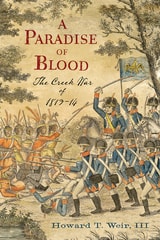
A Paradise of Blood
The Creek War of 1813–14Howard T. Weir, III
Westholme Publishing, 2016
In 1811, a portion of the Creek Indians who inhabited a vast area across Georgia, Alabama, and parts of Florida and Mississippi, interpreted an earth tremor as a sign that they had to return to their traditional way of life. What was an internal Indian dispute soon became engulfed in the greater War of 1812 to become perhaps the most consequential campaign of that conflict. At immediate stake in what became known as the Creek War of 1813–14 was whether the Creeks and their inconstant British and Spanish allies or the young United States would control millions of acres of highly fertile Native American land. The conflict’s larger issue was whether the Indian nations of the lower American South—the Creek, Cherokee, Choctaw, and Chickasaw—would be able to remain in their ancestral homes.
Beginning with conquistador Ferdinand DeSoto’s fateful encounter with Indians of the southeast in the 1500s, A Paradise of Blood: The Creek War of 1813–14 by Howard T. Weir, III, narrates the complete story of the cultural clash and centuries-long struggle for this landscape of stunning beauty. Using contemporary letters, military reports, and other primary sources, the author places the Creek War in the context of Tecumseh’s fight for Native American independence and the ongoing war between the United States and European powers for control of North America. The Creek War was marked by savagery, such as the murder of hundreds of settlers at Fort Mims, Alabama—the largest massacre of its kind in United States history—and fierce battles, including Horseshoe Bend, where more Indian warriors were confirmed killed than in any other single engagement in the long wars against the Indians. Many notable personalities fought during the conflict, including Andrew Jackson, who gained national prominence for his service, Sam Houston, War Chief William Weatherford, and Davy Crockett. When the war was over, more than twenty million acres had been added to the United States, thousands of Indians were dead or homeless, and Jackson was on his way to the presidency. The war also eliminated the last effective Native American resistance to westward expansion east of the Mississippi, and by giving the United States land that was ideal for large-scale cotton planting, it laid the foundation for the Civil War a generation later. A Paradise of Blood is a comprehensive and masterful history of one of America’s most important and influential early wars.
A Peaceful Conquest
Woodrow Wilson, Religion, and the New World OrderCara Lea Burnidge
University of Chicago Press, 2016
With A Peaceful Conquest, Cara Lea Burnidge presents the most detailed analysis yet of how Wilson’s religious beliefs affected his vision of American foreign policy, with repercussions that lasted into the Cold War and beyond. Framing Wilson’s intellectual development in relationship to the national religious landscape, and paying greater attention to the role of religion than in previous scholarship, Burnidge shows how Wilson’s blend of Southern evangelicalism and social Christianity became a central part of how America saw itself in the world, influencing seemingly secular policy decisions in subtle, lasting ways. Ultimately, Burnidge makes a case for Wilson’s religiosity as one of the key drivers of the emergence of the public conception of America’s unique, indispensable role in international relations.
As the presidential election cycle once again raises questions of America’s place in the world, A Peaceful Conquest offers a fascinating excavation of its little-known roots.
A Peculiar Imbalance
The Fall and Rise of Racial Equality in Minnesota, 1837–1869William D. Green
University of Minnesota Press, 2015
A Peculiar Imbalance is the little-known history of the black experience in Minnesota in the mid-1800s, a time of dramatic change in the region. William D. Green explains how, as white progressive politicians pushed for statehood, black men who had been integrated members of the community, owning businesses and maintaining good relationships with their neighbors, found themselves denied the right to vote or to run for office in those same communities.
As Minnesota was transformed from a wilderness territory to a state, the concepts of race and ethnicity and the distinctions among them made by Anglo-Americans grew more rigid and arbitrary. A black man might enjoy economic success and a middle-class lifestyle but was not considered a citizen under the law. In contrast, an Irish Catholic man was able to vote—as could a mixed-blood Indian—but might find himself struggling to build a business because of the ethnic and religious prejudices of the Anglo-American community. A Peculiar Imbalance examines these disparities, reflecting on the political, social, and legal experiences of black men from 1837 to 1869, the year of black suffrage.
A Perfect Mess
The Unlikely Ascendancy of American Higher EducationDavid F. Labaree
University of Chicago Press, 2017
And the best it is: today America’s universities and colleges produce the most scholarship, earn the most Nobel prizes, hold the largest endowments, and attract the most esteemed students and scholars from around the world. But this was not an inevitability. Weakly funded by the state, American schools in their early years had to rely on student tuition and alumni donations in order to survive. This gave them tremendous autonomy to seek out sources of financial support and pursue unconventional opportunities to ensure their success. As Labaree shows, by striving as much as possible to meet social needs and fulfill individual ambitions, they developed a broad base of political and financial support that, grounded by large undergraduate programs, allowed for the most cutting-edge research and advanced graduate study ever conducted. As a result, American higher education eventually managed to combine a unique mix of the populist, the practical, and the elite in a single complex system.
The answers to today’s problems in higher education are not easy, but as this book shows, they shouldn’t be: no single person or institution can determine higher education’s future. It is something that faculty, administrators, and students—adapting to society’s needs—will determine together, just as they have always done.

A Pillar of Fire to Follow
American Indian Dramas, 1808–1859Priscilla Sears
University of Wisconsin Press, 1982
A Place Called Appomattox
William Marvel
Southern Illinois University Press, 2007
In A Place Called Appomattox, William Marvel turns his extensive Civil War scholarship toward Appomattox County, Virginia, and the village of Appomattox Court House, which became synonymous with the end of the Civil War when Robert E. Lee surrendered to Ulysses S. Grant there in 1865. Marvel presents a formidably researched and elegantly written analysis of the county from 1848 to 1877, using it as a microcosm of Southern attitudes, class issues, and shifting cultural mores that shaped the Civil War and its denouement.
With an eye toward correcting cultural myths and enriching the historical record, Marvel analyzes the rise and fall of the village and county from 1848 to 1877, detailing the domestic economic and social vicissitudes of the village, and setting the stage for the flight of Lee’s Army toward Appomattox and the climactic surrender that still resonates today.
Now available for the first time in paperback, A Place Called Appomattox reveals a new view of the Civil War, tackling some of the thorniest issues often overlooked by the nostalgic exaggerations and historical misconceptions that surround Lee’s surrender.
A Place for Humility
Whitman, Dickinson, and the Natural WorldChristine Gerhardt
University of Iowa Press, 2014
Dickinson and Whitman developed their environmentally suggestive poetics at roughly the same historical moment, at a time when a major shift was occurring in American culture’s view and understanding of the natural world. Just as they were achieving poetic maturity, the dominant view of wilderness was beginning to shift from obstacle or exploitable resource to an endangered treasure in need of conservation and preservation.
A Place for Humility examines Dickinson’s and Whitman’s poetry in conjunction with this important change in American environmental perception, exploring the links between their poetic projects within the context of developing nineteenth-century environmental thought. Christine Gerhardt argues that each author's poetry participates in this shift in different but related ways, and that their involvement with their culture’s growing environmental sensibilities constitutes an important connection between their disparate poetic projects. There may be few direct links between Dickinson’s “letter to the World” and Whitman’s “language experiment,” but via a web of environmentally-oriented discourses, their poetry engages in a cultural conversation about the natural world and the possibilities and limitations of writing about it—a conversation in which their thematic and formal choices meet on a surprising number of levels.
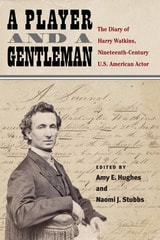
A Player and a Gentleman
The Diary of Harry Watkins, Nineteenth-Century U.S. American ActorEdited by Amy E. Hughes and Naomi J. Stubbs
University of Michigan Press, 2018
Hardworking actor, playwright, and stage manager Harry Watkins (1825–94) was also a prolific diarist. For fifteen years Watkins regularly recorded the plays he saw, the roles he performed, the books he read, and his impressions of current events. Performing across the U.S., Watkins collaborated with preeminent performers and producers, recording his successes and failures as well as his encounters with celebrities such as P. T. Barnum, Junius Brutus Booth, Edwin Forrest, Anna Cora Mowatt, and Lucy Stone. His is the only known diary of substantial length and scope written by a U.S. actor before the Civil War—making Watkins, essentially, the antebellum equivalent of Samuel Pepys. Theater historians Amy E. Hughes and Naomi J. Stubbs have selected, edited, and annotated excerpts from the diary in an edition that offers a vivid glimpse of how ordinary people like Watkins lived, loved, struggled, and triumphed during one of the most tumultuous periods in U.S. history. The selections in A Player and a Gentleman are drawn from a more expansive digital archive of the complete diary. The book, like its digital counterpart, will richly enhance our knowledge of antebellum theater culture and daily life in the U.S. during this period.
A Plot of Her Own
The Female Protagonist in Russian LiteratureSona Stephan Hoisington
Northwestern University Press, 1995
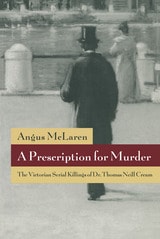
A Prescription for Murder
The Victorian Serial Killings of Dr. Thomas Neill CreamAngus McLaren
University of Chicago Press, 1993
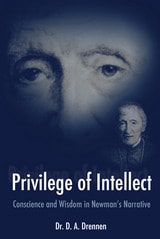
A Privilege of Intellect
Conscience and Wisdom in Newman’s NarrativeD. A. Drennen
University of Scranton Press, 2010
Based on decades of research, A Privilege of Intellect is D. A. Drennen’s portrait of the English cardinal John Henry Newman (1801–90), whose conversion to the Roman Catholic Church in 1845 significantly boosted the presence of the Catholic Church in England and caused many Anglicans to follow his example. Newman—who will be beatified this fall—devoted his life both to the Church and to the university, demonstrating that religious faith and intellectual pursuits could exist in harmony. Drennen’s biography combines theology with psychology and philosophy and will appeal to anyone interested in the history of the Church of England and the Roman Catholic Church.
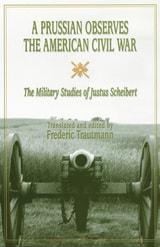
A Prussian Observes the American Civil War
The Military Studies of Justus ScheibertEdited & Translated by Frederic Trautmann
University of Missouri Press, 2001
Prussia, like much of nineteenth-century Germany, was governed by the belief that knowledge, and thus understanding, was best derived from direct observation and communicated through documentation. Justus Scheibert, an officer in the Royal Prussian Engineers, was therefore sent to the United States for seven months to observe the Civil War and report the effects of artillery on fortifications. His interests, however, surpassed that limited assignment, and his observations, as well as the writings translated in this work, went on to include tactics, strategy, logistics, intelligence, combined operations, and the medical service.
Scheibert, an expert on warfare, had access to the Confederate high command, including such luminaries as Robert E. Lee, J. E. B. Stuart, and Stonewall Jackson. He brought to the war not only the fresh perspective of a foreigner, but also the insightful eye of a career military officer and a skillful author and correspondent. Although he was personally sympathetic to the South, Scheibert researched both sides of the conflict in order to write unbiased, informed commentary for his fellow Prussian officers. His firsthand account of many aspects of the Civil War included a theoretical discussion of every branch of service and the Confederate high command, illustrated with his personal observations.
Sheibert's narrative portrays soldiers, weaponry, and battles, including the first, and one of the few, studies of combined operations in the Civil War. Trautmann combines two of Scheibert's publications, The Civil War in the North American States: A Military Study for the German Officer (1874) and Combined Operations by Army and Navy: A Study Illustrated by the War on the Mississippi, 1861-1863 (ca. 1887), which for decades influenced German military writing. Trautmann's translations evince the grace and achieve the readability of Scheibert's intricate and complex works.
A Prussian Observes the American Civil War makes an important addition to Civil War studies and will appeal greatly to professional historians and those interested in, and dedicated to, Civil War and military studies.
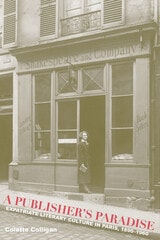
A Publisher's Paradise
Expatriate Literary Culture in Paris, 1890-1960Colette Colligan
University of Massachusetts Press, 2014
From 1890 to 1960, some of Anglo-America's most heated cultural contests over books, sex, and censorship were staged not at home, but abroad in the City of Light. Paris, with its extraordinary liberties of expression, became a special place for interrogating the margins of sexual culture and literary censorship, and a wide variety of English language “dirty books” circulated through loose expatriate publishing and distribution networks.
A Publisher's Paradise explores the political and literary dynamics that gave rise to this expatriate cultural flourishing, which included everything from Victorian pornography to the most daring and controversial modernist classics. Colette Colligan tracks the British and French politicians and diplomats who policed Paris editions of banned books and uncovers offshore networks of publishers, booksellers, authors, and readers. She looks closely at the stories the “dirty books” told about this publishing haven and the smut peddlers and literary giants it brought together in transnational cultural formations. The book profiles an eclectic group of expatriates living and publishing in Paris, from relatively obscure figures such as Charles Carrington, whose list included both The Picture of Dorian Gray and the pornographic novel Randiana, to bookshop owner Sylvia Beach, famous for publishing James Joyce's Ulysses in 1922.
A Publisher's Paradise is a compelling exploration of the little-known history of foreign pornography in Paris and the central role it played in turning the city into a modernist outpost for literary and sexual vanguardism, a reputation that still lingers today in our cultural myths of midnight in Paris.
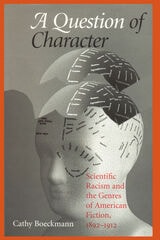
A Question of Character
Scientific Racism and the Genres of American Fiction, 1892-1912Catherine Ann Boeckmann
University of Alabama Press, 2005
Boeckmann links character, literary genre, and science, revealing how major literary works both contributed to and disrupted the construction of race in turn-of-the-century America.
In A Question of Character, Cathy Boeckmann establishes a strong link between racial questions and the development of literary traditions at the end of the 19th century in America. This period saw the rise of "scientific racism," which claimed that the races were distinguished not solely by exterior appearance but also by a set of inherited character traits. As Boeckmann explains, this emphasis on character meant that race was not only a thematic concern in the literature of the period but also a generic or formal one as well.
Boeckmann explores the intersections between race and literary history by tracing the language of character through both scientific and literary writing. Nineteenth-century pseudo-sciences such as phrenology and physiognomy had a vocabulary for discussing racial character that overlapped conceptually with the conventions for portraying race in literature. Through close readings of novels by Thomas Dixon, Mark Twain, William Dean Howells, Charles Chesnutt, and James Weldon Johnson—each of which deals with a black character "passing" as white—Boeckmann shows how this emphasis on character relates to the shift from romantic and sentimental fiction to realism. Because each of these genres had very specific conventions regarding the representation of character, genres often dictated how races could be depicted.
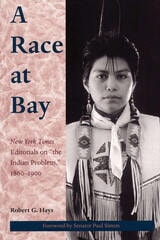
A Race at Bay
New York Times Editorials on "the Indian Problem," 1860 - 1900Robert G. Hays. Foreword by Paul Simon
Southern Illinois University Press, 1997
Robert G. Hays chronicles the "Indian problem" precisely as it was explained to Americans through the editorial columns of the New York Times between 1860 and 1900, the years when battles between white settlers and Native Americans split a nation and its spirit apart.
Covering the final forty-one years of the nineteenth century, Hays’s collection of Times editorials gives readers what current accounts cannot: perspectives by contemporary writers with unique insights into the public images of Native Americans and their place in a nation bent on expansion. The authentic voices of a national newspaper’s daily record speak with an urgency both immediate and real.
These editorials express the unbridled bitterness and raw ambition of a nation immersed in an agenda of conquest. They also resonate with the struggle to find a common ground. Some editorials are patronizing and ironic: "Yet it seems pitiful to cage so fine a savage among a herd of vulgar criminals in a penitentiary." Others include a willingness to poke fun: "Many persons on the platform were astonished to find that an ‘illiterate barbarian’ could handle the weapon of sarcasm. The truth is that the Indians spoke far better than ninety-nine out of a hundred members of congress." And yet others evince an attitude of respect, which set the tone for reconciling national ambition with natural rights.
In some instances, the Times allowed Native Americans to tell their own stories, as in this eloquent, moving account of the testimony of Satanta, the warrior chief of the Kiowas: "A certain dim foreboding of the Indians’ fate swept across his mind, and in its passage lit his eyes up with a fierce light, and his voice rose to a pitch of frenzy as he exclaimed: ‘We don’t want to settle—I love to roam over the prairie; there I am free and happy."
History demonstrates that the costs of owning one’s soil and one’s destiny remain without measure. Many of the problems blocking the progress of Native Americans continue unsolved: unemployment, infant mortality, suicide, crime, alcoholism, and poverty. Following such works as Helen Hunt Jackson’s A Century of Dishonor and Dee Brown’s Bury My Heart at Wounded Knee, Hays looks back on the records of national history for the roots of our challenges today.
A Radical Spirit
The History and Potential of the Latter Day Saint TraditionEdited by Andrew Bolton, Taunalyn Ford, and Patrick Q. Mason
University of Illinois Press, 2027
Early followers of Joseph Smith believed their new faith could organize society from the ground up and create a religious community shaped by justice, equality, and spiritual transformation. The essayists look at the movement’s diverse influences—religious, philosophical, and cultural—alongside the economic, gender, and racial issues that informed its radicalism. They also trace the competing pressures inside and outside the movement that helped determine which radical ideas survived and which faded or were later enhanced.
Eye-opening and expansive, A Radical Spirit rediscovers implications of the original heart of the Restoration tradition that thrived among the marginalized poor in the USA, Canada and in Europe—a radical Spirit of Jesus that offers possibilities for our times.
Contributors: Andrew Bolton, Gerard Charmley, Rebekah Clark, Taunalyn Ford, Russell Arben Fox, Erik J. Freeman, David J. Howlett, Brad A. Martell, Lori Martell, Patrick Q. Mason, Michael Ratcliffe, Jennifer Reeder, Joseph M. Spencer, Jordan T. Watkins, Walker Wright
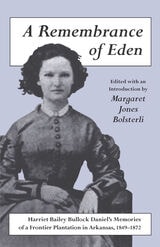
A Remembrance of Eden
Harriet Bailey Bullock Daniel's Memories of a Frontier Plantation in Arkansas, 1849–1872Margaret Jones Bolsterli
University of Arkansas Press, 1993
A Revolution in Arms
A History of the First Repeating RiflesJoseph G. Bilby
Westholme Publishing, 2005
Historians often call the American Civil War the first modern war, pointing to the use of observation balloons, the telegraph, trains, mines, ironclad ships, and other innovations. Although recent scholarship has challenged some of these “firsts,” the war did witness the introduction of the first repeating rifles. No other innovation of the turbulent 1860s would have a greater effect on the future of warfare. In A Revolution in Arms: A History of the First Repeating Rifles, historian Joseph G. Bilby unfolds the fascinating story of how two New England inventors, Benjamin Henry and Christopher Spencer, each combined generations of cartridge and rifle technology to develop reliable repeating rifles. In a stroke, the Henry rifle and Spencer rifle and carbine changed warfare forever, accelerating the abandonment of the formal battle line tactics of previous generations and when properly applied, repeating arms could alter the course of a battle. Although slow to enter service, the repeating rifle soon became a sought after weapon by both Union and Confederate troops. Oliver Winchester purchased the rights to the Henry and transformed it into “the gun that won the West.” The Spencer, the most famous of all Civil War small arms, was the weapon of choice for Federal cavalrymen. The revolutionary technology represented by repeating arms used in the American Civil War, including self-contained metallic cartridges, large capacity magazines, and innovative cartridge feeding systems, was copied or adapted by arms manufacturers around the world, and these features remain with us today.
A Rogue's Paradise
Crime and Punishment in Antebellum Florida, 1821-1861James M. Denham
University of Alabama Press, 1997
A history of frontier justice and legal systems in early Florida.
The pervasive influence of the frontier is fundamental to an understanding of antebellum Florida. James M. Denham traces the growth and social development of this sparsely settled region through its experience with crime and punishment. He examines such issues as Florida's criminal code, its judicial and law enforcement officers, the accommodation of criminals in jails and courts, outlaw gangs, patterns of punishment, and the attitude of the public toward lawbreakers.
Using court records, government documents, newspapers, and personal papers, Denham explores how crime affected ordinary Floridians—whites and blacks, perpetrators, victims, and enforcers. He contends that although the frontier determined the enforcement and administration of the law, the ethic of honor dominated human relationships.
A Room of His Own
A Literary-Cultural Study of Victorian ClublandBarbara Black
Ohio University Press, 2012
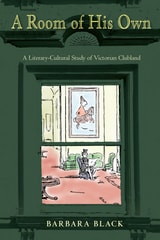
In nineteenth-century London, a clubbable man was a fortunate man, indeed. The Reform, the Athenaeum, the Travellers, the Carlton, the United Service are just a few of the gentlemen’s clubs that formed the exclusive preserve known as “clubland” in Victorian London—the City of Clubs that arose during the Golden Age of Clubs. Why were these associations for men only such a powerful emergent institution in nineteenth-century London? Distinctly British, how did these single-sex clubs help fashion men, foster a culture of manliness, and assist in the project of nation building? What can elite male affiliative culture tell us about nineteenth-century Britishness?
A Room of His Own sheds light on the mysterious ways of male associational culture as it examines such topics as fraternity, sophistication, nostalgia, social capital, celebrity, gossip, and male professionalism. The story of clubland (and the literature it generated) begins with Britain’s military heroes home from the Napoleonic campaign and quickly turns to Dickens’s and Thackeray’s acrimonious Garrick Club Affair. It takes us to Richard Burton’s curious Cannibal Club and Winston Churchill’s The Other Club; it goes underground to consider Uranian desire and Oscar Wilde’s clubbing and resurfaces to examine the problematics of belonging in Trollope’s novels. The trespass of French socialist Flora Tristan, who cross-dressed her way into the clubs of Pall Mall, provides a brief interlude. London’s clubland—this all-important room of his own—comes to life as Barbara Black explores the literary representations of clubland and the important social and cultural work that this urban site enacts. Our present-day culture of connectivity owes much to nineteenth-century sociability and Victorian networks; clubland reveals to us our own enduring desire to belong, to construct imagined communities, and to affiliate with like-minded comrades.

A Room of His Own
A Literary-Cultural Study of Victorian ClublandBarbara Black
Ohio University Press, 0
A Room of His Own sheds light on the mysterious ways of male associational culture as it examines such topics as fraternity, sophistication, nostalgia, social capital, celebrity, gossip, and male professionalism. The story of clubland (and the literature it generated) begins with Britain’s military heroes home from the Napoleonic campaign and quickly turns to Dickens’s and Thackeray’s acrimonious Garrick Club Affair. It takes us to Richard Burton’s curious Cannibal Club and Winston Churchill’s The Other Club; it goes underground to consider Uranian desire and Oscar Wilde’s clubbing and resurfaces to examine the problematics of belonging in Trollope’s novels. The trespass of French socialist Flora Tristan, who cross-dressed her way into the clubs of Pall Mall, provides a brief interlude. London’s clubland—this all-important room of his own—comes to life as Barbara Black explores the literary representations of clubland and the important social and cultural work that this urban site enacts. Our present-day culture of connectivity owes much to nineteenth-century sociability and Victorian networks; clubland reveals to us our own enduring desire to belong, to construct imagined communities, and to affiliate with like-minded comrades.
A Secret Society History of the Civil War
Mark A. Lause
University of Illinois Press, 2014
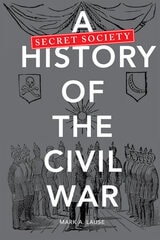
Antebellum secret societies ranged politically from those with progressive or even revolutionary agendas to those that pursued conservative or oppressive goals. This book shows how, in the years leading up to the Civil War, these clandestine organizations exacerbated existing sectional tensions in the United States. Lause's research indicates that the pervasive influence of secret societies may have played a part in key events such as the Freesoil movement, the beginning of the Republican party, John Brown's raid on Harpers Ferry, Lincoln's election, and the Southern secession process of 1860-1861.
This exceptional study encompasses both white and African American secret society involvement, revealing the black fraternal experience in antebellum America as well as the clandestine operations that provided assistance to escaped slaves via the Underground Railroad. Unraveling these pervasive and extensive networks of power and influence, A Secret Society History of the Civil War demonstrates that antebellum secret societies played a greater role in affecting Civil War-era politics than has been previously acknowledged.
A Secret To Be Burried
Diary Emily Hawley GillespieJudy Nolte Lensink
University of Iowa Press, 1989
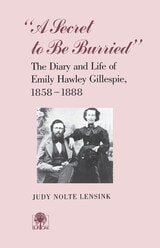
The sound of nineteenth-century women, once thought lost to us, is alive because ordinary women like Emily Hawley Gillespie gave voice to their thoughts in diaries. This condensed version of the 2,500-page journals of Emily Gillespie, faithfully written from 1858 to 1888, is a detailed account of rural Iowa life. More than this, it contains the reflections of a woman who dreamed of being a painter and writer and instead became a wife and a mother, a woman whose radical convictions were recorded in her diary, while publicly she conformed to the prescribed life of a Victorian pioneer woman. Through Emily's journals, readers are offered immediate and unmodified contact with settlers in Iowa one hundred years ago. A wealth of facts are included—what produce she harvested and preserved from her garden, how her husband tended his fields and what he raised, the challenges and rewards of family life.
Judy Lensink's skillful analysis shows the larger patterns in Emily Gillespie's life and provides keys that unlock the diary's secrets. Emily's life is revealed as a youth full of promise fading into middle and declining years of lost dreams and eventual tragedy, which caused her to write, "I have written many things in my journal, but the worst is a secret to be burried when I shall cease to be."
A Selection of Modernized Recipes from Food in the Civil War
The SouthJennifer Billock
Michigan State University Press, 2015
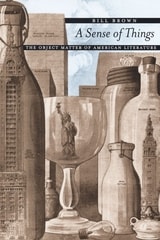
A Sense of Things
The Object Matter of American LiteratureBill Brown
University of Chicago Press, 2003
Brown's captivating new study explores the roots of modern America's fascination with things and the problem that objects posed for American literature at the turn of the century. This was an era when the invention, production, distribution, and consumption of things suddenly came to define a national culture. Brown shows how crucial novels of the time made things not a solution to problems, but problems in their own right. Writers such as Mark Twain, Frank Norris, Sarah Orne Jewett, and Henry James ask why and how we use objects to make meaning, to make or remake ourselves, to organize our anxieties and affections, to sublimate our fears, and to shape our wildest dreams. Offering a remarkably new way to think about materialism, A Sense of Things will be essential reading for anyone interested in American literature and culture.

A Settler's Year
Pioneer Life through the SeasonsKathleen Ernst
Wisconsin Historical Society Press, 2015
"This is a book with great meaning for those of us who grew up on farms, and a book to be shared with young people eager to know more about pioneer life." --Jerry Apps, author of "Old Farm: A History" and "Whispers and Shadows: A Naturalist's Memoir"
"A Settler's Year" provides a rare glimpse into the lives of early immigrants to the upper Midwest. Evocative photographs taken at Old World Wisconsin, the country's largest outdoor museum of rural life, lushly illustrate stories woven by historian, novelist, and poet Kathleen Ernst and compelling firsthand accounts left by the settlers themselves.
In this beautiful book, readers will discover the challenges and triumphs found in the seasonal rhythms of rural life in the nineteenth and early twentieth centuries. As they turn the pages--traveling from sprawling farm to tidy crossroads village, and from cramped and smoky cabins to gracious, well-furnished homes--they'll experience the back-straining chores, cherished folk traditions, annual celebrations, and indomitable spirit that comprised pioneer life.
At its heart "A Settler's Year" is about people dreaming of, searching for, and creating new homes in a new land. This moving book transports us back to the pioneer era and inspires us to explore the stories found on our own family trees.
A Shared History
Writing in the High School, College, and University, 1856-1886Amy J. Lueck
Southern Illinois University Press, 2020
Lueck explores Civil War- and Reconstruction-era challenges to the University of Louisville and nearby local high schools, their curricular transformations, and their fate in regard to national education reform efforts. These institutions reflect many of the educational trends and developments of the day: college and university building, the emergence of English education as the dominant curriculum for higher learning, student-centered pedagogies and educational theories, the development and transformation of normal schools, the introduction of manual education and its mutation into vocational education, and the extension of advanced education to women, African American, and working-class students.
Lueck demonstrates a complex genealogy of interconnections among high schools, colleges, and universities that demands we rethink our categories and standards of assessment and our field’s history. A shift in our historical narrative would promote a move away from an emphasis on the preparation, transition, and movement of student writers from high school to college or university and instead allow a greater focus on the fostering of rich rhetorical practices and pedagogies at all educational levels. As the definition of college-level writing becomes increasingly contested once again, Lueck invites a reassessment of the discipline’s understanding of contemporary programs based in high schools like dual-credit and concurrent enrollment.
A Slaveholders' Union
Slavery, Politics, and the Constitution in the Early American RepublicGeorge William Van Cleve
University of Chicago Press, 2010
After its early introduction into the English colonies in North America, slavery in the United States lasted as a legal institution until the passage of the Thirteenth Amendment to the Constitution in 1865. But increasingly during the contested politics of the early republic, abolitionists cried out that the Constitution itself was a slaveowners’ document, produced to protect and further their rights. A Slaveholders’ Union furthers this unsettling claim by demonstrating once and for all that slavery was indeed an essential part of the foundation of the nascent republic.
In this powerful book, George William Van Cleve demonstrates that the Constitution was pro-slavery in its politics, its economics, and its law. He convincingly shows that the Constitutional provisions protecting slavery were much more than mere “political” compromises—they were integral to the principles of the new nation. By the late 1780s, a majority of Americans wanted to create a strong federal republic that would be capable of expanding into a continental empire. In order for America to become an empire on such a scale, Van Cleve argues, the Southern states had to be willing partners in the endeavor, and the cost of their allegiance was the deliberate long-term protection of slavery by America’s leaders through the nation’s early expansion. Reconsidering the role played by the gradual abolition of slavery in the North, Van Cleve also shows that abolition there was much less progressive in its origins—and had much less influence on slavery’s expansion—than previously thought.
Deftly interweaving historical and political analyses, A Slaveholders’ Union will likely become the definitive explanation of slavery’s persistence and growth—and of its influence on American constitutional development—from the Revolutionary War through the Missouri Compromise of 1821.
A Small but Spartan Band
The Florida Brigade in Lee's Army of Northern VirginiaZack C. Waters
University of Alabama Press, 2013
A Social History of Modern Art, Volume 2
Art in an Age of Bonapartism, 1800-1815Albert Boime
University of Chicago Press, 1990
Heavily illustrated, this volume is an invaluable social history of modern art during the Napoleonic era.
Stimulating and informative, this volume will become a valuable resource for faculty and undergraduates.—R. W. Liscombe, Choice

A Socialist Utopia in the New South
The Ruskin Colonies in Tennessee and Georgia, 1894-1901W. Fitzhugh Brundage
University of Illinois Press, 1996
This first book-length study of the Ruskin colonies shows how several hundred utopian socialists gathered as a cooperative community in Tennessee and Georgia in the late nineteenth century. The communitarians' noble but fatally flawed act of social endeavor revealed the courage and desperation they felt as they searched for alternatives to the chaotic and competitive individualism of the age of robber barons and for a viable model for a just and humane society at a time of profound uncertainty about public life in the United States.
A Spiritual Revolution
The Impact of Reformation and Enlightenment in Orthodox Russia, 1700–1825Andrey V. Ivanov
University of Wisconsin Press, 2023
Embedded with lively portrayals of historical actors and vivid descriptions of political details, A Spiritual Revolution is the first large-scale effort to fully identify exactly how Western progressive thought influenced the Russian Church. These new ideas played a foundational role in the emergence of the country as a modernizing empire and the rise of the Church hierarchy as a forward-looking agency of institutional and societal change. Ivanov addresses this important debate in the scholarship on European history, firmly placing Orthodoxy within the much wider European and global continuum of religious change.