Results by title
21 books match the query 'Homophobia'

Archive Activism
Memoir of a "Uniquely Nasty" JourneyCharles Francis
University of North Texas Press, 2023

Atmospheres of Violence
Structuring Antagonism and the Trans/Queer UngovernableEric A. Stanley
Duke University Press, 2021
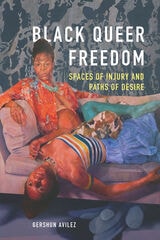
Black Queer Freedom
Spaces of Injury and Paths of DesireGerShun Avilez
University of Illinois Press, 2020

Conspiracy Narratives from Postcolonial Africa
Freemasonry, Homosexuality, and Illicit EnrichmentRogers Orock and Peter Geschiere
University of Chicago Press, 2024
In this book, anthropologists Rogers Orock and Peter Geschiere examine the moral panic over a perceived rise in homosexuality that engulfed Cameroon and Gabon beginning in the early twenty-first century. As they uncover the origins of the conspiratorial narratives that fed this obsession, they argue that the public’s fears were grounded in historically situated assumptions about the entanglement of same-sex practices, Freemasonry, and illicit enrichment.
This specific panic in postcolonial Central Africa fixated on high-ranking Masonic figures thought to lure younger men into sex in exchange for professional advancement. The authors’ thorough account shows how attacks on elites as homosexual predators corrupting the nation became a powerful outlet for mounting populist anger against the excesses and corruption of the national regimes. Unraveling these tensions, Orock and Geschiere present a genealogy of Freemasonry, taking readers from London through Paris to francophone Africa and revealing along the way how the colonial past shapes present-day anxieties linking same-sex practices to enrichment.
Displacing Homophobia
Ronald R. Butters, John M. Clum, and Michael Moon, eds.
Duke University Press, 1989

Don't
A Reader's Guide to the Military's Anti-Gay PolicyJanet E. Halley
Duke University Press, 1999
Not so, reveals Halley. In order to work through the steps by which the new law was ultimately drafted, she opens with a close reading of the 1986 Supreme Court sodomy case which served as the legal and rhetorical model for the policy revisions made in 1993. Halley also describes how the Clinton administration’s attempts to offer Congress an opportunity to regulate conduct—and not status—were flatly rejected and not included in the final statute. Using cultural and critical theory seldom applied to explain the law, Halley argues that, far from providing privacy and an assurance that servicemembers' careers will be ruined only if they engage in illegal conduct, the rule activates a culture of minute surveillance in which every member must strictly avoid using any gesture in an ever-evolving lexicon of “conduct that manifests a propensity.” In other words, not only homosexuals but all military personnel are placed in danger by the new policy. After challenging previous pro-gay arguments against the policy that have failed to expose its most devious and dangerous elements, Halley ends with a persuasive discussion about how it is both unconstitutional and, politically, an act of sustained bad faith.
This knowledgeable and eye-opening analysis of one of the most important public policy debates of the 1990s will interest legal scholars, policymakers, activists, military historians and personnel, as well as citizens concerned about issues of discrimination.
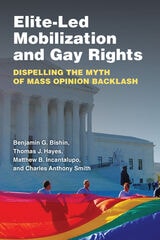
Elite-Led Mobilization and Gay Rights
Dispelling the Myth of Mass Opinion BacklashBenjamin George Bishin, Thomas J. Hayes, Matthew B. Incantalupo, and Charles Anthony Smith
University of Michigan Press, 2021
Media and scholastic accounts describe a strong public opinion backlash—a sharply negative and enduring opinion change—against attempts to advance gay rights. Academic research, however, increasingly questions backlash as an explanation for opposition to LGBT rights. Elite-Led Mobilization and Gay Rights argues that what appears to be public opinion backlash against gay rights is more consistent with elite-led mobilization—a strategy used by anti-gay elites, primarily white evangelicals, seeking to prevent the full incorporation of LGBT Americans in the polity in order to achieve political objectives and increase political power. This book defines and tests the theory of Mass Opinion Backlash and develops and tests the theory of Elite-Led Mobilization by employing a series of online and natural experiments, surrounding the U.S. Supreme Court rulings in Obergefell v. Hodges and United States v. Windsor, and President Obama’s position change on gay marriage. To evaluate these theories, the authors employ extensive survey, voting behavior, and campaign finance data, and examine the history of the LGBT movement and its opposition by religious conservatives, from the Lavender Scare to the campaign against Trans Rights in the defeat of Houston’s 2015 HERO ordinance. Their evidence shows that opposition to LGBT rights is a top-down process incited by anti-gay elites rather than a bottom-up reaction described by public opinion backlash.

Fractal Repair
Queer Histories of Modern JamaicaMatthew Chin
Duke University Press, 2024
Global Homophobia
States, Movements, and the Politics of OppressionEdited by Meredith L. Weiss and Michael J. Bosia
University of Illinois Press, 2013
Combining rich empirical analysis with theoretical synthesis, these studies examine how homophobia travels across complex and ambiguous transnational networks, how it achieves and exerts decisive power, and how it shapes the collective identities and strategies of those groups it targets. The first comparative volume to focus specifically on the global diffusion of homophobia and its implications for an emerging worldwide LGBT movement, Global Homophobia opens new avenues of debate and dialogue for scholars, students, and activists.
Contributors are Mark Blasius, Michael J. Bosia, David K. Johnson, Kapya J. Kaoma, Christine (Cricket) Keating, Katarzyna Korycki, Amy Lind, Abouzar Nasirzadeh, Conor O'Dwyer, Meredith L. Weiss, and Sami Zeidan.
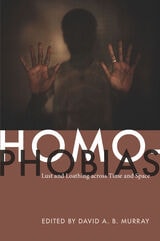
Homophobias
Lust and Loathing across Time and SpaceDavid A. B. Murray, ed.
Duke University Press, 2009
The contributors to this volume open up the scope of inquiry into processes of homophobia, moving the analysis of a particular form of “hate” into new, wider sociocultural and political fields. The ongoing production of homophobic discourses is carefully analyzed in diverse sites including New York City, Australia, the Caribbean, Greece, India, and Indonesia, as well as American Christian churches, in order to uncover the complex operational processes of homophobias and their intimate relationships to nationalism, sexism, racism, class, and colonialism. The contributors also critically inquire into the limitations of the term homophobia and interrogate its utility as a cross-cultural designation.
Contributors. Steven Angelides, Tom Boellstorff, Lawrence Cohen, Don Kulick, Suzanne LaFont, Martin F. Manalansan IV, David A. B. Murray, Brian Riedel, Constance R. Sullivan-Blum
How the Religious Right Shaped Lesbian and Gay Activism
Tina Fetner
University of Minnesota Press, 2008
An unexpected analysis of the battle between opposing activist movements
While gay rights are on the national agenda now, activists have spent decades fighting for their platform, seeing themselves as David against the religious right’s Goliath. At the same time, the religious right has continuously and effectively countered the endeavors of lesbian and gay activists, working to repeal many of the laws prohibiting discrimination based on sexual orientation and to progress a constitutional amendment “protecting” marriage.
In this accessible and grounded work, Tina Fetner uncovers a remarkably complex relationship between the two movements—one that transcends political rivalry. Fetner shows how gay activists and the religious right have established in effect a symbiotic relationship in which each side very much affects the development of its counterpart. As lesbian and gay activists demand an end to prejudice, inclusion in marriage, the right to serve in the military, and full citizenship regardless of sexual orientation, the religious right has responded with antigay planks in Republican party platforms and the blocking of social and political change efforts. Fetner examines how the lesbian and gay movement reacts to opposition by changing rhetoric, tone, and tactics and reveals how this connection has influenced—and made more successful—the evolution of gay activism in the United States. Fetner addresses debates that lie at the center of the culture wars and, ultimately, she demonstrates how the contentious relationship between gay and lesbian rights activists and the religious right—a dynamic that is surprisingly necessary to both—challenges assumptions about how social movements are significantly shaped by their rivals.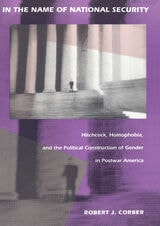
In the Name of National Security
Hitchcock, Homophobia, and the Political Construction of Gender in Postwar AmericaRobert J. Corber
Duke University Press, 1993
As Corber shows, throughout the 1950s a cast of mind known as the Cold War consensus prevailed in the United States. Promoted by Cold War liberals--that is, liberals who wanted to perserve the legacies of the New Deal but also wished to separate liberalism from a Communist-dominated cultural politics--this consensus was grounded in the perceived threat that Communists, lesbians, and homosexuals posed to national security. Through an analysis of the films of Alfred Hitchcock, combined with new research on the historical context in which these films were produced, Corber shows how Cold War liberals tried to contain the increasing heterogeneity of American society by linking questions of gender and sexual identity directly to issues of national security, a strategic move that the films of Hitchcock both legitimated and at times undermined. Drawing on psychoanalytic and Marxist theory, Corber looks at such films as Rear Window, Strangers on a Train, and Psycho to show how Hitchcock manipulated viewers' attachments and identifications to foster and reinforce the relationship between homophobia and national security issues.
A revisionary account of Hitchcock's major works, In the Name of National Security is also of great interest for what it reveals about the construction of political "reality" in American history.
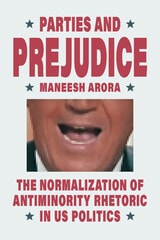
Parties and Prejudice
The Normalization of Antiminority Rhetoric in US PoliticsManeesh Arora
University of Chicago Press, 2025
An essential guide to how the interactions between social norms, party politics, and expressions of prejudice are driving contemporary politics.
Antiminority rhetoric in American politics has grown more overt. What were once fringe comments on Stormfront have now become typical campaign appeals from many mainstream politicians. If there was ever a doubt, this is a poignant reminder that the boundaries of what is “acceptable” and “unacceptable” to say and do are fluid and socially enforced.
In Parties and Prejudice, Maneesh Arora offers a broad framework for understanding this new political terrain. Arora argues that the interaction between social norms and party politics determines what the political consequence of prejudicial speech will be. He illuminates this nuanced relationship by showing that norms vary based on the targeted minority group and the intended audience.
Drawing on experiments, survey data, news coverage, and real-world examples, Parties and Prejudice examines the distinctive ways that egalitarian/inegalitarian norms have developed—within each party—for Black, Muslim, and LGBTQ+ Americans. It is essential reading for understanding Donald Trump’s rise to power, the modern conservative agenda (including opposition to critical race theory and transgender rights), and threats to the development of a multiracial democracy.

Queer Lovers and Hateful Others
Regenerating Violent Times and PlacesJin Haritaworn
Pluto Press, 2015
At the centre of this book is the concept of 'queer regeneration.' Haritaworn sees the queer lover as a transitional object which allows the present-day neoliberal regime to make punishment and neglect appear as signs of care and love for diversity. Alongside this shift, in the wake of older moral panics over crime, violence, patriarchy, integration, and segregation, the new Other, that is, the homophobic migrant appears. To understand this transition, Queer Lovers and Hateful Others looks at the environments in which queer bodies have become worthy of protection, and the everyday erasures that shape life in the inner city, and how queer activists actively seek out and dispel the myths of sites of nostalgia for the 'invented traditions' of women-and-gay-friendliness.
Haritaworn guides the reader through a rich archive of media, arts, policy, and activism, including posters, newspaper reports, hate crime action plans, urban projects, psychological studies, demonstrations, kiss-ins, political speeches, and films. In the process, queer lovers, drag kings, criminalised youth, homosexuals persecuted under National Socialism, and other figures of degeneracy and regeneration appear on a shared plane, where new ways of sharing space become imaginable.

Queer Objects to the Rescue
Intimacy and Citizenship in KenyaGeorge Paul Meiu
University of Chicago Press, 2023
Campaigns calling on police and citizens to purge their countries of homosexuality have taken hold across the world. But the “homosexual threat” they claim to be addressing is not always easy to identify. To make that threat visible, leaders, media, and civil society groups have deployed certain objects as signifiers of queerness. In Kenya, for example, bead necklaces, plastics, and even diapers have come to represent the danger posed by homosexual behavior to an essentially “virile” construction of national masculinity.
In Queer Objects tothe Rescue, George Paul Meiu explores objects that have played an important and surprising role in both state-led and popular attempts to rid Kenya of various imagined threats to intimate life. Meiu shows that their use in the political imaginary has been crucial to representing the homosexual body as a societal threat and as a target of outrage, violence, and exclusion, while also crystallizing anxieties over wider political and economic instability. To effectively understand and critique homophobia, Meiu suggests, we must take these objects seriously and recognize them as potential sources for new forms of citizenship, intimacy, resistance, and belonging.
Sex Panic Rhetorics, Queer Interventions
Ian Barnard
University of Alabama Press, 2020
Analyzes the rhetoric of contemporary sex panics to expose how homophobia, heterosexism, and transphobia define public, political, and scholarly preoccupations with sexuality and gender
In Sex Panic Rhetorics, Queer Interventions, Ian Barnard makes the counter-intuitive argument that contemporary “sex panics” are undergirded by queerphobia, even when the panics in question don’t appear to have much to do with queerness. Barnard presents six case studies that treat a wide range of sex panic rhetorics around child molesters, sex trafficking, transgenderism, incest, queer kids, and pedagogy to demonstrate this argument. By using examples from academic scholarship, political discourse, and popular culture, including the Kevin Spacey scandal and the award-winning film Moonlight, Barnard shows how homophobia and transphobia continue to pervade contemporary Western culture.
Barnard is concerned not so much with looking at the overt homophobia and transphobia that are the more obvious objects of antihomophobic and antitransphobic critique. The author’s focus, rather, is on excavating the significant traces of these panics in a neoliberal culture that has supposedly demonstrated its civility by its embrace of diversity, renunciation of its homophobic past, and attentiveness to the transgender revolution that has swept popular media and political culture in the United States and elsewhere. During a time of increasing conservative backlashes against advancing LGBTQ rights and human rights discourses in general, this book shows why it is important to attend to the liberal covers for sex panics that are not too far removed from their rhetorically conservative cousins.
Survival of a Perverse Nation
Morality and Queer Possibility in ArmeniaTamar R. Shirinian
Duke University Press, 2024

Sweet Tea
A PlayE. Patrick Johnson; With a Foreword by Jane M. Saks
Northwestern University Press, 2020
Based on several tours and individual stagings, Sweet Tea: A Play invites readers, students, theater practitioners, and audiences from different backgrounds to engage with the lives of eleven men and one gender-nonconforming person—incredible characters all originally played by the author in a one-man show.
The Mourning After
Loss and Longing among Midcentury American MenJohn Ibson
University of Chicago Press, 2018
The Sexual Politics of Empire
Postcolonial Homophobia in HaitiErin L. Durban
University of Illinois Press, 2023
Evangelical Christians and members of the global LGBTQI human rights movement have vied for influence in Haiti since the 2010 earthquake. Each side accuses the other of serving foreign interests. Yet each proposes future foreign interventions on behalf of their respective causes despite the country’s traumatic past with European colonialism and American imperialism. As Erin L. Durban shows, two discourses dominate discussions of intervention. One maintains imperialist notions of a backward Haiti so riddled with cultural deficiencies that foreign supervision is necessary to overcome Haitians’ resistance to progress. The other sees Haiti as a modern but failed state that exists only through its capacity for violence, including homophobia. In the context of these competing claims, Durban explores the creative ways that same-sex desiring and gender creative Haitians contend with anti-LGBTQI violence and ongoing foreign intervention.
Compelling and thought-provoking, The Sexual Politics of Empire examines LGBTQI life in contemporary Haiti against the backdrop of American imperialism and intervention.

You're Not from Around Here, Are You?
A Lesbian in Small-Town AmericaLouise A. Blum
University of Wisconsin Press, 2001
This is a funny, moving story about life in a small town, from the point of view of a pregnant lesbian. Louise A. Blum, author of the critically acclaimed novel Amnesty, now tells the story of her own life and her decision to be out, loud, and pregnant. Mixing humor with memorable prose, Blum recounts how a quiet, conservative town in an impoverished stretch of Appalachia reacts as she and a local woman, Connie, fall in love, move in together, and determine to live their life together openly and truthfully.
The town responds in radically different ways to the couple’s presence, from prayer vigils on the village green to a feature article in the family section of the local newspaper. This is a cautionary, wise, and celebratory tale about what it’s like to be different in America—both the good and the bad. A depiction of small town life with all its comforts and its terrors, this memoir speaks to anyone who has ever felt like an outsider in America. Blum tells her story with a razor wit and deft precision, a story about two "girls with grit," and the child they decide to raise, right where they are, in small town America.