Results by title
78 books match the query 'After' and 59 start with a
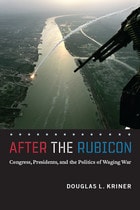
After the Rubicon
Congress, Presidents, and the Politics of Waging WarDouglas L. Kriner
University of Chicago Press, 2010
When the United States goes to war, the nation’s attention focuses on the president. As commander in chief, a president reaches the zenith of power, while Congress is supposedly shunted to the sidelines once troops have been deployed abroad. Because of Congress’s repeated failure to exercise its legislative powers to rein in presidents, many have proclaimed its irrelevance in military matters.
After the Rubicon challenges this conventional wisdom by illuminating the diverse ways in which legislators influence the conduct of military affairs. Douglas L. Kriner reveals that even in politically sensitive wartime environments, individual members of Congress frequently propose legislation, hold investigative hearings, and engage in national policy debates in the public sphere. These actions influence the president’s strategic decisions as he weighs the political costs of pursuing his preferred military course.
Marshalling a wealth of quantitative and historical evidence, Kriner expertly demonstrates the full extent to which Congress materially shapes the initiation, scope, and duration of major military actions and sheds new light on the timely issue of interbranch relations.
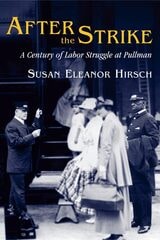
After the Strike
A Century of Labor Struggle at PullmanSusan Eleanor Hirsch
University of Illinois Press, 2003
The 1894 Pullman strike and the rise of the Brotherhood of Sleeping Car Porters played major roles in the century-long development of union organizing and labor-management relations in the Pullman Company. Susan Eleanor Hirsch connects the stories of Pullman car builders and porters to answer critical questions like: what created job segregation by race and gender? What role did such segregation play in shaping the labor movement?
Hirsch illuminates the relationship between labor organizing and the racial and sexual discrimination practiced by both employers and unions. Because the Pullman Company ran the sleeping-car service for American railroads and was a major manufacturer of railcars, its workers were involved in virtually every wave of union organizing from the 1890s to the 1940s.
In exploring the years of struggle by the men and women of the Pullman Company, After the Strike reveals the factors that determined the limited success and narrow vision of most American unions.
After the TRC
Reflections on Truth and ReconciliationWilmot James
Ohio University Press, 2001
Has South Africa dealt effectively with the past, and is the country ready to face the future? What are the challenges facing both government and civil society in the years ahead? These and other questions are explored in this collection of essays by international and local commentators on the Truth and Reconciliation Commission.
A range of perspectives on whether the TRC met its objectives of truth and reconciliation is presented. The areas of particular contention-the payment of reparation, the granting of amnesty, and memorialization-are also examined.
Finally, the major challenges facing South Africa are identified, and ways of meeting these challenges and developing the assets of the nation are explored.
Contributors: Haribert Adam, Kanya Adam, Alex Boraine, Colin Bundy, Mary Burton, John de Gruchy, Richard Goldstone, Willem Heath, Wilmot James, Jeffrey Lever, Mahmood Mamdani, Gary Minkley, Njabulo Ndebele, Dumisa Ntsebeza, Kaizer Nyatsumba, Grace Naledi Pandor, Mamphela Ramphele, Ciraj Rassool, Albie Sachs, Patricia Valdez, Linda van de Vijver, Jan van Eck, Frederik Van Zyl Slabbert, Charles Villa-Vicencio, Francis Wilson, and Leslie Witz

After the Thrill Is Gone
A Decade of Post-Apartheid South Africa, Volume 103Grant Farred and Rita Barnard, eds.
Duke University Press, 0
In a range of politically inflected essays by philosophers, community activists, political scientists, sociologists, literary scholars, and cultural and postcolonial theorists—many of whom are diasporic or resident South Africans—this special issue of SAQ provides a critical look at the realities of black majority governance, at the African National Congress, and at the costs of ANC rule to the populace. One essay draws a condemning sketch of poverty and violence in the townships and the growing communities of squatters that continue despite the emergence of democracy. A philosophical piece contemplates the practice of human rights in a South African society grappling with the memory of apartheid abuses. The fiction and poetry in the collection explore sexual identity, including issues created by the AIDS epidemic, and offer critiques of government policies. Using comic strips, another contributor demonstrates the ability of South African popular culture to satirize the nation’s political status quo. Taken together, the essays in After the Thrill Is Gone open a sobering perspective on South Africa’s recent history, its present, and its future.
Contributors. Rita Barnard, Patrick Bond, Ashwin Desai, Emmanuel Chukwudi Eze, Grant Fared, Michiel Heyns, Shaun Irlam, Neil Lazarus, Michael MacDonald, Zine Magubane, Richard Pithouse, Lesego Rampolokeng, Adam Sitze
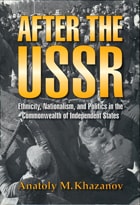
After the USSR
Ethnicity, Nationalism, and Politics in the Commonwealth of Independent StatesAnatoly M. Khazanov
University of Wisconsin Press, 1996
A world-renowned anthropologist, Anatoly M. Khazanov offers a witty, insightful, and cautionary analysis of ethnic nationalism and its pivotal role in the collapse of the Soviet empire.
“Khazanov’s encyclopedic knowledge of the history and culture of post-Soviet societies, combined with field research there since the 1960s, informs the case studies with a singular authoritative voice. This volume is destined to be an absolutely necessary reference for the understanding of ethnic relations and the politics of minorities in the ex-USSR into the next century.”—Leonard Plotnicov, editor of Ethnology
First Paperback Edition
After the West Was Won
Homesteaders and Town-Builders in Western South Dakota, 1900-1917Paula M. Nelson
University of Iowa Press, 1989
After the Western Reserve
The Ohio Fiction of Jessie Brown PoundsSandra Parker
University of Wisconsin Press, 1999
In her fiction, Jessie Brown Pounds preserved the flavor of Ohio’s rural village culture as the nineteenth century drew to a close. This anthology rediscovers Pounds’s varied works and reminds modern students that Middle-Western culture included women writers as social critics and mythmakers. Included are short stories, sketches, one undated short story published posthumously in 1921, and Rachael Sylvestre, a first-person historical novel written in 1904.
After the Whale
Melville in the Wake of Moby-DickClark Davis
University of Alabama Press, 1995
Beyond Moby-Dick: Reinterpreting Melville's later works through language, embodiment, and literary transformation.
The study focuses on Melville’s vision of the purpose and function of language from Moby-Dick through Billy Budd with a special emphasis on how language—in function and form—follows and depends on the function and form of the body, how Melville’s attitude toward words echoes his attitude toward fish. Davis begins by locating and describing the fundamental dialectic formulated in Moby-Dick in the characters of Ahab and Ishmael. This dialectic produces two visions of bodily reality and two corresponding visions of language: Ahab’s, in which language is both weapon and substitute body, and Ishmael’s, in which language is an extension of the body—a medium of explanation, conversation, and play. These two forms of language provide a key to understanding the difficult relationships and formal changes in Melville’s writings after Moby-Dick.
By following each work’s attitude toward the dialectic, we can see the contours of the later career more clearly and so begin a movement away from weakly contextualized readings of individual novels and short stories to a more complete consideration of Melville’s career. Since the rediscovery of Herman Melville in the early decades of this century, criticism has been limited to the prose in general and to a few major works in particular.
Those who have given significant attention to the short fiction and poetry have done so frequently out of context, that is, in multi-author works devoted exclusively to these genres. The result has been a criticism with large gaps, most especially for works from Melville’s later career. The relative lack of interest in the poetry has left us with little understanding of how Melville’s later voices developed, of how the novels evolved into tales, the tales into poetry, and the poetry back into prose. In short, the development of Melville’s art during the final three decades of his life remains a subject of which we have been afforded only glimpses, rarely a continuous attention. After the Whale provides a new, more comprehensive understanding of Melville’s growth as a writer.
After the Wildfire
Ten Years of Recovery from the Willow FireJohn Alcock
University of Arizona Press, 2017
Swallowtail butterflies frolic on the wind. Vireos and rock wrens sing their hearts out by the recovering creek. Spiders and other predators chase their next meal. Through it all, John Alcock observes, records, and delights in what he sees. In a once-burnt area, life resurges. Plants whose seeds and roots withstood an intense fire become habitat for the returning creatures of the wild. After the Wildfire describes the remarkable recovery of wildlife in the Mazatzal Mountains in central Arizona.
It is the rare observer who has the dedication to revisit the site of a wildfire, especially over many years and seasons. But naturalist John Alcock returned again and again to the Mazatzals, where the disastrous Willow fire of 2004 burned 187 square miles. Documenting the fire’s aftermath over a decade, Alcock thrills at the renewal of the once-blackened region. Walking the South Fork of Deer Creek in all seasons as the years passed, he was rewarded by the sight of exuberant plant life that in turn fostered an equally satisfying return of animals ranging from small insects to large mammals.
Alcock clearly explains the response of chaparral plants to fire and the creatures that reinhabit these plants as they come back from a ferocious blaze: the great spreadwing damselfly, the western meadowlark, the elk, and birds and bugs of rich and colorful varieties. This book is at once a journey of biological discovery and a celebration of the ability of living things to reoccupy a devastated location. Alcock encourages others to engage the natural world—even one that has burnt to the ground.