Results by title
977 books match the query 'American literature' and 88 start with a
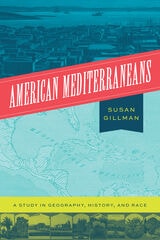
American Mediterraneans
A Study in Geography, History, and RaceSusan Gillman
University of Chicago Press, 2022
The naturalist Alexander von Humboldt, visiting the Gulf-Caribbean in the early nineteenth century, called it America’s Mediterranean. Almost a century later, Southern California was hailed as “Our Mediterranean, Our Italy!” Although “American Mediterranean” is not a household phrase in the United States today, it once circulated widely in French, Spanish, and English as a term of art and folk idiom. In this book, Susan Gillman asks what cultural work is done by this kind of unsystematic, open-ended comparative thinking.
American Mediterraneans tracks two centuries of this geohistorical concept, from Humboldt in the early 1800s, to writers of the 1890s reflecting on the Pacific world of the California coast, to writers of the 1930s and 40s speculating on the political past and future of the Caribbean. Following the term through its travels across disciplines and borders, American Mediterraneans reveals a little-known racialized history, one that paradoxically appealed to a range of race-neutral ideas and ideals.

American Naturalism and the Jews
Garland, Norris, Dreiser, Wharton, and CatherDonald Pizer
University of Illinois Press, 2007

American Orient
Imagining the East from the Colonial Era through the Twentieth CenturyDavid Weir
University of Massachusetts Press, 2011
Surveying the American fascination with the Far East since the mid-eighteenth century, this book explains why the Orient had a fundamentally different meaning in the United States than in Europe or Great Britain. David Weir argues that unlike their European counterparts, Americans did not treat the East simply as a site of imperialist adventure; on the contrary, colonial subjugation was an experience that early Americans shared with the peoples of China and India.
In eighteenth-century America, the East was, paradoxically, a means of reinforcing the enlightenment values of the West: Franklin, Jefferson, and other American writers found in Confucius a complement to their own political and philosophical beliefs. In the nineteenth century, with the shift from an agrarian to an industrial economy, the Hindu Orient emerged as a mystical alternative to American reality. During this period, Emerson, Thoreau, and other Transcendentalists viewed the “Oriental” not as an exotic other but as an image of what Americans could be, if stripped of all the commercialism and materialism that set them apart from their ideal. A similar sense of Oriental otherness informed the aesthetic discoveries of the early twentieth century, as Pound, Eliot, and other poets found in Chinese and Japanese literature an artistic purity and intensity absent from Western tradition. For all of these figures the Orient became a complex fantasy that allowed them to overcome something objectionable, either in themselves or in the culture of which they were a part, in order to attain some freer, more genuine form of philosophical, religious, or artistic expression.
American Romanticism and the Marketplace
Michael T. Gilmore
University of Chicago Press, 1985
"[Gilmore] demonstrates the profound, sustained, engagement with society embodied in the works of Emerson, Hawthorne, Thoreau and Melville. In effect, he relocates the American Renaissance where it properly belongs, at the centre of a broad social, economic, and ideological movement from the Jacksonian era to the Civil War. Basically, Gilmore's argument concerns the writers' participation in what Thoreau called 'the curse of trade.' He details their mixed resistance to and complicity in the burgeoning literary marketplace and, by extension, the entire ' economic revolution' which between 1830 and 1860 'transformed the United States into a market society'. . . .
"The result is a model of literary-historical revisionism. Gilmore's opening chapters on Emerson and Thoreau show that 'transcendental' thought and language can come fully alive when understood within the material processes and ideological constraints of their time. . . . The remaining five chapters, on Hawthorne and Melville, contain some of the most penetrating recent commentaries on the aesthetic strategies of American Romantic fiction, presented within and through some of the most astute, thoughtful considerations I know of commodification and the 'democratic public' in mid-nineteenth-century America. . . . Practically and methodologically, American Romanticism and the Marketplace has a significant place in the movement towards a new American literary history. It places Gilmore at the forefront of a new generation of critics who are not just reinterpreting familiar texts or discovering new texts to interpret, but reshaping our ways of thinking about literature and culture."—Sacvan Bercovitch, Times Literary Supplement
"Gilmore writes with energy, clarity, and wit. The reader is enriched by this book." William H. Shurr, American Literature
American Studies as Transnational Practice
Turning toward the TranspacificEdited by Yuan Shu and Donald E. Pease
Dartmouth College Press, 2016
American Tropics
Articulating Filipino AmericaAllan Punzalan Isaac
University of Minnesota Press, 2006
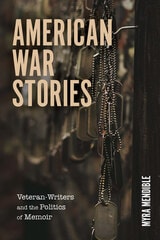
American War Stories
Veteran-Writers and the Politics of MemoirMyra Mendible
University of Massachusetts Press, 2021
American War Stories centers on an extensive selection of memoirs written by veterans of the Vietnam, Iraq, and Afghanistan conflicts—including Brian Turner's My Life as a Foreign Country, Marcus Luttrell's Lone Survivor, and Camilo Mejia's Road from ar Ramadi—to explore the complex relationship between memory and politics in the context of postmodern war. Placing veterans' stories in conversation with broader cultural and political discourses, Myra Mendible analyzes the volatile mix of agendas, identities, and issues informing veteran-writers' narrative choices to argue that their work plays an important, though underexamined, political function in how Americans remember and judge their wars.
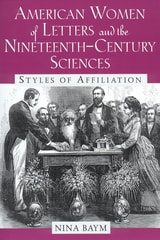
American Women of Letters and the Nineteenth-Century Sciences
Styles of AffiliationBaym, Nina
Rutgers University Press, 2001
Choice Outstanding Academic Title
During the nineteenth century, the content and institutional organization of the sciences evolved dramatically, altering the public's understanding of knowledge. As science grew in importance, many women of letters tried to incorporate it into a female worldview. Nina Baym explores the responses to science displayed in a range of writings by American women. Conceding that they could not become scientists, women insisted, however, that they were capable of understanding science and participating in its discourse. They used their access to publishing to advocate the study and transmission of scientific information to the general public.
Bayms book includes biographies and a full exploration of these women's works. Among those considered are:
• Almira Phelps, author of Familiar Lectures on Botany (it sold 350,000 copies)
• Sarah Hale, who filled Godey's Lady's Book with science articles
• Catharine Esther Beecher, who based her domestic advice on scientific information
• Elizabeth Cary Agassiz, the actual ghostwriter of her husband's popular science essays
• Emily Dickinson, whose poetry is replete with scientific images.
Baym also investigates science in women's novels, writing by and about women doctors, and the scientific claims advanced by women's spiritualist movements. This book truly breaks new ground, outlining a field of inquiry that few have noted exists.
American and British Writers in Mexico, 1556-1973
By Drewey Wayne Gunn
University of Texas Press, 1974
American and British Writers in Mexico is the study that laid the foundation upon which subsequent examinations of Mexico’s impact upon American and British letters have built. Chosen by the Mexican government to be placed, in translation, in its public libraries, the book was also referenced by Nobel Laureate Octavio Paz in an article in the New Yorker, “Reflections—Mexico and the United States.” Drewey Wayne Gunn demonstrates how Mexican experiences had a singular impact upon the development of English writers, beginning with early British explorers who recorded their impressions for Hakluyt’s Voyages, through the American Beats, who sought to escape the strictures of American culture.
Among the 140 or so writers considered are Stephen Crane, Ambrose Bierce, Langston Hughes, D. H. Lawrence, Somerset Maugham, Katherine Anne Porter, Hart Crane, Malcolm Lowry, John Steinbeck, Graham Greene, Tennessee Williams, Saul Bellow, William Carlos Williams, Robert Lowell, Ray Bradbury, Allen Ginsberg, William Burroughs, and Jack Kerouac.
Gunn finds that, while certain elements reflecting the Mexican experience—colors, landscape, manners, political atmosphere, a sense of the alien—are common in their writings, the authors reveal less about Mexico than they do about themselves. A Mexican sojourn often marked the beginning, the end, or the turning point in a literary career. The insights that this pioneering study provide into our complex cultural relationship with Mexico, so different from American and British authors’ encounters with Continental cultures, remain vital. The book is essential for anyone interested in understanding the full range of the impact of the expatriate experience on writers.
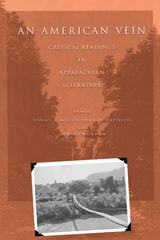
An American Vein
Critical Readings in Appalachian LiteratureDanny L. Miller
Ohio University Press, 2005
The blossoming of Appalachian studies began some thirty years ago. Thousands of young people from the hills have since been made aware of their region’s rich literary tradition through high school and college courses. An entire generation has discovered that their own landscapes, families, and communities had been truthfully portrayed by writers whose background was similar to their own.
An American Vein: Critical Readings in Appalachian Literature is an anthology of literary criticism of Appalachian novelists, poets, and playwrights. The book reprises critical writing of influential authors such as Joyce Carol Oates, Cratis Williams, and Jim Wayne Miller. It introduces new writing by Rodger Cunningham, Elizabeth Engelhardt, and others.
Many writers from the mountains have found success and acclaim outside the region, but the region itself as a thriving center of literary creativity has not been widely appreciated. The editors of An American Vein have remedied this, producing the first general collection of Appalachian literary criticism. This book is a resource for those who teach and read Appalachian literature. What’s more, it holds the promise of introducing new readers, nationally and internationally, to Appalachian literature and its relevance to our times.

An Analytical Index to American Literature
Vols. I–XXX, March 1929–January 1959Thomas F. Marshall
Duke University Press, 0
Since the magazine has been from its beginning the chief repository of research in the field and the principal medium for scholarly reviews, an analysis of this material provides, in essence, a working bibliography for the serious student of American culture form 1929 to 1959. Consequently, care has been taken to expand the already large number of cross-references so that material not clearly indicated by the titles of articles or books may be identified.
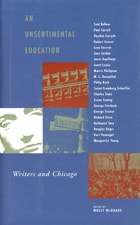
An Unsentimental Education
Writers and ChicagoMolly McQuade
University of Chicago Press, 1995
Interviews with:Saul Bellow, Paul Carroll, Hayden Carruth, Robert Coover, Leon Forrest, June Jordan, Janet Kauffman, Morris Philipson, M. L. Rosenthal, Philip Roth, Susan Fromberg Shaeffer, Charles Simic, Susan Sontag, George Starbuck, George Steiner, Richard Stern, Nathaniel Tarn, Douglas Unger, Kurt Vonnegut, and Marguerite Young.
Analogical Thinking
Post-Enlightenment Understanding in Language, Collaboration, and InterpretationRonald Schleifer
University of Michigan Press, 2001
The book traces this mode of thinking in linguistics, collaborative intellectual work in the arts and sciences, and interpretations of literary and sacred texts, concluding with a reading of the concept of Enlightenment in a comparison of Descartes and Foucault. The book examines the poststructuralism of Derrida; the collaborations of information theory and modern science as opposed to the individualism of Adam Smith and others, and analogical interpretations of Yeats, Dinesen, the Bible, Dreiser, and Mailer. Its overall aim is to present an interdisciplinary examination of a particular kind of understanding that responds to the experiences of our time.
Ronald Schleifer is Professor of English, University of Oklahoma. His books include Rhetoric and Death: The Language of Modernism and Postmodern Discourse Theory, Criticism and Culture; and Culture and Cognition: The Boundaries of Literary and Scientific Inquiry.
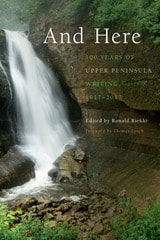
And Here
100 Years of Upper Peninsula Writing, 1917–2017Ronald Riekki
Michigan State University Press, 2017
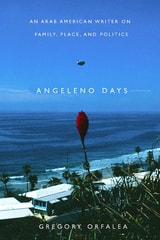
Angeleno Days
An Arab American Writer on Family, Place, and PoliticsGregory Orfalea
University of Arizona Press, 2009
Populated with fascinating characters—the Angelenos of Orfalea’s life—these essays tell the story of the author’s trials. He returns to Los Angeles to teach, trying to reconcile the LA of his childhood with the city he now faces. He takes on progressively more difficult and painful subjects, finally confronting the memories of the shocking tragedy that took the lives of his father and sister.
With more than 400,000 Arab Americans in Los Angeles—probably surpassing Detroit as the largest contingent in America—Orfalea also explores his own community and its political and social concerns. He agonizes over another destruction of Lebanon and examines in searing detail a massacre of civilians in Iraq.
Angeleno Days takes the memoir and personal essay to rare heights. Orfalea is a deeply human writer who reveals not only what it means to be human in America now, but also what it will take to remain human in the days to come. These essays soar, confound, reveal, and strike at our senses and sensibilities, forcing us to think and feel in new ways.
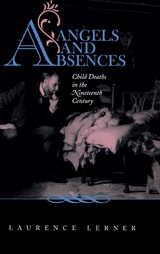
Angels and Absences
Child Deaths in the Nineteenth CenturyLaurence Lerner
Vanderbilt University Press, 1997
What is the difference between public and private feeling, and how far can we deduce past feelings from the words that have been left us? Why do child deaths figure so often and so prominently in the literature of the nineteenth century, and how was the theme of the death of a child used to elicit such poignant responses in the readers of that era? In this fascinating new book, Laurence Lerner vividly contrasts the contempt with which twentieth- century criticism so often dismisses such works as mere sentimentality with the enthusiasm and tears of nineteenth-century contemporaries.
Drawing examples from both real and literary deaths, Lerner delves into the writings of well-known authors such as Dickens, Coleridge, Shelley, Flaubert, Mann, Huxley, and Hesse, as well as lesser known writers like Felicia Hemans and Lydia Sigourney. In the process, he synthesizes fresh ideas about the thorny subjects of sentimentality, aesthetic judgment, and the function of religion in literature.
Lerner's forthright and evocative prose style is enjoyable reading, and he excels in teasing out the moral implications and the psychosocial entanglements of his chosen narrative and lyrical texts. This is a book that will illuminate an important aspect of the history of private life. It should have wide application for those interested in the history, sociology, and literature of the nineteenth century.
Anglo-American Feminist Challenges to the Rhetorical Traditions
Virginia Woolf, Mary Daly, Adrienne RichKrista Ratcliffe
Southern Illinois University Press, 1996
Although women and men have different relationships to language and to each other, traditional theories of rhetoric do not foreground such gender differences. Krista Ratcliffe argues that because feminists generally have not conceptualized their language theories from the perspective of rhetoric and composition studies, rhetoric and composition scholars must construct feminist theories of rhetoric by employing a variety of interwoven strategies: recovering lost or marginalized texts; rereading traditional rhetoric texts; extrapolating rhetorical theories from such nonrhetoric texts as letters, diaries, essays, cookbooks, and other sources; and constructing their own theories of rhetoric.
Focusing on the third option, Ratcliffe explores ways in which the rhetorical theories of Virginia Woolf, Mary Daly, and Adrienne Rich may be extrapolated from their Anglo-American feminist texts through examination of the interrelationship between what these authors write and how they write. In other words, she extrapolates feminist theories of rhetoric from interwoven claims and textual strategies. By inviting Woolf, Daly, and Rich into the rhetorical traditions and by modeling the extrapolation strategy/methodology on their writings, Ratcliffe shows how feminist texts about women, language, and culture may be reread from the vantage point of rhetoric to construct feminist theories of rhetoric. She also outlines the pedagogical implications of these three feminist theories of rhetoric, thus contributing to ongoing discussions of feminist pedagogies.
Traditional rhetorical theories are gender-blind, ignoring the reality that women and men occupy different cultural spaces and that these spaces are further complicated by race and class, Ratcliffe explains. Arguing that issues such as who can talk, where one can talk, and how one can talk emerge in daily life but are often disregarded in rhetorical theories, Ratcliffe rereads Roland Barthes’ "The Old Rhetoric" to show the limitations of classical rhetorical theories for women and feminists. Discovering spaces for feminist theories of rhetoric in the rhetorical traditions, Ratcliffe invites readers not only to question how women have been located as a part of— and apart from—these traditions but also to explore the implications for rhetorical history, theory, and pedagogy.
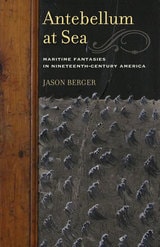
Antebellum at Sea
Maritime Fantasies in Nineteenth-Century AmericaJason Berger
University of Minnesota Press, 2012
In the antebellum years, the Western world’s symbolic realities were expanded and challenged as merchant, military, and scientific activity moved into Pacific and Arctic waters. In Antebellum at Sea, Jason Berger explores the roles that early nineteenth-century maritime narratives played in conceptualizing economic and social transitions in the developing global market system and what these chronicles disclose about an era marked by immense change.
Focusing on the work of James Fenimore Cooper and Herman Melville, Berger enhances our understanding of how the nineteenth century negotiated its own tenuous progress by portraying how a wide range of maritime stories lays bare disturbing experiences of the new. Berger draws on Slavoj Žižek’s Lacanian notion of fantasy in order to reconsider the complex way maritime accounts operated in the political landscape of antebellum America, examining topics such as the function of maritime labor know-how within a transformation of scientific knowledge, anxiety produced by conflict between gender-specific and culture-specific forms of enjoyment, and how legal practices illuminate troubling juridical paradoxes at the heart of Polk-era political life.
Addressing the ideas of the antebellum age from unexpected and revealing perspectives, Berger calls on the conception of fantasy to consider how antebellum maritime literature disputes conventional views of American history, literature, and national identity.

Anti-Apocalypse
Exercises in Genealogical CriticismLee Quinby
University of Minnesota Press, 1994
Anti-Apocalypse was first published in 1994. Minnesota Archive Editions uses digital technology to make long-unavailable books once again accessible, and are published unaltered from the original University of Minnesota Press editions.
As the year 2000 looms, heralding a new millennium, apocalyptic thought abounds-and not merely among religious radicals. In politics, science, philosophy, popular culture, and feminist discourse, apprehensions of the End appear in images of cultural decline and urban chaos, forecasts of the end of history and ecological devastation, and visions of a new age of triumphant technology or a gender-free utopia. There is, Lee Quinby contends, a threatening "regime of truth" prevailing in the United States-and this regime, with its enforcement of absolute truth and morality, imperils democracy. In Anti-Apocalypse, Quinby offers a powerful critique of the millenarian rhetoric that pervades American culture. In doing so, she develops strategies for resisting its tyrannies.
Drawing on feminist and Foucauldian theory, Quinby explores the complex relationship between power, truth, ethics, and apocalypse. She exposes the ramifications of this relationship in areas as diverse as jeanswear magazine advertising, the Human Genome project, contemporary feminism and philosophy, texts by Henry Adams and Zora Neale Hurston, and radical democratic activism. By bringing together such a wide range of topics, Quinby shows how apocalypse weaves its way through a vast network of seemingly unrelated discourses and practices. Tracing the deployment of power through systems of alliance, sexuality, and technology, Quinby reveals how these power relationships produce conflicting modes of subjectivity that create possibilities for resistance. She promotes a variety of critical stances—genealogical feminism, an ethics of the flesh, and "pissed criticism"—as challenges to apocalyptic claims for absolute truth and universal morality. Far-reaching in its implications for social and cultural theory as well as for political activism, Anti-Apocalypse will engage readers across the cultural spectrum and challenge them to confront one of the most subtle and insidious orthodoxies of our day.Lee Quinby is associate professor of English and American studies at Hobart and William Smith Colleges. She is the author of Freedom, Foucault, and the Subject of America (1991) and coeditor (with Irene Diamond) of Feminism and Foucault: Reflections on Resistance (1988).
Apocalypse South
Judgment, Cataclysm, and Resistance in the Regional ImaginaryAnthony Dyer Hoefer
The Ohio State University Press, 2012
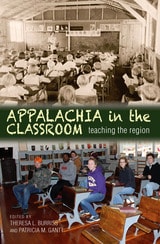
Appalachia in the Classroom
Teaching the RegionTheresa L. Burriss
Ohio University Press, 2013
Appalachia in the Classroom contributes to the twenty-first century dialogue about Appalachia by offering topics and teaching strategies that represent the diversity found within the region. Appalachia is a distinctive region with various cultural characteristics that can’t be essentialized or summed up by a single text.
Appalachia in the Classroom offers chapters on teaching Appalachian poetry and fiction as well as discussions of nonfiction, films, and folklore. Educators will find teaching strategies that they can readily implement in their own classrooms; they’ll also be inspired to employ creative ways of teaching marginalized voices and to bring those voices to the fore. In the growing national movement toward place-based education, Appalachia in the Classroom offers a critical resource and model for engaging place in various disciplines and at several different levels in a thoughtful and inspiring way.
Contributors: Emily Satterwhite, Elizabeth S. D. Engelhardt, John C. Inscoe, Erica Abrams Locklear, Jeff Mann, Linda Tate, Tina L. Hanlon, Patricia M. Gantt, Ricky L. Cox, Felicia Mitchell, R. Parks Lanier, Jr., Theresa L. Burriss, Grace Toney Edwards, and Robert M. West.
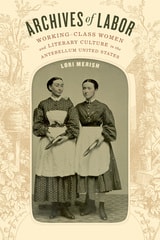
Archives of Labor
Working-Class Women and Literary Culture in the Antebellum United StatesLori Merish
Duke University Press, 2017
Arkansas, Arkansas Volume 1
Writers and Writings from the Delta to the Ozarks, 1541-1969John C. Guilds
University of Arkansas Press, 1999
Arkansas, Arkansas Volume 2
Writers and Writings from the Delta to the Ozarks,The Contemporary Scene, 1970–presentjohn Guilds
University of Arkansas Press, 1999
Articles on American Literature, 1950-1967
Lewis Leary
Duke University Press, 0
This compilation is collaborative; its core is a conflation of items based on the quarterly checklists of "Articles on American Literature Appearing in Current Periodicals" in American Literature from January 1951 through January 1958. Other items have been added frot the annual bibliographies in the Publications of the Modern Language Association of America, the American Quarterly, and the New England Quarterly. And finally, there have been added listings from other more specialized bibliographies on genres or authors.
The accumulated listings are arranged in a single author alphabet, with miscellaneous articles divided into convenient categories. That this volume is nearly twice the length of its predecessor is an indication of the burgeoning scholarship devoted to American literature in the last twenty years. It is of the greatest importance then that the scholar have the kind of comprehensive guide which will free him from the time -consuming task of searching out materials. Lewis Leary's book provides just such a guide.
Appearing concurrently with this volume is a reprinting of the popular Articles on American Literature 1900-1950, originally published in 1954. This compilation (itself a revision and extension of the 1947 Articles on American Literature Appearing in Current Periodicals, 1920-1945) is an alphabetical listing of articles on American literature, primarily in English, appearing in periodicals from 1900 through 1950.
As Sacred to Us
Simon Pokagon’s Birch Bark Stories in Their ContextsBlaire Morseau
Michigan State University Press, 2023
Ashes of the Mind
War and Memory in Northern Literature, 1865-1900Martin Griffin
University of Massachusetts Press, 2009
The memory of the American Civil War took many forms over the decades after the conflict ended: personal, social, religious, and political. It was also remembered and commemorated by poets and fiction writers who understood that the war had bequeathed both historical and symbolic meanings to American culture. Although the defeated Confederacy became best known for producing a literature of nostalgia and an ideological defensiveness intended to protect the South's own version of history, authors loyal to the Union also confronted the question of what the memory of the war signified, and how to shape the literary response to that individual and collective experience.
In Ashes of the Mind, Martin Griffin examines the work of five Northerners—three poets and two fiction writers—who over a period of four decades tried to understand and articulate the landscape of memory in postwar America, and in particular in that part of the nation that could, with most justification, claim the victory of its beliefs and values. The book begins with an examination of the rhetorical grandeur of James Russell Lowell's Harvard Commemoration Ode, ranges across Herman Melville's ironic war poetry, Henry James's novel of North-South reconciliation, The Bostonians, and Ambrose Bierce's short stories, and ends with the bitter meditation on race and nation presented by Paul Laurence Dunbar's elegy “Robert Gould Shaw.” Together these texts reveal how a group of representative Northern writers were haunted in different ways by the memory of the
conflict and its fraught legacy.
Griffin traces a concern with individual and community loss, ambivalence toward victory, and a changing politics of commemoration in the writings of Lowell, Melville, James, Bierce, and Dunbar. What links these very different authors is a Northern memory of the war that became more complex and more compromised as the century went on, often replacing a sense of justification and achievement with a perception of irony and failed promise.
Asian American Literature
An Introduction to the Writings and Their Social ContextElaine Kim
Temple University Press, 1984
Asian American Players
Masculinity, Literature, and the Anxieties of WarAudrey Wu Clark
The Ohio State University Press, 2023
The player is a womanizer, a trickster, a gambler—but can Asian American men fully participate in this kind of masculinity? In Asian American Players, Audrey Wu Clark showcases how the literary figure of the Asian American player unsettles the hegemony of white American masculinity through mimicry, even as that masculinity socially and politically alienates him. She examines gendered and racialized US militarism through works written during major postmodern American wars, investigating how books by John Okada, David Henry Hwang, Chang-rae Lee, Frances Khirallah Noble, and Viet Thanh Nguyen (re)fashion Asian American masculinity in ways that ultimately mimic masculinist American foreign policy and military strategies during corresponding wars. She unearths a dual picture of Asian American players: as traces of the anxiety of America’s quest for empowerment and continued military and industrial dominance in the international arena and as those tarred as inferior and disloyal outsiders within this mirrored global dominance. She thus finds new inroads into understanding US imperialism and militarism and identifies ways that key literary figures have written against insidious tropes.
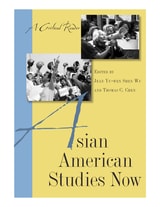
Asian American Studies Now
A Critical ReaderWu, Jean Yu-Wen Shen
Rutgers University Press, 2010
Jean Yu-wen Shen Wu and Thomas C. Chen have selected essays for the significance of their contribution to the field and their clarity, brevity, and accessibility to readers with little to no prior knowledge of Asian American studies. Featuring both reprints of seminal articles and groundbreaking texts, as well as bold new scholarship, Asian American Studies Now addresses the new circumstances, new communities, and new concerns that are reconstituting Asian America.

Asian American Studies
A ReaderEdited by Jean Yu-Wen Shen Wu and Min Song
Rutgers University Press, 2000
The reader is organized into two parts: "The Documented Past" and "Social Issues and Literature." Within these broad divisions, the subjects covered include Chinatown stories, nativist reactions, exclusionism, citizenship, immigration, community growth, Asia American ethnicities, racial discourse and the Civil Rights movement, transnationalism, gender, refugees, anti-Asian American violence, legal battles, class polarization, and many more.
Among the contributors are such noted scholars as Gary Okihiro, Michael Omi, Yen Le Espiritu, Lisa Lowe, and Ronald Takaki; writers such as Sui Sin Far, Bienvenido Santos, Sigrid Nunez, and R. Zamora Linmark, as well as younger, emerging scholars in the field.
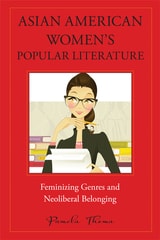
Asian American Women's Popular Literature
Feminizing Genres and Neoliberal BelongingPamela Thoma
Temple University Press, 2013
A volume in the American Literatures Initiative.
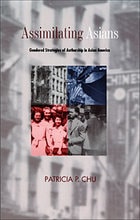
Assimilating Asians
Gendered Strategies of Authorship in Asian AmericaPatricia P. Chu
Duke University Press, 2000
Chu further demonstrates that Asian American male and female writers engage different strategies in the struggle to adapt, reflecting their particular, gender-based relationships to immigration, work, and cultural representation. While offering fresh perspectives on the well-known writings—both fiction and memoir—of Maxine Hong Kingston, Amy Tan, Bharati Mukherjee, Frank Chin, and David Mura, Assimilating Asians also provides new insight into the work of less recognized but nevertheless important writers like Carlos Bulosan, Edith Eaton, Younghill Kang, Milton Murayama, and John Okada. As she explores this expansive range of texts—published over the course of the last century by authors of Chinese, Japanese, Korean, Filipino, and Indian origin or descent—Chu is able to illuminate her argument by linking it to key historical and cultural events.
Assimilating Asians makes an important contribution to the fields of Asian American, American, and women’s studies. Scholars of Asian American literature and culture, as well as of ethnicity and assimilation, will find particular interest and value in this book.
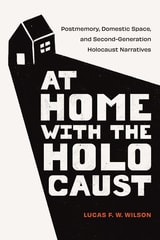
At Home with the Holocaust
Postmemory, Domestic Space, and Second-Generation Holocaust NarrativesLucas F. W. Wilson
Rutgers University Press, 2025
At Home, At War
Domesticity and World War I in American LiteratureJennifer Haytock
The Ohio State University Press, 2003
Atavistic Tendencies
The Culture of Science in American ModernityDana Seitler
University of Minnesota Press, 2008
A provocative exploration of the impact of the human sciences on literature, politics, and culture
The post-Darwinian theory of atavism forecasted obstacles to human progress in the reappearance of throwback physical or cultural traits after several generations of absence. In this original and stimulating work, Dana Seitler explores the ways in which modernity itself is an atavism, shaping a historical and theoretical account of its dramatic rise and impact on Western culture and imagination.
Examining late nineteenth- and early twentieth-century science, fiction, and photography, Seitler discovers how modern thought oriented itself around this paradigm of obsolescence and return—one that served to sustain ideologies of gender, sexuality, and race. She argues that atavism was not only a discourse of violence—mapping racial and sexual divisions onto the boundary between human and animal—but was also an illustration of how modern science understood human being as a temporal category. On one hand, atavism positioned some humans as more advanced than others on an evolutionary scale. On the other, it undermined such progressivism by suggesting that because all humans had evolved from animals they were therefore not purely human. Atavism thus reveals how scientific theories of a recurrent past were a significant feature of modernity.At the beginning of the twentieth century, atavistic theory had widespread social and economic effects on the taxonomies of medicine, the logic of the welfare state, conceptions of the modern family, and images of the abnormal. Investigating the cultural logic of science in conjunction with naturalist, feminist, and popular narratives, Seitler exposes the influence of atavism: a fundamental shift in ways of knowing—and telling stories about—the modern human.
Atlantic Double-Cross
American Literature and British Influence in the Age of EmersonRobert Weisbuch
University of Chicago Press, 1987
Describing the transatlantic "double-cross" of literary influence, Weisbuch documents both the American desire to create a literature distinctly different from English models and the English insistence that any such attempt could only fail. The American response, as he demonstrates, was to make strengths out of national disadvantages by rethinking history, time, and traditional concepts of the self, and by reinterpreting and ridiculing major British texts in mocking allusions and scornful parodies.
Weisbuch approaches a precise characterization of this "double-cross" by focusing on paired sets of English and American texts. Investigations of the causes, motives, and literary results of the struggle alternate with detailed analyses of several test cases. Weisbuch considers Melville's challenge to Dickens, Thoreau's response to Coleridge and Wordsworth, Hawthorne's adaptation of Keats and influence on Eliot, Whitman's competition with Arnold, and Poe's reshaping of Shelley. Adding a new dimension to the exploration of an emerging aesthetic consciousness, Atlantic Double-Cross provides important insights into the creation of the American literary canon.
Authentic Blackness
The Folk in the New Negro RenaissanceJ. Martin Favor
Duke University Press, 1999
Authentic Blackness looks at the place of the “folk”—those African Americans “furthest down,” in the words of Alain Locke—and how the representation of the folk and the black middle class both spurred the New Negro Movement and became one of its most serious points of contention. Drawing on vernacular theories of African American literature from such figures as Henry Louis Gates Jr. and Houston Baker as well as theorists Judith Butler and Stuart Hall, Favor looks closely at the work of four Harlem Renaissance fiction writers: James Weldon Johnson, Nella Larsen, George Schuyler, and Jean Toomer. Arguing that each of these writers had, at best, an ambiguous relationship to African American folk culture, Favor demonstrates how they each sought to redress the notion of a fixed black identity. Authentic Blackness illustrates how “race” has functioned as a type of performative discourse, a subjectivity that simultaneously builds and conceals its connections with such factors as class, gender, sexuality, and geography.