Results by title
4 books match the query 'Samurai'
Christian Converts and Social Protests in Meiji Japan
Irwin Scheiner
University of Michigan Press, 2002
Nowhere has there been a discussion of the confusion necessarily generated by the rapidity of the change or of the agony created in the lives of many whose attitudes, expectations, and even success depended on the continuance of now abolished institutions. Historians have ignored the settled conditions of most samurai and instead concentrated on the study of the minority of activist samurai leaders who, with the backing of only a few Han (feudal domains) sought to overthrow the old order and whose success in doing so has made the study of the modernization of Japan the prime concern of historians. The history of the Meiji period may have been an overall political and industrial success story, but for a fuller understanding of the conditions of that success it is also necessary to understand "what it was really like" for the members of the old elite to be estranged from the proponents of revolution and what many members did to assure their own social and psychological position in a world they had not expected.
In this book the author attempts to show that the impact of the Meiji Restoration destroyed the meaningfulness of the Confucian doctrine for these declasse samurai. Through Christianity, the samurai attempted to revive their status in society by finding a doctrine that offered a meaningful path to power. But in doing so, they had to accept a new theory of social relations. Ultimately, as the convert's understanding of society became totally informed by the Christian doctrine, they accepted a transcendent authority that brought them into conflict with society about them. Therefore, to understand the development of a Christian opposition in Meiji society we must begin with the conversion experience itself. [intro]
[more]
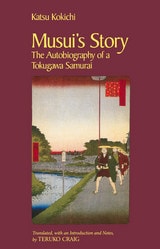
Musui's Story
The Autobiography of a Tokugawa SamuraiKokichi Katsu; Translated by Teruko Craig
University of Arizona Press, 1988
A series of picaresque adventures set against the backdrop of a Japan still closed off from the rest of the world, Musui's Story recounts the escapades of samurai Katsu Kokichi. As it depicts Katsu stealing, brawling, indulging in the pleasure quarters, and getting the better of authorities, it also provides a refreshing perspective on Japanese society, customs, economy, and human relationships.
From childhood, Katsu was given to mischief. He ran away from home, once at thirteen, making his way as a beggar on the great trunk road between Edo and Kyoto, and again at twenty, posing as the emissary of a feudal lord. He eventually married and had children but never obtained official preferment and was forced to supplement a meager stipend by dealing in swords, selling protection to shopkeepers, and generally using his muscle and wits.
Katsu's descriptions of loyalty and kindness, greed and deception, vanity and superstition offer an intimate view of daily life in nineteenth-century Japan unavailable in standard history books. Musui's Story will delight not only students of Japan's past but also general readers who will be entranced by Katsu's candor and boundless zest for life.
[more]
Samurai in the Land of the Gaucho
Transpacific Modernity and Nikkei Literature in ArgentinaKoichi Hagimoto
Vanderbilt University Press, 2023
Winner of the 2024 Marysa Navarro Best Book Prize, New England Council for Latin American Studies (NECLAS)
In the early twentieth century, historical imaginings of Japan contributed to the Argentine vision of “transpacific modernity." Intellectuals such as Eduardo Wilde and Manuel Domecq García celebrated Japanese customs and traditions as important values that can be integrated into Argentine society. But a new generation of Nikkei or Japanese Argentines is rewriting this conventional narrative in the twenty-first century. Nikkei writers such as Maximiliano Matayoshi and Alejandra Kamiya are challenging the earlier, unapologetic view of Japan based on their own immigrant experiences.
Compared to the experience of political persecution against Japanese immigrants in Brazil and Peru, the Japanese in Argentina generally lived under a more agreeable sociopolitical climate. In order to understand the "positive" perception of Japan in Argentine history and literature, Samurai in the Land of the Gaucho turns to the current debate on race in Argentina, particularly as it relates to the discourse of whiteness. One of the central arguments is that Argentina's century-old interest in Japan represents a disguised method of (re)claiming its white, Western identity.
Through close readings of diverse genres (travel writing, essay, novel, short story, and film) Samurai in the Land of the Gaucho yields a multi-layered analysis in order to underline the role Japan has played in both defining and defying Argentine modernity from the twentieth century to the present.
[more]
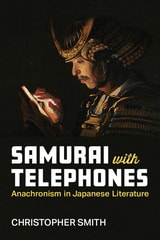
Samurai with Telephones
Anachronism in Japanese LiteratureChristopher Smith
University of Michigan Press, 2024
What is going on when a graphic novel has a twelfth-century samurai pick up a telephone to make a call, or a play has an ancient aristocrat teaching in a present-day schoolroom? Rather than regarding such anachronisms as errors, Samurai with Telephones develops a theory of how texts can use different types of anachronisms to challenge or rewrite history, play with history, or open history up to new possibilities. By applying this theoretical framework of anachronism to several Japanese literary and cultural works, author Christopher Smith demonstrates how different texts can use anachronism to open up history for a wide variety of different textual projects.
From the modern period, this volume examines literature by Mori Ōgai and Ōe Kenzaburō, manga by Tezuka Osamu, art by Murakami Takashi, and a variety of other pop cultural works. Turning to the Early Modern period (Edo period, 1600–1868), which produced a literature rich with playful anachronism, he also examines several Kabuki and Bunraku plays, kibyōshi comic books, and gōkan illustrated novels. In analyzing these works, he draws a distinction between anachronisms that attempt to hide their work on history and convincingly rewrite it and those conspicuous anachronisms that highlight and disrupt the construction of historical narratives.
From the modern period, this volume examines literature by Mori Ōgai and Ōe Kenzaburō, manga by Tezuka Osamu, art by Murakami Takashi, and a variety of other pop cultural works. Turning to the Early Modern period (Edo period, 1600–1868), which produced a literature rich with playful anachronism, he also examines several Kabuki and Bunraku plays, kibyōshi comic books, and gōkan illustrated novels. In analyzing these works, he draws a distinction between anachronisms that attempt to hide their work on history and convincingly rewrite it and those conspicuous anachronisms that highlight and disrupt the construction of historical narratives.
[more]