Results by title
2728 books match the query 'Education' and 268 start with a
A New Insurgency
The Port Huron Statement and Its TimesHoward Brick and Gregory Parker, eds.
Michigan Publishing Services, 2018
This volume features three never-before-published “manifesto drafts” written by Tom Hayden in early 1962 that generated the discussion leading to the Port Huron meeting. Other highlights include recollections from leading women in the Port Huron deliberations who, three years later, protested the subordination of women within the radical movements, thus setting the stage for the rise of women’s liberation. A New Insurgency is based on the University of Michigan’s conference commemorating the fiftieth anniversary of the Port Huron Statement in 2012.
“The fiftieth anniversary of the Port Huron Statement has drawn a great number of reflections and commemorations, but this carefully conceived volume offers an account of unrivaled ambition, exceptional breadth, and surprising insight. It both excavates the event itself—vividly, perceptively, exhaustively—and gives it the largest and most illuminating of contexts. A New Insurgency is as close to definitive as any volume of this kind can become.”
—Geoff Eley, Karl Pohrt Distinguished University Professor of Contemporary History, University of Michigan
A Perfect Mess
The Unlikely Ascendancy of American Higher EducationDavid F. Labaree
University of Chicago Press, 2017
And the best it is: today America’s universities and colleges produce the most scholarship, earn the most Nobel prizes, hold the largest endowments, and attract the most esteemed students and scholars from around the world. But this was not an inevitability. Weakly funded by the state, American schools in their early years had to rely on student tuition and alumni donations in order to survive. This gave them tremendous autonomy to seek out sources of financial support and pursue unconventional opportunities to ensure their success. As Labaree shows, by striving as much as possible to meet social needs and fulfill individual ambitions, they developed a broad base of political and financial support that, grounded by large undergraduate programs, allowed for the most cutting-edge research and advanced graduate study ever conducted. As a result, American higher education eventually managed to combine a unique mix of the populist, the practical, and the elite in a single complex system.
The answers to today’s problems in higher education are not easy, but as this book shows, they shouldn’t be: no single person or institution can determine higher education’s future. It is something that faculty, administrators, and students—adapting to society’s needs—will determine together, just as they have always done.
A Perfect Mess
The Unlikely Ascendancy of American Higher EducationDavid F. Labaree
University of Chicago Press, 2017
Read the news about America’s colleges and universities—rising student debt, affirmative action debates, and conflicts between faculty and administrators—and it’s clear that higher education in this country is a total mess. But as David F. Labaree reminds us in this book, it’s always been that way. And that’s exactly why it has become the most successful and sought-after source of learning in the world. Detailing American higher education’s unusual struggle for survival in a free market that never guaranteed its place in society—a fact that seemed to doom it in its early days in the nineteenth century—he tells a lively story of the entrepreneurial spirit that drove American higher education to become the best.
And the best it is: today America’s universities and colleges produce the most scholarship, earn the most Nobel prizes, hold the largest endowments, and attract the most esteemed students and scholars from around the world. But this was not an inevitability. Weakly funded by the state, American schools in their early years had to rely on student tuition and alumni donations in order to survive. This gave them tremendous autonomy to seek out sources of financial support and pursue unconventional opportunities to ensure their success. As Labaree shows, by striving as much as possible to meet social needs and fulfill individual ambitions, they developed a broad base of political and financial support that, grounded by large undergraduate programs, allowed for the most cutting-edge research and advanced graduate study ever conducted. As a result, American higher education eventually managed to combine a unique mix of the populist, the practical, and the elite in a single complex system.
The answers to today’s problems in higher education are not easy, but as this book shows, they shouldn’t be: no single person or institution can determine higher education’s future. It is something that faculty, administrators, and students—adapting to society’s needs—will determine together, just as they have always done.
A Pictorial History of the University of Iowa
An Expanded EditionJohn C. Gerber
University of Iowa Press, 1988

A Place of Our Own
The Rise of Reform Jewish CampingEdited by Michael M. Lorge and Gary P. Zola
University of Alabama Press, 2006
The history of educational summer camps in American Reform Judaism. Reform Judaism is not the only religious community in America to make the summer camp experience a vital part of a faith community's effort to impart its values and beliefs to its adolescents, but perhaps no group relied more on summer camp as an adjunct to home and community for this purpose. Summer camp became an important part of Reform group identity, a bulwark against the attraction of assimilation into the greater society and mere nominal Judaism.
These essays, which commemorate the fiftieth anniversary of the founding of the first Reform Jewish educational camp in the United States (Olin-Sang-Ruby Union Institute [OSRUI], in Oconomowoc, Wisconsin) cover a wide range of topics related to both the Reform Judaism movement and the development of the Reform Jewish camping system in the United States. Donald M. Splansky’s chapter on “Prayer at Reform Jewish Camps” documents changes in prayer services that took place both at OSRUI and in the Reform movement in general; Michael Zeldin’s “Making the Magic in Reform Jewish Summer Camps” describes the educational philosophies employed at many camps and analyzes their effectiveness; and Jonathan D. Sarna’s “The Crucial Decade in Jewish
A Practical Guide to Assessing English Language Learners
Christine Coombe, Keith Folse, and Nancy Hubley
University of Michigan Press, 2007
Tips to improve students’ test-taking strategies are offered, and each chapter ends with a helpful list of Ten Things to Remember, as well as informative case studies featuring two teachers and their assessment decisions. Incorporating its own principles, A Practical Guide to Assessing English Language Learners opens with a short quiz for the reader called Are You Testwise? that quickly determines how each teacher will benefit from this indispensable guide.

A Preface to Theology
W. Clark Gilpin
University of Chicago Press, 1996
Gilpin approaches this goal indirectly, by investigating the historic social roles of Protestant theologians and the educational institutions in which they have pursued their scholarship and teaching. Ranging from analyses of the New England Puritan Cotton Mather to contemporary theologians as "public intellectuals," Gilpin proposes that we find out what theology is by asking what theologians do.
By showing how particular cultural problems have always shaped the work of theologians, Gilpin's work profoundly illuminates the foundations of American academic theology, providing insights that will help guide its future.
A Primer for Teaching African History
Ten Design PrinciplesTrevor R. Getz
Duke University Press, 2018
A Primer for Teaching Digital History
Ten Design PrinciplesJennifer Guiliano
Duke University Press, 2022
A Primer for Teaching Indian Ocean World History
Ten Design PrinciplesEdward A. Alpers and Thomas F. McDow
Duke University Press, 2024
A Primer for Teaching Pacific Histories
Ten Design PrinciplesMatt K.Matsuda
Duke University Press, 2020
A Problem of Fit
How the Complexity of College Pricing Hurts Students—and UniversitiesPhillip B. Levine
University of Chicago Press, 2022
How much does it cost to attend college in the United States today? The answer is more complex than many realize. College websites advertise a sticker price, but uncovering the actual price—the one after incorporating financial aid—can be difficult for students and families. This inherent uncertainty leads some students to forgo applying to colleges that would be the best fit for them, or even not attend college at all. The result is that millions of promising young people may lose out on one of society’s greatest opportunities for social mobility. Colleges suffer too, losing prospective students and seeing lower enrollments and less socioeconomic diversity. If markets require prices to function well, then the American higher-education system—rife as it is with ambiguity in its pricing—amounts to a market failure.
In A Problem of Fit, economist Phillip B. Levine explains why institutions charge the prices they do and discusses the role of financial aid systems in facilitating—and discouraging—access to college. Affordability issues are real, but price transparency is also part of the problem. As Levine makes clear, our conversations around affordability and free tuition miss a larger truth: that the opacity of our current college-financing systems is a primary driver of inequities in education and society. In a clear-eyed assessment of educational access and aid in a post-COVID-19 economy, A Problem of Fit offers a trenchant new argument for educational reforms that are well within reach.

A Professional Professoriate
Unionization, Bureaucratization, and the AAUPPhilo A. Hutcheson
Vanderbilt University Press, 2000
Hutcheson examines how tensions between the requirements of institutional bureaucracies and the norms of the academic profession resulted in contentiousness and conflict within the national AAUP, between administrators and faculty members on individual campuses, within the ranks of faculties themselves, and even deep in the consciences of many concerned individuals. The book analyzes the association's ability to respond effectively and to balance the values of collegial representation with the powers of collective bargaining. It thus offers a detailed and authoritative examination of the AAUP's search for ways to sustain professionalism while dealing with the fundamental changes in the nature of the professoriate in the post-World War II era.
A Professor at the End of Time
The Work and Future of the ProfessoriateBest, John
Rutgers University Press, 2017
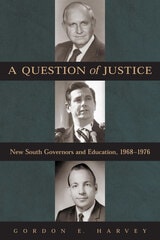
A Question of Justice
New South Governors and Education, 1968-1976Gordon E. Harvey
University of Alabama Press, 2005
The governors who used education to transform the modern South.
In southern politics, 1970 marked a watershed. A group of southern governors entered office that year and changed both the way the nation looked at the South and the way the constituents of those states viewed themselves. Reubin Askew in Florida, John West in South Carolina, Jimmy Carter in Georgia, and Albert Brewer in Alabama all represented a new breed of progressive moderate politician that helped demolish Jim Crow segregation and the dual economies, societies, and educational systems notorious to the Sunbelt South. Historian Gordon Harvey explores the political lives and legacies of three of these governors, examining the conditions that led to such a radical change in political leadership, the effects their legislative agendas had on the identity of their states, and the aftermath of their terms in elected office.
A common thread in each governor's agenda was educational reform. Albert Brewer's short term as Alabama governor resulted in a sweeping education package that still stands as the most progressive the state has seen. Reubin Askew, far more outspoken than Brewer, won the Florida gubernatorial election through a campaign that openly promoted desegregation, busing, and tax reform as a means of equal school funding. John West's commitment to a policy of inclusion helped allay fears of both black and white parents and made South Carolina's one of the smoothest transitions to integrated schools.
As members of the first generation of New South governors, Brewer, Askew, and West played the role of trailblazers. Their successful assaults on economic and racial injustice in their states were certainly aided by such landmark events as Brown v. Board of Education, the civil rights movement, and the expansion of voting rights-all of which sounded the death knell for the traditional one-party segregated South. But in this critical detailing of their work for justice, we learn how these reform-minded men made education central to their gubernatorial terms and, in doing so, helped redefine the very character of the place they called home.

A Reason Open to God
Pope Benedict XVI Brown
Catholic University of America Press, 2013

A Reflective Practitioner's Guide to (Mis)Adventures in Drama Education - or - What Was I Thinking?
Edited by Peter Duffy
Intellect Books, 2015
A Road Course in Early American Literature
Travel and Teaching from Atzlán to AmherstThomas Hallock
University of Alabama Press, 2021
Essays that fuse literary scholarship and personal travelogue to explore American identity
A Road Course in Early American Literature: Travel and Teaching from Atzlán to Amherst explores a two-part question: what does travel teach us about literature, and how can reading guide us to a deeper understanding of place and identity? Thomas Hallock charts a teacher’s journey to answering these questions, framing personal experiences around the continued need for a survey course covering early American literature up to the mid-nineteenth century.
Hallock approaches literary study from the overlapping perspectives of pedagogue, scholar, unrepentant tourist, husband, father, friend, and son. Building on Ralph Waldo Emerson’s premise that there is “creative reading as well as creative writing,” Hallock turns to the vibrant and accessible tradition of American travel writing, employing the form of biblio-memoir to bridge the impasse between public and academic discourse and reintroduce the dynamic field of early American literature to wider audiences.
Hallock’s own road course begins and ends at the Low country of Georgia and South Carolina, following a circular structure of reflection. He weaves his journey through a wide swath of American literatures and authors: from Native American and African American oral traditions, to Wheatley and Equiano, through Emerson, Poe, and Dickinson, among others. A series of longer, place-oriented narratives explore familiar and lesser-known literary works from the sixteenth-century invasion of Florida through the Mexican War of 1846–1848 and the American Civil War. Shorter chapters bridge the book’s central themes—the mapping of cognitive and physical space, our personal stake in reading, the tensions that follow earlier acts of erasure, and the impossibility of ever fully shutting out the past.
Exploring complex cultural histories and contemporary landscapes filled with ghosts and new voices, this volume draws inspiration from a tradition of travel, place-oriented, and literature-based works ranging from William Carlos Williams’s In the American Grain and Jack Kerouac’s On the Road to Alice Walker’s In Search of Our Mother’s Gardens, Wendy Lesser’s Why I Read: The Serious Pleasure of Books, and Rebecca Mead’s My Life in Middlemarch.
An accompanying bibliographic essay is periodically updated and available at Hallock’s website: www.roadcourse.us.

A Second Home
Missouri's Early SchoolsSue Thomas
University of Missouri Press, 2006
The one-room schoolhouse may be a thing of the past, but it is the foundation on which modern education rests. Sue Thomas now traces the progress of early education in Missouri, demonstrating how important early schools were in taming the frontier.
A Second Home offers an in-depth and entertaining look at education in the days when pioneers had to postpone schooling for their children until they could provide shelter for their families and clear their fields for crops, while well-to-do families employed tutors or sent their children back east. Thomas tells of the earliest known English school at the Ramsay settlement near Cape Girardeau, then of the opening of a handful of schools around the time of the Louisiana Purchase—such as Benjamin Johnson’s school on Sandy Creek, Christopher Schewe’s school for boys when St. Louis was still a village, and the Ste. Genevieve Academy, where poor and Indian children were taught free of charge. She describes how, as communities grew, additional private schools opened—including “dame schools,” denominational schools, and subscription schools—until public education came into its own in the 1850s.
Drawing on oral histories collected throughout the state, as well as private diaries and archival research, the book is full of firsthand accounts of what education once was like—including descriptions of the furnishings, teaching methods, and school-day activities in one-room log schools. It also includes the experiences of former slaves and free blacks following the Civil War when they were newly entitled to public education, with discussions of the contributions of John Berry Meachum, James Milton Turner, and other African American leaders.
With its remembrances of simpler times, A Second Home tells of community gatherings in country schools and events such as taffy pulls and spelling bees, and offers tales of stern teachers, student pranks, and schoolyard games. Accompanying illustrations illuminate family and school life in the colonial, territorial, early statehood, and post-Civil War periods. For readers who recall older family members’ accounts or who are simply fascinated by the past, this is a book that will conjure images of a bygone time while opening a new window on Missouri history.
A Setting For Excellence, Part II
The Story of the Planning and Development of the Ann Arbor Campus of the University of MichiganFrederick W. Mayer
University of Michigan Press, 2017
By tracing the development of the Ann Arbor campus from its early days to the present, within the context of the evolution of higher education in America, Mayer provides a strong argument for the importance of rigorous and enlightened campus planning as a critical element of the learning environment of the university. His comprehensive history of campus planning, illustrated with photos, maps, and diagrams from Michigan’s history, is an outstanding contribution to the university’s history as it approaches its bicentennial.
A Setting For Excellence
The Story of the Planning and Development of the Ann Arbor Campus of the University of MichiganFrederick W. Mayer
University of Michigan Press, 2015
By tracing the development of the Michigan campus from its early days to the present, within the context of the evolution of higher education in America, Mayer provides a strong argument for the importance of rigorous and enlightened campus planning as a critical element of the learning environment of the university. His comprehensive history of campus planning, illustrated with photos, maps, and diagrams from Michigan’s history, is an outstanding contribution to the university’s history as it approaches its bicentennial in 2017. Perhaps more important, Mayer’s book provides a valuable treatise on the evolution of campus planning as an architectural discipline.
A Shared History
Writing in the High School, College, and University, 1856-1886Amy J. Lueck
Southern Illinois University Press, 2020
Lueck explores Civil War- and Reconstruction-era challenges to the University of Louisville and nearby local high schools, their curricular transformations, and their fate in regard to national education reform efforts. These institutions reflect many of the educational trends and developments of the day: college and university building, the emergence of English education as the dominant curriculum for higher learning, student-centered pedagogies and educational theories, the development and transformation of normal schools, the introduction of manual education and its mutation into vocational education, and the extension of advanced education to women, African American, and working-class students.
Lueck demonstrates a complex genealogy of interconnections among high schools, colleges, and universities that demands we rethink our categories and standards of assessment and our field’s history. A shift in our historical narrative would promote a move away from an emphasis on the preparation, transition, and movement of student writers from high school to college or university and instead allow a greater focus on the fostering of rich rhetorical practices and pedagogies at all educational levels. As the definition of college-level writing becomes increasingly contested once again, Lueck invites a reassessment of the discipline’s understanding of contemporary programs based in high schools like dual-credit and concurrent enrollment.
A Sourcebook for Ancient Greek
Grammar, Poetry, and ProseJohn Tomarchio
Catholic University of America Press, 2022
A Sourcebook for Classical Rhetoric
John Tomarchio
Catholic University of America Press, 2023
A Sourcebook for English Lyric Poetry
John Tomarchio
Catholic University of America Press, 2023
A Student's Guide to Law School
What Counts, What Helps, and What MattersAndrew B. Ayers
University of Chicago Press, 2013
As a recent graduate and an appellate lawyer, Andrew Ayers knows how high the stakes are—he’s been there, and not only did he survive the experience, he graduated first in his class. In A Student’s Guide to Law School he shares invaluable insight on what it takes to make a successful law school journey. Originating in notes Ayers jotted down while commuting to his first clerkship with then-Judge Sonia Sotomayor, and refined throughout his first years as a lawyer, A Student’s Guide to Law School offers a unique balance of insider’s knowledge and professional advice.
Organized in four parts, the first part looks at tests and grades, explaining what’s expected and exploring the seven choices students must make on exam day. The second part discusses the skills needed to be a successful law student, giving the reader easy-to-use tools to analyze legal materials and construct clear arguments.
The third part contains advice on how to use studying, class work, and note-taking to find your best path. Finally, Ayers closes with a look beyond the classroom, showing students how the choices they make in law school will affect their career—and even determine the kind of lawyer they become.
The first law school guide written by a recent top-ranked graduate, A Student’s Guide to Law School is relentlessly practical and thoroughly relevant to the law school experience of today’s students. With the tools and advice Ayers shares here, students can make the most of their investment in law school, and turn their valuable learning experiences into a meaningful career.
A Student-Friendly Guide to Move from Civil Law to U.S. Common Law
Nancy Daspit and Kirsten Schaetzel
University of Michigan Press, 2025
To help students who may feel overwhelmed adjusting to a new approach to legal education, this book focuses on these key differences between civil law and common law jurisdictions. It defines and demonstrates the application of key concepts with examples, illustrations, and exercises. While relatively brief, it provides numerous references to the other texts and sources for students wanting or needing more depth for some of the topics. The book also includes numerous examples illustrating the differences, with an emphasis on common law examples, of key documents and processes used in the practice of law. Further, it includes student-focused exercises and questions on the analytical and rhetorical skills needed for a successful law practice, whether the student will continue in a common law jurisdiction or merely needs to understand the common law for continued practice in their civil law jurisdiction.
Within this book, students will find
- a brief historical background regarding the development of the common law system;
- a description of the US government structure, with an emphasis on the judicial branch;
- key rhetorical and analytical differences between civil law and common law;
- numerous examples of differences between the two systems, with an emphasis on common law requirements;
- and exercises for practice with key concepts and terminology.
A Task for Sisyphus
Why Europe’s Roma Policies FailIulius Rostas
Central European University Press, 2020
A Taste for Language
Literacy, Class, and English StudiesJames Ray Watkins Jr.
Southern Illinois University Press, 2009
“This is a book about the American Dream as it has become embodied in the university in general and in the English department in particular,” writes James Ray Watkins at the start of A Taste for Language: Literacy, Class, and English Studies. In it, Watkins argues that contemporary economic and political challenges require a clear understanding of the identity of English studies, making elementary questions about literacy, language, literature, education, and class once again imperative.
A personal history of university-level English studies in the twentieth century, A Taste for Language combines biography, autobiography, and critical analysis to explore the central role of freshman English and literary studies in the creation and maintenance of the middle class. It tells a multi-generational story of the author and his father, intertwined with close reading of texts and historical analysis. The story moves from depression-era Mississippi, where the author's father was born, to a contemporary English department, where the author now teaches.
Watkins looks at not only textbooks, scholars, and the academy but also at families and other social institutions. A rich combination of biography, autobiography, and critical analysis, A Taste for Language questions what purpose an education in English language and literature serves in the lives of the educated in a class-based society and whether English studies has become wholly irrelevant in the twenty-first century.

A Teaching Subject
Composition Since 1966, New EditionJoseph Harris
Utah State University Press, 2012
In this classic text, Joseph Harris traces the evolution of college writing instruction since the Dartmouth Seminar of 1966. A Teaching Subject offers a brilliant interpretive history of the first decades during which writing studies came to be imagined as a discipline separable from its partners in English studies. Postscripts to each chapter in this new edition bring the history of composition up to the present.
Reviewing the development of the field through five key ideas, Harris unfolds a set of issues and tensions that continue to shape the teaching of writing today. Ultimately, he builds a case, now deeply influential in its own right, that composition defines itself through its interest and investment in the literacy work that students and teachers do together. Unique among English studies fields, composition is, Harris contends, a teaching subject.
A Third University Is Possible
la la paperson
University of Minnesota Press, 2017
A Third University is Possible unravels the intimate relationship between the more than 200 US land grant institutions, American settler colonialism, and contemporary university expansion. Author la paperson cracks open uncanny connections between Indian boarding schools, Black education, and missionary schools in Kenya; and between the Department of Homeland Security and the University of California. Central to la paperson’s discussion is the “scyborg,” a decolonizing agent of technological subversion.
Drawing parallels to Third Cinema and Black filmmaking assemblages, A Third University is Possible ultimately presents new ways of using language to develop a framework for hotwiring university “machines” to the practical work of decolonization.
Forerunners: Ideas First is a thought-in-process series of breakthrough digital publications. Written between fresh ideas and finished books, Forerunners draws on scholarly work initiated in notable blogs, social media, conference plenaries, journal articles, and the synergy of academic exchange. This is gray literature publishing: where intense thinking, change, and speculation take place in scholarship.
A Time for Wisdom
Knowledge, Detachment, Tranquility, TranscendencePaul T. McLaughlin
Templeton Press, 2022
These are volatile times. Fear, suspicion, and cynicism are chronic. A mere tweet inflames the passions of millions while click-bait “hot takes” stoke the amygdalas of everyone with an Internet connection. We treat those not in our tribe as a threat and deem anyone with a different opinion as evil. Mistaking myopia for measure, we lack all sense of proportion in our judgments. We are shortsighted, mired in the present, ignorant of history, and blind to the future. We thought that technology would save us by connecting us to each other and the world’s information. Instead, it enticed our vices, encouraged our biases, and eroded the one virtue we need now more than ever: wisdom.
A Time for Wisdom is for readers who feel beleaguered by the incivility of the modern world, dispirited by its coarse rhetoric and toxic partisanship. It is an invitation to escape the shallow cacophony and restore peace and perspective to our daily lives. Written by two psychologists, the book takes the best scientific research on wisdom and integrates it with timeless concepts that have, for ages, guided troubled souls through life’s hardships. From this foundation, the authors present four steps we can follow to practice wisdom in the 21st Century:
- Receiving knowledge.
- Practicing detachment.
- Experiencing tranquility.
- Cultivating transcendence.
These are profound and spiritual principles that can bring us immense satisfaction when we aspire to live by them.
In A Time for Wisdom, the authors show us how. They commend a course of action towards the Good, the True, and the Beautiful, towards calm and clear moral reasoning. They lead us out of the circus of contemporary life and show us a path beyond our petty self-centeredness. By journeying along that path, we can, like the great sages and scientists before us, rise above the immediacy of the moment and partake of the numinous and the infinite.
A University Looks at its Program
The Report of the University of Minnesota Bureau of Institutional Research, 1942-1952Ruth Eckert
University of Minnesota Press, 1954
A University for the 21st Century
James J. Duderstadt
University of Michigan Press, 2000
A Way With Words
Style in the Age of Artificial IntelligenceJohn Marsh
University of Michigan Press, 2026
Using examples from papers students might actually write, the book invites readers to apply what they have learned to quizzes that mix and match issues—vague pronouns, sentence fragments, punctuating quotations—from previous chapters. The book includes a thoughtful discussion about balancing the competing demands of writing well and fighting linguistic discrimination. Finally, A Way with Words prompts readers to consider what artificial intelligence programs like ChatGPT and Bard will mean for student writing. It offers advice about how writers can distinguish their writing from the assembly-line writing that artificial intelligence tends to generate, and how they can develop their style to stand out to their teachers, employers, and clients.
ABC Learning Design
Active, Blended, Connected and BeyondEdited by Clive Young, Nataša Perovic, Leo Havemann, and Karen Shackleford-Cesare
University College London, 2026
A practical, step-by-step guide to the ABC Learning Design method, designed for local adaptation and readily transferable across institutions committed to educational reform.
ABC Learning Design is a popular and effective rapid design method for developing educational programs, modules, and short courses that has been widely adopted across the UK and Europe. This book introduces ABC Learning Design to a new audience, adding insights from institutions that have localised and implemented the method in diverse contexts.
ACCESS
Multiple Avenues for Deaf PeopleDoreen DeLuca
Gallaudet University Press, 2008
The companion to Signs and Voices: Deaf Culture, Identity, Language, and Arts, this volume presents an accomplished group of contributors who address the major technological, institutional, and societal advances in access for deaf people, as well as the remaining hurdles. Part One: Assistive Technologies begins with Maggie Casteel’s description of the latest innovative hearing assistive technology. Al Sonnenstrahl discusses his career as a deaf engineer who segued into advocating for equal access in telecommunications. Robert C. O’Reilly, Amanda J. Mangiardi, and H. Timothy Bunnell outline the process of cochlear implantation in children.
Jami N. Fisher and Philip J. Mattiacci open Part Two: Education and Literacy by examining civil rights issues in education. Michael Stinson considers the conflict that inclusion creates in developing a deaf identity. Lisa Herbert discusses her identity as a signing deaf person who also has a cochlear implant. Grace Walker focuses on her experiences with a cochlear implant that eventually led her to stop using it.
In the final section, Part Three: Civil Rights, Christy Hennessey describes her work as an advocate and job placement counselor with deaf and hard of hearing people. Tony Saccente discusses HIV/AIDs counseling to the deaf gay community. Leila Monaghan follows by reviewing recent studies of deaf attitudes towards HIV/AIDs. Greg Hlibok concludes with his commentary on leading the Deaf President Now! movement and its subsequent effects on deaf civil rights.
AESTHETICS & EDUCATION
Michael J. Parsons and H. Gene Blocker
University of Illinois Press, 1993
What is the appropriate content of aesthetics for students of art at different age levels? How can it best be taught? How should it be combined with studio work and other art disciplines?
Michael J. Parsons and H. gene Blocker answer these and other questions in a volume designed to help art educators, potential educators, and curriculum developers integrate aesthetics into the study of art in the school curriculum. The two introduce some of the philosophical problems and questions in art, encouraging teachers and others to form a personal outlook on these issues.
AESTHETICS AND ARTS EDUCATION
Edited by Ralph A. Smith and Alan Simpson
University of Illinois Press, 1991
Ab Initio Language Teaching in British Higher Education
The Case of GermanEdited by Ulrike Bavendiek, Silke Mentchen, Christian Mossmann, and Dagmar Paulus
University College London, 2022
As entries for UK school exams in modern foreign languages decrease, this book serves the urgent need for research and guidance on ab initio learning and teaching in higher education. Drawing extensively on the expertise of teachers of German in universities across the UK, the volume offers an overview of recent trends, new pedagogical approaches, and practical guidance for teaching languages at the beginners’ level in the higher education classroom that will be useful for teachers of both German and other languages.
The first chapters assess the role of ab initio provision within the wider context of modern language departments and language centers. They are followed by sections on teaching methods and approaches in the ab initio classroom, including the use of music, textbook evaluation, effective use of flipped classrooms, and the contribution of language apps. Finally, the book focuses on the learner in the ab initio context and explores issues around autonomy and learner strengths.
Abstracts and the Writing of Abstracts
John M. Swales and Christine B. Feak
University of Michigan Press, 2009
Today's research world demands a variety of different abstracts to serve different purposes. As a result, writing abstracts can be a difficult task for graduate and international students, researchers, and even practiced authors. Abstracts and the Writing of Abstracts is designed to demystify the construction of this essential writing form and to equip scholars with the skills to summarize their work in clear and compelling ways.
This volume represents a revision and expansion of the material on writing abstracts that appeared in English in Today's Research World.
The Abstracts volume focuses on abstracts for research articles before addressing abstracts for short communications, conferences, and PhD dissertations. It also covers keywords, titles, and author names. Wherever appropriate within the text, Language Focus sections discuss options and provide tips for meeting specific linguistic challenges posed by the writing of different types of abstracts.
Academic Ableism
Disability and Higher EducationJay Timothy Dolmage
University of Michigan Press, 2017
Academic Ableism
Disability and Higher EducationJay Timothy Dolmage
University of Michigan Press, 2017
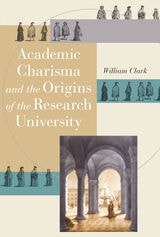
Academic Charisma and the Origins of the Research University
William Clark
University of Chicago Press, 2005
William Clark argues that the research university—which originated in German Protestant lands and spread globally in the nineteenth and twentieth centuries—developed in response to market forces and bureaucracy, producing a new kind of academic whose goal was to establish originality and achieve fame through publication. With an astonishing wealth of research, Academic Charisma and the Origins of the Research University investigates the origins and evolving fixtures of academic life: the lecture catalogue, the library catalog, the grading system, the conduct of oral and written exams, the roles of conversation and the writing of research papers in seminars, the writing and oral defense of the doctoral dissertation, the ethos of "lecturing with applause" and "publish or perish," and the role of reviews and rumor. This is a grand, ambitious book that should be required reading for every academic.
Academic Disciplines
Holland's Theory and the Study of College Students and FacultyJohn C. Smart
Vanderbilt University Press, 2000
Using as a framework the "theory of careers" developed by John L. Holland, the authors of this volume examine the patterns of student stability and change inherent in the college experience, as well as the variations in professional attitudes and behaviors of college faculty. Their goal is to learn more about what colleges and universities might do to facilitate the retention, satisfaction, and learning of their students.
For example, why should faculties split over student-oriented teaching strategies, one group favoring the formal, structured classroom, the other a freer, more spontaneous environment? Why do some undergraduates become independent thinkers with strong analytical, mathematical, and scientific competencies while others develop powerful interpersonal and group leadership skills?
Holland's theory--at its core a person-environment fit theory--assumes that there are six personality types and six analogous academic environments and that the educational persistence, satisfaction, and achievement of students are a function of the congruence or "fit" between students and their academic environments. The authors also assume that there are circumstances under which the environments of the major field exert more influence on students than do the students' own personality traits. Applying Holland's theory to distinctive clusters of academic disciplines, the authors have found that the answers to such fundamental questions as those asked above emanate from a basic understanding of the influences of academic disciplines and the manner by which they shape the patterns of thought and behavior of both college students and faculty.
Academic Disciplines will benefit researchers and graduate students who study college students and faculty, as well as administrators and policymakers responsible for the performance of colleges and universities.

Academic Engagement in Public and Political Discourse
Proceedings of the Michigan Meeting, May 2015Andrew J. Hoffman, Kirsti Ashworth, Chase Dwelle, Peter Goldberg, Andrew Henderson, Louis Merlin, Yulia Muzyrya, Norma-Jean Simon, Veronica Taylor, Corinne Weisheit, and Sarah Wilson
Michigan Publishing Services, 2015
To answer these questions and many more, the University of Michigan hosted a Michigan Meeting that involved over 40 speakers, including 4 University Presidents, and 225 registrants. This report summarizes that three-day meeting with a focus on four key themes. First, what is engagement and should we do it? Second, what are the ground rules for public and political engagement? Third, what are some models that have worked and what can we learn from them? Fourth and finally, what are the obstacles to engagement and how can they be overcome?
Academic Freedom in a Plural World
Global Critical PerspectivesFrédéric Mégret
Central European University Press, 2024
The notion of academic freedom dates back to the creation of universities and has long been understood to be central to their vocation. This freedom has come under attack by different actors throughout its history. In the current context, rising threats to democracy and human liberties, the corporatization of research, concerns about diversity and increased societal polarization, are putting a considerable pressure on its exercise. However, academic freedom is also a concept that suffers from persistent ambiguities associated with the general notion of freedom as well as debates about the function of universities.
This edited collection addresses the question of academic freedom by situating it in its broader global context. More conceptual treatments contribute to an understanding of academic freedom as distinct and separate from, although related to, freedom of expression, or student rights. These conceptual treatments are combined with studies of actual struggles over the scope of academic freedom in specific universities. The contributions come from a broad variety of sites seek to deprovincialize the conversation beyond North America or the English-speaking world.
Academic Freedom
The Global ChallengeMichael Ignatieff
Central European University Press, 2018
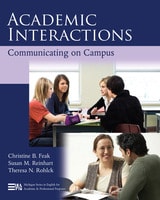
Academic Interactions
Communicating on CampusChristine B. Feak, Susan M. Reinhart, and Theresa N. Rohlck
University of Michigan Press, 2018
This version of the book matches 9780472033324 except it is not packaged with a DVD. All references to the DVD in the text have been replaced with "videos." Video access sold separately on Vitalsource, here: https://www.vitalsource.com/products/videos-to-accompany-academic-interactions-christine-b-feak-susan-m-v9780472003631?term=9780472003631.
The ability to understand and be understood when communicating with professors and with native speakers is crucial to academic success. Academic Interactions focuses on actual academic speaking events, particularly classroom interactions and office hours, and gives students practice improving the ways that they communicate in a college/university setting.
Academic Interactions addresses skills like using names and names of locations correctly on campus, giving directions, understanding instructors and their expectations, interacting during office hours, participating in class and in seminars, and delivering formal and informal presentations. In addition, advice is provided for communicating via email with professors and working in groups with native speakers (including negotiating tasks in groups).
The text uses transcripts from MICASE (the Michigan Corpus of Academic Spoken English) to ensure that students learn the vocabulary and communication strategies that will be most effective in their academic pursuits. Units also feature language use issues like ellipsis, hedging, and apologies.
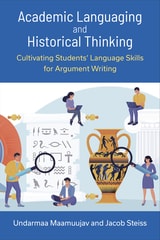
Academic Languaging and Historical Thinking
Cultivating Students' Language Skills for Argument WritingUndarmaa Maamuujav and Jacob Steiss
University of Michigan Press, 2026
Starting with a pedagogical approach, the book takes readers through research on the relationship between language and writing, the ways that historians make claims and the kinds of evidence they use, and how to successfully find and evaluate sources. It then offers instructional activities and strategies that center around key disciplinary practices in historical argumentation: making claims, sourcing and integrating evidence, presenting reasoning, and addressing counterarguments. These activities can be easily modified for different teaching and learning contexts, including supporting multilingual learners of English. Whether readers are practicing teachers, pre-service teachers, or instructional coaches, this book will help them learn how to integrate academic language skills with argument writing instruction in history to teach students to be confident academic writers and competent language users.