Results by title
3388 books match the query 'Fiction' and 293 start with a
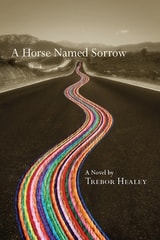
A Horse Named Sorrow
Trebor Healey
University of Wisconsin Press, 2012
Award-winning novelist Trebor Healey depicts San Francisco in the 1980s and ’90s in poetic prose that is both ribald and poignant, and a crossing into the American West that is dreamy, mythic, and visionary.
When troubled twenty-one-year-old Seamus Blake meets the strong and self-possessed Jimmy (just arrived in San Francisco by bicycle from his hometown in Buffalo, New York), he feels his life may finally be taking a turn for the better. But the ensuing romance proves short-lived as Jimmy dies of an AIDS-related illness. The grieving Seamus is obliged to keep a promise to Jimmy: “Take me back the way I came.”
And so Seamus sets out by bicycle on a picaresque journey with the ashes, hoping to bring them back to Buffalo. He meets truck drivers, waitresses, college kids, farmers, ranchers, Marines, and other travelers—each one giving him a new perspective on his own life and on Jimmy’s death. When he meets and becomes involved with a young Native American man whose mother has recently died, Seamus’s grief and his story become universal and redemptive.
A Jest of God
Margaret Laurence
University of Chicago Press, 1993
Winner of the Governor General's Literary Award, A Jest of God was also the basis of the movie Rachel, Rachel.
"Mrs. Laurence tells [her story] unsparingly, with absolute authority, using her thorough understanding of Rachel to draw us into her anguish. We know Rachel, sympathize with her, and in a sense, become Rachel, so authentic is her voice. . . . A Jest of God has extraordinary clarity, beautiful detail, as well as the emotional impact of honest confession."—Joan J. Hall, Saturday Review
"Laurence's rendition is close to faultless . . . reaffirming her ability to draw, without pathos, life-sized women. . . . Skillfully wrought and eloquently told."—Marilyn Gardner, Christian Science Monitor
One of Canada's most accomplished writers, Margaret Laurence(1926-1987) was the recipient of many awards, including the prestigious Governer General's Litarary Award for The Diviners and A Jest of God.
A Kind of Dream
StoriesKelly Cherry
University of Wisconsin Press, 2014
The selves in this book include Nina, a writer, and her husband, Palmer, a historian, who, having settled into marriage and family life, are now faced with the bittersweetness of late life; BB and Roy, who make a movie in Mongolia; Tavy, Nina’s adopted daughter, a painter in her twenties who meets her birth mother for the first time; and Tavy’s young daughter, Callie, a budding violinist. Other vivid characters confront the awful fact of violence in America; try to cope with political ineptitude; and one devises his own code of sexual morality. Perhaps the most important character is Nina's dog, a salt-and-pepper cairn terrier of uncommon wisdom.
Fame, death, rash self-destruction, laughter, the excitement of making good art, love, marriage, being a mother, being a father, the appreciation of beauty, and always life—life itself, life in all its shapes and guises—it’s all here.
A Kind of Dream is the culminating book in a trilogy Kelly Cherry began with My Life and Dr. Joyce Brothers and The Society of Friends. Each book stands alone, but together they take us on a Dantean journey from midlife to Paradise. Cherry’s prose is hallmarked by lyric grace, sly wit, the energy of her intelligence, and profound compassion for and understanding of her characters. Set in Madison, Wisconsin, A Kind of Dream reveals a surprisingly wide view of the world and the authority of someone who has mastered her art. It is a book to experience and to reflect upon.
Best Books for General Audiences, selected by the American Association of School Librarians
Best Books for General Audiences, selected by the Public Library Reviewers
A Land Like You
Tobie Nathan
Seagull Books, 2020
Cairo 1925, Haret al-Yahud, the old Jewish Quarter. Esther, a beautiful young woman believed to be possessed by demons, longs to give birth after seven blissful years of marriage. Her husband, blind since childhood, does not object when, in her effort to conceive, she participates in Muslim zar rituals. Zohar, the novel’s narrator, comes into the world, but because his mother’s breasts are dry, he is nursed by a Muslim peasant—also believed to be possessed—who has just given birth to a girl, Masreya. Suckled at the same breasts and united by a rabbi’s amulet, the milk-twins will be consumed by a passionate, earth-shaking love.
Part fantastical fable, part realistic history, A Land Like You draws on ethno-psychiatrist Tobie Nathan’s deep knowledge of North African folk beliefs to create a glittering tapestry in which spirit possession and religious mysticism exist side by side with sober facts about the British occupation of Egypt and the rise of the Muslim Brotherhood and the Free Officers’ Movement. Historical figures such as Gamel Abdel Nasser, Anwar Sadat, and King Farouk mingle with Nathan’s fictional characters in this engaging story.

A Land the Size of Binoculars
Igor Klekh
Northwestern University Press, 2004
Throughout, Klekh studies landscapes as intimate as the terrain between fathers and sons and as broad as the wild, mysterious Carpathian Mountains. His work has been compared to that of Borges, Eco, and the magical realists, and celebrated for its synthesis of numerous literary traditions, its use of esoteric knowledge, and its breathtaking prose.
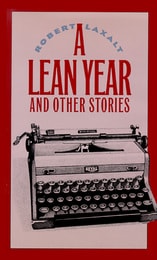
A Lean Year and Other Stories
Robert Laxalt
University of Nevada Press, 1994
In the lead story, Cowboy Clint Hamilton laments that the town is “getting more like a big city every day” as the traditional gambling joints of earlier times give way to the gaudy casinos that will soon become modern glitz.
Sobering experiences from his days as a reporter give Laxalt an insight into murderers and prison life and lethal gas chambers. In a chilling short story, “The Snake Pen,” we find the seed of Robert Laxalt’s celebrated novel, A Man In the Wheatfield.
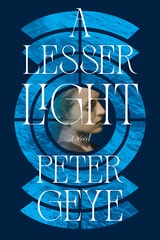
A Lesser Light
A NovelPeter Geye
University of Minnesota Press, 2025
On the rocky shores of Lake Superior, a piercing story of selfhood and determinism develops: is the future what we’re handed or what we make of it?
It’s 1910, and Theodulf Sauer has finally achieved a position befitting his ego: master lighthouse keeper at a newly commissioned station towering above Lake Superior. When his new wife, Willa, arrives on the first spring ferry, it’s clear her life has taken the opposite turn: after being summoned home from college to Duluth when her father dies, she and her scheming mother find themselves destitute, and Willa is rushed into this ill-suited arranged marriage before she can comprehend her fate.
As the lighthouse station establishes, the new relationship teeters between tense and hostile, with little mutual understanding or tenderness. Willa takes solace in her learned fascination with the cosmos, especially (despite her husband’s suspicion of the event) in viewing the imminent Halley’s Comet. Under ominous night skies, Theodulf stands sentry over the lake, clinging to long-ago and faraway memories of happiness that fill him with longing and shame.
Into this impasse, a clairvoyant girl and her resolute uncle emerge from across the cove. They see through the Sauers’ thin façade and, by turns and in different ways, convey promise, sympathy, and insight that counter Willa’s despair. Armed with renewed self-determination, Willa forges a path to happiness. But before she can grasp it, tragedy comes to their remote beacon, and her future plunges toward a dark unknown.
Set against a brooding and beautiful landscape, A Lesser Light is a story about industry and calamity, science versus superstition, inner desire countered with societal expectations—and the consequences when these forces collide in the wilderness of rapid social change.
A Letter to Harvey Milk
Short StoriesLesléa Newman
University of Wisconsin Press, 2004
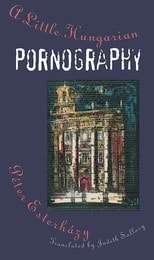
A Little Hungarian Pornography
Peter Esterhazy
Northwestern University Press, 1997
In a state where the lack of democracy was called socialist democracy, economic chaos a socialist economy, and revolution an anti-revolution, the notion of speech and obscenity becomes equally distorted and skewed. Under these circumstances, the author considers the shackles inherent in the vocabulary of oppression and contrasts this with the freedom of the body in sex. A kaleidoscopic digression on perversion and politics, A Little Hungarian Pornography is both satire and critique, trifle and tract, and further support for Esterházy's status as one of the best writers in Europe today.
A Man in Charge
A NovelMorris Philipson
University of Chicago Press, 2000
A Man in the Wheatfield
Robert Laxalt
University of Nevada Press, 2002
A Matter of Time
Alex Capus
Haus Publishing, 2009
A Milwaukee Inheritance
David Milofsky
University of Wisconsin Press, 2019
Moira is becoming obsessed with starting a family; Andy is becoming obsessed by thoughts of her friend Patsy. An unwinnable domestic dispute involving his shady tenant (and former classmate) Frankie “The Pin” Pignatano takes over more and more of his life. As tensions rise at home, at work, and in the duplex, Andy is forced to decide which vows he can honor.
This slow-burning, finely textured portrait of family dynamics pivots on secrets between generations and how the shadows of the past can darken the future.
A Mother's Kisses
Bruce Jay Friedman
University of Chicago Press, 2000

A Naked Singularity
A NovelSergio De La Pava
University of Chicago Press, 2012
The mind-bending, brilliant, often hilarious PEN Award-winning classic novel of justice, the law, and the brutal gap between the two.
A Naked Singularity tells the story of Casi, a child of Colombian immigrants who lives in Brooklyn and works in Manhattan as a public defender--one who, tellingly has never lost a trial. Never. In the book, we watch what happens when his sense of justice and even his sense of self begin to crack--and how his world then slowly devolves. It’s a huge, ambitious novel clearly in the vein of DeLillo, Foster Wallace, Pynchon, and even Melville, and it's told in a distinct, frequently hilarious voice, with a striking human empathy at its center. Its panoramic reach takes readers through crime and courts, immigrant families and urban blight, media savagery and media satire, scatology and boxing, and even a breathless heist worthy of any crime novel. If InfiniteJest stuck a pin in the map of mid-90s culture and drew our trajectory from there, A Naked Singularity does the same for the feeling of surfeit, brokenness, and exhaustion that permeates our civic and cultural life today. In the opening sentence of William Gaddis’s A Frolic of His Own, a character sneers, "Justice? You get justice in the next world. In this world, you get the law." A Naked Singularity reveals the extent of that gap, and lands firmly on the side of those who are forever getting the law.
A Narrative Compass
Stories that Guide Women's LivesEdited by Betsy Hearne and Roberta Seelinger Trites
University of Illinois Press, 2008
Each of us has a narrative compass, a story that has guided our lifework. In this extraordinary collection, women scholars from a variety of disciplines identify and examine the stories that have inspired them, haunted them, and shaped their research, from Little House on the Prairie to Little Women, from the fairy tales of Hans Christian Andersen and Alice's Adventures in Wonderland to Nancy Drew, Mary Jane, and even the Chinese memoir Jottings from the Transcendant's Abode at Mt. Youtai. Telling the "story of her story" leads each of the essayists to insights about her own approach to studying narratives and to a deeper, often surprising, understanding of the power of imagination.
Contributors are Deyonne Bryant, Minjie Chen, Cindy L. Christiansen, Beverly Lyon Clark, Karen Coats, Wendy Doniger, Bonnie Glass-Coffin, Betsy Hearne, Joanna Hearne, Ann Hendricks, Rania Huntington, Christine Jenkins, Kimberly Lau, Pamela Riney-Kehrberg, Maria Tatar, Ebony Elizabeth Thomas, Roberta Seelinger Trites, Claudia Quintero Ulloa, and Ofelia Zepeda.
A Near-Perfect Gift
R.M. Kinder
University of Michigan Press, 2005
A Nest Of Hooks
Lon Otto
University of Iowa Press, 1978
A New Anatomy of Storyworlds
What Is, What If, As IfMarie-Laure Ryan
The Ohio State University Press, 2022
A New Species
GENDER AND SCIENCE IN SCIENCE FICTIONRobin Roberts
University of Illinois Press, 1993
A New Sun Rises Over the Old Land
A Novel of Sihanouk’s CambodiaSuon Sorin
National University of Singapore Press, 2020
First published in 1961, eight years after Cambodia gained independence from French colonial rule, A New Sun Rises Over the Old Land is an iconic work of modern Khmer literature, a singularly illuminating document of the new nation. This is one of the first English translations of a modern Khmer novel, and the text is accompanied by an extended introduction that situates the author in his historical and artistic context and examines the novel’s literary value.

A Perfect Vacuum
Stanislaw Lem
Northwestern University Press, 1999
Beginning with a review of his own book, Lem moves on to tackles (or create pastiches of) the French new novel, James Joyce, pornography, authorless writing, and Dostoevsky, while at the same time ranging across scientific topics, from cosmology to the pervasiveness of computers. The result is a metafictional tour de force by one of the world's most popular writers.
A Place Called Milagro de la Paz
Manlio Argueta, translated from the Spanish by Michael B. Miller
Northwestern University Press, 2000
A Place Called Sweet Shrub
The Second Novel in a TrilogyJane Roberts Wood
University of North Texas Press, 2000
A Place Remote
StoriesGwen Goodkin
West Virginia University Press, 2020
In each of these ten stories, Gwen Goodkin forces her characters to face the dramatic events of life head-on—some events happen in a moment, while others are the fallout of years or decades of turning away. A boy is confronted by the cost of the family farm, an optometrist careens toward an explosive mental disaster, a mourning teen protects his sister, lifelong friends have an emotional confrontation over an heirloom, and a high school student travels to Germany to find his voice and, finally, a moment of long-awaited redemption.
A Place between Stations
StoriesStories by Stepanie Allen
University of Missouri Press, 2003
Selma detests my small considerations of strangers. When she catches me nodding at the panhandlers she ignores, or opening doors for women I don't know, she says nothing, but holds herself tall and aloof. She is doing it for the both of us. She is compensating for what she believes is a weakness in her husband that, even in this day and age, a black man still cannot afford. And she may be right. But at this stage of my life I feel not so much black or male, middle-aged or well-to-do or professional, as incomplete. I am son to my father, father to my boys, husband to my unhappy wife, but somehow more lost than found in the mix.
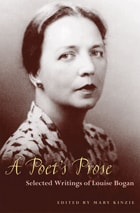
A Poet’s Prose
Selected Writings Of Louise BoganLouise Bogan
Ohio University Press, 2005
Although best known as a master of the formal lyric poem, Louise Bogan (1897–1970) also published fiction and what would now be called lyrical essays. A Poet’s Prose: Selected Writings of Louise Bogan showcases her devotion to compression, eloquence, and sharp truths.
Louise Bogan was poetry reviewer for the New Yorker for thirty-eight years, and her criticism was remarkable for its range and effect. Bogan was responsible for the revival of interest in Henry James and was one of the first American critics to notice and review W. H. Auden. She remained intellectually and emotionally responsive to writers as different from one another as Caitlin Thomas, Dorothy Richardson, W. B. Yeats, André Gide, and Rainer Maria Rilke.
Bogan’s short stories appeared regularly in magazines during the 1930s, penetrating the social habits of the city as well as the loneliness there. The autobiographical element in her fiction and journals, never entirely confessional, spurred some of her finest writing. The distinguished poet and critic Mary Kinzie provides in A Poet’s Prose a selection of Bogan's best criticism, prose meditations, letters, journal entries, autobiographical essays, and published and unpublished fiction.
Louise Bogan won the Bollingen Prize in 1954 for her collected poems. She is the subject of the Pulitzer Prize-winning biography by Elizabeth Frank, Louise Bogan: A Portrait.
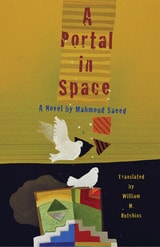
A Portal in Space
By Mahmoud Saeed, Translated by William M. Hutchins
University of Texas Press, 2015
A Portal in Space, set in Basra, Iraq, during the Iran-Iraq War (1980–1988), follows the lives of Anwar, a newly minted architect, and the other members of his affluent family as they attempt to maintain a sense of normality during the frequent bombing attacks from Iran. When Anwar joins the Iraqi army and then goes missing in action, his family struggles to cope with uncertainty over his fate. His mother falls into depression and secludes herself in the family home, while his father shifts his attention from his duties as a judge to the weekly pilgrimage to Baghdad seeking information on his son—and to Zahra, the young widow he meets there.
Emotionally engaging, A Portal in Space is a wry, wise tale of human beings striving to retain their humanity during a war that is anything but humane. Mahmoud Saeed succeeds brilliantly in bringing the sights and sounds of Iraq to life on the page—whether in a bunker on the front lines of the Iran-Iraq War or in the parlor of a fortune-teller in Baghdad. As Zahra says of the novel she is writing: “It is a normal novel that contains love, war, life, deceit, and death.”
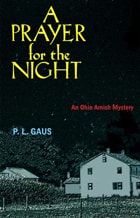
A Prayer for the Night
An Ohio Amish MysteryP. L. Gaus
Ohio University Press, 2006
Amid a whirlwind of drugs, sex, and other temptations of the “English” world, a group of Amish teenagers on their Rumschpringe test the limits of their parents’ religion to the breaking point. The murder of one and the abduction of another challenge Professor Michael Branden as he confronts the communal fear that the young people can never be brought home safely.
Along with Holmes County Sheriff Bruce Robertson and Pastor Cal Troyer, Professor Branden works against the clock to find a murderer and a kidnapper, and to break a drug ring operating in the county, determined, wherever the trail may lead him, to restore the shattered community. In his desperate search, Branden struggles with the reluctance of the Amish to trust the law to help them find the answers to their problems.
In A Prayer for the Night, his fifth Ohio Amish Mystery, P. L. Gaus deftly balances the pace and practices of Amish life in northern Ohio against the unfolding urgency of a hostage situation. As Gaus has proven before, the mystery gains from its exploration of the ever-widening chasm between the traditional life of the Amish people and their interaction with the outside world.
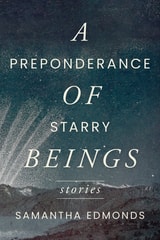
A Preponderance of Starry Beings
StoriesSamantha Edmonds
Northwestern University Press, 2025
Genre-bending stories of the cosmos and the worlds within our own skin
Blending fairy tale and science fiction with the otherworldliness of adolescence, A Preponderance of Starry Beings is a collection for anyone preoccupied with looking skyward. These stories probe the experience of coming of age on the outskirts of the universe, whether that be a small Midwestern town or a distant galaxy, and of weighing earthly obligations against the vast promises of space.
In a sleepy Ohio neighborhood, two girls seek refuge from their homophobic schoolmates in an antiques shop filled with Star Trek memorabilia. On a generation spaceship, children revolt against their parents’ plans to colonize a distant world. Deep in the Florida Everglades, seven sisters must protect their otherworldly mythology when two men arrive to fix the family automobile.
A Preponderance of Starry Beings invites us into a mundane and whimsical world of night islands, small towns, and faith lost and found, where a safe landing matters less than taking the leap.
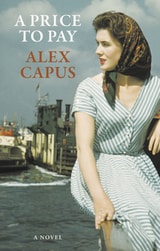
A Price to Pay
Alex Capus
Haus Publishing, 2014
A Price to Pay, the fourth of Capus’s novels to be published in English, tells the interwoven stories of three disparate figures from interwar Switzerland: pacifist Felix Bloch, who ends up working on the Manhattan Project; Laura d’Oriano, who wants to become a singer but instead becomes an Allied spy in fascist Italy; and Emile Gillieron, who accompanies Heinrich Schliemann to Troy and becomes one of art’s greatest forgers. Taking off from the only moment in history when all three were in the same place—a November day in 1924 at Zürich Station—Capus traces their diverging paths as they secure their places in the annals of history—but at what price?
A Private State
StoriesCharlotte Bacon
University of Massachusetts Press, 1998
Here is a finely crafted collection of stories about women who have arrived at awkward edges in their lives. Some are adolescents, some at the brink of old age, and some find themselves suddenly ill or pregnant. Others come to the abrupt discovery that their marriages are not as whole as they had believed, while a few tumble onto startling secrets. But despite their range in age and situation, they all try to use their new knowledge to stitch together a fresh pattern by which to live.
While most of the action unfolds along the East Coast—in Maryland, Maine, Boston, Philadelphia, New York—several of the women travel to Arizona, California, and Jamaica. Often the light is too bright in these glittery places and they wonder why they have come. Many seem to be searching for a sense of home, which one girl describes as a place that is “complete and full of longing all at once.”
Yet this desire for a personal territory, a point of constancy, is not necessarily rewarded: in this book, separations lead to divorce, sisters continue to misread each other, cancers kill. Still, the women refuse to turn their gaze away from what the world has thrown in their path. Often as not, they pick it up, wonder at it, test its relevance, and continue on, not happier perhaps, but certainly more knowing.
With humor and insight, Charlotte Bacon illuminates the unexpected ambiguities of women's lives. A Private State marks the arrival of an extremely talented writer.
A Quality of Loss
Mcinerny
St. Augustine's Press, 2025
The world in the 1970s was a cultural upheaval in many respects. This novel is a story of the deepest disruption but in the quietest and most hidden of places––namely, a monk living in isolation who is turned upside down by recent developments in the Catholic Church motivated by post-modern plans.
Brother Martin journals what he doesn't identify as confusion in D.Q. McInerny's debut novel that paints the portrait of a period in history that many are only now taking more seriously. What happened before the turn into the new millennium, and why are the effects of Vatican Council II more obvious and influential now than they were in the immediate wake of this council? The story of Brother Martin is a time capsule for many readers, but for others it is an insight into life that was stubbornly resistant to modern thinking in favor of the transcendent and eternal with respect to spirituality. McInerny shows through story-telling how much the institution was anything but a hinderance to the human soul and how much we may have lost by rejecting old forms on the sole basis of not having come up with them ourselves. This story is a generational bridge and reveals religious life in a truthful and still generous light.
A Question of Upbringing
Book 1 of A Dance to the Music of TimeAnthony Powell
University of Chicago Press, 1995
Anthony Powell’s universally acclaimed epic A Dance to the Music of Time offers a matchless panorama of twentieth-century London. Now, for the first time in decades, readers in the United States can read the books of Dance as they were originally published—as twelve individual novels—but with a twenty-first-century twist: they’re available only as e-books.
A Question of Upbringing (1951) introduces us to the young Nick Jenkins and his housemates at boarding school in the years just after World War I. Boyhood pranks and visits from relatives bring to life the amusements and longueurs of schooldays even as they reveal characters and traits that will follow Jenkins and his friends through adolescence and beyond: Peter Templer, a rich, passionate womanizer; Charles Stringham, aristocratic and louche; and Kenneth Widmerpool, awkward and unhappy, yet strikingly ambitious. By the end of the novel, Jenkins has finished university and is setting out on a life in London; old ties are fraying, new ones are forming, and the first steps of the dance are well underway.
"Anthony Powell is the best living English novelist by far. His admirers are addicts, let us face it, held in thrall by a magician."—Chicago Tribune
"A book which creates a world and explores it in depth, which ponders changing relationships and values, which creates brilliantly living and diverse characters and then watches them grow and change in their milieu. . . . Powell's world is as large and as complex as Proust's."—Elizabeth Janeway, New York Times
"One of the most important works of fiction since the Second World War. . . . The novel looked, as it began, something like a comedy of manners; then, for a while, like a tragedy of manners; now like a vastly entertaining, deeply melancholy, yet somehow courageous statement about human experience."—Naomi Bliven, New Yorker
“The most brilliant and penetrating novelist we have.”—Kingsley Amis
“There is no other work in the annals of European fiction that attempts meticulously to recreate half a century of history, decade by decade, with anything like the emotional precision or details of Powell’s twelve volumes. Neither Balzac’s panorama of the Restoration, nor Zola’s chronicles of the Second Empire, nor Proust’s reveries in the Belle Epoque can match a comparable span of time, an attention to variations within it, or a compositional intricacy capable of uniting them into a single narrative. . . . The elegance of this artifice was only compatible with comedy.”—Perry Anderson
A Radiant Curve
Poems and StoriesLuci Tapahonso
University of Arizona Press, 2008
These engaging words draw us into a workaday world that, magically but never surprisingly, has room for the Diyin Dine’é (the Holy People), Old Salt Woman, and Dawn Boy. When she describes her grandson’s First Laugh Ceremony—explaining that it was originally performed for White Shell Girl, who grew up to be Changing Woman—her account enriches us and we long to hear more. Tapahonso weaves the Navajo language into her work like she weaves “the first four rows of black yarn” into a rug she is making “for my little grandson, who inherited my father’s name: Hastiin Tsétah Naaki Bísóí.”
As readers, we find that we too are surrounded by silent comfort, held lovingly in the confident hands of an accomplished writer who has a great deal to tell us about life.
A Reading of Dante's Inferno
Wallace Fowlie
University of Chicago Press, 1981
A Refuge of Lies
Reflections on Faith and FictionCesareo Bandera
Michigan State University Press, 2013
Erich Auerbach’s seminal Mimesis: The Representation of Reality in Western Literature was published more than sixty years ago and is deservedly considered a classic. The book brought into focus the fundamental difference that exists between the two basic approaches to the textual representation of reality in Western culture. These two “styles,” as Auerbach called them, were archetypically displayed in Homer’s poems and in the Old Testament, respectively. Auerbach’s differentiation is the starting point for Bandera’s insightful work, which expands and develops on this theory in several key ways. One of the more significant differences between the two styles transcends and grounds all the others. It concerns the truth of each of the two archetypal texts, or rather, the attitude exhibited in those texts with regard to the truth of what they narrate. Auerbach, Bandera notes, is amazed at the Bible’s “passionate” concern for the truth of what it says—a concern he found absent in Homer. Bandera finds that what the prophet Isaiah called “a refuge of lies” defines Homer’s work. He draws on his own research and René Girard’s theory of the sacred to develop an enhanced perspective of the relationship between these texts.
A River Runs Through It and Other Stories, Twenty-fifth Anniversary Edition
Norman Maclean
University of Chicago Press, 2001
Maclean grew up in the western Rocky Mountains in the first decades of the twentieth century. As a young man he worked many summers in logging camps and for the United States Forest Service. The two novellas and short story in this collection are based on his own experiences—the experiences of a young man who found that life was only a step from art in its structures and beauty. The beauty he found was in reality, and so he leaves a careful record of what it was like to work in the woods when it was still a world of horse and hand and foot, without power saws, "cats," or four-wheel drives. Populated with drunks, loggers, card sharks, and whores, and set in the small towns and surrounding trout streams and mountains of western Montana, the stories concern themselves with the complexities of fly fishing, logging, fighting forest fires, playing cribbage, and being a husband, a son, and a father.
By turns raunchy, poignant, caustic, and elegiac, these are superb tales which express, in Maclean's own words, "a little of the love I have for the earth as it goes by." A first offering from a 70-year-old writer, the basis of a top-grossing movie, and the first original fiction published by the University of Chicago Press, A River Runs through It and Other Stories has sold more than a million copies. As Proulx writes in her foreword to this new edition, "In 1990 Norman Maclean died in body, but for hundreds of thousands of readers he will live as long as fish swim and books are made."
A River Runs Through It, and Other Stories
Norman Maclean
University of Chicago Press, 1976
Based on Norman Maclean's childhood experiences, the title novella has established itself as one of the most moving stories of our time; it captivates readers with vivid descriptions of life along Montana's Big Blackfoot River and its near magical blend of fly fishing with the troubling affections of the heart.
The paperback edition is now available with an evocative new cover by acclaimed Montana painter Russell Chatham.
"A masterpiece. . . . This is more than stunning fiction: It is a lyric record of a time and a life, shining with Maclean's special gift for calling the reader's attention to arts of all kinds—the arts that work in nature, in personality, in social intercourse, in fly-fishing."—Kenneth M. Pierce, Village Voice
Norman Maclean (1902-90), woodsman, scholar, teacher, and storyteller, grew up in the Western Rocky Mountains of Montana and worked for many years in logging camps and for the United States Forestry Service before beginning his academic career. He retired from the University of Chicago in 1973.

A River Runs through It
Norman Maclean
University of Chicago Press, 1989
Based on Norman Maclean's childhood experiences, A River Runs through It has established itself as one of the most moving stories of our time; it captivates readers with vivid descriptions of life along Montana's Big Blackfoot River and its near magical blend of fly fishing with the troubling affections of the heart.
This handsome edition is designed and illustrated by Barry Moser. There are thirteen two-color wood engravings.
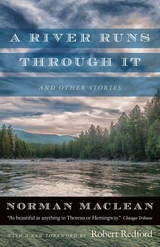
A River Runs through It and Other Stories
Norman Maclean
University of Chicago Press, 2017
Elegantly redesigned, A River Runs through It includes a new foreword by Robert Redford, director of the Academy Award-winning 1992 film adaptation of River. Based on Maclean’s own experiences as a young man, the book’s two novellas and short story are set in the small towns and mountains of western Montana. It is a world populated with drunks, loggers, card sharks, and whores, but also one rich in the pleasures of fly-fishing, logging, cribbage, and family. By turns raunchy and elegiac, these superb tales express, in Maclean’s own words, “a little of the love I have for the earth as it goes by.”
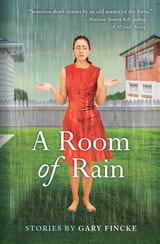
A Room of Rain
Gary Fincke
West Virginia University Press, 2015
The narratives throughout Gary Fincke’s sixth collection of short stories contain newsworthy events that are chronicled secondhand: the shooting of a policeman, the murder of a house flipper, the firing of a teacher for punching a violent student, the accidental drowning of a gay man in a flood, and a fire somewhat accidently set by a juvenile smoker in a school.
Despite these surprising events, the narrator of each story is an ordinary person caught up in the action but preoccupied by other things, whether zombie movies, collecting unusual words, the oddity of other people’s sexual habits, or what to do in retirement.
These shocking incidents become both central and peripheral to the narrative, as Fincke portrays the fluctuating emotions and self-protective reflections of fathers, sons, and husbands, creating a world where individuals rarely understand each other, yet still arrive at moments of compassion, tolerance, perseverance, and familial love.
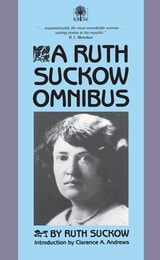
A Ruth Suckow Omnibus
Ruth Suckow
University of Iowa Press, 1988
This collection of ten short stories and one novella reintroduces a superb regional writer whose fiction, though firmly planted in the soil of the Midwest, stretches in significance to include all human drama.
Despite her wide experience, Ruth Suckow became and remained a writer interested in small-town and small-city life. All her fiction contains deep and penetrating insights into the motivations of characters who are upheld by their dreams, memories of small-town childhoods, and the need to make sense of the contrast between past and present, idealism and practicality, conformity and individualism. These expressive, resonant stories will be welcomed by all new readers and by Ruth Suckow fans everywhere.

A Saint Is Born in Chima
A NovelBy Manuel Zapata Olivella
University of Texas Press, 1991
When the paralyzed cripple Domingo Vidal is rescued unsinged from a burning house, the people of Chima believe they have witnessed a miracle. Domingo becomes their patron "saint," and tales of his miracles multiply. Domingo makes the rains come, cures the blind and lame, and swells barren wombs with new life. But is Domingo really a saint, or is he a pagan idol? Padre Berrocal calls the people heretics, but they are afraid not to worship Domingo. To what excesses will superstition and ignorance drive the frightened people of Chima?
This novel, published in 1963 as En Chimá nace un santo, makes important connections between the frustrations of poverty and the excesses of religious fanaticism. Zapata Olivella indicts the dogmatic attitudes of religious and civil institutions as a major cause of the creation of local cults like the one that grows up around "Saint" Domingo. In Zapata Olivella's compelling narrative, the struggle over Domingo points up both the inflexibility of established institutions and the potential power for change that lies within the hands of a determined populace.
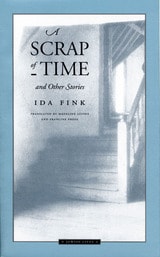
A Scrap of Time and Other Stories
Ida Fink
Northwestern University Press, 1995
Winner of the PEN/Book-of-the-Month Club Translation Prize
Winner of the Anne Frank Prize
These shattering stories describe the lives of ordinary people as they are compelled to do the unimaginable: a couple who must decide what to do with their five-year-old daughter as the Gestapo come to march them out of town; a wife whose safety depends on her acquiescence in her husband's love affair; a girl who must pay a grim price for an Aryan identity card.
A Sense of Order
And Other StoriesJack Harrell
Signature Books, 2010
In another story, the LDS prophet is drawn to s simpler time when he could wander out unnoticed and buy a candy bar. Church Security won’t let him outside on his own and Public Relations won’t let him wear anything but a suit and tie. Still, the impulse to be a regular guy for an afternoon is compelling. Can’t he make his own decisions? He can, but what are the consequences?
And then there’s Jerry, who passes three men in suits who are talking and laughing at the loading dock behind an LDS temple. One of them looks up, drops a cigarette and crushes it, then slips into a nearby car. Another man—someone who has made Jerry’s life miserable—taunts him, saying: “Jerry, your goodness is your enemy …and tell all your friends.” Who is responsible? Maybe it’s the author’s reverie that’s to blame, but his stories have a way of getting deep inside the psyche and haunting us.

A Short History of Indians in Canada
StoriesThomas King
University of Minnesota Press, 2013

A Singular Man
Emmanuel Bove
Northwestern University Press, 1995
A Sinister Assassin
Last Writings, Ivry-Sur-Seine, September 1947 to March 1948Antonin Artaud
Diaphanes, 2022
A Sinister Assassin presents translations of Antonin Artaud’s largely unknown final work of 1947–48, revealing new insights into his obsessions with human anatomy, sexuality, societal power, creativity, and ill-will—notably, preoccupations of the contemporary world.
Artaud’s last conception of performance is that of a dance-propelled act of autopsy, generating a ”body without organs” which negates malevolent microbial epidemics. This book assembles Artaud’s crucial writings and press interviews from September 1947 to March 1948, undertaken at a decrepit pavilion in the grounds of a convalescence clinic in Ivry-sur-Seine, on the southern edge of Paris, as well as in-transit through Paris’s streets. It also draws extensively on Artaud’s manuscripts and original interviews with his friends, collaborators, and doctors throughout the 1940s, illuminating the many manifestations of Artaud’s final writings: the contents of his last, death-interrupted notebook; his letters; his two final key texts; his glossolalia; the magazine issue which collected his last fragments; and the two extraordinary interviews he gave to national newspaper journalists in the final days of his life, in which he denounces and refuses both his work’s recent censorship and his imminent death.
Edited, translated, and with an introduction by Stephen Barber, A Sinister Assassin illuminates Artaud’s last, most intensive, and terminal work for the first time.
A Slap in the Face
Abbas Khider
Seagull Books, 2018
In our era of mass migration, much of it driven by war and its aftermath, A Slap in the Face could not be more timely. It tells the story of Karim, an Iraqi refugee living in Germany whose right to asylum has been revoked in the wake of Saddam Hussein’s defeat. But Hussein wasn’t the only reason Karim left, and as Abbas Khider unfolds his story, we learn both the secret struggles he faced in his homeland and the battles with prejudice, distrust, poverty, and bureaucracy he has to endure in his attempts to make a new life in Germany. As he erupts in frustration at his caseworker and finally forces her to listen to his story, we get an account of a contemporary life upended by politics and violence, told with warmth and humor that, while surprising us, does nothing to lessen the outrages Karim describes.