Results by title
572 books match the query 'Photography' and 53 start with a
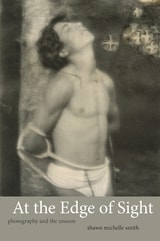
At the Edge of Sight
Photography and the UnseenShawn Michelle Smith
Duke University Press, 2013
The advent of photography revolutionized perception, making visible what was once impossible to see with the human eye. In At the Edge of Sight, Shawn Michelle Smith engages these dynamics of seeing and not seeing, focusing attention as much on absence as presence, on the invisible as the visible. Exploring the limits of photography and vision, she asks: What fails to register photographically, and what remains beyond the frame? What is hidden by design, and what is obscured by cultural blindness? Smith studies manifestations of photography's brush with the unseen in her own photographic work and across the wide-ranging images of early American photographers, including F. Holland Day, Eadweard Muybridge, Andrew J. Russell, Chansonetta Stanley Emmons, and Augustus Washington. She concludes by showing how concerns raised in the nineteenth century remain pertinent today in the photographs of Abu Ghraib. Ultimately, Smith explores the capacity of photography to reveal what remains beyond the edge of sight.
[more]
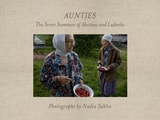
Aunties
The Seven Summers of Alevtina and LudmilaNadia Sablin
Duke University Press, 2015
In northwest Russia, in a small village called Alekhovshchina, Nadia Sablin’s aunts spend the warmer months together in the family home and live as the family has always lived—chopping wood to heat the house, bringing water from the well, planting potatoes, and making their own clothes. Sablin’s lyrical and evocative photographs, taken over seven summers, capture the small details and daily rituals of her aunts’ surprisingly colorful and dreamlike days, taking us not only to another country but to another time. Alevtina and Ludmila, now in their seventies, seem both old and young, as if time itself was as seamless and cyclical as their routines—working on puzzles, sewing curtains, tatting lace, picking berries, repairing fences—and as full of the same subtle mysteries. Sablin collaborated with her aunts to recreate scenes she remembered from her childhood and to make new images of the patterns of their days. In these photographs, Sablin combines observation and invention, biography and autobiography, to tell the stories of her aunts’ life together, and in the process, quilts together a thoughtful meditation on memory, aging, and belonging.
[more]
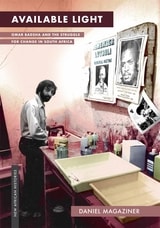
Available Light
Omar Badsha and the Struggle for Change in South AfricaDaniel Magaziner
Ohio University Press, 2024
Available Light tells the story of an activist, an artist, a uniquely South African individual, and his community and family across the second half of the twentieth century. Omar Badsha was born in Durban, on the country’s southeastern coast in 1945. His was the third generation of his Gujarati family to call South Africa home. Before he turned five, the country’s white electorate had voted to institute apartheid to strip the rights and privileges of citizenship from most of the population, including Badsha’s Indian community and especially the country’s Black majority. By the time he turned fifteen, nonviolent protest against apartheid had been quashed; by the time he turned twenty, so too had the armed struggle to dislodge white supremacy within the country. The ongoing, resilient, and oft-rebuffed struggle against apartheid was a definitive factor in Badsha’s life. Furthermore, Badsha was raised in a community where art—painting, carving, music, poetry, theater—was inseparable from other values, whether Islamic and conservative or radical and urgently committed. When Badsha struggled in school, he, like his father, turned to art to express what he otherwise had difficulty conveying. Art brought him into contact with people of disparate backgrounds from far beyond Durban. In time, his friendships with other artists helped him refine his voice, first in drawing and eventually in photography, and capture the political ethic by which he strove to live his life and which he shared with similarly committed artist-activists. Daniel Magaziner chronicles how art and politics became intertwined in South Africa and explains what it takes to maintain a critical aesthetic approach to political crises in the past and present. The book tracks the personal and social costs that commitment can incur, while also appreciating how Badsha and others like him have maintained their vision of an equitable, transformed society even today, when the ideals that once animated the South African struggle are on the back foot worldwide.
[more]