Results by title
1668 books match the query 'Popular culture' and 121 start with a
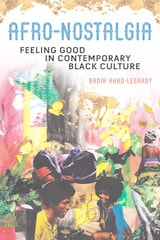
Afro-Nostalgia
Feeling Good in Contemporary Black CultureBadia Ahad-Legardy
University of Illinois Press, 2021
Badia Ahad-Legardy mines literature, visual culture, performance, and culinary arts to form an archive of black historical joy for use by the African-descended. Her analysis reveals how contemporary black artists find more than trauma and subjugation within the historical past. Drawing on contemporary African American culture and recent psychological studies, she reveals nostalgia’s capacity to produce positive emotions. Afro-nostalgia emerges as an expression of black romantic recollection that creates and inspires good feelings even within our darkest moments.
Original and provocative, Afro-Nostalgia offers black historical pleasure as a remedy to contend with the disillusionment of the present and the traumas of the past.
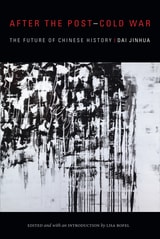
After the Post–Cold War
The Future of Chinese HistoryDai Jinhua
Duke University Press, 2018
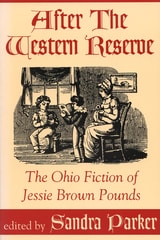
After the Western Reserve
The Ohio Fiction of Jessie Brown PoundsSandra Parker
University of Wisconsin Press, 1999
In her fiction, Jessie Brown Pounds preserved the flavor of Ohio’s rural village culture as the nineteenth century drew to a close. This anthology rediscovers Pounds’s varied works and reminds modern students that Middle-Western culture included women writers as social critics and mythmakers. Included are short stories, sketches, one undated short story published posthumously in 1921, and Rachael Sylvestre, a first-person historical novel written in 1904.
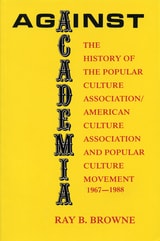
Against Academia
The History of the Popular Culture Association/American Culture Association and the Popular Culture Movement 1967-1988Ray B. Browne
University of Wisconsin Press, 1989
The history of the study of popular culture in American academia since its (re)introduction in 1967 is filled with misunderstanding and opposition. From the first, proponents of the study of this major portion of American culture made clear that they were interested in making popular culture a supplement to the usual courses in such fields as literature, sociology, history, philosophy, and the other humanities and social sciences; nobody proposed that study of popular culture replace the other disciplines, but many suggested that it was time to reexamine the accepted courses and see if they were still viable. Opposition to the status quo always causes anxiety and opposition, but when the issues are clarified, often opposition and anxiety melt away, as they now are doing.
Anxiety and opposition were generated on another level when people in academic and curricular power felt that voices were being raised that questioned their credentials and control. They flailed out with every argument at their command, generally thinking only of their self interest and not that of the students and the future of academic education. Generally this wall of opposition has also been breached.
The Popular Culture Association and its many friends and backers in academia, in the United States and abroad, has demonstrated that the study of our everyday and dominant culure should be taken seriously, understandingly and analytically, just as all other aspects of culture should be. Taken that way the study can be useful in developing better educated and responsible citizens from the cradle to the grave. The humanities and social sciences are too important for any portion—especially the majority portion—to be ignored or downplayed. The study of popular culture constitutes a significant and important element, one that can be ignored only at peril.
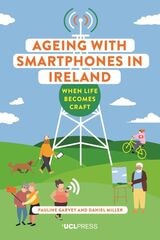
Ageing with Smartphones in Ireland
When Life Becomes CraftPauline Garvey and Daniel Miller
University College London, 2021
This volume documents a radical change in the experience of aging. Based on two ethnographies in Dublin, Ireland, the book illustrates how smartphones enable old people to focus on crafting a new life in retirement. For some, the smartphone is an intimidating burden linked to being on the wrong side of a new digital divide. But for most, however, it has become integral to a new trajectory towards a more sustainable life, both for themselves and their environment. The smartphone has reunited extended family and old friends, helped resolve intergenerational conflicts though new forms of grandparenting, and has become a health resource. This is a book about acknowledging late middle age in contemporary Ireland and examines how older people in Ireland experience life today.
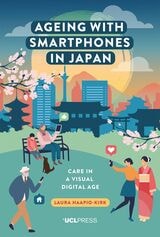
Ageing with Smartphones in Japan
Care in a Visual Digital AgeLaura Haapio-Kirk
University College London, 2024
Ageing with Smartphones in Japan examines sixteen months of ethnographic research following older adults, age fifty and up, in urban Kyoto and rural Kochi Prefecture, Japan as they navigate social and personal shifts post-retirement in the age of the smartphone. It attempts to answer what this transition means for friendship, gendered labor, multigenerational living, internal migration, health, as well as life purpose for older adults. This book closely investigates how the smartphone challenges gender-based norms and how older adults creatively navigate them. Using comics, drawings, and fieldwork sketches it also explores how they use digital visual communication to socialize with friends and family.
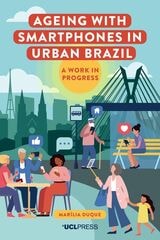
Ageing with Smartphones in Urban Brazil
A Work in ProgessMarília Duque
University College London, 2022
With people living longer all over the world, aging has begun to be framed as a socioeconomic problem. In Brazil, older people are expected to remain healthy and autonomous while actively participating in society. Based on ethnographic research in São Paulo, this book shows how older people in a middle-class neighborhood try to reconcile these expectations with the freedom and pleasures reserved for old age by using smartphones. Smartphones have become of great importance to the residents as they search for and engage in new forms of work and hobbies. Connected by a digital network, they work as content curators, sharing activities that fill their schedules. Managing multiple WhatsApp groups is a job in itself, as well as a source of solidarity and hope. Friendship groups help each to download new apps, search for medical information and guidance, and navigate the city. Together, the author shows, older people are reinventing themselves as volunteers, entrepreneurs, and influencers, or they are finding a new interest that gives their later life a purpose. The smartphone, which enables the residents to share and discuss their busy lives, is also helping them, and us, to rethink aging.
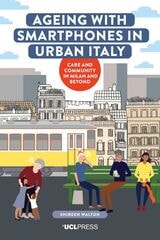
Ageing with Smartphones in Urban Italy
Care and Community in Milan and BeyondShireen Walton
University College London, 2021
This book is an anthropological account of the experience of age and ageing in an inner-city neighborhood in Milan, exploring the relationship between ageing and technology amidst a backdrop of rapid global technological innovation, including the advent of mobile health, smart cities, and a number of wider socioeconomic and technological transformations. Through extensive urban and digital ethnographic research in Milan, Shireen Walton shows how the smartphone has become a “constant companion” in contemporary life, accompanying people throughout the day and through individual and collective experiences. The volume argues that ageing with smartphones in the contemporary urban Italian context is about living with ambiguity, change, and contradiction, as well as developing curiosities about a changing world, our changing selves, and changing relationships with others.
Agitated States
Performance in the American Theater of CrueltyAnthony Kubiak
University of Michigan Press, 2002
Beginning with the writings of John Winthrop and others, through the Federalist and "romantic" stages of American cultural life, and into the modern and contemporary periods, Anthony Kubiak finds an America not usually discovered by traditional or materialist approaches to history. He deploys the psychoanalytic theory of Jacques Lacan, the cultural theory of SlavojZizek, and the performance theory of Herbert Blau in an unparalleled reappraisal of dominant American identity, culture, and history.
Anthony Kubiak is Associate Professor of English, University of South Florida. He is also author of Stages of Terror: Terrorism, Ideology, and Coercion as Theatre History.
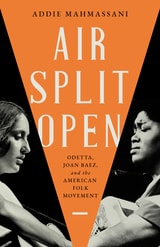
Air Split Open
Odetta, Joan Baez, and the American Folk MovementMahmassani, Addie
University of Iowa Press, 2026
Nearly a decade ago, Bob Dylan fan Addie Mahmassani took a look at her large collection of books on the 1960s folk revival and asked what was missing. The answer was obvious: There was scarce feminist analysis of the scene. Air Split Open takes an important step in filling this gap.
Deploying her background in cultural history, gender, sexuality, and performance studies, Mahmassani tracks the interwoven careers of Odetta and Joan Baez, creating a new story of the folk revival that is at once incisive and entertaining, while also grappling with broader questions of the way male-centered historical narratives take shape in the context of American popular culture. A feminist take on the music scene that defined an era, Air Split Open is fueled by deep respect for the American folk tradition and all those, known and unknown, who have carried it forward.

Alarms & Epitaphs
The Art of Eric AmblerPeter Wolfe
University of Wisconsin Press, 1993
Albums of James Tissot
Willard Misfeldt
University of Wisconsin Press, 1982
Artist James Tissot compiled photographs of his work in three albums, which are reproduced in this book.

Alien Constructions
Science Fiction and Feminist ThoughtBy Patricia Melzer
University of Texas Press, 2006
Though set in other worlds populated by alien beings, science fiction is a site where humans can critique and re-imagine the paradigms that shape this world, from fundamentals such as the sex and gender of the body to global power relations among sexes, races, and nations. Feminist thinkers and writers are increasingly recognizing science fiction's potential to shatter patriarchal and heterosexual norms, while the creators of science fiction are bringing new depth and complexity to the genre by engaging with feminist theories and politics. This book maps the intersection of feminism and science fiction through close readings of science fiction literature by Octavia E. Butler, Richard Calder, and Melissa Scott and the movies The Matrix and the Alien series.
Patricia Melzer analyzes how these authors and films represent debates and concepts in three areas of feminist thought: identity and difference, feminist critiques of science and technology, and the relationship among gender identity, body, and desire, including the new gender politics of queer desires, transgender, and intersexed bodies and identities. She demonstrates that key political elements shape these debates, including global capitalism and exploitative class relations within a growing international system; the impact of computer, industrial, and medical technologies on women's lives and reproductive rights; and posthuman embodiment as expressed through biotechnologies, the body/machine interface, and the commodification of desire. Melzer's investigation makes it clear that feminist writings and readings of science fiction are part of a feminist critique of existing power relations—and that the alien constructions (cyborgs, clones, androids, aliens, and hybrids) that populate postmodern science fiction are as potentially empowering as they are threatening.
Alien Encounters
Popular Culture in Asian AmericaMimi Thi Nguyen and Thuy Linh Nguyen Tu, eds.
Duke University Press, 2007
This interdisciplinary collection brings together contributors working in Asian American studies, English, anthropology, sociology, and art history. They consider issues of cultural authenticity raised by Asian American participation in hip hop and jazz, the emergence of an orientalist “Indo-chic” in U.S. youth culture, and the circulation of Vietnamese music variety shows. They examine the relationship between Chinese restaurants and American culture, issues of sexuality and race brought to the fore in the video performance art of a Bruce Lee–channeling drag king, and immigrant television viewers’ dismayed reactions to a Chinese American chef who is “not Chinese enough.” The essays in Alien Encounters demonstrate the importance of scholarly engagement with popular culture. Taking popular culture seriously reveals how people imagine and express their affective relationships to history, identity, and belonging.
Contributors. Wendy Hui Kyong Chun, Kevin Fellezs, Vernadette Vicuña Gonzalez, Joan Kee, Nhi T. Lieu, Sunaina Maira, Martin F. Manalansan IV, Mimi Thi Nguyen, Robyn Magalit Rodriguez, Sukhdev Sandhu, Christopher A. Shinn, Indigo Som, Thuy Linh Nguyen Tu, Oliver Wang

Aliens
An Anthropology of Science FictionEdited by George E. Slusser and Eric S. Rabkin
Southern Illinois University Press, 1987
How and when does there come to be an “anthropology of the alien?” This set of essays, written for the eighth J. Lloyd Eaton Conference on Fantasy and Science Fiction, is concerned with the significance of that question. “[Anthropology] is the science that must designate the alien ifit is to redefine a place for itself in the universe,” according to the Introduction.
The idea of the alien is not new. In the Renaissance, Montaigne’s purpose in describing an alien encounter was excorporation—mankind was the “savage” because the artificial devices of nature controlled him. Shakespeare’s version of the alien encounter was incorporation; his character of Caliban is brought to the artificial, political world of man and incorporated into the body politic
“The essays in this volume . . . show, in their general orientation, that the tribe of
This book is divided into three parts: “Searchings: The Quest for the Alien” includes “The Aliens in Our Mind,” by Larry Niven; “Effing the Ineffable,” by Gregory Benford; “Border Patrols,” by Michael Beehler; “Alien Aliens,” by Pascal Ducommun; and “Metamorphoses of the Dragon,” by George E. Slusser.
“Sightings: The Aliens among Us” includes “Discriminating among Friends,” by John Huntington; “Sex, Superman, Sociobiology,” by Joseph D. Miller; “Cowboys and Telepaths,” by Eric S. Rabkin; “Robots,” by Noel Perrin; “Aliens in the Supermarket,” by George R. Guffey; and “Aliens ‘R’ U.S.,” by Zoe Sofia.
All My Relatives
Community in Contemporary Ethnic American LiteraturesBonnie TuSmith
University of Michigan Press, 1994
All My Relatives provides a new way of reading popular works such as The Woman Warrior, The Joy Luck Club, The Color Purple and John Edgar Wideman's Sent for You Yesterday. TuSmith's study will appeal to general readers as well as students and scholars of American culture, ethnic studies, and American literature.
"An original contribution to the field. TuSmith's willingness to step over invisible boundaries and to draw parallels between the cultural contexts of several ethnic groups at once is refreshing and important." --Amy Ling, University of Wisconsin, Madison
"Ambitious and timely . . . a significant work that Americanists will want to read. TuSmith does an excellent job of clarifying the meaning and significance of the term "ethnicity" in relation to American literature."--Ramón Saldívar, Stanford University
". . . TuSmith establishes the importance of traditional (usually oral) modes of expression to ethnic texts that are both relational and accessible . . . . [S]hould become a standard point of reference in the emerging field of comparative American literature."--Choice
Bonnie TuSmith is Assistant Professor of English, Bowling Green State University.
All That Glitters
Country Music in AmericaGeorge H. Lewis
University of Wisconsin Press, 1993
All Together Now
American Holiday Symbolism Among Children and AdultsCindy Dell Clark
Rutgers University Press, 2019
The decorations, songs, special ways of dressing, and rituals carry deep significance that is viscerally felt by even young tots. Ritual has the capacity to condense a plethora of meaning into a unified metaphor such as a Christmas tree, a menorah, or the American flag. These symbols allow children and adults to co-opt the meaning of symbols in flexible and age-relevant ways, all while the symbols are still treasured and shared in common.
All the Rage
The Story of Gay Visibility in AmericaSuzanna Danuta Walters
University of Chicago Press, 2001
Many consider the new gay visibility a sign of social acceptance, while others charge that it is mere window dressing, obscuring the dogged persistence of discrimination. Walters moves beyond these positions and instead argues that these realities coexist: gays are simultaneously depicted as the sign of social decay and the chic flavor of the month. Taking on the common wisdom that visibility means progress, All the Rage maps the terrain on which gays are accepted as witty accessories in movies, gain access to political power, and yet still fall into constrictive stereotypes. Walters warns us with clarity and wit of the pitfalls of equating visibility with full integration into the fabric of American society. From the playful TV fantasies of lesbian weddings on Friends to the very real obstacles confronting gay marriage, from the award-winning comedy Will & Grace to Bible-thumping radio superhost Dr. Laura, All the Rage takes on naive celebrants and jaded naysayers alike. With a sophisticated mix of caution and optimism, it provides an illuminating guide through these exciting, controversial times.
Altering States
Ethnographies of Transition in Eastern Europe and the Former Soviet UnionDaphne Berdahl, Matti Bunzl, and Martha Lampland, Editors
University of Michigan Press, 2000
Ambient Television
Visual Culture and Public SpaceAnna McCarthy
Duke University Press, 2001
Discussing the roles television has played in different institutions from 1945 to the present day, McCarthy draws on a wide array of sources. These include retail merchandising literature, TV industry trade journals, and journalistic discussions of public viewing, as well as the work of cultural geographers, architectural theorists, media scholars, and anthropologists. She also uses photography as a research tool, documenting the uses and meanings of television sets in the built environment, and focuses on such locations as the tavern and the department store to show how television is used to support very different ideas about gender, class, and consumption. Turning to contemporary examples, McCarthy discusses practices such as Turner Private Networks’ efforts to transform waiting room populations into advertising audiences and the use of point-of-sale video that influences brand visibility and consumer behavior. Finally, she inquires into the activist potential of out-of-home television through a discussion of the video practices of two contemporary artists in everyday public settings.
Scholars and students of cultural, visual, urban, American, film, and television studies will be interested in this thought-provoking, interdisciplinary book.
Ambiguous Borderlands
Shadow Imagery in Cold War American CultureErik Mortenson
Southern Illinois University Press, 2016
After contextualizing the postwar use of shadow imagery in the wake of the atomic bomb, Ambiguous Borderlands looks at shadows in print works, detailing the reemergence of the pulp fiction crime fighter the Shadow in the late-1950s writings of Sylvia Plath, Amiri Baraka, and Jack Kerouac. Using Freudian and Jungian conceptions of the unconscious, Mortenson then discusses Kerouac’s and Allen Ginsberg’s shared dream of a “shrouded stranger” and how it shaped their Beat aesthetic. Turning to the visual, Mortenson examines the dehumanizing effect of shadow imagery in the Cold War photography of Robert Frank, William Klein, and Ralph Eugene Meatyard. Mortenson concludes with an investigation of the use of chiaroscuro in 1950s film noir and the popular television series The Twilight Zone, further detailing how the complexities of Cold War society were mirrored across these media in the ubiquitous imagery of light and dark.
From comics to movies, Beats to bombs, Ambiguous Borderlands provides a novel understanding of the Cold War cultural context through its analysis of the image of the shadow in midcentury media. Its interdisciplinary approach, ambitious subject matter, and diverse theoretical framing make it essential reading for anyone interested in American literary and popular culture during the fifties and sixties.
America's Favorite Radio Station
WKRP in CincinnatiMichael B. Kassel
University of Wisconsin Press, 1993
America's Vietnam
The Longue Durée of U.S. Literature and EmpireMarguerite Nguyen
Temple University Press, 2018
America’s Vietnam challenges the prevailing genealogy of Vietnam’s emergence in the American imagination—one that presupposes the Vietnam War as the starting point of meaningful Vietnamese-U.S. political and cultural involvements. Examining literature from as early as the 1820s, Marguerite Nguyen takes a comparative, long historical approach to interpreting constructions of Vietnam in American literature. She analyzes works in various genres published in English and Vietnamese by Monique Truong and Michael Herr as well as lesser-known writers such as John White, Harry Hervey, and Võ Phiến. The book’s cross-cultural prism spans Paris, Saigon, New York, and multiple oceans, and its departure from Cold War frames reveals rich cross-period connections.
America’s Vietnam recounts a mostly unexamined story of Southeast Asia’s lasting and varied influence on U.S. aesthetic and political concerns. Tracking Vietnam’s transition from an emergent nation in the nineteenth century to a French colony to a Vietnamese-American war zone, Nguyen demonstrates that how authors represent Vietnam is deeply entwined with the United States’ shifting role in the world. As America’s longstanding presence in Vietnam evolves, the literature it generates significantly revises our perceptions of war, race, and empire over time.
America
Exploration and TravelSteven E. Kagel
University of Wisconsin Press, 1979
Travel gets us from one place to another—often with wonderful attendant enjoyment–but exploration makes us understand our travel, the places we travel to—and ourselves. The essays in this collection constitute a major step toward this understanding. They open up new areas for concern and draw many valuable insights and conclusions.
American Artifacts
Essays in Material CultureJules David Prown
Michigan State University Press, 2000
When defining culture, one must indeed take into account even the minutest of details. What of a lighter, for example, or a telephone? The essays in this new collection examine just that. The contributors pose not only a historical, pragmatic use for the items, but also delve into more imaginative aspects of what defines us as Americans. Both the lighter and the telephone are investigated, as well as how the lava lamp represents sixties counterculture and containment. The late nineteenth-century corset is discussed as an embodiment of womanhood, and an Amish quilt is used as an illustration of cultural continuity. These are just a few of the artifacts discussed. Scholars will be intrigued by the historical interpretations that contributors proposed concerning a teapot, card table, and locket; students will not only find merit in the expositions, but also by learning from the models how such interpretation can be carried out. This collection helps us understand that very thing that makes us who we are. Viewing these objects from both our past and our present, we can begin to define what it is to be American.
American Autobiography after 9/11
Megan Brown
University of Wisconsin Press, 2017
This lively and theoretically grounded book analyzes twenty-first-century memoirs from Three Cups of Tea to Fun Home, emphasizing the ways in which they reinforce and circulate ideologies, becoming guides or models for living. Brown expands her inquiry beyond books to the autobiographical narratives in reality television and political speeches. She offers a persuasive explanation for the memoir boom: the genre as a response to an era of uncertainty and struggle.
American Blockbuster
Movies, Technology, and WonderCharles R. Acland
Duke University Press, 2020
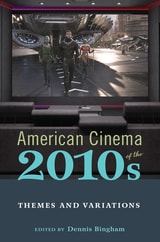
American Cinema of the 2010s
Themes and VariationsDennis Bingham
Rutgers University Press, 2022
The newest installment in the Screen Decades series, American Cinema in the 2010s takes a close look at the memorable movies, visionary filmmakers, and behind-the-scenes drama that made this decade such an exciting time to be a moviegoer. Each chapter offers an in-depth examination of a specific year, covering a wide variety of films, from blockbuster superhero movies like Black Panther and animated films like Frozen to smaller-budget biopics like I, Tonya and horror films like Hereditary. This volume introduces readers to a decade in which established auteurs like Quentin Tarantino were joined by an exceptionally diverse set of new talents, taking American cinema in new directions.
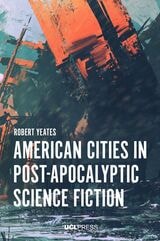
American Cities in Post-Apocalyptic Science Fiction
Robert Yeates
University College London, 2021
American Cities in Post-Apocalyptic Science Fiction traces the image of urban ruins across twentieth- and twenty-first-century American media. Surveying pulp magazines, radio dramas, films, video games, and the transmedia franchise, Robert Yeates explores how the synergy of technological innovation and artistic vision created an increasingly immersive space to reimagine the urban future. Through a series of medium-specific case studies, Yeates offers provocative new readings of familiar works such as Blade Runner and The Walking Dead situated against a fresh history of ruined cities in American literature.
American Commonplace
Essays on the Popular Culture of the United StatesUniversity of Wisconsin Press, 1982
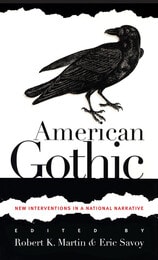
American Gothic
New Interventions in a National NarrativeRobert K. Martin
University of Iowa Press, 1998
In America as in Britain, the rise of the Gothic represented the other—the fearful shadows cast upon Enlightenment philosophies of common sense, democratic positivism, and optimistic futurity. Many critics have recognized the centrality of these shadows to American culture and self-identification. American Gothic, however, remaps the field by offering a series of revisionist essays associated with a common theme: the range and variety of Gothic manifestations in high and popular art from the roots of American culture to the present.
The thirteen essayists approach the persistence of the Gothic in American culture by providing a composite of interventions that focus on specific issues—the histories of gender and race, the cultures of cities and scandals and sensations—in order to advance distinct theoretical paradigms. Each essay sustains a connection between a particular theoretical field and a central problem in the Gothic tradition.
Drawing widely on contemporary theory—particularly revisionist views of Freud such as those offered by Lacan and Kristeva—this volume ranges from the well-known Gothic horrors of Edgar Allan Poe and Nathaniel Hawthorne to the popular fantasies of Stephen King and the postmodern visions of Kathy Acker. Special attention is paid to the issues of slavery and race in both black and white texts, including those by Ralph Ellison and William Faulkner. In the view of the editors and contributors, the Gothic is not so much a historical category as a mode of thought haunted by history, a part of suburban life and the lifeblood of films such as The Exorcist and Fatal Attraction.

American Nightmares
The Haunted House Formula in American Popular FictionDale Bailey
University of Wisconsin Press, 1999
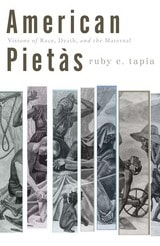
American Pietàs
Visions of Race, Death, and the MaternalRuby C. Tapia
University of Minnesota Press, 2010
Tapia explores the implications of this argument for racialized productions of death and the maternal in the context of specific cultural moments: the commemoration of Princess Diana in U.S. magazines; the intertext of Toni Morrison’s and Hollywood’s Beloved; the social and cultural death in teen pregnancy, imaged and regulated in California’s Partnership for Responsible Parenting campaigns; and popular constructions of the “Widows of 9/11” in print and televisual journalism.
Taken together, these various visual media texts function in American Pietàs as cultural artifacts and as visual nodes in a larger network of racialized productions of maternal bodies in contexts of national death and remembering. To engage this network is to ask how and toward what end the racial project of the nation imbues some maternal bodies with resurrecting power and leaves others for dead. In the spaces between these different maternities, says Tapia, U.S. citizen-subjects are born—and reborn.
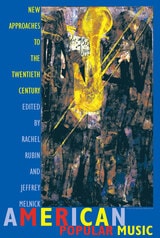
American Popular Music
New Approaches to the Twentieth CenturyRachel Rubin
University of Massachusetts Press, 2001
Designed as a broad introductory survey, and written by experts in the field, this book examines the rise of American music over the past hundred years — the period in which that music came into its own and achieved unprecedented popularity. Beginning with a look at music as a business, eleven essays explore a variety of popular musical genres, including Tin Pan Alley, blues, jazz, country, gospel, rhythm and blues, rock and roll, folk, rap, and Mexican American corridos. Reading these essays, we come to see that the forms created by one group often appeal to, and are in turn influenced by, other groups—across lines of race, ethnicity, class, gender, region, and age. The chapters speak to one another, arguing for the primacy of such concepts as minstrelsy, urbanization, hybridity, and crossover as the most powerful tools for understanding American popular music. Moving beyond outdated music-industry categories and misleading genre labels, while acknowledging the complexities of the market, the book recovers and reinforces the essential blackness of much popular music—even a presumably white form like country and western. In addition to Rachel Rubin and Jeffrey Melnick, contributors include Reebee Garofalo, Geoffrey Jacques, Kip Lornell, Mark Anthony Neal, Millie Rahn, David Sanjek, James Smethurst, Elijah Wald, and Gail Hilson Woldu.
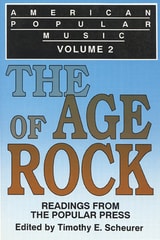
American Popular Music
Readings From the Popular Press Volume 2: The Age of RockTimothy E. Scheurer
University of Wisconsin Press, 1989
American Popular Music
Readings From the Popular Press Volume I: The Nineteenth-Century Tin Pan AlleyTimothy E. Scheurer
University of Wisconsin Press, 1989
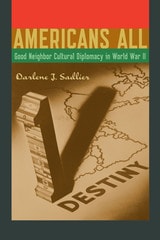
Americans All
Good Neighbor Cultural Diplomacy in World War IIBy Darlene J. Sadlier
University of Texas Press, 2012
Cultural diplomacy—“winning hearts and minds” through positive portrayals of the American way of life—is a key element in U.S. foreign policy, although it often takes a backseat to displays of military might. Americans All provides an in-depth, fine-grained study of a particularly successful instance of cultural diplomacy—the Office of the Coordinator of Inter-American Affairs (CIAA), a government agency established by President Franklin D. Roosevelt in 1940 and headed by Nelson A. Rockefeller that worked to promote hemispheric solidarity and combat Axis infiltration and domination by bolstering inter-American cultural ties.
Darlene J. Sadlier explores how the CIAA used film, radio, the press, and various educational and high-art activities to convince people in the United States of the importance of good neighbor relations with Latin America, while also persuading Latin Americans that the United States recognized and appreciated the importance of our southern neighbors. She examines the CIAA’s working relationship with Hollywood’s Motion Picture Society of the Americas; its network and radio productions in North and South America; its sponsoring of Walt Disney, Orson Welles, John Ford, Gregg Toland, and many others who traveled between the United States and Latin America; and its close ties to the newly created Museum of Modern Art, which organized traveling art and photographic exhibits and produced hundreds of 16mm educational films for inter-American audiences; and its influence on the work of scores of artists, libraries, book publishers, and newspapers, as well as public schools, universities, and private organizations.
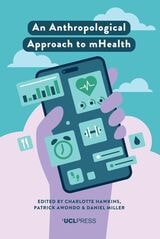
An Anthropological Approach to mHealth
Edited by Charlotte Hawkins, Patrick Awondo, and Daniel Miller
University College London, 2024
An Anthropological Approach to mHealth underlines ten sixteen-month ethnographies, set across Asia, Africa, Europe, and Latin America, that revealed people’s use of communicative apps, including as LINE, WeChat, and WhatsApp’s alternative primary health apps, highlighting the irrelevance of dedicated health apps. Using a “smart-from-below” approach, this book studies these surprising practices and proposes a radically different anthropological method to the development and dissemination of mobile health (mHealth), a rapidly growing sector in healthcare.
An Introduction to the Detective Story
Leroy Lad Panek
University of Wisconsin Press, 1987
This book is a no-apologies introduction to Detective Fiction. It's written in an aggressive, modern English well-suited to a genre which has traditionally broken ground in terms of aggressive writing, contemporary scenarios, and tough dialogue.

An Utterly Dark Spot
Gaze and Body in Early Modern PhilosophyMiran Bozovic
University of Michigan Press, 2000
Ananda
Where Yoga LivesJohn Ball
University of Wisconsin Press, 1982
Whenever the subject of communities and communal living comes uo, a variety of doubts and suspicions is usually aroused. The possible brainwashing of impressionable young people is frequently mentioned. Although the idea itself is centuries old, it has yet to be accepted as an approved method of living, even in this so-called New Age.
Of the many hundreds that have been started, very few have proven successful. The fact that Ananda has done so remarkably well against terrifying odds, and that at every time of crisis help always seems to come in some extraordinary way, invites attention. During his lifetime, which ended in 1952, Yogananda called for the founding of spiritual communities dedicated to world brotherhood and to "simple living and high thinking." Ananda is the first response to this directive. Its remarkable history, and its present expanding horizons, are the subject of this work.
Anatomy of Murder
Mystery, Detective, and Crime FictionCarl D. Malmgren
University of Wisconsin Press, 2001
Ancestral Connections
Art and an Aboriginal System of KnowledgeHoward Morphy
University of Chicago Press, 1991
The rich symbolism of Yolngu art links the Yolngu directly with the "Dreaming," the time of world-creation that continues as the spiritual dimension of the present. Morphy shows how a complex dialectic of "inside" and "outside" interpretations of painting structures the system of knowledge in Yolngu society, and how European interest in this art has caused certain changes in the conditions of its production. The "inside" significance of the art, however, has not changed; it retains its dual ability to represent and to constitute relationships between things.
Ancestral Connections is a major contribution to the anthropology of art. A subtle commentary on the colonial encounter in northern Australia, the book demonstrates how the Yolngu have used their art—against all odds—as an instrument of cultural survival and as a component of the economic and political transformation of their society.
Andy Warhol, Poetry, and Gossip in the 1960s
Reva Wolf
University of Chicago Press, 1997
Wolf investigates the underground culture of poets, artists, and filmmakers who interacted with Warhol regularly. She claims that Warhol understood the literary imagination of his generation and that recognizing Warhol's literary activities is essential to understanding his art. Drawing on a wealth of unpublished material, including interviews, personal and public archives, tape recordings, documentary photographs, and works of art, Wolf offers dramatic evidence that Warhol's interactions with writers functioned like an extended conversation and details how this process impacted his work. This highly original and fascinating study gives us fresh insight into Warhol's art as practice and reformulates the myth that surrounds this popular American artist.
Anglophilia
Deference, Devotion, and Antebellum AmericaElisa Tamarkin
University of Chicago Press, 2008
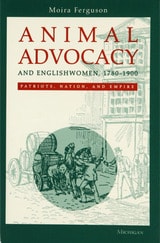
Animal Advocacy and Englishwomen, 1780-1900
Patriots, Nation, and EmpireMoira Ferguson
University of Michigan Press, 1998
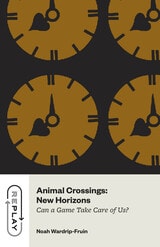
Animal Crossing
New Horizons: Can a Game Take Care of Us?Noah Wardrip-Fruin
University of Chicago Press, 2025
A moving, personal exploration of what we looked for, and found, in the gaming sensation Animal Crossing during and after the pandemi
Animal Crossing: New Horizons was released on March 20, 2020—just as a pandemic kept many from family, work, restaurants, and the rest of their regularly scheduled lives. At its height, the game averaged one million copies sold per day, as players sought comfort, escape, and a virtual means of connection. In this book, game scholar Noah Wardrip-Fruin, isolated with his family by both lockdown and disability, explores the power of this game and the mixed emotions of a player and a parent trying to make it from one day to the next—while his kids’ obsession with Animal Crossing creates conflicts between them and pushback against family rules.
Wardrip-Fruin helps both Animal Crossing fans and newcomers understand the unexpected beneath the game’s surface: like the story of the first Animal Crossing, codesigned by an absent father seeking connection; like the hallmarks of video game manipulation, from “streak” bonuses to game-determined playtimes; like the appeal of endless shopping, in a kind of “safe” capitalism; and, of course, like the character quirks of a raccoon dog, Tom Nook, who provides a world of both safety and strange paternalism.
For many, this blockbuster game offered a comforting world compared to a reality of danger. In this first entry in the Replay series, Wardrip-Fruin offers an absorbing investigation of a game’s role in contemporary social life and a book that belongs on the shelf of anyone who loves or is puzzled by this Nintendo sensation.
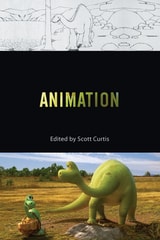
Animation
Curtis, Scott
Rutgers University Press, 2019

Anime's Knowledge Cultures
Geek, Otaku, ZhaiJinying Li
University of Minnesota Press, 2024
Unlocking the technosocial implications of global geek cultures
Why has anime, a “low-tech” medium from last century, suddenly become the cultural “new cool” in the information age? Through the lens of anime and its transnational fandom, Jinying Li explores the meanings and logics of “geekdom” as one of the most significant sociocultural groups of our time. In Anime’s Knowledge Cultures, Li shifts the center of global geography in knowledge culture from the computer boys in Silicon Valley to the anime fandom in East Asia.
Drawing from film studies, animation studies, media theories, fan studies, and area studies, she provides broad cultural and theoretical explanations of anime’s appeal to a new body of tech-savvy knowledge workers and consumers commonly known as geeks, otaku, or zhai. Examining the forms, techniques, and aesthetics of anime, as well as the organization, practices, and sensibilities of its fandom, Anime’s Knowledge Cultures is at once a theorization of anime as a media environment as well as a historical and cultural study of transnational geekdom as a knowledge culture. Li analyzes anime culture beyond the national and subcultural frameworks of Japan or Japanese otaku, instead theorizing anime’s transnational, transmedial network as the epitome of the postindustrial knowledge culture of global geekdom.
By interrogating the connection between the anime boom and global geekdom, Li reshapes how we understand the meanings and significance of anime culture in relation to changing social and technological environments.