Results by title
1095 books match the query 'Rhetoric' and 94 start with a
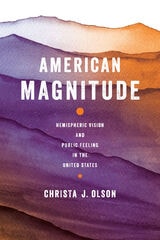
American Magnitude
Hemispheric Vision and Public Feeling in the United StatesChrista J. Olson
The Ohio State University Press, 2021
Winner, 2023 Rhetoric Society of America Book Award
Winner, 2022 Marie Hochmuth Nichols Award from the National Communication Association
At a moment in US politics when racially motivated nationalism, shifting relations with Latin America, and anxiety over national futures intertwine, understanding the long history of American preoccupation with magnitude and how it underpins national identity is vitally important. In American Magnitude, Christa J. Olson tracks the visual history of US appeals to grandeur, import, and consequence (megethos), focusing on images that use the wider Americas to establish US character. Her sources—including lithographs from the US-Mexican War, pre–Civil War paintings of the Andes, photo essays of Machu Picchu, and WWII-era films promoting hemispheric unity—span from 1845 to 1950 but resonate into the present.
Olson demonstrates how those crafting the appeals that feed the US national imaginary—artists, scientists, journalists, diplomats, and others—have invited US audiences to view Latin America as a foil for the greatness of their own nation and encouraged white US publics in particular to see themselves as especially American among Americans. She reveals how each instance of visual rhetoric relies upon the eyes of others to instantiate its magnitude—and falters as some viewers look askance instead. The result is the possibility of a post-magnitude United States: neither great nor failed, but modest, partial, and imperfect.
American Rhetoric in the New Deal Era, 1932-1945
A Rhetorical History of the United States, Volume VIIThomas Benson
Michigan State University Press, 2006
The New Deal era is hard to define with precision—in time or in ideology. Some historians use New Deal to designate the intense period of domestic reform legislation of the first Franklin Delano Roosevelt administration, 1933–37. Others confine discussion of the era to the legislation of 1933, and identify another wave of legislation in 1935 as a Second New Deal. Most of the essays in this book focus on the prewar period, with glimpses that look forward to the rhetoric of the approach to and engagement in World War II.
Amid the Fall, Dreaming of Eden
Du Bois, King, Malcolm X, and Emancipatory CompositionBradford T. Stull
Southern Illinois University Press, 1999
Whom, or what, does composition—defined here as an intentional process of study, either oral or written—serve? Bradford T. Stull contends that composition would do well to articulate, in theory and practice, what could be called "emancipatory composition." He argues that emancipatory composition is radically theopolitical: it roots itself in the foundational theological and political language of the American experience while it subverts this language in order to emancipate the oppressed and, thereby, the oppressors.
To articulate this vision, Stull looks to those who compose from an oppressed place, finding in the works of W. E. B. Du Bois, Martin Luther King Jr., and Malcolm X radical theopolitical practices that can serve as a model for emancipatory composition. While Stull acknowledges that there are many sites of oppression, he focuses on what Du Bois has called the problem of the twentieth century: the color line, positing that the unique and foundational nature of the color line provides a fecund place in which, from which, a theory and practice of emancipatory composition might be elucidated.
By focusing on four key theopolitical tropes—The Fall, The Orient, Africa, and Eden—that inform the work of Du Bois, King, and Malcolm X, Stull discovers the ways in which these civil rights leaders root themselves in the vocabulary of the American experience in order to subvert it so that they might promote emancipation for African Americans, and thus all Americans.
In drawing on the work of Paulo Freire, Kenneth Burke, Edward Said, Christopher Miller, Ernst Bloch, and others, Stull also locates this study within the larger cultural context. By reading Du Bois, King, and Malcolm X together in a way that they have never before been read, Stull presents a new vision of composition practice to the African American studies community and a reading of African American emancipatory composition to the rhetoric and composition community, thus extending the question of emancipatory composition into new territory.
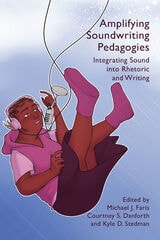
Amplifying Soundwriting Pedagogies
Integrating Sound into Rhetoric and WritingMichael J. Faris
University Press of Colorado, 2022
An Alternate Pragmatism for Going Public
Jim Webber
Utah State University Press, 2017
An Alternate Pragmatism for Going Public interrogates composition’s most prominent responses to contemporary K–16 education reform. By “going public,” teachers, scholars, and administrators rightfully reassert their expertise against corporate-political standards and assessments like the Common Core, Complete College America, and the Collegiate Learning Assessment. However, author Jim Webber shows that composition’s professional imperative for self-defense only partly fulfils the broader aims of “going public,” which include fostering public participation that can assess and potentially affirm the public good of professional judgment.
Drawing on the pragmatic/democratic tradition, Webber envisions an alternate rhetoric of professionalism, one that not only reasserts compositionists’ expertise but also expands opportunities for publics to authorize this expertise. While this public inquiry and engagement may not safeguard professional standing against neoliberal reform, it reorients composition toward an equally important goal, enabling publics to gauge the adequacy of the educational standardization so often advocated by contemporary reform.
An Alternate Pragmatism for Going Public shows how public engagement can serve composition’s efforts related to “going public.”
Ancient Rhetorics and Digital Networks
Edited by Michele Kennerly and Damien Smith Pfister
University of Alabama Press, 2018
What can ancient rhetorical theory possibly tell us about the role of new digital media technologies in contemporary public culture? Some central issues we currently deal with—making sense of information abundance, persuading others in our social network, navigating new media ecologies, and shaping broader cultural currents—also pressed upon the ancients.
Ancient Rhetorics and Digital Networks makes this connection explicit, reexamining key figures, texts, concepts, and sensibilities from ancient rhetoric in light of the glow of digital networks, or, ordered conversely, surveying the angles and tangles of digital networks from viewpoints afforded by ancient rhetoric. By providing an orientation grounded in ancient rhetorics, this collection simultaneously historicizes contemporary developments and reenergizes ancient rhetorical vocabularies.
Contributors engage with a variety of digital phenomena including remix, big data, identity and anonymity, memes and virals, visual images, decorum, and networking. Taken together, the essays in Ancient Rhetorics and Digital Networks help us to understand and navigate some of the fundamental communicative issues we deal with today.
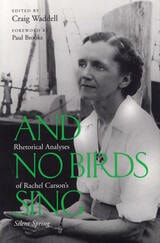
And No Birds Sing
Rhetorical Analyses of Rachel Carson's Silent SpringEdited by Craig Waddell. Foreword by Paul Brooks. Afterword by Linda Lear
Southern Illinois University Press, 2000
Craig Waddell presents essays investigating Rachel Carson’s influential 1962 book, Silent Spring. In his foreword, Paul Brooks, Carson’s editor at Houghton Mifflin, describes the process that resulted in Silent Spring. In an afterword, Linda Lear, Carson’s recent biographer, recalls the end of Carson’s life and outlines the attention that Carson’s book and Carson herself received from scholars and biographers, attention that focused so minutely on her life that it detracted from a focus on her work. The foreword by Brooks and the afterword by Lear frame this exploration within the context of Carson’s life and work.
Contributors are Edward P. J. Corbett, Carol B, Gartner, Cheryll Glotfelty, Randy Harris, M. Jimmie Killingsworth, Linda Lear, Ralph H. Lutts, Christine Oravec, Jacqueline S. Palmer, Markus J. Peterson, Tarla Rai Peterson, and Craig Waddell. Together, these essays explore Silent Spring’seffectiveness in conveying its disturbing message and the rhetorical strategies that helped create its wide influence.
Angelina Grimke
Rhetoric, Identity, and the Radical ImaginationStephen H. Browne
Michigan State University Press, 1999
Abolitionist, women's rights activist, and social reformer, Angelina Grimké (1805-79) was among the first women in American history to seize the public stage in pursuit of radical social reform. "I will lift up my voice like a trumpet," she proclaimed, "and show this people their transgressions." And when she did lift her voice in public, on behalf of the public, she found that, in creating herself, she might transform the world. In the process, Grimké crossed the wires of race, gender, and power, and produced explosions that lit up the world of antebellum reform. Among the most remarkable features of Angelina Grimké's rhetorical career was her ability to stage public contests for the soul of America—bringing opposing ideas together to give them voice, depth, and range to create new and more compelling visions of social change.
Angelina Grimké: Rhetoric, Identity, and the Radical Imagination is the first full-length study to explore the rhetorical legacy of this most unusual advocate for human rights. Stephen Browne examines her epistolary and oratorical art and argues that rhetoric gave Grimké a means to fashion not only her message but her very identity as a moral force.
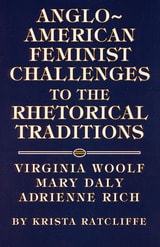
Anglo-American Feminist Challenges to the Rhetorical Traditions
Virginia Woolf, Mary Daly, Adrienne RichKrista Ratcliffe
Southern Illinois University Press, 1996
Although women and men have different relationships to language and to each other, traditional theories of rhetoric do not foreground such gender differences. Krista Ratcliffe argues that because feminists generally have not conceptualized their language theories from the perspective of rhetoric and composition studies, rhetoric and composition scholars must construct feminist theories of rhetoric by employing a variety of interwoven strategies: recovering lost or marginalized texts; rereading traditional rhetoric texts; extrapolating rhetorical theories from such nonrhetoric texts as letters, diaries, essays, cookbooks, and other sources; and constructing their own theories of rhetoric.
Focusing on the third option, Ratcliffe explores ways in which the rhetorical theories of Virginia Woolf, Mary Daly, and Adrienne Rich may be extrapolated from their Anglo-American feminist texts through examination of the interrelationship between what these authors write and how they write. In other words, she extrapolates feminist theories of rhetoric from interwoven claims and textual strategies. By inviting Woolf, Daly, and Rich into the rhetorical traditions and by modeling the extrapolation strategy/methodology on their writings, Ratcliffe shows how feminist texts about women, language, and culture may be reread from the vantage point of rhetoric to construct feminist theories of rhetoric. She also outlines the pedagogical implications of these three feminist theories of rhetoric, thus contributing to ongoing discussions of feminist pedagogies.
Traditional rhetorical theories are gender-blind, ignoring the reality that women and men occupy different cultural spaces and that these spaces are further complicated by race and class, Ratcliffe explains. Arguing that issues such as who can talk, where one can talk, and how one can talk emerge in daily life but are often disregarded in rhetorical theories, Ratcliffe rereads Roland Barthes’ "The Old Rhetoric" to show the limitations of classical rhetorical theories for women and feminists. Discovering spaces for feminist theories of rhetoric in the rhetorical traditions, Ratcliffe invites readers not only to question how women have been located as a part of— and apart from—these traditions but also to explore the implications for rhetorical history, theory, and pedagogy.
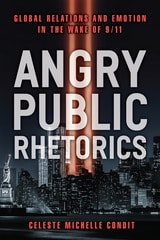
Angry Public Rhetorics
Global Relations and Emotion in the Wake of 9/11Celeste Michelle Condit
University of Michigan Press, 2018
These voices show that anger is more effective for producing some collective actions, such as rallying supporters, reifying existing worldviews, motivating attack, enforcing shared norms, or threatening from positions of power; and less effective for others, like broadening thought, attracting new allies, adjudicating justice across cultural norms, or threatening from positions of weakness. Because social anger requires shared norms, collectivized anger cannot serve social justice. In order for anger to be a force for global justice, the world’s peoples must develop shared norms to direct discussion of international relations. Angry Public Rhetorics provides guidance for such public forums.
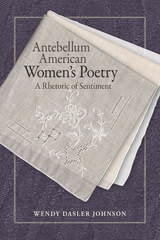
Antebellum American Women's Poetry
A Rhetoric of SentimentWendy Dasler Johnson
Southern Illinois University Press, 2016
Considering the logos, ethos, and pathos—aims, writing personae, and audience appeal—of poems by African American abolitionist Frances Watkins Harper, working-class prophet Lydia Huntley Sigourney, and feminist socialite Julia Ward Howe, Wendy Dasler Johnson demonstrates that sentimental poetry was an inportant component of antebellum social activism. She articulates the ethos of the poems of Harper, who presents herself as a properly domestic black woman, nevertheless stepping boldly into Northern pulpits to insist slavery be abolished; the poetry of Sigourney, whose speaker is a feisty, working-class, ambiguously gendered prophet; and the works of Howe, who juggles her fame as the reformist “Battle Hymn” lyricist and motherhood of five children with an erotic Continental sentimentalism.
Antebellum American Women's Poetry makes a strong case for restoration of a compelling system of persuasion through poetry usually dismissed from studies of rhetoric. This remarkable book will change the way we think about women’s rhetoric in the nineteenth century, inviting readers to hear and respond to urgent, muffled appeals for justice in our own day.
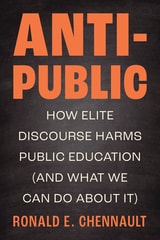
Anti-Public
How Elite Discourse Harms Public Education (and What We Can Do About It)Ronald E. Chennault
Rutgers University Press, 2026
Consider this: Restrictions placed by state legislatures on what schools can teach about America's history of conquest and enslavement. Broad bans enacted by local school boards that remove meaningful books from school curricula and the shelves of libraries. Court rulings that muddy the distinction between what counts as private versus public expressions of religion in public school settings and that open the door to publicly funded religious education. All of these recent actions chip away at the foundation of public education in America. But how did we get here? Decades of elite public discourse (talk and text) about public education helped to bring us to this point. Much of this conversation is anti-public. It includes statements by major elected officials, education advocacy organizations, journalists in mainstream press outlets, and other influential actors. Chennault casts light on the cultural and political processes at work and challenges the unquestioned assumptions beneath the surface of this discourse, with the hopes that we can transform and strengthen public education.
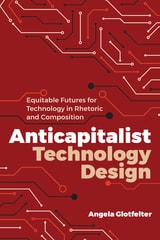
Anticapitalist Technology Design
Equitable Futures for Technology in Rhetoric and CompositionAngela Glotfelter
Utah State University Press, 2026
Under capitalism, every key we press, search we conduct, and prompt we write implicates us within a global web of exploitation that has created vast economic disparities. How, then, are we to understand and use technologies to write, think, argue, and teach about equitable futures for our world?
In response to this question, Anticapitalist Technology Design explores technology usage in writing programs as a site for equity work within a political-economic frame. Using an approach that combines classical Marxist ideas about political economy with contemporary advances in social justice theory, this book presents an intersectional approach to conducting anticapitalist work in rhetoric and composition around technology use.
Angela Glotfelter explores this work through the lens of anticapitalist technology design, a method that considers how inequitable ideologies are rhetorically encoded into new technologies and perpetuated through their usage. She applies this method to the case study of prototyping an equity dashboard for a first-year composition program, demonstrating the potential of anticapitalist technology design in practice.
Anticapitalist Technology Design brings together work from across the Marxist tradition, critical race theory, user experience, and transnational feminism, and will resonate with any one who wants to navigate new technologies in economically and socially just ways.
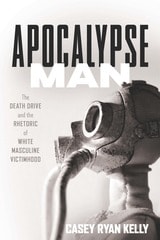
Apocalypse Man
The Death Drive and the Rhetoric of White Masculine VictimhoodCasey Ryan Kelly
The Ohio State University Press, 2020
Exemplified by President Donald J. Trump’s slogan “Make American Great Again,” white masculinity has become increasingly organized around melancholic attachments to an imagined past when white men were still atop the social hierarchy. How and why are white men increasingly identifying as victims of social, economic, and political change? Casey Ryan Kelly’s Apocalypse Man seeks to answer this question by examining textual and performative examples of white male rhetoric—as found among online misogynist and incel communities, survivalists and “doomsday preppers,” gender-motivated mass shooters, gun activists, and political demagogues. Using sources ranging from reality television and Reddit manifestos to gun culture and political rallies, Kelly ultimately argues that death, victimhood, and fatalism have come to underwrite the constitution of contemporary white masculinity.

Apology to Apostrophe
Autobiography and the Rhetoric of Self-Representation in SpainJames D. Fernandez
Duke University Press, 1992
As Fernández demonstrates, recent developments in critical theory provide new and fruitful approaches to autobiographical works that have long been neglected, misunderstood, or, in some cases, virtually unknown. Focusing primarily but not exclusively on nineteenth-century Spain, Fernández exposes a rhetorical tension that often occurs in autobiographical discourse, between self-justification, or "apology," and the transcendence of this worldly impulse, or "apostrophe." This tension, he argues, is of particular interest in the case of Spain, but not peculiar to that nation, and his attention to the theoretical nature of autobiography leads to insightfl considerations of many canonical European autobiographies, including those of Saint Augustine, Rousseau, Saint Teresa, and Cardinal Newman.
Considering Spanish autobiography in the context of first-person narrative in Europe and in the terms of current debates on the relationship between writing and selfhood, Apology to Apostrophe marks a significant advance in our historical understanding and critical discussion of the genre. The book will be of great value not only to Hispanists but also to those interested in autobiography and cultural history.
Appeals in Modern Rhetoric
An Ordinary Language ApproachM. Jimmie Killingsworth
Southern Illinois University Press, 2005
Appeals in Modern Rhetoric: An Ordinary-Language Approach introduces students to current issues in rhetorical theory through an extended treatment of the rhetorical appeal, a frequently used but rarely discussed concept at the core of rhetorical analysis and criticism. Shunning the standard Aristotelian approach that treats ethos, pathos, and logos as modes of appeal, M. Jimmie Killingsworth uses common, accessible language to explain the concept of the rhetorical appeal—meaning the use of language to plead and to please. The result is a practical and innovative guide to understanding how persuasion works that is suitable for graduate and undergraduate courses yet still addresses topics of current interest to specialists.
Supplementing the volume are practical and theoretical approaches to the construction and analysis of rhetorical messages and brief and readable examples from popular culture, academic discourse, politics, and the verbal arts. Killingsworth draws on close readings of primary texts in the field, referencing theorists to clarify concepts, while he decodes many of the basic theoretical constructs common to an understanding of identification. Beginning with examples of the model of appeals in social criticism, popular film, and advertising, he covers in subsequent chapters appeals to time, place, the body, gender, and race. Additional chapters cover the use of common tropes and rhetorical narrative, and each chapter begins with definitions of key concepts.

Appetites of Empire
Food, Farming, and Fitness Rhetorics During the Obama EraDustin Greenwalt
University of Alabama Press, 2026
In Imperial Styles: Food, Farming, and Fitness Rhetorics During the Obama Era, Dustin Greenwalt examines how discussions of food, farming, and fitness became influential sites for negotiating questions of identity, citizenship, health, and economic life during the early twenty-first century.
Applied Pedagogies
Strategies for Online Writing InstructionDaniel Ruefman
Utah State University Press, 2016
This is a practical text, providing ways to employ the best instructional strategies possible for today’s diverse and dynamic digital writing courses. Organized into three sections—Course Conceptualization and Support, Fostering Student Engagement, and MOOCs—chapters explore principles of rhetorically savvy writing crossed with examples of effective digital teaching contexts and genres of digital text. Contributors consider not only pedagogy but also the demographics of online students and the special constraints of the online environments for common writing assignments.
The scope of online learning and its place within higher education is continually evolving. Applied Pedagogies offers tools for the online writing classrooms of today and anticipates the needs of students in digital contexts yet to come. This book is a valuable resource for established and emerging writing instructors as they continue to transition to the digital learning environment.
Contributors: Kristine L. Blair, Jessie C. Borgman, Mary-Lynn Chambers, Katherine Ericsson, Chris Friend, Tamara Girardi, Heidi Skurat Harris, Kimberley M. Holloway, Angela Laflen, Leni Marshall, Sean Michael Morris, Danielle Nielsen, Dani Nier-Weber, Daniel Ruefman, Abigail G. Scheg, Jesse Stommel
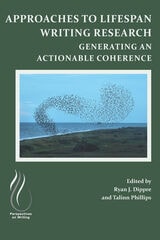
Approaches to Lifespan Writing Research
Generating an Actionable CoherenceRyan J. Dippre
University Press of Colorado, 2020
Copublished with CSU Open Press
This edited collection builds on the three themes that emerged from the 2018 inaugural lifespan writing conference—identity, society, and theory—to further the study of writing through the lifespan. The contributors to this collection provide a framework within which the reader can develop a dynamic, interdisciplinary, multifaceted understanding of the limits and possibilities of studying lifespan writing. Recognizing that such research requires methodological rigor and flexibility as well as theoretical precision and adaptability, Approaches to Lifespan Writing Research draws on a range of methodological and theoretical approaches, from autoethnography to longitudinal structural equation modeling. This methodological and theoretical flexibility reflects the challenges inherent in studying lifespan writing—in particular, the need to develop an integrated framework that enables the “translation” of research findings for use by other lifespan writing researchers. Approaches to Lifespan Writing Research begins that process.
This book is also available as an open access ebook through the WAC Clearinghouse
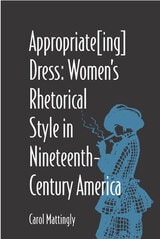
Appropriate[Ing] Dress
Women's Rhetorical Style in Nineteenth-Century AmericaCarol Mattingly
Southern Illinois University Press, 2002
Carol Mattingly examines the importance of dress and appearance for nineteenth-century women speakers and explores how women appropriated gendered conceptions of dress and appearance to define the struggle for representation and power that is rhetoric. Although crucial to women’s effectiveness as speakers, Mattingly notes, appearance has been ignored because it was taken for granted by men.
Because women rarely spoke in public before the nineteenth century, no guidelines existed regarding appropriate dress when they began to speak to audiences. Dress evoked immediate images of gender, an essential consideration for women speakers because of its strong association with place, locating women in the domestic sphere and creating a primary image that women speakers would work with—and against—throughout the century. Opposition to conspicuous change for women often necessitated the subtle transfer of comforting images when women sought to inhabit traditionally masculine spaces. The most successful women speakers carefully negotiated expectations by highlighting some conventions even as they broke others.
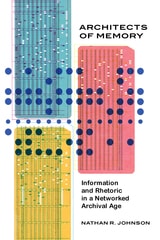
Architects of Memory
Information and Rhetoric in a Networked Archival AgeNathan R. Johnson
University of Alabama Press, 2020
Understanding the systems that shape what societies remember, archive, and forget.
We are now living in the richest age of public memory. From museums and memorials to the vast digital infrastructure of the internet, access to the past is only a click away. Even so, the methods and technologies created by scientists, espionage agencies, and information management coders and programmers have drastically delimited the ways that communities across the globe remember and forget our wealth of retrievable knowledge.
In Architects of Memory: Information and Rhetoric in a Networked Archival Age, Nathan R. Johnson charts turning points where concepts of memory became durable in new computational technologies and modern memory infrastructures took hold. He works through both familiar and esoteric memory technologies—from the card catalog to the book cart to Zatocoding and keyword indexing—as he delineates histories of librarianship and information science and provides a working vocabulary for understanding rhetoric’s role in contemporary memory practices.
This volume draws upon the twin concepts of memory infrastructure and mnemonic technê to illuminate the seemingly opaque wall of mundane algorithmic techniques that determine what is worth remembering and what should be forgotten. Each chapter highlights a conflict in the development of twentieth-century librarianship and its rapidly evolving competitor, the discipline of information science. As these two disciplines progressed, they contributed practical techniques and technologies for making sense of explosive scientific advancement in the wake of World War II. Taming postwar science became part and parcel of practices and information technologies that undergird uncountable modern communication systems, including search engines, algorithms, and databases for nearly every national clearinghouse of the twenty-first century.
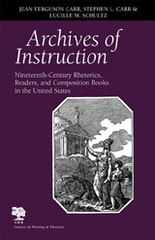
Archives of Instruction
Nineteenth-Century Rhetorics, Readers, and Composition Books in the United StatesJean Ferguson Carr, Stephen L. Carr, and Lucille M. Schultz
Southern Illinois University Press, 2005
Both a historical recovery and a critical rethinking of the functions and practices of textbooks, Archives of Instruction: Nineteenth-Century Rhetorics, Readers, and Composition Books in the United States argues for an alternative understanding of our rhetorical traditions. The authors describe how the pervasive influence of nineteenth-century literacy textbooks demonstrate the early emergence of substantive instruction in reading and writing. Tracing the histories of widespread educational practices, the authors treat the textbooks as an important means of cultural formation that restores a sense of their distinguished and unique contributions.
At the beginning of the nineteenth century, few people in the United States had access to significant school education or to the materials of instruction. By century’s end, education was a mass—though not universal—experience, and literacy textbooks were ubiquitous artifacts, used both in home and in school by a growing number of learners from diverse backgrounds. Many of the books have been forgotten, their contributions slighted or dismissed, or they are remembered through a haze of nostalgia as tokens of an idyllic form of schooling. Archives of Instruction suggests strategies for re-reading the texts and details the watersheds in the genre, providing a new perspective on the material conditions of schooling, book publication, and emerging practices of literacy instruction. The volume includes a substantial bibliography of primary and secondary works related to literacy instruction at all levels of education in the United States during the nineteenth century.
Argumentation Theory and the Rhetoric of Assent
David Williams
University of Alabama Press, 1990
The eleven essays coalesce around the general question of "When, if ever, is assent justified?" And, as Professor Cox astutely notes in his introduction, such a question immediately leads into considerations of argument and power. In these considerations, many differing perspectives are represented in this volume: aesthetic and symbolist approaches, rationalistic and formalistic approaches, field theory perspectives, orientations toward various conceptualizations of a public sphere, etc.
Argumentation Theory and the Rhetoric of Assent is intended not as a primer on argument theory but rather as a look at American approaches to a philosophy of argumentation and argument criticism. As such, the essays probe the implications of both current practices and theoretical approaches: the objective is not to map the terrain argumentation theory has traversed in recent years but rather to plot a route for the direction in which argumentation studies should move. The concluding essays by James Arnt Aune and G. Thomas Goodnight confront these concerns explicitly.
Arguments in Rhetoric Against Quintilian
Translation and Text of Peter Ramus's Rhetoricae Distinctiones in QuintilianumPeter Ramus, Translated by Carole Newlands, Edited by James J. Murphy,
Southern Illinois University Press, 2010
First published in 1986, this book offers the Latin text and English translation of a pivotal work by one of the most influential and controversial writers of early modern times. Pierre de la Ramée, better known as Peter Ramus, was a college instructor in Paris who published a number of books attacking and attempting to refute foundational texts in philosophy and rhetoric. He began in the early 1540s with books on Aristotle—which were later banned and burned—and Cicero, and later, in 1549, he published Rhetoricae Distinctiones in Quintilianum. The purpose of Ramus’s book is announced in the opening paragraph of its dedication to Charles of Lorraine: “I have a single argument, a single subject matter, that the arts of dialectic and rhetoric have been confused by Aristotle, Cicero, and Quintilian. I have previously argued against Aristotle and Cicero. What objection then is there against calling Quintilian to the same account?”
Carole Newlands’s excellent translation—the first in modern English—remains the standard English version. This volume also provides the original Latin text for comparative purposes. In addition, James J. Murphy’s insightful introduction places the text in historical perspective by discussing Ramus’s life and career, the development of his ideas, and the milieu in which his writings were produced. This edition includes an updated bibliography of works concerning Ramus, rhetoric, and related topics.
Aristotle's "Art of Rhetoric"
Aristotle
University of Chicago Press, 2019
Here Robert C. Bartlett offers a literal, yet easily readable, new translation of Aristotle’s “Art of Rhetoric,” one that takes into account important alternatives in the manuscript and is fully annotated to explain historical, literary, and other allusions. Bartlett’s translation is also accompanied by an outline of the argument of each book; copious indexes, including subjects, proper names, and literary citations; a glossary of key terms; and a substantial interpretive essay.
Aristotle's Rhetoric
An Art of CharacterEugene Garver
University of Chicago Press, 1995
Aristotle's Voice
Rhetoric, Theory, and Writing in AmericaJasper Neel
Southern Illinois University Press, 1994
In this book, Jasper Neel’s sure-to-be-controversial resituating of Aristotle centers around three questions that have been constants in his twenty-two years of teaching experience: What does itmean to teach writing? What should one know before teaching writing? And, if there is such a thing as "research in the teaching of writing," what is it?
Believing that all composition teachers are situated politically and socially, both as part of the institution in which they teach and as beings with lived histories, Neel examines his own life and the life of composition studies as a discipline in the context of Aristotle. Neel first situates the Rhetoric as a political document; he then situates the Rhetoric in the Aristotelian system and describes how professional discourse came to know itself through Aristotle’s way of studying the world; finally, he examines the operation of the Rhetoric inside itself before arguing the need to turn to Aristotle’s notion of sophistry as a way of negating his system.
By pointing out the connections among Aristotelian rhetoric, the contemporary university, and the contemporary writing teacher, Neel shows that Aristotle’s frightening social theories are as alive today as are Aristotelian notions of discourse.
Neel explains that by their very nature teachers must speak with a professional voice. It is through showing how to "hear" one’s professional voice that Neel explores the notion of professional discourse that originates with Aristotle. In maintaining that one must pay a high price in order to speak through Aristotle’s theory or to assume the role of "professional," he argues that no neutral ground exists either for pedagogy or for the analysis of pedagogy. Neel concludes this discussion by proposing that Aristotelian sophistry is both an antidote to Aristotelian racism, sexism, and bigotry and a way of allowing Aristotelian categories of discourse to remain useful.
Finally, as an Aristotelian, a teacher, and a writer, Neel responds both to Aristotle and to professionalism by rethinking the influence of the past and reviving the voice of Aristotelian sophistry.
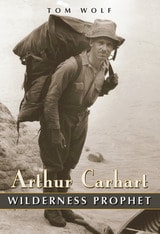
Arthur Carhart
Wilderness ProphetTom Wolf
University Press of Colorado, 2025
Arthur Carhart (1892-1978), America's first champion of wilderness, the first Forest Service landscape architect, and the most popular conservation writer of mid-century America, never won the titan status of his contemporary, Aldo Leopold. A political maverick, he refused to side with any major advocacy group and none has made him its saint. Carhart was a grassroots thinker in a top-down era.
Arthur Carhart, the first biography of this Republican environmentalist and major American thinker, writer, and activist, reveals the currency of his ideas. Tom Wolf elucidates Carhart 's vision of conservation as "a job for all of us," with citizens, municipal authorities, and national leaders all responsible for the environmental effects of their decisions. Carhart loved the local and decried interest groups—from stockmens' associations to wilderness lobbies—as cliques attempting blanket control. He pressured land management agencies to base decisions on local ecology and local partnerships. A lifelong wilderness advocate who proposed the first wilderness preserve at Trappers Lake, Colorado, in 1919, Carhart chose to oppose the Wilderness Act, heartsick at its compromises with lobbies.
Because he shifted his stance and changed his views in response to new information, Carhart is not an easy subject for a biography. Wolf traces Carhart's twists and turns to show a man whose voice was distinctive and contrary and who spoke from a passionate concern for the land and couldn't be counted on for anything else. Readers of American history and outdoor writing will enjoy this portrait of a historic era in conservation politics and the man who so often eschewed politics in favor of the land and people he loved.
Arthur M. Schlesinger Jr. and the Ideological History of American Liberalism
Stephen P. Depoe
University of Alabama Press, 1994
Arthur M. Schlesinger, Jr., is a historian and political advocate whose ideas and activities have significantly influenced the shape and direction of American liberalism during the past fifty years. A central feature of Schlesinger’s ideological perspective is his belief that American history has been marked by alternating periods of conservative and liberal dominance, which he has termed the “tides of national politics.” Throughout his career, Schlesinger has used the “tides of national politics” to defend the legitimacy and superiority of active liberal government and leadership.
The study investigates how the “tides” concept has functioned in both Schlesinger’s historical scholarship and his partisan political discourse. Depoe also explores the ways in which the “tides” concept has shaped and channeled Schlesinger’s political thought over time, leading him toward certain definitions of situations and away from others. Finally, Depoe offers Schlesinger’s life and work as a case study of the highs and lows of postwar American liberalism. By tracing Schlesinger’s responses to Eisenhower-era conservatism, Kennedy’s New Frontier, and the problems of Vietnam and violence during the 1960s, and the gradual delegitimation of liberalism from the 1970s to the present, this book offers a road map that can guide the reader toward a better understanding of the past, present, and future of liberalism in America.
Assessing the Teaching of Writing
Twenty-First Century Trends and TechnologiesAmy E. Dayton
Utah State University Press, 2015
Although fraught with politics and other perils, teacher evaluation can contribute in important, positive ways to faculty development at both the individual and the departmental levels. Yet the logistics of creating a valid assessment are complicated. Inconsistent methods, rater bias, and overreliance on student evaluation forms have proven problematic. The essays in Assessing the Teaching of Writing demonstrate constructive ways of evaluating teacher performance, taking into consideration the immense number of variables involved.
Contributors to the volume examine a range of fundamental issues, including the political context of declining state funds in education; growing public critique of the professoriate and demands for accountability resulting from federal policy initiatives like No Child Left Behind; the increasing sophistication of assessment methods and technologies; and the continuing interest in the scholarship of teaching. The first section addresses concerns and advances in assessment methodologies, and the second takes a closer look at unique individual sites and models of assessment. Chapters collectively argue for viewing teacher assessment as a rhetorical practice.
Fostering new ways of thinking about teacher evaluation, Assessing the Teaching of Writing will be of great interest not only to writing program administrators but also to those concerned with faculty development and teacher assessment outside the writing program.
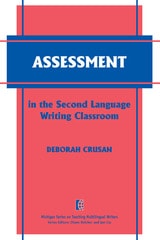
Assessment in the Second Language Writing Classroom
Deborah Crusan
University of Michigan Press, 2010
Assessment in the Second Language Writing Classroom is a teacher and prospective teacher-friendly book, uncomplicated by the language of statistics. The book is for those who teach and assess second language writing in several different contexts: the IEP, the developmental writing classroom, and the sheltered composition classroom. In addition, teachers who experience a mixed population or teach cross-cultural composition will find the book a valuable resource. Other books have thoroughly covered the theoretical aspects of writing assessment, but none have focused as heavily as this book does on pragmatic classroom aspects of writing assessment. Further, no book to date has included an in-depth examination of the machine scoring of writing and its effects on second language writers.
Crusan not only makes a compelling case for becoming knowledgeable about L2 writing assessment but offers the means to do so. Her highly accessible, thought-provoking presentation of the conceptual and practical dimensions of writing assessment, both for the classroom and on a larger scale, promises to engage readers who have previously found the technical detail of other works on assessment off-putting, as well as those who have had no previous exposure to the study of assessment at all.
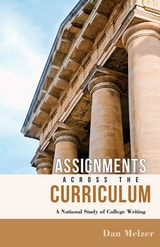
Assignments across the Curriculum
A National Study of College WritingDan Melzer
Utah State University Press, 2014
In Assignments across the Curriculum, Dan Melzer analyzes the rhetorical features and genres of writing assignments through the writing-to-learn and writing-in-the-disciplines perspectives. Presenting the results of his study of 2,101 writing assignments from undergraduate courses in the natural sciences, social sciences, business, and humanities in 100 postsecondary institutions in the United States, Assignments across the Curriculum is unique in its cross-institutional breadth and its focus on writing assignments.
The results provide a panoramic view of college writing in the United States. Melzer's framework begins with the rhetorical situations of the assignments—the purposes and audiences—and broadens to include the assignments' genres and discourse community contexts. Among his conclusions is that courses connected to a writing-across-the-curriculum (WAC) initiative ask students to write more often, in a greater variety of genres, and for a greater variety of purposes and audiences than non-WAC courses do, making a compelling case for the influence of the WAC movement.
Melzer's work also reveals patterns in the rhetorical situations, genres, and discourse communities of college writing in the United States. These larger patterns are of interest to WAC practitioners working with faculty across disciplines, to writing center coordinators and tutors working with students who bring assignments from a variety of fields, to composition program administrators, to first-year writing instructors interested in preparing students for college writing, and to high school teachers attempting to bridge the gap between high school and college writing.

At Home in the Anthropocene
Amy D. Propen
The Ohio State University Press, 2022
By employing the tenets of posthumanism, compassionate conservation, and entangled empathy—and making them accessible through storytelling and narrative—Propen offers new perspectives about how to more compassionately and productively understand ideas about home, connectivity, and coexistence across a range of places and ecosystems. Uniquely conceptualized to include narrative related to the Anthropause, as well as travel and nature writing amidst COVID-19, At Home in the Anthropocene engages with questions about home and belonging in generative ways that attempt to open up possibilities for sustainable futures in which we may productively coexist with our more-than-human kin.

At Risk
Rhetoric, Deviance, and the Politics of HIV PreventionMcKinley Green
The Ohio State University Press, 2026
At Risk explores how young people living with HIV have developed risk-reduction practices that seem to contradict public health recommendations for HIV prevention. Putting forward a rhetoric of deviance to frame these instances, McKinley Green argues that they represent intentional healthcare decisions that help young people mitigate the health risks that are most pressing in their daily lives. While current HIV risk-reduction priorities in the US are framed around a finite spectrum of sexual behaviors and medical technologies, those living with HIV often encounter a broader spectrum of risks shaped by structural inequities like racism, housing insecurity, queer and transphobia, HIV stigma, trauma in medical settings, and addiction, all of which create conditions that increase the risk of HIV transmission and present other threats to safety and autonomy.
Drawing from more than sixty hours of interviews with young people living with HIV, frontline healthcare workers, and HIV activists, Green highlights how those living with HIV have developed agency and expertise in navigating, mitigating, and communicating about risk. In doing so, he offers alternative epistemologies of sexual health risk that point toward more patient-centered HIV prevention frameworks.
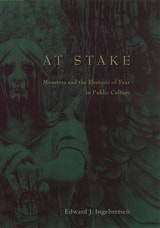
At Stake
Monsters and the Rhetoric of Fear in Public CultureEdward Ingebretsen
University of Chicago Press, 2001
In a study that is at once an analysis of popular culture, a polemic on religious and secular rhetoric, and an ethics of representation, Edward Ingebretsen searches for answers. At Stake explores the social construction of monstrousness in public discourse-tabloids, television, magazines, sermons, and popular fiction. Ingebretsen argues that the monster serves a moralizing function in our culture, demonstrating how not to be in order to enforce prevailing standards of behavior and personal conduct. The boys who shot up Columbine High School, for instance, personify teen rebellion taken perilously too far. Susan Smith, the South Carolinian who murdered her two children, embodies the hazards of maternal neglect. Andrew Cunanan, who killed Gianni Versace, among others, characterizes the menace of predatory sexuality. In a biblical sense, monsters are not unlike omens from the gods. The dreadful consequences of their actions inspire fear in our hearts, and warn us by example.
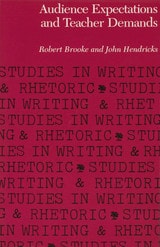
Audience Expectations and Teacher Demands
Robert Brooke and John Hendricks
Southern Illinois University Press, 1989
The audience—the community of readers who will use the texts a writer produces—must be an important influence on the writer for his or her work to be effective.
Robert Brooke and John Hendricks examine the difficult task of teaching "writing for an audience" in a classroom where students know that the teacher, not the addressed audience, assigns the grade.
The authors describe in detail a particular writing class, taught by Brooke and observed by Hendricks, that attempted to teach writing for an audience. By combining the experiences from their study with student reactions to the class, they draw some conclusions about the dynamics of teaching writing and about learning in general.
Authenticity Guaranteed
Masculinity and the Rhetoric of Anti-Consumerism in American CultureSally Robinson
University of Massachusetts Press, 2018
Americans love to hate consumerism. Scholars, intellectuals, musicians, and writers of all kinds take pleasure in complaining that consumer culture endangers the “real” things in life, including self-determination and individualism. In Authenticity Guaranteed, Sally Robinson brings to light the unacknowledged gender and class assumptions of anti-consumerist critique in the second half of the twentieth century. American anti-consumerism, despite its apparent complexity, takes a remarkably consistent and predictable narrative form. From the mid-century Organization Man to the millennial No Logo, anti-consumerist critique reinforces the gender order by insisting that authenticity is threatened, and masculine agency curtailed, by the feminizing forces of consumer culture.
Robinson identifies a tradition of masculine protest and rebellion against feminization in iconic texts such as The Catcher in the Rye and Fight Club, as well as in critiques of postmodernism, academic denunciations of shopping, and a variety of other discourses that aim to diagnose what ails American consumer culture. This fresh and timely argument enters into conversation with a wide range of existing scholarship and opens up new questions for scholarly and political discussion.
Authoring Autism
On Rhetoric and Neurological QueernessM. Remi Yergeau
Duke University Press, 2018
Authoring
An Essay for the English Profession on Potentiality and SingularityJanis Haswell and Richard Haswell
Utah State University Press, 2010
Authority
Construction and CorrosionBruce Lincoln
University of Chicago Press, 1994
Employing a vast array of examples drawn from classical antiquity, Scandinavian law, Cold War scholarship, and American presidential politics, Lincoln offers a telling analysis of the performance of authority, and subversions of it, from ancient times to the present. Using a small set of case studies that highlight critical moments in the construction of authority, he goes on to offer a general examination of "corrosive" discourses such as gossip, rumor, and curses; the problematic situation of women, who often are barred from the authorizing sphere; the role of religion in the construction of authority; the question of whether authority in the modern and postmodern world differs from its premodern counterpart; and a critique of Hannah Arendt's claims that authority has disappeared from political life in the modern world. He does not find a diminution of authority or a fundamental change in the conditions that produce it. Rather, Lincoln finds modern authority splintered, expanded, and, in fact, multiplied as the mechanisms for its construction become more complex—and more expensive.
Autobiographical Writing Across the Disciplines
A ReaderDiane P. Freedman and Olivia Frey, eds.
Duke University Press, 2003
The editors’ introduction presents a condensed history of academic writing, chronicles the origins of autobiographical criticism, and emphasizes the role of feminism in championing the value of personal narrative to disciplinary discourse. The essays are all explicitly informed by the identities of their authors, among whom are a feminist scientist, a Jewish filmmaker living in Germany, a potential carrier of Huntington’s disease, and a doctor pregnant while in medical school. Whether describing how being a professor of ethnic literature necessarily entails being an activist, how music and cooking are related, or how a theology is shaped by cultural identity, the contributors illuminate the relationship between their scholarly pursuits and personal lives and, in the process, expand the boundaries of their disciplines.
Contributors:
Kwame Anthony Appiah
Ruth Behar
Merrill Black
David Bleich
James Cone
Brenda Daly
Laura B. DeLind
Carlos L. Dews
Michael Dorris
Diane P. Freedman
Olivia Frey
Peter Hamlin
Laura Duhan Kaplan
Perri Klass
Muriel Lederman
Deborah Lefkowitz
Eunice Lipton
Robert D. Marcus
Donald Murray
Seymour Papert
Carla T. Peterson
David Richman
Sara Ruddick
Julie Tharp
Bonnie TuSmith
Alex Wexler
Naomi Weisstein
Patricia Williams
Automated Athens
Ancient Greek Ideals in the Early Age of AutomationMichele Kennerly
University of Chicago Press, 2026
A critical history of the recurring idea that technology will free us from work and bring about a truly democratic society.
In popular thought, ancient Athens endures as a place ahead of its time—the birthplace of democracy, a cultural center, and a model toward which modern societies should strive. In Automated Athens, Michele Kennerly examines the many and frequent appeals to this nostalgic vision of the ancient city-state throughout the early age of computerized automation. In the mid-twentieth century, people hoped that automation would free us from mindless, dehumanizing work so that we could attend to creative and communal pursuits. Proponents appealed to ancient Athens, saying automated systems and machines would stand in for the craftsmen, enslaved people, and subordinated women who performed the undesirable work that enabled that city-state’s flourishing. Automated Athens scrutinizes this appeal as it moves chronologically into present debates about the promise of automation and AI. For Kennerly, our inability to settle debates about where accelerating automation may take us, especially politically, reveals a deeper cultural indecisiveness about how to live well and live well together.
Averroes’ Middle Commentary on Aristotle’s Rhetoric
Arabic-English Translation, with Notes and IntroductionLahcen El Yazghi Ezzaher
Southern Illinois University Press, 2023
Abū al-Walīd Muḥammad ibn Aḥmad ibn Rushd (d. 1198 AD), known as Averroes in the West, wrote one of the most significant medieval Arabic commentaries on Aristotle’s famous treatise, Rhetoric. Averroes worked within a tradition that included the Muslim philosophers Al-Farabi (d. 950) and Avicenna (d. 1037), who together built an early canon introducing Aristotle’s writings to the academies of medieval Europe. Here, for the first time, Lahcen El Yazghi Ezzaher translates Averroes’ Middle Commentary into English, with analysis highlighting its shaping of philosophical thought.
Ibn Rushd was born into a prominent family living in Córdoba and Seville during the reign of the Almoḥad dynasty in the Maghreb and al-Andalus. At court, he received support to write a body of rhetorical commentaries extending the work of his Arabic-Muslim predecessors, a critical step in fostering Aristotle’s influence on European scholasticism and Western education. Ezzaher’s meticulous translation of Averroes’ Middle Commentary reflects the depth and breadth of this engagement, incorporating a discussion of the Arabic-Muslim commentary tradition and Averroes’ contribution to it. His research illuminates the complexity of Averroes’ position, articulating the challenges Muslim scholars faced in making non-Muslim texts available to their community. Through his work, we see how people at different historical moments have adapted intellectual concepts to preserve rhetoric’s vitality and relevance in new contexts.
Averroes’ Middle Commentary exemplifies the close connections between ancient Greece and medieval Muslim scholarship and the ways Muslim scholars navigated an appreciation for Aristotelian philosophy alongside a commitment to their cultural and religious systems.
Awful Archives
Conspiracy Theory, Rhetoric, and Acts of EvidenceJenny Rice
The Ohio State University Press, 2020
After sketching a broader framework for understanding what evidence is, Awful Archives then asks how we can practice more ethical and productive forms of debate, especially when we’re faced with arguments that feel like a dead end. Thorough, engaging, and deeply insightful, Awful Archives:Conspiracy Theory, Rhetoric, and Acts of Evidence introduces an entirely new perspective on evidence—one that will impact the field for years to come.