Results by title
991 books match the query 'Writing' and 71 start with a
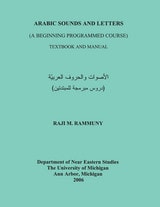
Arabic Sounds and Letters
A Beginning Programmed Course. Textbook and ManualRaji M. Rammuny
University of Michigan Press, 2006
The textbook includes twenty lessons aimed at introducing Arabic sounds and writing system in a programmed method of instruction, supported by images and audio tapes*. The Manual consists of two parts. Part One includes a suggested methodology to guide teachers and students and Part Two contains basic communication needs in both Arabic script and transliteration to create a climate of enjoyable learning while students are acquiring the sounds and letters.
Raji M. Rammuny is Professor of Arabic Studies, Department of Near Eastern Studies, University of Michigan. He is the author of numerous books, including Advanced Standard Arabic through Authentic Texts and Audiovisual Materials, Parts 1 and 2, also published by the University of Michigan Press.
*The CD accompanying Arabic Sounds and Letters can be obtained from the UM Language Resource Center. Contact them by email at flacs@umich.edu or by phone at 734-764-3521.
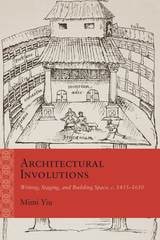
Architectural Involutions
Writing, Staging, and Building Space, c. 1435-1650Mimi Yiu
Northwestern University Press, 2014
Winner of the MLA Prize for Independent Scholars
Taking the reader on an inward journey from façades to closets, from physical to psychic space, Architectural Involutions offers an alternative genealogy of theater by revealing how innovations in architectural writing and practice transformed an early modern sense of interiority. The book launches from a matrix of related “platforms”—a term that in early modern usage denoted scaffolds, stages, and draftsmen’s sketches—to situate Alberti, Shakespeare, Jonson, and others within a landscape of spatial and visual change.
As the English house underwent a process of inward folding, replacing a logic of central assembly with one of dissemination, the subject who negotiated this new scenography became a flashpoint of conflict in both domestic and theatrical arenas. Combining theory with archival findings, Mimi Yiu reveals an emergent desire to perform subjectivity, to unfold an interior face to an admiring public. Highly praised for its lucid writing, comprehensive supplementary material, and engaging tone, Architectural Involutions was the winner of the 2016 MLA Prize for Independent Scholars.
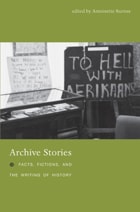
Archive Stories
Facts, Fictions, and the Writing of HistoryAntoinette Burton, ed.
Duke University Press, 2005
Archive Stories brings together ethnographies of the archival world, most of which are written by historians. Some contributors recount their own experiences. One offers a moving reflection on how the relative wealth and prestige of Western researchers can gain them entry to collections such as Uzbekistan’s newly formed Central State Archive, which severely limits the access of Uzbek researchers. Others explore the genealogies of specific archives, from one of the most influential archival institutions in the modern West, the Archives nationales in Paris, to the significant archives of the Bakunin family in Russia, which were saved largely through the efforts of one family member. Still others explore the impact of current events on the analysis of particular archives. A contributor tells of researching the 1976 Soweto riots in the politically charged atmosphere of the early 1990s, just as apartheid in South Africa was coming to an end. A number of the essays question what counts as an archive—and what counts as history—as they consider oral histories, cyberspace, fiction, and plans for streets and buildings that were never built, for histories that never materialized.
Contributors. Tony Ballantyne, Marilyn Booth, Antoinette Burton, Ann Curthoys, Peter Fritzsche, Durba Ghosh, Laura Mayhall, Jennifer S. Milligan, Kathryn J. Oberdeck, Adele Perry, Helena Pohlandt-McCormick, John Randolph, Craig Robertson, Horacio N. Roque Ramírez, Jeff Sahadeo, Reneé Sentilles
Archives, Archival Practices, and the Writing of History in Premodern Korea
Jungwon Kim, special issue editor
Duke University Press, 0
Contributors. Ksenia Chizhova, Jungwon Kim, Sung-Eun Thomas Kim, Franklin Rausch, Graeme Reynolds, Sem Vermeersch, Sixiang Wang, Yuan Ye
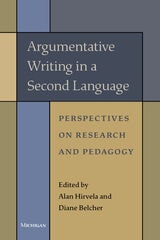
Argumentative Writing in a Second Language
Perspectives on Research and PedagogyAlan R. Hirvela and Diane D. Belcher
University of Michigan Press, 2021
Part I of the volume is topic-oriented and focuses on explorations of important issues and perspectives, while Part II features several chapters reporting classroom-based studies of a variety of instructional approaches that expand our understanding of how argumentative writing can be taught. The book will be of value to pre-service and in-service teachers in varying instructional contexts, as well as teacher educators and L2 writing scholars/researchers.
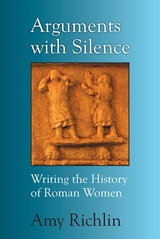
Arguments with Silence
Writing the History of Roman WomenAmy Richlin
University of Michigan Press, 2014
Women in ancient Rome challenge the historian. Widely represented in literature and art, they rarely speak for themselves. Amy Richlin, among the foremost pioneers in ancient studies, gives voice to these women through scholarship that scours sources from high art to gutter invective.
In Arguments with Silence, Richlin presents a linked selection of her essays on Roman women’s history, originally published between 1981 and 2001 as the field of “women in antiquity” took shape, and here substantially rewritten and updated. The new introduction to the volume lays out the historical methodologies these essays developed, places this process in its own historical setting, and reviews work on Roman women since 2001, along with persistent silences. Individual chapter introductions locate each piece in the social context of Second Wave feminism in Classics and the academy, explaining why each mattered as an intervention then and still does now.
Inhabiting these pages are the women whose lives were shaped by great art, dirty jokes, slavery, and the definition of adultery as a wife’s crime; Julia, Augustus’ daughter, who died, as her daughter would, exiled to a desert island; women wearing makeup, safeguarding babies with amulets, practicing their religion at home and in public ceremonies; the satirist Sulpicia, flaunting her sexuality; and the praefica, leading the lament for the dead.
Amy Richlin is one of a small handful of modern thinkers in a position to consider these questions, and this guided journey with her brings surprise, delight, and entertainment, as well as a fresh look at important questions.
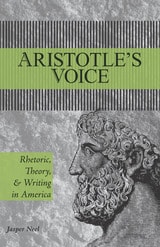
Aristotle's Voice
Rhetoric, Theory, and Writing in AmericaJasper Neel
Southern Illinois University Press, 1994
In this book, Jasper Neel’s sure-to-be-controversial resituating of Aristotle centers around three questions that have been constants in his twenty-two years of teaching experience: What does itmean to teach writing? What should one know before teaching writing? And, if there is such a thing as "research in the teaching of writing," what is it?
Believing that all composition teachers are situated politically and socially, both as part of the institution in which they teach and as beings with lived histories, Neel examines his own life and the life of composition studies as a discipline in the context of Aristotle. Neel first situates the Rhetoric as a political document; he then situates the Rhetoric in the Aristotelian system and describes how professional discourse came to know itself through Aristotle’s way of studying the world; finally, he examines the operation of the Rhetoric inside itself before arguing the need to turn to Aristotle’s notion of sophistry as a way of negating his system.
By pointing out the connections among Aristotelian rhetoric, the contemporary university, and the contemporary writing teacher, Neel shows that Aristotle’s frightening social theories are as alive today as are Aristotelian notions of discourse.
Neel explains that by their very nature teachers must speak with a professional voice. It is through showing how to "hear" one’s professional voice that Neel explores the notion of professional discourse that originates with Aristotle. In maintaining that one must pay a high price in order to speak through Aristotle’s theory or to assume the role of "professional," he argues that no neutral ground exists either for pedagogy or for the analysis of pedagogy. Neel concludes this discussion by proposing that Aristotelian sophistry is both an antidote to Aristotelian racism, sexism, and bigotry and a way of allowing Aristotelian categories of discourse to remain useful.
Finally, as an Aristotelian, a teacher, and a writer, Neel responds both to Aristotle and to professionalism by rethinking the influence of the past and reviving the voice of Aristotelian sophistry.
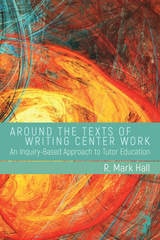
Around the Texts of Writing Center Work
An Inquiry-Based Approach to Tutor EducationR. Mark Hall
Utah State University Press, 2017
Around the Texts of Writing Center Work reveals the conceptual frameworks found in and created by ordinary writing center documents. The values and beliefs underlying course syllabi, policy statements, website copy and comments, assessment plans, promotional flyers, and annual reports critically inform writing center practices, including the vital undertaking of tutor education.
In each chapter, author R. Mark Hall focuses on a particular document. He examines its origins, its use by writing center instructors and tutors, and its engagement with enduring disciplinary challenges in the field of composition, such as tutoring and program assessment. He then analyzes each document in the contexts of the conceptual framework at the heart of its creation and everyday application: activity theory, communities of practice, discourse analysis, reflective practice, and inquiry-based learning.
Around the Texts of Writing Center Work approaches the analysis of writing center documents with an inquiry stance—a call for curiosity and skepticism toward existing and proposed conceptual frameworks—in the hope that the theoretically conscious evaluation and revision of commonplace documents will lead to greater efficacy and more abundant research by writing center administrators and students.
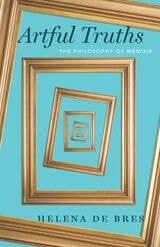
Artful Truths
The Philosophy of MemoirHelena de Bres
University of Chicago Press, 2021
Artful Truths offers a concise guide to the fundamental philosophical questions that arise when writing a literary work about your own life. Bringing a philosopher’s perspective to a general audience, Helena de Bres addresses what a memoir is, how the genre relates to fiction, memoirists’ responsibilities to their readers and subjects, and the question of why to write a memoir at all. Along the way, she delves into a wide range of philosophical issues, including the nature of the self, the limits of knowledge, the idea of truth, the obligations of friendship, the relationship between morality and art, and the question of what makes a life meaningful.
Written in a clear and conversational style, it offers a resource for those who write, teach, and study memoirs, as well as those who love to read them. With a combination of literary and philosophical knowledge, de Bres takes the many challenges directed at memoirists seriously, while ultimately standing in defense of a genre that, for all its perplexities—and maybe partly because of them—continually proves to be both beloved and valuable.
Artful Truths
The Philosophy of MemoirHelena de Bres
University of Chicago Press, 2021
Offers a philosophical perspective on the nature and value of writing a memoir.
Artful Truths offers a concise guide to the fundamental philosophical questions that arise when writing a literary work about your own life. Bringing a philosopher’s perspective to a general audience, Helena de Bres addresses what a memoir is, how the genre relates to fiction, memoirists’ responsibilities to their readers and subjects, and the question of why to write a memoir at all. Along the way, she delves into a wide range of philosophical issues, including the nature of the self, the limits of knowledge, the idea of truth, the obligations of friendship, the relationship between morality and art, and the question of what makes a life meaningful.
Written in a clear and conversational style, it offers a resource for those who write, teach, and study memoirs, as well as those who love to read them. With a combination of literary and philosophical knowledge, de Bres takes the many challenges directed at memoirists seriously, while ultimately standing in defense of a genre that, for all its perplexities—and maybe partly because of them—continually proves to be both beloved and valuable.
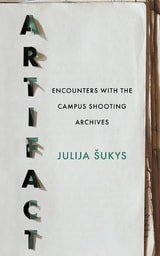
Artifact
Encounters with the Campus Shooting ArchivesJulija Šukys
West Virginia University Press, 2025
2026 IPPY Awards Bronze Medal Winner, Current Events - Social Issues/Humanitarian
2026 PROSE Award Finalist, Humanities: Literature
Artifact is about the stories we tell ourselves after mass shootings. Each college campus shooting leaves a record: archival collections, monuments to the dead, government-led inquiries, internal university investigations, and lawsuits. Artifact: Encounters with the Campus Shooting Archives seeks to understand university and college campus shootings that involve students and faculty of those institutions. The book examines the aftermaths of such attacks by moving between university archives, memorials to victims, conversations with survivors, and beyond.
Julija Šukys examines a series of five North American university and college campus shootings between 1966 and 2015: the École Polytechnique in Montreal, Concordia University in Montreal, Virginia Tech, University of Alabama–Huntsville, and Umpqua Community College in Roseburg, Oregon. These attacks involved students and faculty as both victims and perpetrators—that is, all the shooters were either faculty members or (in one case, would-be) students of the institution where the killings took place.
Šukys arrives at each site long after the killings have taken place: by now, the teddy bears, flowers, and crosses have been cleared away. Prying journalists are long gone. She sorts through myriad objects left at makeshift memorial sites. She talks for hours with a professor who survived an attack only because her colleague’s gun jammed as it was pointed at her head. She wanders and documents the reconfigured buildings made unrecognizable after the horrors that occurred within them. She reads tedious court transcripts, officious government-commissioned reports, and a troubling memoir written by a shooter’s mother and sifts through the mathematics papers that one campus shooter publishes from his prison cell.
Artifact weighs what it means to live in a place where students and their teachers are gunned down on a seemingly regular basis. It asks how we can continue to learn, teach, and live when nothing changes in response to these deaths. It attempts to speak into silence, to look at the pain of those who have come through trauma, and to meet their gazes without platitudes or triumphalism. The result is a searching book about care, memory, forgiveness, and survival.

Artist Scholar
Reflections on Writing and ResearchG. James Daichendt
Intellect Books, 2012
Artist Scholar: Reflections on Writing and Research is part history, introduction, and discussion for artists and designers entering, graduating, and employed by the contemporary art academy in the United States. The evolution of art education in the university continues to expand in the 21st century as the variables of craft, skill, technique, theory, history and criticism shift and expand as the perspective of arts-based research is introduced into this professionalized environment. Given this context: what can M.F.A. students do to improve their understanding of writing and research without sacrificing their commitment to their studio art process?
Through a series of essays, the text argues for better writing at the M.F.A. level with the purpose of becoming better artists. By contextualizing art practice in the university and providing a foundation for future artist scholarship, it serves as an invitation to artist scholars to push their work further and develop the confidence to situate their art in the university context.
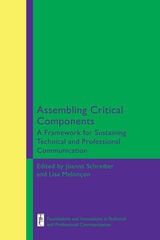
Assembling Critical Components
A Framework for Sustaining Technical and Professional Communication Editionedited by Joanna Schreiber and Lisa Melonçon
University Press of Colorado, 2022
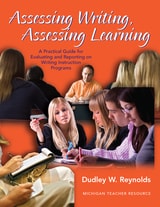
Assessing Writing, Assessing Learning
A Practical Guide for Evaluating and Reporting on Writing Instruction ProgramsDudley W. Reynolds
University of Michigan Press, 2010
The goals of this resource are broader than many standard books on writing assessment, which focus on evaluating an individual’s ability to create an effective piece of writing for a particular purpose. Assessing Writing, Assessing Learning seeks to support teachers, administrators, program directors, and funding entities who want to make the best use of the resources at their disposal to understand what students are learning and why and then take actions based on what they have learned. It also seeks to provide a common basis for communication among all the interested parties—the writing professionals, the people who identified the need for the program, and the students.
The book has sections on planning, tools (different ways of collecting data and links to instruments), and reporting (examples provided). Each section includes a discussion of issues and advice for working through the issue along with numerous examples, plus a list of resources to consult to learn more. The final chapter provides worksheets that may be reproduced and used to help those in charge of setting up and delivering a writing program to think through the issues presented. A glossary of terms is also included.
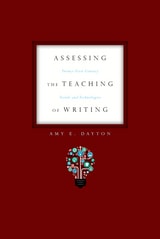
Assessing the Teaching of Writing
Twenty-First Century Trends and TechnologiesAmy E. Dayton
Utah State University Press, 2015
Although fraught with politics and other perils, teacher evaluation can contribute in important, positive ways to faculty development at both the individual and the departmental levels. Yet the logistics of creating a valid assessment are complicated. Inconsistent methods, rater bias, and overreliance on student evaluation forms have proven problematic. The essays in Assessing the Teaching of Writing demonstrate constructive ways of evaluating teacher performance, taking into consideration the immense number of variables involved.
Contributors to the volume examine a range of fundamental issues, including the political context of declining state funds in education; growing public critique of the professoriate and demands for accountability resulting from federal policy initiatives like No Child Left Behind; the increasing sophistication of assessment methods and technologies; and the continuing interest in the scholarship of teaching. The first section addresses concerns and advances in assessment methodologies, and the second takes a closer look at unique individual sites and models of assessment. Chapters collectively argue for viewing teacher assessment as a rhetorical practice.
Fostering new ways of thinking about teacher evaluation, Assessing the Teaching of Writing will be of great interest not only to writing program administrators but also to those concerned with faculty development and teacher assessment outside the writing program.
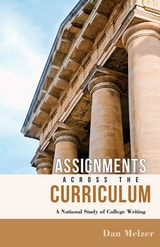
Assignments across the Curriculum
A National Study of College WritingDan Melzer
Utah State University Press, 2014
In Assignments across the Curriculum, Dan Melzer analyzes the rhetorical features and genres of writing assignments through the writing-to-learn and writing-in-the-disciplines perspectives. Presenting the results of his study of 2,101 writing assignments from undergraduate courses in the natural sciences, social sciences, business, and humanities in 100 postsecondary institutions in the United States, Assignments across the Curriculum is unique in its cross-institutional breadth and its focus on writing assignments.
The results provide a panoramic view of college writing in the United States. Melzer's framework begins with the rhetorical situations of the assignments—the purposes and audiences—and broadens to include the assignments' genres and discourse community contexts. Among his conclusions is that courses connected to a writing-across-the-curriculum (WAC) initiative ask students to write more often, in a greater variety of genres, and for a greater variety of purposes and audiences than non-WAC courses do, making a compelling case for the influence of the WAC movement.
Melzer's work also reveals patterns in the rhetorical situations, genres, and discourse communities of college writing in the United States. These larger patterns are of interest to WAC practitioners working with faculty across disciplines, to writing center coordinators and tutors working with students who bring assignments from a variety of fields, to composition program administrators, to first-year writing instructors interested in preparing students for college writing, and to high school teachers attempting to bridge the gap between high school and college writing.
Association of University Presses Directory 2021
Edited by The Association of University Presses
AUP, 2020
Authors, booksellers, librarians, instructors, and publishing professionals across the industry will find this an invaluable resource, featuring editorial programs and publishing details for all 150+ Association members and much more.
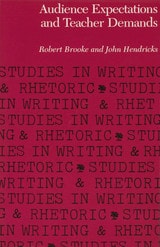
Audience Expectations and Teacher Demands
Robert Brooke and John Hendricks
Southern Illinois University Press, 1989
The audience—the community of readers who will use the texts a writer produces—must be an important influence on the writer for his or her work to be effective.
Robert Brooke and John Hendricks examine the difficult task of teaching "writing for an audience" in a classroom where students know that the teacher, not the addressed audience, assigns the grade.
The authors describe in detail a particular writing class, taught by Brooke and observed by Hendricks, that attempted to teach writing for an audience. By combining the experiences from their study with student reactions to the class, they draw some conclusions about the dynamics of teaching writing and about learning in general.
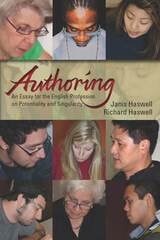
Authoring
An Essay for the English Profession on Potentiality and SingularityJanis Haswell and Richard Haswell
Utah State University Press, 2010
Authorship in the Long Eighteenth Century
Dustin Griffin
University of Delaware Press, 2014
Published by University of Delaware Press. Distributed worldwide by Rutgers University Press.
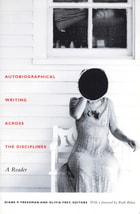
Autobiographical Writing Across the Disciplines
A ReaderDiane P. Freedman and Olivia Frey, eds.
Duke University Press, 2003
The editors’ introduction presents a condensed history of academic writing, chronicles the origins of autobiographical criticism, and emphasizes the role of feminism in championing the value of personal narrative to disciplinary discourse. The essays are all explicitly informed by the identities of their authors, among whom are a feminist scientist, a Jewish filmmaker living in Germany, a potential carrier of Huntington’s disease, and a doctor pregnant while in medical school. Whether describing how being a professor of ethnic literature necessarily entails being an activist, how music and cooking are related, or how a theology is shaped by cultural identity, the contributors illuminate the relationship between their scholarly pursuits and personal lives and, in the process, expand the boundaries of their disciplines.
Contributors:
Kwame Anthony Appiah
Ruth Behar
Merrill Black
David Bleich
James Cone
Brenda Daly
Laura B. DeLind
Carlos L. Dews
Michael Dorris
Diane P. Freedman
Olivia Frey
Peter Hamlin
Laura Duhan Kaplan
Perri Klass
Muriel Lederman
Deborah Lefkowitz
Eunice Lipton
Robert D. Marcus
Donald Murray
Seymour Papert
Carla T. Peterson
David Richman
Sara Ruddick
Julie Tharp
Bonnie TuSmith
Alex Wexler
Naomi Weisstein
Patricia Williams