Results by title
18284 books match the query 'United States' and 1653 start with a
American Public Philosophy and the Mystery of Lincolnism
Eric C. Sands
University of Missouri Press, 2009
American Radical
The Life and Times of I. F. StoneD. D. Guttenplan
Northwestern University Press, 2012
In an era when the old radical questions—about war, the economy, health care, and the right to dissent—are suddenly new again, Guttenplan’s lively, provocative book makes clear why so many of Stone’s pronouncements have acquired the force of prophecy.
American Railroads
John F. Stover
University of Chicago Press, 1997
A fascinating account of the rise, decline, and rebirth of railroads in the United States, John F. Stover's American Railroads traces their history from the first lines that helped eastern seaports capture western markets to today's newly revitalized industry. Stover describes the growth of the railroads' monopoly, with the consequent need for state and federal regulations; relates the vital part played by the railroads during the Civil War and the two World Wars; and charts the railroads' decline due to the advent of air travel and trucking during the 1950s.
In two new chapters, Stover recounts the remarkable recovery of the railroads, along with other pivotal events of the industry's recent history. During the 1960s declining passenger traffic and excessive federal regulation led to the federally-financed creation of Amtrak to revive passenger service and Conrail to provide freight service on bankrupt northeastern railroads. The real savior for the railroads, though, proved to be the Staggers Rail Act of 1980, which brought prosperity to rail freight carriers by substantially deregulating the industry. By 1995, renewed railroad freight traffic had reached nearly twice its former peak in 1944.
Bringing both a seasoned eye and new insights to bear on one of the most American of industries, Stover has produced the definitive history of railroads in the United States.
American Railroads
John F. Stover
University of Chicago Press, 1997
Few scenes capture the American experience so eloquently as that of a lonely train chugging across the vastness of the Great Plains, or snaking through tortuous high mountain passes. Although this vision was eclipsed for a time by the rise of air travel and trucking, railroads have enjoyed a rebirth in recent years as profitable freight carriers.
A fascinating account of the rise, decline, and rebirth of railroads in the United States, John F. Stover's American Railroads traces their history from the first lines that helped eastern seaports capture western markets to today's newly revitalized industry. Stover describes the growth of the railroads' monopoly, with the consequent need for state and federal regulations; relates the vital part played by the railroads during the Civil War and the two World Wars; and charts the railroads' decline due to the advent of air travel and trucking during the 1950s.
In two new chapters, Stover recounts the remarkable recovery of the railroads, along with other pivotal events of the industry's recent history. During the 1960s declining passenger traffic and excessive federal regulation led to the federally-financed creation of Amtrak to revive passenger service and Conrail to provide freight service on bankrupt northeastern railroads. The real savior for the railroads, though, proved to be the Staggers Rail Act of 1980, which brought prosperity to rail freight carriers by substantially deregulating the industry. By 1995, renewed railroad freight traffic had reached nearly twice its former peak in 1944.
Bringing both a seasoned eye and new insights to bear on one of the most American of industries, Stover has produced the definitive history of railroads in the United States.
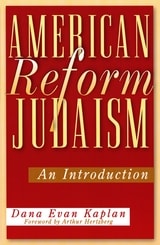
American Reform Judaism
An IntroductionDana Evan Kaplan
Rutgers University Press, 2003
The only comprehensive and up-to-date look at Reform Judaism, this book analyzes the forces currently challenging the Reform movement, now the largest Jewish denomination in the United States.
To distinguish itself from Orthodox and Conservative Judaism, the Reform movement tries to be an egalitarian, open, and innovative version of the faith true to the spirit of the tradition but nonetheless fully compatible with modern secular life. Promoting itself in this way, Reform Judaism has been tremendously successful in recruiting a variety of people—intermarried families, feminists, gays and lesbians, and interracial families among others—who resist more traditional forms of worship.
As an unintended result of this success, the movement now struggles with an identity crisis brought on by its liberal theology, which teaches that each Jew is free to practice Judaism more or less as he or she pleases. In the absence of the authority that comes from a theology based on a commanding, all-powerful God, can Reform Judaism continue to thrive? Can it be broadly inclusive and still be uniquely and authentically Jewish?
Taking this question as his point of departure, Dana Evan Kaplan provides a broad overview of the American Reform movement and its history, theology, and politics. He then takes a hard look at the challenges the movement faces as it attempts to reinvent itself in the new millennium. In so doing, Kaplan gives the reader a sense of where Reform Judaism has come from, where it stands on the major issues, and where it may be going.
Addressing the issues that have confronted the movement—including the ordination of women, acceptance of homosexuality, the problem of assimilation, the question of rabbinic officiation at intermarriages, the struggle for acceptance in Israel, and Jewish education and others—Kaplan sheds light on the connection between Reform ideology and cultural realities. He unflinchingly, yet optimistically, assesses the movement’s future and cautions that stormy weather may be ahead.
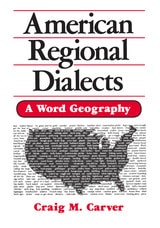
American Regional Dialects
A Word GeographyCraig M. Carver
University of Michigan Press, 1987
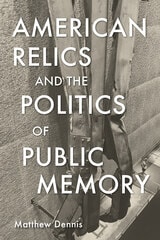
American Relics and the Politics of Public Memory
Matthew Dennis
University of Massachusetts Press, 2023
The gold epaulettes that George Washington wore into battle. A Union soldier’s bloody shirt in the wake of the Civil War. A crushed wristwatch after the 9/11 attacks. The bullet-riddled door of the Pulse nightclub. Volatile and shape-shifting, relics have long played a role in memorializing the American past, acting as physical reminders of hard-won battles, mass tragedies, and political triumphs.
Surveying the expanse of U.S. history, American Relics and the Politics of Public Memory shows how these objects have articulated glory, courage, and national greatness as well as horror, defeat, and oppression. While relics mostly signified heroism in the nation’s early years, increasingly, they have acquired a new purpose—commemorating victimhood. The atrocious artifacts of lynching and the looted remains of Native American graves were later transformed into shameful things, exposing ongoing racial violence and advancing calls for equality and civil rights. Matthew Dennis pursues this history of fraught public objects and assesses the emergence of new venues of memorialization, such as virtual and digital spaces. Through it all, relics continue to fundamentally ground and shape U.S. public memory in its uncertain present and future.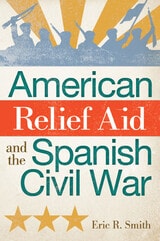
American Relief Aid and the Spanish Civil War
Eric R. Smith
University of Missouri Press, 2013
The Spanish Civil War created a conflict for Americans who preferred that the United States remain uninvolved in foreign affairs. Despite the country's isolationist tendencies, opposition to the rise of fascism across Europe convinced many Americans that they had to act in support of the Spanish Republic. While much has been written about the war itself and its international volunteers, little attention has been paid to those who coordinated these relief efforts at home.
American Relief Aid and the Spanish Civil War tells the story of the political campaigns to raise aid for the Spanish Republic as activists pushed the limits of isolationist thinking. Those concerned with Spain’s fate held a range of political convictions (including anarchists, socialists, liberals, and communists) with very different understandings of what fascism was. Yet they all agreed that fascism’s advance must be halted. With labor strikes, fund-raising parties, and ambulance tours, defenders of Spain in the United States sought to shift the political discussion away from isolation of Spain’s elected government and toward active assistance for the faltering Republic.
Examining the American political organizations affiliated with this relief effort and the political repression that resulted as many of Spain’s supporters faced the early incarnations of McCarthyism’s trials, Smith provides new understanding of American politics during the crucial years leading up to World War II. By also focusing on the impact the Spanish Civil War had on those of Spanish ethnicity in the United States, Smith shows how close to home the seemingly distant war really hit.
American Rhetoric in the New Deal Era, 1932-1945
A Rhetorical History of the United States, Volume VIIThomas Benson
Michigan State University Press, 2006
The New Deal era is hard to define with precision—in time or in ideology. Some historians use New Deal to designate the intense period of domestic reform legislation of the first Franklin Delano Roosevelt administration, 1933–37. Others confine discussion of the era to the legislation of 1933, and identify another wave of legislation in 1935 as a Second New Deal. Most of the essays in this book focus on the prewar period, with glimpses that look forward to the rhetoric of the approach to and engagement in World War II.
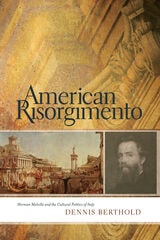
American Risorgimento
Herman Melville and the Cultural Politics of ItalyDennis Berthold
The Ohio State University Press, 2009
American Romanticism and the Marketplace
Michael T. Gilmore
University of Chicago Press, 1985
"[Gilmore] demonstrates the profound, sustained, engagement with society embodied in the works of Emerson, Hawthorne, Thoreau and Melville. In effect, he relocates the American Renaissance where it properly belongs, at the centre of a broad social, economic, and ideological movement from the Jacksonian era to the Civil War. Basically, Gilmore's argument concerns the writers' participation in what Thoreau called 'the curse of trade.' He details their mixed resistance to and complicity in the burgeoning literary marketplace and, by extension, the entire ' economic revolution' which between 1830 and 1860 'transformed the United States into a market society'. . . .
"The result is a model of literary-historical revisionism. Gilmore's opening chapters on Emerson and Thoreau show that 'transcendental' thought and language can come fully alive when understood within the material processes and ideological constraints of their time. . . . The remaining five chapters, on Hawthorne and Melville, contain some of the most penetrating recent commentaries on the aesthetic strategies of American Romantic fiction, presented within and through some of the most astute, thoughtful considerations I know of commodification and the 'democratic public' in mid-nineteenth-century America. . . . Practically and methodologically, American Romanticism and the Marketplace has a significant place in the movement towards a new American literary history. It places Gilmore at the forefront of a new generation of critics who are not just reinterpreting familiar texts or discovering new texts to interpret, but reshaping our ways of thinking about literature and culture."—Sacvan Bercovitch, Times Literary Supplement
"Gilmore writes with energy, clarity, and wit. The reader is enriched by this book." William H. Shurr, American Literature
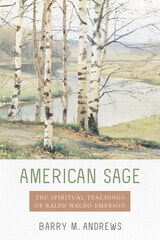
American Sage
The Spiritual Teachings of Ralph Waldo EmersonBarry M. Andrews
University of Massachusetts Press, 2021
Unitarian minister Barry M. Andrews has spent years studying Emerson, finding wisdom and guidance in his teachings and practices, and witnessing how the spiritual lives of others are enriched when they grasp the many meanings in his work. In American Sage, Andrews explores Emerson's writings, including his journals and letters, and makes them accessible to today's spiritual seekers. Written in everyday language and based on scholarship grounded in historical detail, this enlightening book considers the nineteenth-century religious and intellectual crosscurrents that shaped Emerson's worldview to reveal how his spiritual teachings remain timeless and modern, universal and uniquely American.
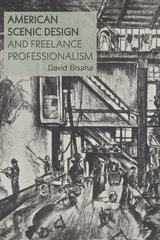
American Scenic Design and Freelance Professionalism
David Bisaha
Southern Illinois University Press, 2022
The figure of the American theatrical scenic designer first emerged in the early twentieth century. As productions moved away from standardized, painted scenery and toward individualized scenic design, the demand for talented new designers grew. Within decades, scenic designers reinvented themselves as professional artists. They ran their own studios, proudly displayed their names on Broadway playbills, and even appeared in magazine and television profiles.
American Scenic Design and Freelance Professionalism tells the history of the field through the figures, institutions, and movements that helped create and shape the profession. Taking a unique sociological approach, theatre scholar David Bisaha examines the work that designers performed outside of theatrical productions. He shows how figures such as Lee Simonson, Norman Bel Geddes, Jo Mielziner, and Donald Oenslager constructed a freelance, professional identity for scenic designers by working within their labor union (United Scenic Artists Local 829), generating self-promotional press, building university curricula, and volunteering in wartime service.
However, while new institutions provided autonomy and intellectual property rights for many, women, queer, and Black designers were not always welcome to join the organizations that protected freelance designers’ interests. Among others, Aline Bernstein, Emeline Roche, Perry Watkins, Peggy Clark, and James Reynolds were excluded from professional groups because of their identities. They nonetheless established themselves among the most successful designers of their time. Their stories expand the history of American scenic design by showing how professionalism won designers substantial benefits, yet also created legacies of exclusion with which American theatre is still reckoning.
American Science in the Age of Jackson
George H. Daniels
University of Alabama Press, 1968
A foundational history of science, ideas, and professional identity in nineteenth-century America.
American Science in the Age of Jackson is a landmark study that traces the emergence of a distinctly American scientific community during one of the most transformative periods in the nation's history. Focusing on the years between 1815 and 1845, George H. Daniels examines how a loosely connected network of amateur naturalists, physicians, educators, and scientific enthusiasts evolved into a more organized and professional body of researchers united by shared goals, methods, institutions, and intellectual commitments. Through an innovative analysis of leading scientists and the scientific journals that connected them, Daniels reconstructs the foundations of American science at the moment it began to establish an independent identity.
Originally recognized as the first major effort to define an American scientific community, this influential work explores the individuals, publications, and philosophical traditions that shaped scientific inquiry in the early republic and Jacksonian era. Daniels examines the careers and writings of the most prominent American scientists of the period, demonstrating how they built professional networks, established standards of evidence and inquiry, and promoted science as an essential component of national progress. In doing so, he illuminates the institutional development of scientific societies, colleges, journals, and research programs that would lay the groundwork for the nation's later scientific achievements.
Featuring biographical sketches of leading scientists, analyses of early scientific journals, and a detailed examination of the ideas that united the nation's scientific elite, American Science in the Age of Jackson remains a foundational text for understanding the origins of scientific culture in the United States. More than a history of science, it is a history of intellectual ambition, institutional growth, and the pursuit of knowledge in a rapidly changing society. Scholars and students of American history, history of science, intellectual history, philosophy, and nineteenth-century studies will find this volume an indispensable resource for understanding how American science established the foundations of its modern identity.
American Sexual Politics
Sex, Gender, and Race since the Civil WarEdited by John C. Fout and Maura Shaw Tantillo
University of Chicago Press, 1993
Included are Anthony S. Parent, Jr., and Susan Brown Wallace on childhood and sexual identity under slavery; Martha Hodes on white women and Black men in the South; Kevin J. Mumford on male sexual impotence and Victorian Culture; Jesse F. Battan on language, authority, and sexual desire; Joan Smith Iversen on the antipolygamy controversy, 1880-1890; Angus McLaren on sex radicalism in the Canadian Pacific Northwest, 1890-1920; Pamela S. Haag on ideologies of love, modern romance, and women's sexual subjectivity; Ann duCille on the novels of Jessie Fauset and Nella Larsen; Robyn Wiegman on the anatomy of lynching; Sonya Michel on sexuality in postwar films; Carole Joffe on abortion before legalization; Roy Cain on disclosure and secrecy among gay men; Joshua Gamson on condoms; Lillian Faderman on the return of butch and femme; Katherine Cummings on teaching AIDS; and Arthur Flannigan-Saint-Aubin on "black gay male" discourse.
This diverse overview of American sexual politics will interest students and scholars of the history of sexuality, gender studies, women's studies, and gay studies.
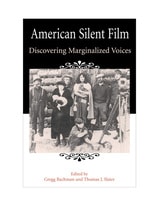
American Silent Film
Discovering Marginalized VoicesEdited by Gregg Bachman and Thomas J. Slater
Southern Illinois University Press, 2002
Gregg Bachman and Thomas J. Slater present an array of essays that reveal the incredible complexity of silent films and the era in which they were produced. Essentially, silent films conjure the names of Mary Pickford and a few white men, including Charlie Chaplin and D. W. Griffith. These eleven essays, however, demonstrate that minorities and women other than Pickford also responded to the times through film. The contributors deal with changing American society at a crucial time, examining our hopes and fears as a nation during the silent film era.
Opening new vistas, this book introduces us to people, films, issues, and concepts that few of us have encountered. One example is screenwriter June Mathis, who wrote more than one hundred scripts, brought Rudolph Valentino to stardom, and supervised all productions at the Goldwyn Studios in 1923. Equally intriguing is Nita Naldi, whose career and tragic life speak volumes about America’s combined fascination with and fear of ethnic minorities. Other key players in the drama of silent films include John Randolph Bray (animated cartoons), Roscoe “Fatty” Arbuckle, and female producer, writer, and director Nell Shipman.
Contributors are Kay Armatage, Jean Chateauvert, Maureen Furniss, Mark Langer, Anne Morey, Diane Negra, George Potamianos, Joanna Rapf, Thomas J. Slater, Sam Stoloff, and Judith Thissen.
Seventeen illustrations enliven this study of silent film.
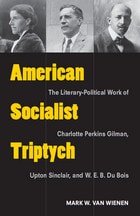
American Socialist Triptych
The Literary-Political Work of Charlotte Perkins Gilman, Upton Sinclair, and W. E. B. Du BoisMark W. Van Wienen
University of Michigan Press, 2014
"A meticulously researched, highly informed, carefully argued, and very accessible account of American socialism, socialists, and socialistic thinking, from the late nineteenth century through the 1960s . . . challenges the intellectual and political legacy of Werner Sombart's Why Is There No Socialism in the United States?, whose spirit still hovers over animated discussions about the 'failures' of socialism in the United States."
---James A. Miller, George Washington University
"A valuable rethinking and reframing of the traditions of leftist literary scholarship in the U.S."
---Sylvia Cook, University of Missouri, St. Louis
American Socialist Triptych: The Literary-Political Work of Charlotte Perkins Gilman, Upton Sinclair, and W. E. B. Du Bois explores the contributions of three writers to the development of American socialism over a fifty--year period and asserts the vitality of socialism in modern American literature and culture.
Drawing upon a wide range of texts including archival sources, Mark W. Van Wienen demonstrates the influence of reform-oriented, democratic socialism both in the careers of these writers and in U.S. politics between 1890 and 1940. While offering unprecedented in-depth analysis of modern American socialist literature, this book charts the path by which the supposedly impossible, dangerous ideals of a cooperative commonwealth were realized, in part, by the New Deal.
American Socialist Triptych provides in-depth, innovative readings of the featured writers and their engagement with socialist thought and action. Upton Sinclair represents the movement's most visible manifestation, the Socialist Party of America, founded in 1901; Charlotte Perkins Gilman reflects the socialist elements in both feminism and 1890s reform movements, and W. E. B. Du Bois illuminates social democratic aspirations within the NAACP. Van Wienen's book seeks to re-energize studies of Sinclair by treating him as a serious cultural figure whose career peaked not in the early success of The Jungle but in his nearly successful 1934 run for the California governorship. It also demonstrates as never before the centrality of socialism throughout Gilman's and Du Bois's literary and political careers.
More broadly, American Socialist Triptych challenges previous scholarship on American radical literature, which has focused almost exclusively on the 1930s and Communist writers. Van Wienen argues that radical democracy was not the phenomenon of a decade or of a single group but a sustained tradition dispersed within the culture, providing a useful genealogical explanation for how socialist ideas were actually implemented through the New Deal.
American Socialist Triptych also revises modern American literary history, arguing for the endurance of realist and utopian literary modes at the height of modernist literary experimentation and showing the importance of socialism not only to the three featured writers but also to their peers, including Edward Bellamy, Hamlin Garland, Jack London, Edna St. Vincent Millay, and Claude McKay. Further, by demonstrating the importance of social democratic thought to feminist and African American campaigns for equality, the book dialogues with recent theories of radical egalitarianism. Readers interested in American literature, U.S. history, political theory, and race, gender, and class studies will all find in American Socialist Triptych a valuable and provocative resource.
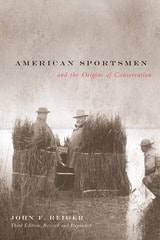
American Sportsmen and the Origins of Conservation, 3rd Ed
John F. Reiger
Oregon State University Press, 2001
Beginning in the 1870s, sportsmen across America formed hundreds of organizations that not only fostered responsibility for game habitats but also spearheaded the creation of national parks, forests, and wildlife refuges. Reiger tells how these "gentlemen" hunters and anglers, outdoor journals like Forest and Stream, and organizations such as the Boone and Crockett Club—founded by Theodore Roosevelt, George Bird Grinnell, and other prominent sportsmen—lobbied for laws regulating the taking of wildlife, and helped to arouse public interest in wilderness preservation.
In this new edition, Reiger traces the antecedents of the sportsmen's conservation movement to the years before the Civil War. He extends his coverage into the present by demonstrating how the nineteenth-century sportsman's code—with its demand for taking responsibility for the total environment—continues to be the cornerstone of the sporting ethic. A new Epilogue depicts leading environmental thinker Aldo Leopold as the best-known exponent of this hunter-conservationist ideal.
Praised as "one of the seminal works in conservation history" by historian Hal Rothman, Reiger's book continues to be essential reading for all concerned with how earlier Americans regarded the land, demonstrating even to those who oppose hunting that they share with sportsmen and sportswomen an awareness and appreciation of our fragile environment.
American Studies as Transnational Practice
Turning toward the TranspacificEdited by Yuan Shu and Donald E. Pease
Dartmouth College Press, 2016
American Studies in a Moment of Danger
George Lipsitz
University of Minnesota Press, 2001
A forthright look at the future of the discipline in the wake of immense social changes.
What becomes of "national knowledge" in our age of globalization? If dramatic changes in technology, commerce, and social relations are undermining familiar connections between culture and place, what happens to legacies of learning that put the nation at the center of the study of history, culture, language, politics, and geography? In short, what remains of American Studies? At a critical moment, this book offers a richly textured historical perspective on where our notions of national knowledge-and our sense of American Studies-have come from and where they may lead in a future of new ideas about culture and community.
The America that seems to be disappearing before our very eyes is, George Lipsitz argues, actually the cumulative creation of yesterday’s struggles over identity, culture, and power. With examples from statistics and history, poster designs and music lyrics, Lipsitz shows how American Studies has been shaped by the social movements of the 1930s, 1960s, and 1980s. His analysis reveals the sedimented history of social movement contestation contained in contemporary popular music, visual art, and cinema.Finally, Lipsitz identifies the ways in which the globalization of commerce and culture are producing radically new understandings of politics, performance, consumption, knowledge, and nostalgia; the changing realities present not so much a danger as a clear challenge to a still-evolving American Studies-a challenge that this book helps us to confront wisely, flexibly, and effectively. Critical American Studies SeriesAnnouncing a new seriesCritical American Studies George Lipsitz, series editorThis series examines recent trends in American Studies that address fundamental questions about history, culture, social structure, race, gender, sexuality, and citizenship. It examines the forces-including mass migration, global economy, the seeming weaknesses of the nation-state, and ongoing ethnic antagonisms-that compel the field to reexamine the role of culture in producing individual and collective identities.
American Sunshine
Diseases of Darkness and the Quest for Natural LightDaniel Freund
University of Chicago Press, 2012
In the second half of the nineteenth century, American cities began to go dark. Hulking new buildings overspread blocks, pollution obscured the skies, and glass and smog screened out the health-giving rays of the sun. Doctors fed anxities about these new conditions with claims about a rising tide of the "diseases of darkness," especially rickets and tuberculosis.
In American Sunshine, Daniel Freund tracks the obsession with sunlight from those bleak days into the twentieth century. Before long, social reformers, medical professionals, scientists, and a growing nudist movement proffered remedies for America’s new dark age. Architects, city planners, and politicians made access to sunlight central to public housing and public health. and entrepreneurs, dairymen, and tourism boosters transformed the pursuit of sunlight and its effects into a commodity. Within this historical context, Freund sheds light on important questions about the commodification of health and nature and makes an original contribution to the histories of cities, consumerism, the environment, and medicine.
American Superrealism
Nathanael West and the Politics of Representation in the 1930sJonathan Veitch
University of Wisconsin Press, 1997
Nathanael West has been hailed as “an apocalyptic writer,” “a writer on the left,” and “a precursor to postmodernism.” But until now no critic has succeeded in fully engaging West’s distinctive method of negation. In American Superrealism, Jonathan Veitch examines West’s letters, short stories, screenplays and novels—some of which are discussed here for the first time—as well as West’s collaboration with William Carlos Williams during their tenure as the editors of Contact. Locating West in a lively, American avant-garde tradition that stretches from Marcel Duchamp to Andy Warhol, Veitch explores the possibilities and limitations of dada and surrealism—the use of readymades, scatalogical humor, human machines, “exquisite corpses”—as modes of social criticism. American Superrealism offers what is surely the definitive study of West, as well as a provocative analysis that reveals the issue of representation as the central concern of Depression-era America.
American Surveillance
Intelligence, Privacy, and the Fourth AmendmentAnthony Gregory
University of Wisconsin Press, 2016
Anthony Gregory challenges such simplifications, offering a nuanced history and analysis of these difficult issues. He highlights the complexity of the relationship between the gathering of intelligence for national security and countervailing efforts to safeguard individual privacy. The Fourth Amendment prohibiting unreasonable searches and seizures offers no panacea, he finds, in combating assaults on privacy—whether by the NSA, the FBI, local police, or more mundane administrative agencies. Given the growth of technology, together with the ambiguities and practical problems of enforcing the Fourth Amendment, advocates for privacy protections need to work on multiple policy fronts.
“This fascinating review of the shifts and accretions of American law and culture is filled with historical surprises and twenty-first-century shocks, so beneficial in an era of gross American ahistoricality and cultural acquiescence to the technological state. Every flag-waving patriot, every dissenter, every judge and police officer, every small-town mayor and every president should read America Surveillance. We have work to do!”—Lt. Col. Karen U. Kwiatkowski, (Ret.), former Senior Operations Staff Officer, Office of the Director, National Security Agency
American Sweepstakes
How One Small State Bucked the Church, the Feds, and the Mob to Usher in the Lottery AgeKevin Flynn
University Press of New England, 2015
American Tacos
A History and GuideBy José R. Ralat
University of Texas Press, 2020
2021 Best Travel Book, International Latino Book Awards
Tacos may have been created south of the border, but Americans have made this Mexican food their own, with each style reflective of a time and a place. American Tacos explores them all, taking us on a detailed and delicious journey through the evolution of this dish.In search of every taco variety from California to Texas and beyond, Ralat traveled from coast to coast and border to border, visiting thirty-eight cities across the country. He examines the pervasive crunchy taco and the new Alta California tacos from chefs Wes Avila, Christine Rivera, and Carlos Salgado. He tastes famous Tex-Mex tacos like the puffy taco and breakfast taco, then tracks down the fry bread taco and the kosher taco. And he searches for the regional hybrid tacos of the American South and the modern, chef-driven tacos of restaurants everywhere. Throughout, he tells the story of how each style of taco came to be, creating a rich look at the diverse taco landscape north of the border. Featuring interviews with taqueros and details on taco paraphernalia and the trappings of taco culture, American Tacos is a book no taco fan will want to take a bite without.
American Tacos
A History and GuideJosé R. Ralat
University of Texas Press, 2024
The first history of tacos developed in the United States, now revised and expanded, this book is the definitive survey that American taco lovers must have for their own taco explorations.
“Everything a food history book should be: illuminating, well-written, crusading, and inspiring a taco run afterwards. You’ll gain five pounds reading it, but don’t worry—most of that will go to your brain.”—Gustavo Arellano, Los Angeles Times
“[Ralat] gives an in-depth look at each taco’s history and showcases other aspects of taco culture that has solidified it as a go-to dish on dinner tables throughout the nation.”—Smithsonian Magazine
“A fascinating look at America’s many regional tacos. . . . From California’s locavore tacos to Korean ‘K-Mex’ tacos to Jewish ‘deli-Mex’ to Southern-drawl ‘Sur-Mex’ tacos to American-Indian-inspired fry bread tacos to chef-driven ‘moderno’ tacos, Ralat lays out a captivating landscape.”—Houston Chronicle
“You’ll learn an enormous and entertaining amount about [tacos] in . . . American Tacos. . . . The book literally covers the map of American tacos, from Texas and the South to New York, Chicago, Kansas City and California.”—Forbes
“An impressively reported new book . . . a fast-paced cultural survey and travel guide . . . American Tacos is an exceptional book.”—Taste
American Taxation, American Slavery
Robin L. Einhorn
University of Chicago Press, 2006
For all the recent attention to the slaveholding of the founding fathers, we still know remarkably little about the influence of slavery on American politics. American Taxation, American Slavery tackles this problem in a new way. Rather than parsing the ideological pronouncements of charismatic slaveholders, it examines the concrete policy decisions that slaveholders and non-slaveholders made in the critical realm of taxation. The result is surprising—that the enduring power of antigovernment rhetoric in the United States stems from the nation’s history of slavery rather than its history of liberty.
We are all familiar with the states’ rights arguments of proslavery politicians who wanted to keep the federal government weak and decentralized. But here Robin Einhorn shows the deep, broad, and continuous influence of slavery on this idea in American politics. From the earliest colonial times right up to the Civil War, slaveholding elites feared strong democratic government as a threat to the institution of slavery. American Taxation, American Slavery shows how their heated battles over taxation, the power to tax, and the distribution of tax burdens were rooted not in debates over personal liberty but rather in the rights of slaveholders to hold human beings as property. Along the way, Einhorn exposes the antidemocratic origins of the popular Jeffersonian rhetoric about weak government by showing that governments were actually more democratic—and stronger—where most people were free.
A strikingly original look at the role of slavery in the making of the United States, American Taxation, American Slavery will prove essential to anyone interested in the history of American government and politics.
American Theater in the Culture of the Cold War
Producing and Contesting Containment, 1947-1962Bruce A. Mcconachie
University of Iowa Press, 2003
McConachie reconstructs these cognitive processes by relying on scripts, set designs, reviews, memoirs, and other evidence. After establishing his theoretical framework, he focuses on three archtypal figures of containment significant in Cold War culture, Empty Boys, Family Circles, and Fragmented Heroes. McConachie uses a range of plays, musicals, and modern dances from the dominant culture of the Cold War to discuss these figures, including The Seven Year Itch, Cat on a Hot Tin Roof; The King and I,A Raisin in the Sun, Night Journey, and The Crucible. In an epilogue, he discusses the legacy of Cold War theater from 1962 to 1992.

American Theatrical Film
Stages of DevelopmentUniversity of Wisconsin Press, 1985
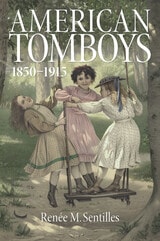
American Tomboys, 1850-1915
Renée M. Sentilles
University of Massachusetts Press, 2018
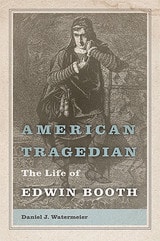
American Tragedian
The Life of Edwin BoothDaniel J. Watermeier
University of Missouri Press, 2015
Daniel J. Watermeier has, through decades of tireless research paired with his own sharp insight, put together the most complete Edwin Booth biography to date. Drawing on a wealth of archival materials and contemporary theatrical scholarship, American Tragedian: The Life of Edwin Booth gives more attention than previous biographies to Booth’s apprentice and journeyman years; his rise in antebellum America to stardom with a new, acclaimed style of acting; his work as an innovative theater builder and theatrical producer; his several foreign tours; and his nationwide tours in the late 1880s. It also addresses Booth’s critical reception in dozens of cities in America and abroad and situates his professional activities within the events and trends of the time.
As interesting as it is informative, Watermeier’s book offers an in-depth look at the triumphal career and tumultuous life of one of the American stage’s most celebrated figures.
American Tropics
Articulating Filipino AmericaAllan Punzalan Isaac
University of Minnesota Press, 2006
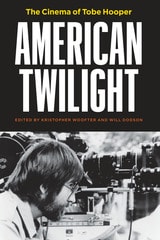
American Twilight
The Cinema of Tobe HooperBy Kristopher Woofter and Will Dodson
University of Texas Press, 2021
A master of gritty horror, Tobe Hooper captured on-screen an America in constant crisis and upended myths of prosperity to reveal the country’s internal decay.
Tobe Hooper's productions, which often trespassed upon the safety of the family unit, cast a critical eye toward an America in crisis. Often dismissed by scholars and critics as a one-hit wonder thanks to his 1974 horror classic The Texas Chain Saw Massacre, Hooper nevertheless was instrumental in the development of a robust and deeply political horror genre from the 1960s until his death in 2017. In American Twilight, the authors assert that the director was an auteur whose works featured complex monsters and disrupted America’s sacrosanct perceptions of prosperity and domestic security.
American Twilight focuses on the skepticism toward American institutions and media and the articulation of uncanny spaces so integral to Hooper’s vast array of feature and documentary films, made-for-television movies, television episodes, and music videos. From Egg Shells (1969) to Poltergeist (1982), Djinn (2013), and even Billy Idol’s music video for “Dancing with Myself” (1985), Tobe Hooper provided a singular directorial vision that investigated masculine anxiety and subverted the idea of American exceptionalism.
American Unemployment
Past, Present, and FutureFrank Stricker
University of Illinois Press, 2020
- Workers do not normally choose to be unemployed.
- In our current system, persistent unemployment is not an aberration. It is much more common than full employment, and the outcome of elite policy choices.
- Labor surpluses propped up by flawed unemployment numbers have helped to keep real wages stagnant for more than forty years.
- Prior to the New Deal and the era of big government, laissez-faire policies repeatedly led to depressions with heavy, even catastrophic, job losses.
- Undercounting the unemployed sabotages the creation of government job programs that can lead to more high-paying jobs and full employment.
American Unitarian Churches
Architecture of a Democratic ReligionAnn Marie Borys
University of Massachusetts Press, 2021
In American Unitarian Churches, Ann Marie Borys argues that the progressive values and identity of the Unitarian religion are intimately intertwined with ideals of American democracy and visibly expressed in the architecture of its churches. Over time, church architecture has continued to evolve in response to developments within the faith, and many contemporary projects are built to serve religious, practical, and civic functions simultaneously. Focusing primarily on churches of the nineteenth and twentieth centuries, including Frank Lloyd Wright's Unity Temple and Louis Kahn's First Unitarian Church, Borys explores building histories, biographies of leaders, and broader sociohistorical contexts. As this essential study makes clear, to examine Unitarianism through its churches is to see American architecture anew, and to find an authentic architectural expression of American democratic identity.
American Universities in a Global Market
Edited by Charles T. Clotfelter
University of Chicago Press, 2010

American Value
Migrants, Money, and Meaning in El Salvador and the United StatesDavid Pedersen
University of Chicago Press, 2012
American Values, Religious Voices
100 Days. 100 LettersAndrea L. Weiss and Lisa M. Weinberger
University of Minnesota Press, 2018
American Values, Religious Voices: 100 Days, 100 Letters is a collection of letters written by some of America’s most accomplished and thoughtful scholars of religion during the first 100 days of the Trump presidency. While the letters are addressed to the president, vice president, and members of the 115th Congress and Trump administration, they speak to a broad audience of Americans looking for wisdom and encouragement at this tumultuous time in our nation’s history.
This unique volume assembles the 100 letters, plus four new supplemental essays and many of the graphic illustrations that enhanced the campaign.
Published near the midway point of the Trump presidency, this book showcases a wide range of ancient sacred texts that pertain to our most pressing contemporary issues. At a time of great division in our country, this post-election project models how people of different backgrounds can listen to and learn from one another. The letters offer insight and inspiration, reminding us of the enduring values that make our nation great.
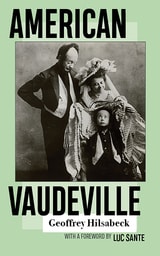
American Vaudeville
Geoffrey Hilsabeck
West Virginia University Press, 2021
At the heart of American Vaudeville is one strange, unsettling fact: for nearly fifty years, from the late nineteenth century to the 1930s, vaudeville was everywhere—then, suddenly, it was nowhere. This book tells the story of what was once the most popular form of entertainment in the country using lists, creation myths, thumbnail biographies, dreams, and obituaries. A lyric history—part social history, part song—American Vaudeville sits at the nexus between poetry, experimental nonfiction, and, because it includes historic images, art books.
Geoffrey Hilsabeck’s book grows out of extensive archival research. Rather than arranging that research—the remains of vaudeville—into a realistic picture or tidy narrative, Hilsabeck dreams vaudeville back into existence, drawing on photographs, letters, joke books, reviews, newspaper stories, anecdotes, and other material gathered from numerous archives, as well as from memoirs by vaudeville performers like Buster Keaton, Eva Tanguay, and Eddie Cantor. Some of this research is presented as-is, a letter from a now forgotten vaudeville performer to her booking agent, for example; some is worked up into brief scenes and biographies; and some is put to even more imaginative uses, finding new life in dialogues and prose poems.
American Vaudeville pulls the past into the present and finds in the beauty and carnivalesque grotesqueness of vaudeville a fitting image of American life today.
American Voudou
Journey into a Hidden WorldRod Davis
University of North Texas Press, 1998
American War Stories
Brenda M. Boyle
Rutgers University Press, 2021
American War Stories
Veteran-Writers and the Politics of MemoirMyra Mendible
University of Massachusetts Press, 2021
American War Stories centers on an extensive selection of memoirs written by veterans of the Vietnam, Iraq, and Afghanistan conflicts—including Brian Turner's My Life as a Foreign Country, Marcus Luttrell's Lone Survivor, and Camilo Mejia's Road from ar Ramadi—to explore the complex relationship between memory and politics in the context of postmodern war. Placing veterans' stories in conversation with broader cultural and political discourses, Myra Mendible analyzes the volatile mix of agendas, identities, and issues informing veteran-writers' narrative choices to argue that their work plays an important, though underexamined, political function in how Americans remember and judge their wars.
American Warsaw
The Rise, Fall, and Rebirth of Polish ChicagoDominic A. Pacyga
University of Chicago Press, 2019
Every May, a sea of 250,000 people decked out in red and white head to Chicago’s Loop to celebrate the Polish Constitution Day Parade. In the city, you can tune in to not one but four different Polish-language radio stations or jam out to the Polkaholics. You can have lunch at pierogi food trucks or pick up pączkis at the grocery store. And if you’re lucky, you get to take off work for Casimir Pulaski Day. For more than a century, Chicago has been home to one of the largest Polish populations outside of Poland, and the group has had an enormous influence on the city’s culture and politics. Yet, until now, there has not been a comprehensive history of the Chicago Polonia.
With American Warsaw, award-winning historian and Polish American Dominic A. Pacyga chronicles more than a century of immigration, and later emigration back to Poland, showing how the community has continually redefined what it means to be Polish in Chicago. He takes us from the Civil War era until today, focusing on how three major waves of immigrants, refugees, and fortune seekers shaped and then redefined the Polonia. Pacyga also traces the movement of Polish immigrants from the peasantry to the middle class and from urban working-class districts dominated by major industries to suburbia. He documents Polish Chicago’s alignments and divisions: with other Chicago ethnic groups; with the Catholic Church; with unions, politicians, and city hall; and even among its own members. And he explores the ever-shifting sense of Polskość, or “Polishness.”
Today Chicago is slowly being eclipsed by other Polish immigrant centers, but it remains a vibrant—and sometimes contentious—heart of the Polish American experience. American Warsaw is a sweeping story that expertly depicts a people who are deeply connected to their historical home and, at the same time, fiercely proud of their adopted city. As Pacyga writes, “While we were Americans, we also considered ourselves to be Poles. In that strange Chicago ethnic way, there was no real difference between the two.”

American Women Modernists
The Legacy of Robert Henri, 1910-1945Edited by Marian Wardle
Rutgers University Press, 2005
Seldom recognized, yet contributing significantly to the structure of early American modernism is a group of women who were once the art students of the popular and perhaps most influential American art teacher of the twentieth century, Robert Henri (1865-1929). Henri encouraged an art that was expressive of personal emotions and experience and that was grounded in life. He preached equality among different media and approaches to art. Giving heed to his teachings, his women students engaged in a wide variety of artistic production. Collectively, the stunning variety and power of their work in painting, sculpture, printmaking, textiles, decorative arts, and furniture broadens our understanding of American modernism and illuminates the role of women artists in shaping it. Yet, these women have remained largely unstudied, and virtually unknown, even among art historians.
The seven new essays included in this volume move beyond the famed Ashcan School-the small group of Henri's male students who worked in a narrow range of urban realist subjects-to recover the lesser known work of his women students. The contributors, who include well-known scholars of art history, American studies, and cultural studies demonstrate how these women participated in the "modernizing" of women's roles during this era; how gender controlled their art, productivity, sales, and reception; how their many styles, media, and subjects enrich our understanding of modern American art; and how the work of modern women artists relates to women's involvement in other areas of modern American society and culture, including labor and social reform, patronage, literature, dance, and music.
Lavishly illustrated and complemented by short biographies of more than 400 of Henri's students, this delightful collection adds a long-ignored but deserving dimension to an expanded story of American modernism and to women's contributions to the arts.
American Women Poets of the Nineteenth Century
Edited by Cheryl Walker
Rutgers University Press, 1992

American Women Report World War I
Chris Dubbs
University of North Texas Press, 2021
American Women Stage Directors of the Twentieth Century
Anne Fliotsos and Wendy Vierow
University of Illinois Press, 2007
Presenting a historical overview of female stage directors in the United States, this valuable reference tool focuses on fifty women who have made significant contributions to professional directing during the twentieth century. Anne Fliotsos and Wendy Vierow collect biographical details and important directing data on each woman, including information on training and career path, notable productions, critical reception, directing style, major awards, and bibliographic materials. Insightful commentary from the directors themselves also provides rich details on the theatre business and working process. This collection recognizes the much overlooked contributions of women directors and is an essential introductory tool for students and researchers of American theatre.

American Women in Transition
Suzanne M. Bianchi
Russell Sage Foundation, 1986
American Women in World War I
They Also ServedLettie Gavin
University Press of Colorado, 1997
American Women of Letters and the Nineteenth-Century Sciences
Styles of AffiliationBaym, Nina
Rutgers University Press, 2001
Choice Outstanding Academic Title
During the nineteenth century, the content and institutional organization of the sciences evolved dramatically, altering the public's understanding of knowledge. As science grew in importance, many women of letters tried to incorporate it into a female worldview. Nina Baym explores the responses to science displayed in a range of writings by American women. Conceding that they could not become scientists, women insisted, however, that they were capable of understanding science and participating in its discourse. They used their access to publishing to advocate the study and transmission of scientific information to the general public.
Bayms book includes biographies and a full exploration of these women's works. Among those considered are:
• Almira Phelps, author of Familiar Lectures on Botany (it sold 350,000 copies)
• Sarah Hale, who filled Godey's Lady's Book with science articles
• Catharine Esther Beecher, who based her domestic advice on scientific information
• Elizabeth Cary Agassiz, the actual ghostwriter of her husband's popular science essays
• Emily Dickinson, whose poetry is replete with scientific images.
Baym also investigates science in women's novels, writing by and about women doctors, and the scientific claims advanced by women's spiritualist movements. This book truly breaks new ground, outlining a field of inquiry that few have noted exists.