1668 books match the query 'Popular culture' and 121 start with a
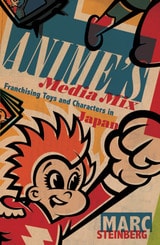
cover of Anime’s Media Mix: Franchising Toys and Characters in Japan

Anime’s Media Mix

Franchising Toys and Characters in Japan

Marc Steinberg

University of Minnesota Press, 2012

In Anime’s Media Mix, Marc Steinberg convincingly shows that anime is far more than a style of Japanese animation. Beyond its immediate form of cartooning, anime is also a unique mode of cultural production and consumption that led to the phenomenon that is today called “media mix” in Japan and “convergence” in the West.

According to Steinberg, both anime and the media mix were ignited on January 1, 1963, when Astro Boy hit Japanese TV screens for the first time. Sponsored by a chocolate manufacturer with savvy marketing skills, Astro Boy quickly became a cultural icon in Japan. He was the poster boy (or, in his case, “sticker boy”) both for Meiji Seika’s chocolates and for what could happen when a goggle-eyed cartoon child fell into the eager clutches of creative marketers. It was only a short step, Steinberg makes clear, from Astro Boy to Pokémon and beyond.

Steinberg traces the cultural genealogy that spawned Astro Boy to the transformations of Japanese media culture that followed—and forward to the even more profound developments in global capitalism supported by the circulation of characters like Doraemon, Hello Kitty, and Suzumiya Haruhi. He details how convergence was sparked by anime, with its astoundingly broad merchandising of images and its franchising across media and commodities. He also explains, for the first time, how the rise of anime cannot be understood properly—historically, economically, and culturally—without grasping the integral role that the media mix played from the start. Engaging with film, animation, and media studies, as well as analyses of consumer culture and theories of capitalism, Steinberg offers the first sustained study of the Japanese mode of convergence that informs global media practices to this day.
[more]
cover of Apocalypse Cinema

Apocalypse Cinema

Stephen Prince

Rutgers University Press, 2021

Vivid images of the apocalypse proliferate throughout contemporary cinema, which pictures the death of civilization in wildly different ways. Some films imagine a future where humanity is wiped out entirely, while others envision humans as an endangered species, enslaved by alien invaders or hunted by zombie hordes. 
 
This book provides a lively overview of apocalypse cinema, including alien invasions, nuclear annihilation, asteroid collisions, climate change, and terrifying plagues. Covering pivotal films from the silent era to the present day, including Metropolis, Invasion of the Body Snatchers, Dr. Strangelove, Contagion, and Avengers: Endgame, Stephen Prince explores how these dark visions are rooted in religious and prophetic traditions, and he considers how our love for apocalypse cinema is tied to fundamental existential questions and anxieties that never go out of fashion. 
[more]
cover of Approaching the Millennium: Essays on Angels in America

Approaching the Millennium

Essays on Angels in America

Deborah R. Geis and Steven F. Kruger, Editors

University of Michigan Press, 1997
Tony Kushner's complex and demanding play Angels in America: A Gay Fantasia on National Themes has been the most talked about, analyzed, and celebrated play of the decade. The critic Harold Bloom has included Kushner's play in his "Western canon" alongside Shakespeare and the Bible, and drama scholar John M. Clum has termed it "a turning point in the history of gay drama, the history of American drama, and of American literary culture." While we might be somewhat wary of the instant canonization that such critical assessments confer, clearly Kushner's play is an important work, honored by the Pulitzer Prize, thought worthy of recognition on "purely aesthetic" grounds at the same time that it has been embraced--and occasionally rejected--for its politics.
Kushner's play explicitly positions itself in the current American conflict over identity politics, yet also situates that debate in a broader historical context: the American history of McCarthyism, of immigration and the "melting pot," of westward expansion, and of racist exploitation. Furthermore, the play enters into the politically volatile struggles of the AIDS crisis, struggles themselves interconnected with the politics of sexuality, gender, race, and class.
The original essays in Approaching the Millennium explore the complexities of the play and situate it in its particular, conflicted historical moment. The contributors help us understand and appreciate the play as a literary work, as theatrical text, as popular cultural phenomenon, and as political reflection and intervention. Specific topics include how the play thematizes gender and sexuality, race and ethnicity; the postmodern incarnation of the Brechtian epic; AIDS and the landscape of American politics. The range of different international productions of Angels in America provides a rich basis for discussion of its production history, including the linguistic and cultural shifts required in its "translation" from one stage to the next.
The last section of Approaching the Millennium includes interviews with Tony Kushner and other key creators and players involved in the original productions of Angels. The interviews explore issues raised earlier in the volume and dialogues between the creative artists who have shaped the play and the critics and "theatricians" engaged in responding to it.
Contributors to this volume are Arnold Aronson, Art Borreca, Gregory W. Bredbeck, Michael Cadden, Nicholas de Jongh, Allen J. Frantzen, Stanton B. Garner, Deborah R. Geis, Martin Harries, Steven F. Kruger, James Miller, Framji Minwalla, Donald Pease, Janelle Reinelt, David Román, David Savran, Ron Scapp, and Alisa Solomon.
Deborah Geis is Associate Professor of English, Queens College, City University of New York. Steven F. Kruger is Professor and Chair of the Department of English, Queens College, City University of New York.
[more]
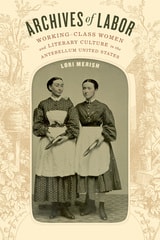
cover of Archives of Labor: Working-Class Women and Literary Culture in the Antebellum United States

Archives of Labor

Working-Class Women and Literary Culture in the Antebellum United States

Lori Merish

Duke University Press, 2017
In Archives of Labor Lori Merish establishes working-class women as significant actors within literary culture, dramatically redrawing the map of nineteenth-century US literary and cultural history. Delving into previously unexplored archives of working-class women's literature—from autobiographies, pamphlet novels, and theatrical melodrama to seduction tales and labor periodicals—Merish recovers working-class women's vital presence as writers and readers in the antebellum era. Her reading of texts by a diverse collection of factory workers, seamstresses, domestic workers, and prostitutes boldly challenges the purportedly masculine character of class dissent during this era. Whether addressing portrayals of white New England "factory girls," fictional accounts of African American domestic workers, or the first-person narratives of Mexican women working in the missions of Mexican California, Merish unsettles the traditional association of whiteness with the working class to document forms of cross-racial class identification and solidarity. In so doing, she restores the tradition of working women's class protest and dissent, shows how race and gender are central to class identity, and traces the ways working women understood themselves and were understood as workers and class subjects.
[more]
cover of Are You Entertained?: Black Popular Culture in the Twenty-First Century

Are You Entertained?

Black Popular Culture in the Twenty-First Century

Simone C. Drake and Dwan Henderson Simmons, editors

Duke University Press, 2020

The advent of the internet and the availability of social media and digital downloads have expanded the creation, distribution, and consumption of Black cultural production as never before. At the same time, a new generation of Black public intellectuals who speak to the relationship between race, politics, and popular culture has come into national prominence. The contributors to Are You Entertained? address these trends to consider what culture and blackness mean in the twenty-first century's digital consumer economy. In this collection of essays, interviews, visual art, and an artist statement the contributors examine a range of topics and issues, from music, white consumerism, cartoons, and the rise of Black Twitter to the NBA's dress code, dance, and Moonlight. Analyzing the myriad ways in which people perform, avow, politicize, own, and love blackness, this volume charts the shifting debates in Black popular culture scholarship over the past quarter century while offering new avenues for future scholarship.

Contributors. Takiyah Nur Amin, Patricia Hill Collins, Kelly Jo Fulkerson-Dikuua, Simone C. Drake, Dwan K. Henderson, Imani Kai Johnson, Ralina L. Joseph, David J. Leonard, Emily J. Lordi, Nina Angela Mercer, Mark Anthony Neal, H. Ike Okafor-Newsum, Kinohi Nishikawa, Eric Darnell Pritchard, Richard Schur, Tracy Sharpley-Whiting, Vincent Stephens, Lisa B. Thompson, Sheneese Thompson

[more]
cover of Arkansas/Arkansaw: How Bear Hunters, Hillbillies, and Good Ol' Boys Defined a State

Arkansas/Arkansaw

How Bear Hunters, Hillbillies, and Good Ol' Boys Defined a State

Brooks Blevins

University of Arkansas Press, 2009

What do Scott Joplin, John Grisham, Gen. Douglas MacArthur, Maya Angelou, Brooks Robinson, Helen Gurley Brown, Johnny Cash, Alan Ladd, and Sonny Boy Williamson have in common? They’re all Arkansans. What do hillbillies, rednecks, slow trains, bare feet, moonshine, and double-wides have in common? For many in America these represent Arkansas more than any Arkansas success stories do. In 1931 H. L. Mencken described AR (not AK, folks) as the “apex of moronia.” While, in 1942 a Time magazine article said Arkansas had “developed a mass inferiority complex unique in American history.” Arkansas/Arkansaw is the first book to explain how Arkansas’s image began and how the popular culture stereotypes have been perpetuated and altered through succeeding generations. Brooks Blevins argues that the image has not always been a bad one. He discusses travel accounts, literature, radio programs, movies, and television shows that give a very positive image of the Natural State. From territorial accounts of the Creole inhabitants of the Mississippi River Valley to national derision of the state’s triple-wide governor’s mansion to Li’l Abner, the Beverly Hillbillies, and Slingblade, Blevins leads readers on an entertaining and insightful tour through more than two centuries of the idea of Arkansas. One discovers along the way how one state becomes simultaneously a punch line and a source of admiration for progressives and social critics alike.

Winner, 2011 Ragsdale Award

[more]
cover of Artful Assassins: Murder as Art in Modern Mexico

Artful Assassins

Murder as Art in Modern Mexico

Fernando Fabio Sanchez

Vanderbilt University Press, 2010

Violence as a way of life, and murder as a political tool. This philosophy is nothing new to Mexico, most recently demonstrated in the wave of assassination and indiscriminate killing brought on by the drug war gripping the country. In Artful Assassins, author and scholar Fernando Fabio Sanchez unveils the long record of violence inspiring artistic expression in Mexico, focusing on its use and portrayal in film and literature. Sanchez is uniquely positioned to explore this topic, through his work as a novelist and poet in Mexico before entering academia in the United States.


Sanchez argues that the seemingly hopeless cycle of violence experienced by Mexico in the 20th century, as reflected in its "crime genre," reveals a broader intrinsic cultural and political failure that suggests grave implications for the current state of crisis. Tracing the development of a national Mexican identity from the 1910 Mexican Revolution onward, Sanchez focuses on the indelible presence of violence and crime underlying the major works that contributed to a larger communal narrative.


Artful Assassins ultimately offers a panoramic overview of the evolution of Mexican arts and letters, as well as nationalism, by claiming murder and assassination as literary and cinematic motifs. The collapse of post-revolutionary political unity was presaged all along in Mexican culture, Sanchez argues. It need only to have been sought in the art of the nation.

[more]
cover of Artificial Paradise: Science Fiction and American Reality

Artificial Paradise

Science Fiction and American Reality

Sharona Ben-Tov

University of Michigan Press, 1995

"The Artificial Paradise shows how science fiction is a powerful purveyor of cultural myths rooted in the history of the West, myths that shape American attitudes toward nature, technology, and the pursuit of happiness. Sharona Ben-Tov posits the theory that science fiction is an American "national mode of thinking" which seeks to replace nature with technological worlds- paradoxically, in hope of regaining a mythic, magical American Eden. Science fiction imagery- from fifties sci-fi through women's sci-fi and cyberpunk- keeps alive the desires of and anxieties born during the Scientific Revolution, when the Western view of nature changed radically. Ben-Tov discusses sci-fi classics like Dune, The Dispossessed, Neuromancer, Vonnegut's fiction, and the Aliens movie in relation to ancient and modern myths of nature, to scientific projects like the atom bomb, Strategic Defense Initiative, robotics, virtual reality, and to cultural psychology. The book will appeal to those interested in popular culture, literature, and feminist studies. It will also enchant general readers who are interested in science fiction, especially readers who want to understand more about the relationship between technology and society. "The Artificial Paradise sets out to map the cultural anxieties that have beset Western thinking since the Scientific Revolution, and to investigate the ills that flow from the split in Western thinking between nature and culture and subject and object, and how the split is expressed and reinforced in popular culture and particularly in written science fiction. . . . [A] thought-provoking, wide-ranging book written in an admirably lucid style."--Sarah Lefanu, author of Feminism and Science Fiction "The examination of America's uneasy relationship with nature is an illuminating approach which draws together science fiction studies and American studies. The witty and readable style should attract a wide readership."--Brian Attebery, Idaho State University "The Artificial Paradise is at once intellectually provocative, knowledgeable, and literate. As our lives become increasingly determined by technology, we will need to turn to such thinkers as Dr. Ben- Tov to guide us through its dangers and pleasures."--Alan Lightman, Massachusetts Institute of Technology Sharona Ben-Tov is Assistant Professor of Creative Writing and English, Bowling Green State University. She is author of During Ceasefire (Harper-Collins), a book of poems.
[more]
cover of Artificial Southerner: Equivocations and Love Songs

Artificial Southerner

Equivocations and Love Songs

Philip Martin

University of Arkansas Press, 2001

The Artificial Southerner tracks the manifestations and ramifications of "Southern identity"—the relationship among a self-conscious, invented regionalism, the real distinctiveness of Southern culture, and the influence of the South in America. In these essays columnist Philip Martin explores the region and those who have both fled and embraced it. He offers lyric portraits of Southerners real, imagined, and absentee: musicians (James Brown, the Rolling Stones, Johnny Cash), writers (Richard Ford, Eudora Welty), politicians (Bill Clinton, Jimmy Carter). He also considers such topics as the architecture of E. Fay Jones, the biracial nature of country music, and the idea of "white trash." "Every American has a South within," he says, "a conquered territory, an old wound . . . a scar." His work meditates on the rock and roll, the literature, the life, and the love which proceed from that inner, self-created South.
[more]
cover of Artificial Women: The 1970s, Mass Culture, and Feminism

Artificial Women

The 1970s, Mass Culture, and Feminism

Victoria Hesford

Duke University Press, 2027

In Artificial Women, Victoria Hesford returns to the culture and politics of the 1970s to offer a new reading of the relationship between feminism and mass media. Considering how mainstream US television and film represented feminism and feminists, Hesford shows that popular culture demonstrated a widespread concern with the artificiality and unpredictability of women—a concern that evidences the larger technological, political, and historical processes through which 1970s feminism was formed. From The Stepford Wives to Maude, Foxy Brown to the SCUM Manifesto, Hesford offers a reframing of 1970s feminism and its representations in popular culture to demonstrate how the Second Wave was coterminous with, rather than distinct from, the poststructural, queer, Black, and women of color feminisms of the 1980s and 1990s. Incorporating contemporary confrontations between trans and transphobic feminisms, Artificial Women argues that 1970s feminism, rather than working toward the abolition of gender, instead produced an excess of gender and a too-muchness of women that feminists and mass culture still navigate today.
[more]
cover of As American as Mom, Baseball, and Apple Pie: Constructing Community in Contemporary American Horror Fiction

As American as Mom, Baseball, and Apple Pie

Constructing Community in Contemporary American Horror Fiction

Linda J. Holland-Toll

University of Wisconsin Press, 2001
This book does nothing less than redefine the very genre of horror fiction, calling into question the usual conventions, motifs, and elements. Unlike many critics of this genre, Linda Holland-Toll sees dis/affirmative horror fiction acting neither to soothe fears nor reduce them to the vicarious “thrills ‘n’ chills” mode, but as intensifying the fears inherent in everyday life.
[more]
cover of Asian Celebrity Cultures in the Digital Age

Asian Celebrity Cultures in the Digital Age

Edited by Jian Xu, Glen Donnar, and Divya Garg

Hong Kong University Press, 2025

An interdisciplinary study of Asian celebrity culture and digital media.

Asian Celebrity Cultures in the Digital Age represents the first comprehensive study on the transformations of celebrity cultures in increasingly globalized and digitalized Asian societies. It discusses relations between Asian celebrities and digital media across emerging phenomena in celebrity practices, cultures, politics, fandom, and economies. Highlighting original case studies from prominent Asian societies, including India, China, Hong Kong, the Philippines, Singapore, Vietnam, Indonesia, Thailand, South Korea, and Japan, this book sheds much-needed light on the de-Westernization and internationalization of celebrity studies and is essential reading for scholars and students in celebrity, fandom, digital media and communication, and cultural studies. 
[more]
cover of Asianfail: Narratives of Disenchantment and the Model Minority

Asianfail

Narratives of Disenchantment and the Model Minority

Eleanor Ty

University of Illinois Press, 2017
Eleanor Ty's bold exploration of literature, plays, and film reveals how young Asian Americans and Asian Canadians have struggled with the ethos of self-sacrifice preached by their parents. This new generation's narratives focus on protagonists disenchanted with their daily lives. Many are depressed. Some are haunted by childhood memories of war, trauma, and refugee camps. Rejecting an obsession with professional status and money, they seek fulfillment by prioritizing relationships, personal growth, and cultural success. As Ty shows, these storytellers have done more than reject a narrowly defined road to happiness. They have rejected neoliberal capitalism itself. In so doing, they demand that the rest of us reconsider our outmoded ideas about the so-called model minority.
[more]
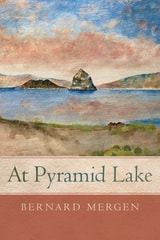
cover of At Pyramid Lake

At Pyramid Lake

Bernard Mergen

University of Nevada Press, 2014

Pyramid Lake is one of the largest lakes in the Great Basin, the terminus of the Truckee River flowing from Lake Tahoe into northern Nevada. This desert oasis, with a surface area of nearly two hundred square miles, is a unique geological feature and was home to the Paiute for thousands of years before the arrival of explorer John C. Frémont in 1844.

For the Paiute, it was a spiritual center that provided life-sustaining resources, such as the cui-ui, a fish unique to the lake and now endangered. For the ranchers and farmers who settled on tribal lands, the waters that flowed into it were necessary to raise cattle and crops. Mergen tells how these competing interests have interacted with the lake and with each other, from the Paiute War of 1860 to the present. The lake’s very existence was threatened by dams and water diversion; it was saved by tribal claims, favorable court decisions, improved water laws, and the rise of environmentalism.

At Pyramid Lake is about more than Indians and water wars, however. It is the story of railroads on the reservation and the role of federal, state, and private groups interested in sportfishing. It is about scientists, artists, and tourists who were captivated by the lake’s beauty. Finally, it is also a story of the lake as a place of spiritual renewal and celebration. Mergen grew up near its shores in the 1940s and returned frequently through the years. In this cultural history, he combines his personal remembrances with other source material, including novels, poetry, newspaper and magazine journalism, unpublished manuscripts, and private conversations, to paint a fascinating portrait of one of Nevada’s natural wonders.
[more]
cover of At Stake: Monsters and the Rhetoric of Fear in Public Culture

At Stake

Monsters and the Rhetoric of Fear in Public Culture

Edward Ingebretsen

University of Chicago Press, 2001

Anyone who reads the papers or watches the evening news is all too familiar with how variations of the word monster are used to describe unthinkable acts of violence. Jeffrey Dahmer, Timothy McVeigh, and O. J. Simpson were all monsters if we are to believe the mass media. Even Bill Clinton was depicted with the term during the Monica Lewinsky scandal. But why is so much energy devoted in our culture to the making of monsters? Why are Americans so transfixed by transgression? What is at stake when the exclamatory gestures of horror films pass for descriptive arguments in courtrooms, ethical speech in political commentary, or the bedrock of mainstream journalism?

In a study that is at once an analysis of popular culture, a polemic on religious and secular rhetoric, and an ethics of representation, Edward Ingebretsen searches for answers. At Stake explores the social construction of monstrousness in public discourse-tabloids, television, magazines, sermons, and popular fiction. Ingebretsen argues that the monster serves a moralizing function in our culture, demonstrating how not to be in order to enforce prevailing standards of behavior and personal conduct. The boys who shot up Columbine High School, for instance, personify teen rebellion taken perilously too far. Susan Smith, the South Carolinian who murdered her two children, embodies the hazards of maternal neglect. Andrew Cunanan, who killed Gianni Versace, among others, characterizes the menace of predatory sexuality. In a biblical sense, monsters are not unlike omens from the gods. The dreadful consequences of their actions inspire fear in our hearts, and warn us by example.
[more]
cover of Atomic Comics: Cartoonists Confront the Nuclear World

Atomic Comics

Cartoonists Confront the Nuclear World

Ferenc Morton Szasz

University of Nevada Press, 2013

The advent of the Atomic Age challenged purveyors of popular culture to explain to the general public the complex scientific and social issues of atomic power. Atomic Comics examines how comic books, comic strips, and other cartoon media represented the Atomic Age from the early 1920s to the present. Through the exploits of superhero figures such as Atomic Man and Spiderman, as well as an array of nuclear adversaries and atomic-themed adventures, the public acquired a new scientific vocabulary and discovered the major controversies surrounding nuclear science. Ferenc Morton Szasz’s thoughtful analysis of the themes, content, and imagery of scores of comics that appeared largely in the United States and Japan offers a fascinating perspective on the way popular culture shaped American comprehension of the fissioned atom for more than three generations.
[more]
cover of Atomic Culture: How We Learned to Stop Worrying and Love the Bomb

Atomic Culture

How We Learned to Stop Worrying and Love the Bomb

Michael A. Amundson

University Press of Colorado, 2004

In Atomic Culture, eight scholars examine the range of cultural expressions of atomic energy from the 1940s to the early twenty-first century, including comic books, nuclear landscapes, mushroom-cloud postcards, the Los Alamos suburbs, uranium-themed board games, future atomic waste facilities, and atomic-themed films such as Dr. Strangelove and The Atomic Kid.

Despite the growing interest in atomic culture and history, the body of relevant scholarship is relatively sparse. Atomic Culture opens new doors into the field by providing a substantive, engaging, and historically based consideration of the topic that will appeal to students and scholars of the Atomic Age as well as general readers.

Contributors include Michael A. Amundson, Mick Broderick, Peter Goin, John Hunner, Ferenc M. Szasz, A. Costandina Titus, Peter C. van Wyck, and Scott C. Zeman.
[more]
cover of Aussie Fans: Uniquely Placed in Global Popular Culture

Aussie Fans

Uniquely Placed in Global Popular Culture

Celia Lam and Jackie Raphael

University of Iowa Press, 2019

Australia holds a unique place in the global scheme of fandom. Much of the media consumed by Australian audiences originates from either the United States or the United Kingdom, yet several Australian productions have also attracted international fans in their own right. This first-ever academic study of Australian fandom explores the national popular culture scene through themes of localization and globalization.

The essays within reveal how Australian audiences often seek authentic imports and eagerly embrace different cultures, examining both Hollywood’s influence on Australian fandom and Australian fan reactions to non-Western content. By shining a spotlight on Australian fandom, this book not only provides an important case study for fan studies scholars, it also helps add nuance to a field whose current literature is predominantly U.S. and U.K. focused.

Contributors: Kate Ames, Ahmet Atay, Jessica Carniel, Toija Cinque, Ian Dixon, Leigh Edmonds, Sharon Elkind, Jacqui Ewart, Lincoln Geraghty, Sarah Keith, Emerald L. King, Renee Middlemost
[more]
cover of Austentatious: The Evolving World of Jane Austen Fans

Austentatious

The Evolving World of Jane Austen Fans

Holly Luetkenhaus and Zoe Weinstein

University of Iowa Press, 2019

The amount of fan-generated content about Jane Austen and her novels has long surpassed the author’s original canon. Adaptations like Clueless, Pride and Prejudice and Zombies, Jane Austen’s Fight Club, and The Lizzie Bennet Diaries have given Austen fans priceless opportunities to enjoy the classic texts anew, and continue to bring new and younger fans into the fold. Now, through online culture, the amount and type of fan-created works has exponentially multiplied in recent years. Fans write stories, create art, make videos, and craft memes, all in homage to one of the most celebrated authors of all time.

This book explores online fan spaces in search of “Janeites” all over the world to discover what fans are making, how fans are sharing their work, and why it matters that so many women and nonbinary individuals find a haven not only in Jane Austen, but also in Jane Austen fandom. In relatable chapters based on firsthand experience, the authors explore how Austen fandom has and continues to build communities around women, people of color, and the LGBTQ+ community. Whether Janeites are shrewdly picking up on the latent sexual tension between women in Emma or casting people of color in leading roles, Luetkenhaus and Weinstein argue that Austen fans are particularly adept at marrying fantasy and feminism.
[more]
cover of Authorizing Superhero Comics: On the Evolution of a Popular Serial Genre

Authorizing Superhero Comics

On the Evolution of a Popular Serial Genre

Daniel Stein

The Ohio State University Press, 2021
Authorizing Superhero Comics examines the comic book superhero as a lasting phenomenon of US popular serial storytelling. Moving beyond linear- or creator-centered models of genre development, Daniel Stein identifies authorization conflicts that have driven the genre’s evolution from the late 1930s to the present. These conflicts include paratextually mediated exchanges between officially authorized comic book producers and, alternatively, authorized fans that trouble the distinction between production and its reception; storyworld-building processes that subsume producers and fans into a collective rooted in a common style; parodies that ensure the genre’s longevity by deflating criticism through self-reflexive humor; and collecting and archiving as forms of memory management that align the genre’s past with the demands of the present. Taking seriously the serial agencies of the superhero comic book as a material artifact with a particular mediality, the study analyzes letter columns, editorial commentary, fanzines, encyclopedias, and other forms of comic book communication as critical frameworks for understanding the evolution of the genre—assessing rarely covered archival sources alongside some of the most treasured figures from the superhero’s multi-decade history, from Batman and Spider-Man to Wonder Woman and Captain America.
[more]
cover of Automobile and American Culture

Automobile and American Culture

David L. Lewis and Laurence Goldstein, Editors

University of Michigan Press, 1983

The Automobile and American Culture, edited by David L. Lewis and Laurence Goldstein, offers a sweeping exploration of the automobile’s impact on American society. Integrating both scholarly and popular approaches, this landmark anthology brings together essays, memoirs, fiction, poetry, and graphics to describe the profound and multifaceted impact of one of the twentieth century’s most fascinating inventions on American life. Now in its revised and expanded form, the collection provides an even closer look at the past, present, and future of America’s automobile revolution.With contributions from acclaimed writers, artists, musicians, and scholars, this volume examines the automobile’s influence on every corner of American society—the city and the farm, fashion and art, domestic life, popular culture, youth, gender, sexuality, and the evolving American psyche. Iconic figures such as Chuck Berry, Carl Sandburg, and Bruce Springsteen appear alongside incisive academic analysis, underscoring the car’s central place in both creative imagination and lived experience.Organized thematically, The Automobile and American Culture explores how the automobile not only transformed the physical landscape and economy, but also became a powerful cultural symbol—one both praised and critiqued as it shaped the nation’s identity, values, and dreams. From the industry’s Michigan roots to roadside Americana and critiques of modern car culture, this anthology stands as the definitive reference for anyone seeking to understand the enduring love affair between Americans and their cars, and the way this relationship continues to influence society today.
[more]