Results by title
2728 books match the query 'Education' and 268 start with a
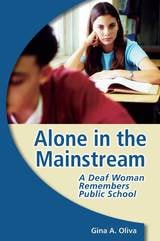
Alone in the Mainstream
A Deaf Woman Remembers Public SchoolGina A. Oliva
Gallaudet University Press, 2004
When Gina Oliva first went to school in 1955, she didn’t know that she was “different.” If the kindergarten teacher played a tune on the piano to signal the next exercise, Oliva didn’t react because she couldn’t hear the music. So began her journey as a “solitary,” her term for being the only deaf child in the entire school. Gina felt alone because she couldn’t communicate easily with her classmates, but also because none of them had a hearing loss like hers. It wasn’t until years later at Gallaudet University that she discovered that she wasn’t alone and that her experience was common among mainstreamed deaf students. Alone in the Mainstream recounts Oliva’s story, as well as those of many other solitaries.
In writing this important book, Oliva combined her personal experiences with responses from the Solitary Mainstream Project, a survey that she conducted of deaf and hard of hearing adults who attended public school. Oliva matched her findings with current research on deaf students in public schools and confirmed that hearing teachers are ill-prepared to teach deaf pupils, they don’t know much about hearing loss, and they frequently underestimate deaf children. The collected memories in Alone in the Mainstream add emotional weight to the conviction that students need to be able to communicate freely, and they also need peers to know they are not alone.
Alone in the Mainstream
Looking Back on Public School as a Deaf or Hard of Hearing ChildGina A. Oliva
Gallaudet University Press, 2024
In Alone in the Mainstream, author Gina A. Oliva documents her experience as a “solitaire,” the only deaf or hard of hearing student in her school. Oliva felt alone because she couldn’t communicate easily with her classmates and because she had no peers who shared a similar experience. As an adult, when she began her career at Gallaudet University, she realized that she wasn’t alone and that her experience was widely shared with other mainstreamed students. She decided to write about this commonality and invited other solitaires to reflect on their own experiences in emails and essays. Collective themes of isolation, low expectations, and low self-esteem emerged. Alone in the Mainstream blends Oliva’s personal narrative with the reflections of sixty other solitaires and makes the case that deaf and hard of hearing children need each other.
This twentieth anniversary edition is a reminder that little has changed for deaf and hard of hearing students in public school settings. Oliva brings this new edition up to date with observations, resources, and discussion questions that accompany her appeal for all deaf and hard of hearing children and their families to have access to sign language, to develop a deaf identity, and to be part of a deaf community.

Alternative Conceptions of Phrase Structure
Edited by Mark R. Baltin and Anthony S. Kroch
University of Chicago Press, 1989
Alternative Models of Sports Development in America
Solutions to a Crisis in Education and Public HealthB. David Ridpath
Ohio University Press, 2017
In the United States, the entanglement of sports and education has persisted for over a century. Multimillion-dollar high school football stadiums, college coaches whose salaries are many times those of their institutions’ presidents, psychological and educational tolls on student-athletes, and high-profile academic scandals are just symptoms of a system that has come under increasing fire. Institutions large and small face persistent quandaries: which do they value more, academic integrity or athletic success? Which takes precedence: prioritizing elite teams and athletes, or making it possible for all students to participate in sports? How do we create opportunities for academic—not just athletic—development for players?
In Alternative Models of Sports Development in America, B. David Ridpath—a leading sports development researcher who has studied both the US system and the European club model—offers clear steps toward creating a new status quo. He lays out four possible alternative models that draw various elements from academic, athletic, and European approaches. His proposals will help increase access of all young people to the benefits of sports and exercise, allow athletes to also thrive as students, and improve competitiveness. The result is a book that will resonate with sports development professionals, academic administrators, and parents.
Always Leading, Forever Valiant
Stories of the University of Michigan, 1817–2017Edited by Kim Clarke
University of Michigan Press, 2017
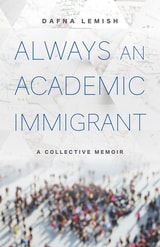
Always an Academic Immigrant
A Collective MemoirDafna Lemish
Rutgers University Press, 2025
Always an Academic Immigrant is a collective memoir that gives voice to eighty-one academics who immigrated from thirty-seven countries for a career in an institution of higher education, in either the United States or one of ten other countries. Through in-depth interviews and observations from her own experiences as an immigrant scholar, Dafna Lemish shares the highs and the lows that academic immigrants feel as they search for both a country and an institution they can call home. She discovers the formative events that led these scholars to pursue careers outside their native lands and details the challenges they faced adapting to unspoken expectations in their new countries and workplaces. Ultimately, this book reveals the strategies that immigrant professors use to bridge their native and adoptive cultures while highlighting the vital contributions they have made to academia as scholars, teachers, and leaders.

America's Theologian
Father Richard McBride of Notre DameTodd Hartch
Catholic University of America Press, 2027
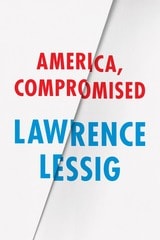
America, Compromised
Lawrence Lessig
University of Chicago Press, 2018
So begins Lawrence Lessig's sweeping indictment of contemporary American institutions and the corruption that besets them. We can all see it—from the selling of Congress to special interests to the corporate capture of the academy. Something is wrong. It’s getting worse.
And it’s our fault. What Lessig shows, brilliantly and persuasively, is that we can’t blame the problems of contemporary American life on bad people, as our discourse all too often tends to do. Rather, he explains, “We have allowed core institutions of America’s economic, social, and political life to become corrupted. Not by evil souls, but by good souls. Not through crime, but through compromise.” Every one of us, every day, making the modest compromises that seem necessary to keep moving along, is contributing to the rot at the core of American civic life. Through case studies of Congress, finance, the academy, the media, and the law, Lessig shows how institutions are drawn away from higher purposes and toward money, power, quick rewards—the first steps to corruption.
Lessig knows that a charge so broad should not be levied lightly, and that our instinct will be to resist it. So he brings copious, damning detail gleaned from years of research, building a case that is all but incontrovertible: America is on the wrong path. If we don’t acknowledge our own part in that, and act now to change it, we will hand our children a less perfect union than we were given. It will be a long struggle. This book represents the first steps.
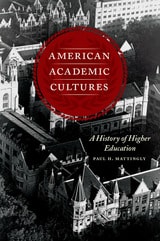
American Academic Cultures
A History of Higher EducationPaul H. Mattingly
University of Chicago Press, 2017
Mattingly sketches out seven broad generational cultures: evangelical, Jeffersonian, republican/nondenominational, industrially driven, progressively pragmatic, internationally minded, and the current corporate model. What we see through his close analysis of each of these cultures in their historical moments is that the politics of higher education, both inside and outside institutions, are ultimately driven by the dominant culture of the time. By looking at the history of higher education in this new way, Mattingly opens our eyes to our own moment, and the part its culture plays in generating its politics and promise.
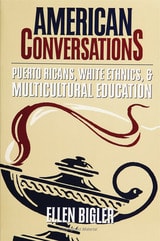
American Conversations
Ellen Bigler
Temple University Press, 1999
The impassioned debate that erupted between long-time white ethnic residents and more recently arrived Puerto Rican citizens in the de-industrialized city the author calls "Arnhem" was initially sparked by one school board member's disparaging comments about Latinos. The conflict led to an investigation by the attempts to implement multicultural reforms in the city's schools. American Conversations follows the ensuing conflict, looks at the history of racial formation in the United States, and considers the specific economic and labor histories of the groups comprising the community in opposition. Including interviews with students, teachers, parents, and community leaders, as well as her own observations of exchanges among them inside and outside the classroom, Bigler's book explores the social positions, diverging constructions of history, and polarized understandings of contemporary racial/ethnic dynamics in Arnhem. Through her retelling of one community's crisis, Bigler illuminates the nature of racial politics in the United States and how both sides in the debate over multicultural education struggle to find a common language.
American Conversations will appeal to anyone invested in education and multiculturalism in the United States as well as those interested in anthropology, sociology, racial and ethnic studies, educational institutions, migration and settlement, the effects of industrial restructuring, and broad issues of community formation and conflict.
American Education
Yesterday, Today, TomorrowEdited by Thomas L. Good
University of Chicago Press, 2000
American Educational Governance on Trial
Change and ChallengesEdited by William L. Boyd and Debra Miretzky
University of Chicago Press, 2003
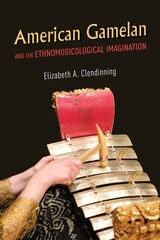
American Gamelan and the Ethnomusicological Imagination
Elizabeth A. Clendinning
University of Illinois Press, 2020
American High School and the Talented Student
Frank O. Copley
University of Michigan Press, 1961
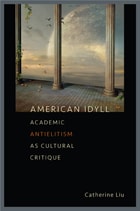
American Idyll
Academic Antielitism as Cultural CritiqueCatherine Liu
University of Iowa Press, 2011
A trenchant critique of failure and opportunism across the political spectrum, American Idyll argues that social mobility, once a revered hallmark of American society, has ebbed, as higher education has become a mechanistic process for efficient sorting that has more to do with class formation than anything else. Academic freedom and aesthetic education are reserved for high-scoring, privileged students and vocational education is the only option for economically marginal ones.
Throughout most of American history, antielitist sentiment was reserved for attacks against an entrenched aristocracy or rapacious plutocracy, but it has now become a revolt against meritocracy itself, directed against what insurgents see as a ruling class of credentialed elites with degrees from exclusive academic institutions. Catherine Liu reveals that, within the academy and stemming from the relatively new discipline of cultural studies, animosity against expertise has animated much of the Left’s cultural criticism.
By unpacking the disciplinary formation and academic ambitions of American cultural studies, Liu uncovers the genealogy of the current antielitism, placing the populism that dominates headlines within a broad historical context. In the process, she emphasizes the relevance of the historical origins of populist revolt against finance capital and its political influence. American Idyll reveals the unlikely alliance between American pragmatism and proponents of the Frankfurt School and argues for the importance of broad frames of historical thinking in encouraging robust academic debate within democratic institutions. In a bold thought experiment that revives and defends Richard Hofstadter’s theories of anti-intellectualism in American life, Liu asks, What if cultural populism had been the consensus politics of the past three decades?
American Idyll shows that recent antielitism does nothing to redress the source of its discontent—namely, growing economic inequality and diminishing social mobility. Instead, pseudopopulist rage, in conservative and countercultural forms alike, has been transformed into resentment, content merely to take down allegedly elitist cultural forms without questioning the real political and economic consolidation of powers that has taken place in America during the past thirty years.
American Indian Educators in Reservation Schools
Terry Huffman
University of Nevada Press, 2014
American Indian Life Skills Development Curriculum
Teresa D. LaFromboise
University of Wisconsin Press, 1996
Suicide is a significant problem for many adolescents in Native American Indian populations. American Indian Life Skills Development Curriculum is a course for high school students and some middle school students that is designed to drastically reduce suicidal thinking and behavior.
Created in collaboration with students and community members from the Zuni Pueblo and the Cherokee Nation of Oklahoma, this curriculum addresses key issues in Native American Indian adolescents’ lives and teaches such life skills as communication, problem solving, depression and stress management, anger regulation, and goal setting. The course is unique in its skills-based approach. After first increasing awareness and knowledge of suicide, it then teaches students specific methods to help a peer turn away from suicidal thinking and seek help from an appropriate help-giver.
The skills-based approach of this curriculum follows well-established teaching methods to develop social skills. Teachers and peers inform students of the rationale and components of a particular skill, model and demonstrate the skill for them, and later provide feedback on individual skill performance.
American Indian Studies
Native PhD Graduates Gift Their StoriesEdited by Mark L. M. Blair, Mary Jo Tippeconnic Fox, and Kestrel A. Smith
University of Arizona Press, 2022
In American Indian Studies, Native PhD graduates share their personal stories about their educational experiences and how doctoral education has shaped their identities, lives, relationships, and careers.
This collection of personal narratives from Native graduates of the University of Arizona’s American Indian Studies (AIS) doctoral program, the first such program of its kind, gifts stories of endurance and resiliency, hardship and struggle, and accomplishment and success. It provides insight into the diverse and dynamic experiences of Native graduate students. The narratives address family and kinship, mentorship, and service and giving back. Essayists share the benefits of having an AIS program at a mainstream academic institution—not just for the students enrolled but also for their communities.
This book offers Native students aspiring to a PhD a realistic picture of what it takes. While each student has their own path to walk, these stories provide the gift of encouragement and serve to empower Native students to reach their educational goals, whether it be in an AIS program or other fields of study.

American Journal of Education, volume 127 number 3 (May 2021)
The University of Chicago Press
University of Chicago Press Journals, 2021
American Journal of Education, volume 127 number 4 (August 2021)
The University of Chicago Press
University of Chicago Press Journals, 2021
American Journal of Education, volume 128 number 1 (November 2021)
The University of Chicago Press
University of Chicago Press Journals, 2021
American Journal of Education, volume 128 number 2 (February 2022)
The University of Chicago Press
University of Chicago Press Journals, 2022
American Journal of Education, volume 128 number 3 (May 2022)
The University of Chicago Press
University of Chicago Press Journals, 2022
American Journal of Education, volume 128 number 4 (August 2022)
The University of Chicago Press
University of Chicago Press Journals, 2022
American Journal of Education, volume 129 number 1 (November 2022)
The University of Chicago Press
University of Chicago Press Journals, 2022
American Journal of Education, volume 129 number 2 (February 2023)
The University of Chicago Press
University of Chicago Press Journals, 2023
American Journal of Education, volume 129 number 3 (May 2023)
The University of Chicago Press
University of Chicago Press Journals, 2023
American Journal of Education, volume 129 number 4 (August 2023)
The University of Chicago Press
University of Chicago Press Journals, 2023
American Journal of Education, volume 130 number 1 (November 2023)
The University of Chicago Press
University of Chicago Press Journals, 2023
American Journal of Education, volume 130 number 2 (February 2024)
The University of Chicago Press
University of Chicago Press Journals, 2024
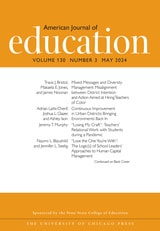
American Journal of Education, volume 130 number 3 (May 2024)
The University of Chicago Press
University of Chicago Press Journals, 2024
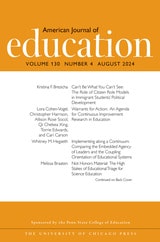
American Journal of Education, volume 130 number 4 (August 2024)
The University of Chicago Press
University of Chicago Press Journals, 2024
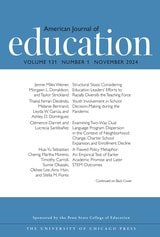
American Journal of Education, volume 131 number 1 (November 2024)
The University of Chicago Press
University of Chicago Press Journals, 2024
American Journal of Education, volume 131 number 2 (February 2025)
The University of Chicago Press
University of Chicago Press Journals, 2025
American Journal of Education, volume 131 number 3 (May 2025)
The University of Chicago Press
University of Chicago Press Journals, 2025
American Journal of Education, volume 131 number 4 (August 2025)
The University of Chicago Press
University of Chicago Press Journals, 2025
American Journal of Education, volume 132 number 1 (November 2025)
The University of Chicago Press
University of Chicago Press Journals, 2025
American Journal of Education, volume 132 number 2 (February 2026)
The University of Chicago Press
University of Chicago Press Journals, 2026
American Journal of Education, volume 132 number 3 (May 2026)
The University of Chicago Press
University of Chicago Press Journals, 2026
American Journal of Education, volume 132 number 4 (August 2026)
The University of Chicago Press
University of Chicago Press Journals, 2026
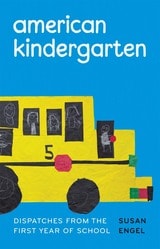
American Kindergarten
Dispatches from the First Year of SchoolSusan Engel
University of Chicago Press, 2026
When we think of kindergarten, many might imagine joyous free play, and a tangle of trucks, dress-up clothes, and blocks, as five-year-olds explore their vivid imaginations and budding social skills. Others might envision a quiet group sitting cross-legged in a circle during story time. Neither of these scenes would be an inaccurate representation of the pivotal year of entry into traditional education in this country. However, neither offers a complete picture of what children do every day in those seemingly transparent, yet actually mysterious, classrooms. What can or should we expect during the first year of school? How are children learning and growing during those hours spent away from their homes?
Susan Engel embarked on finding these answers in American Kindergarten: Dispatches from the First Year of School. Engel toured twenty-nine classrooms across fourteen states, observing each closely, with a special eye toward the ways each classroom’s goals reflect its community. As she made her way across the country, Engel found that on the surface, kindergarten students are similar: good-natured, eager to learn, and deeply affectionate. Their classrooms, too, feature many of the same expectations, routines, and activities. But the differences between the classrooms were striking and often surprising. Over the two years of her classroom visits, Engel identified five promises that teachers and their classrooms make to their students: reading, order, thinking, identity, and love. Engel found that schools differ in how they prioritize and keep the promises they make; some make all five promises, while others emphasize only one or two. The five promises capture a set of values, aspirations, and goals that drive everything that happens in a classroom.
Engaging and incisive, American Kindergarten is the story of the promises our country’s schools make to five-year-old children, and how those promises are kept and sometimes broken.
American Kindergarten
Dispatches from the First Year of SchoolSusan Engel
University of Chicago Press, 2026
An unexpected portrait of the first year of school for America’s youngest learners.
When we think of kindergarten, many might imagine joyous free play, and a tangle of trucks, dress-up clothes, and blocks, as five-year-olds explore their vivid imaginations and budding social skills. Others might envision a quiet group sitting cross-legged in a circle during story time. Neither of these scenes would be an inaccurate representation of the pivotal year of entry into traditional education in this country. However, neither offers a complete picture of what children do every day in those seemingly transparent, yet actually mysterious, classrooms. What can or should we expect during the first year of school? How are children learning and growing during those hours spent away from their homes?
Susan Engel embarked on finding these answers in American Kindergarten: Dispatches from the First Year of School. Engel toured twenty-nine classrooms across fourteen states, observing each closely, with a special eye toward the ways each classroom’s goals reflect its community. As she made her way across the country, Engel found that on the surface, kindergarten students are similar: good-natured, eager to learn, and deeply affectionate. Their classrooms, too, feature many of the same expectations, routines, and activities. But the differences between the classrooms were striking and often surprising. Over the two years of her classroom visits, Engel identified five promises that teachers and their classrooms make to their students: reading, order, thinking, identity, and love. Engel found that schools differ in how they prioritize and keep the promises they make; some make all five promises, while others emphasize only one or two. The five promises capture a set of values, aspirations, and goals that drive everything that happens in a classroom.
Engaging and incisive, American Kindergarten is the story of the promises our country’s schools make to five-year-old children, and how those promises are kept and sometimes broken.

American Literary Scholarship, 1994, Volume 92
David Nordloh
Duke University Press, 0
American School Reform
What Works, What Fails, and WhyJoseph P. McDonald and the Cities and Schools Research Group
University of Chicago Press, 2014
McDonald and his colleagues lay out several interrelated ideas in what they call a theory of action space. Frequently education policy gets so ambitious that implementing it becomes a near impossibility. Action space, however, is what takes shape when talented educators, leaders, and reformers guide the social capital of civic leaders and the financial capital of governments, foundations, corporations, and other backers toward true results. Exploring these extraordinary collaborations through their lifespans and their influences on future efforts, the authors provide political hope—that reform efforts can work, and that our schools can be made better.
American Sign Language and Early Literacy
A Model Parent-Child ProgramKristin Snoddon
Gallaudet University Press, 2012
The usual definition of the term “literacy” generally corresponds with mastering the reading and writing of a spoken language. This narrow scope often engenders unsubstantiated claims that print literacy alone leads to, among other so-called higher-order thinking skills, logical and rational thinking and the abstract use of language. Thus, the importance of literacy for deaf children in American Sign Language (ASL) is marginalized, asserts author Kristin Snoddon in her new book American Sign Language and Early Literacy: A Model Parent-Child Program. As a contrast, Snoddon describes conducting an ethnographic, action study of the ASL Parent-Child Mother Goose program, provided by a Deaf service agency in Ontario, Canada to teach ASL literacy to deaf children.
According to current scholarship, literacy is achieved through primary discourse shared with parents and other intimates, which establishes a child’s initial sense of identity, culture, and vernacular language. Secondary discourse derives from outside agents and interaction, such as expanding an individual’s literacy to other languages. Snoddon writes that the focus of the ASL Parent-Child Mother Goose program is on teaching ASL through rhymes and stories and some facets of the culture of Deaf ASL users. This focus enabled hearing parents to impart first-language acquisition and socialization to their deaf children in a more natural primary discourse as if the parents were Deaf themselves. At the same time, hearing parents experience secondary discourses through their exposure to ASL and Deaf culture.
Snoddon also comments on current infant hearing screening and early intervention and the gaps in these services. She discusses gatekeeper individuals and institutions that restrict access to ASL for young Deaf children and their families. Finally, she reports on public resources for supporting ASL literacy and the implications of her findings regarding the benefits of early ASL literacy programming for Deaf children and their families.

American Universities in a Global Market
Edited by Charles T. Clotfelter
University of Chicago Press, 2010
American by Paper
How Documents Matter in Immigrant LiteracyKate Vieira
University of Minnesota Press, 2016
American by Paper reveals how two groups of immigrants who share a primary language nevertheless have very different experiences of literacy in the United States. It describes the social realities facing documented and undocumented immigrants who use everyday acts of writing to negotiate papers—the visas, green cards, and passports that promise access to the American Dream. It is both an ethnography, filled with illuminating details about contemporary immigrant lives, and a critical intervention into two leading—and conflicting—scholarly ideas of literacy and its social role.
Although popular thinking and scholarship have viewed literacy as a method of culturally assimilating immigrants into the nation, Kate Vieira finds that upward mobility and social inclusion in the United States are tied to literacy in complex ways. She draws from extensive interviews with Portuguese-speaking migrants who live and work together in a former mill town in Massachusetts that she calls South Mills: one group from the Azores, who are usually documented, and another from Brazil, who are usually undocumented. She explains how these migrants experience literacy not as a vehicle for assimilation (as educational policy makers often assert) nor as a means of resisting oppression (as literacy scholars often hope) but instead as tied up in papers, particularly in the papers that confer legal status. Papers and literacy are inextricably bound together, both promoting and constraining opportunities, and they shape why and how migrants read and write.
Vieira builds on insights from literacy theories that have long been in opposition to each other in order to develop a new sociomaterial theory of literacy, one that takes into account its inseparable link to paper, forms, and documentation. This point of view leads to a deeper understanding of how literacy actually accrues meaning by circulating, and recirculating, through institutions and the lives of individuals.

Amherst in the World
Martha Saxton
Amherst College Press, 2020
Contributions by Martha Saxton, Gary J. Kornblith, David W. Wills, Frederick E. Hoxie, Trent Maxey, Nicholas L. Syrett, Wendy H. Bergoffen, Rick López, Matthew Alexander Randolph, Daniel Levinson Wilk, K. Ian Shin, David S. Reynolds, Jane F. Thrailkill, Julie Dobrow, Richard F. Teichgraeber III, Debby Applegate, Michael E. Jirik, Bruce Laurie, Molly Michelmore, and Christian G. Appy.
An A to W of Academic Literacy
Key Concepts and Practices for Graduate StudentsMary Jane Curry, Fangzhi He, Weijia Li, Ting Zhang, Yanhong Zuo, Mahmoud Altalouli, and Jihan Ayesh
University of Michigan Press, 2021
The guide includes 65 common academic literacy terms and explores how they relate to genres, writing conventions, and language use. Each entry briefly defines the term, identifies variations and tensions about its use across disciplines, provides examples, and includes reflection questions. An appendix lists further readings for each entry.
Unique to this volume are comments featuring the experiences of the graduate students who wrote the entries, comments that bring each entry to life and build a bridge to graduate student readers.
An Accidental Triumph
The Improbable History of American Higher EducationSol Gittleman
Vesto Books, 2023
"Hardly a day passes without reference to some scandal, fraud, intellectual or moral failure, or other ill associated with American academic institutions,” writes Sol Gittleman in his bracing new book, An Accidental Triumph. “If American higher education is such a failure, why are students and scholars from all over the world still so eager to secure a place in one of these institutions? Is American higher education a disaster or the envy of the world?”
Gittleman confronts this contradiction in this dynamic mix of history, analysis, and personal reflection. An Accidental Triumph tells the engaging story of how American higher education evolved from a patchwork of seminaries in the early nineteenth century into the world’s leader in research by the middle of the twentieth. Gittleman links this fascinating story to his own fifty-year academic career, which coincided with an explosive rise in enrollment, spurred by the GI Bill, and an unparalleled postwar boom in faculty hiring, prompted by massive new federal support for academic research from organizations such as the National Science Foundation.
Writing with authority, frankness, and unfailing wry good humor, Gittleman surveys the triumphs, tragedies, and tensions of the history of American higher education. Despite the relentless criticism, Gittleman finds good reason to remain optimistic about the future of teaching and research at the college and university level in the United States.