Results by title
4743 books match the query 'Religion' and 371 start with a
Allusive Soundplay in the Hebrew Bible
Jonathan G. Kline
SBL Press, 2016
The first study to focus exclusively on the use in the Hebrew Bible of soundplay to allude to and interpret earlier literary traditions
This book focuses on the way the biblical writers used allusive soundplay to construct theological discourse, that is, in service of their efforts to describe the nature of God and God's relationship to humanity. By showing that a variety of biblical books contain examples of allusive soundplay employed for this purpose, Kline demonstrates that this literary device played an important role in the growth of the biblical text as a whole and in the development of ancient Israelite and early Jewish theological traditions.
Features:- Demonstrates that allusive soundplay was a productive compositional technique in ancient Israel
- Identifies examples of innerbiblical allusion that have not been identified before
- A robust methodology for identifying soundplay in innerbiblical allusions
Alone Before God
The Religious Origins of Modernity in MexicoPamela Voekel
Duke University Press, 2002
Drawing on the archival research of wills, public documents, and other texts from late-colonial and early-republican Mexico, Voekel describes the marked scaling-down of the pomp and display that had characterized baroque Catholic burials and the various devices through which citizens sought to safeguard their souls in the afterlife. In lieu of these baroque practices, the new enlightened Catholics, claims Voekel, expressed a spiritually and hygienically motivated preference for extremely simple burial ceremonies, for burial outside the confines of the church building, and for leaving their earthly goods to charity. Claiming that these changes mirrored a larger shift from an external, corporate Catholicism to a more interior piety, she demonstrates how this new form of Catholicism helped to initiate a cultural and epistemic shift that placed the individual at the center of knowledge.
Breaking with the traditional historiography to argue that Mexican liberalism had deeply religious roots, Alone Before God will be of interest to specialists in Latin American history, modernity, and religion.
Ambient Sufism
Ritual Niches and the Social Work of Musical FormRichard C. Jankowsky
University of Chicago Press, 2021
Ambrosiaster's Commentary on the Pauline Epistles
RomansTheodore S. de Bruyn
SBL Press, 2017
A new translation for scholars and students of biblical interpretation and ancient Christianity
The ancient writer dubbed Ambrosiaster was a pioneer in the revival of interest in the Pauline Epistles in the later fourth century. He was read by Latin writers, including Pelagius and Augustine, and his writings, passed on pseudonymously, had a long afterlife in the biblical commentaries, theological treatises, and canonical literature of the medieval and the early modern periods. In addition to his importance as an interpreter of scripture, Ambrosiaster provides unique perspectives on many facets of Christian life in Rome, from the emergence of clerical celibacy to the development of liturgical practices to the subordination of women.
Features
- An up-to-date overview of what is known about Ambrosiaster, the transmission of his commentary on the Pauline Epistles, his exegetical method, his theological orientation, and aspects of Christianity in Rome in the fourth century
- A scholarly translation of the final version of the commentary, along with notes that identify significant variants from prior versions of the commentary
- Bibliography thatincludes a comprehensive list of the scholarly literature on Ambrosiaster
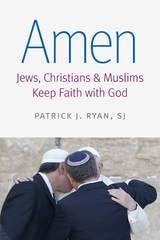
Amen
Patrick J. Ryan SJ
Catholic University of America Press, 2018
Amen
Seeking Presence with Prayer, Poetry, and Mindfulness PracticeRabbi Karyn D. Kedar
Central Conference of American Rabbis, 2020
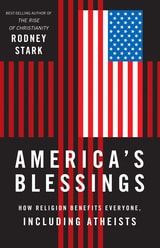
America's Blessings
How Religion Benefits Everyone, Including AtheistsRodney Stark
Templeton Press, 2013
A few years ago, a debate between atheists and religious believers spilled out from the halls of academia and the pews of America’s churches and into the public spotlight. A crop of atheist manifestos led the charge, surmounting and holding the tops of the nonfiction bestseller lists. This debate brought on an outpouring of religious rebuttals as both sides exchanged spirited volleys, accusations were leveled; myths, stereotypes, and strawmen arguments were perpetuated; and bitter hostility filled the air. Today many of these misconceptions and myths linger on, along with the generally acrimonious spirit of the debate.
In America’s Blessings, distinguished researcher Rodney Stark seeks to clear the air of this hostility and debunk many of the debate’s most widely perpetuated misconceptions by drawing from an expansive pool of sociological findings. Stark rises above the fray and focuses exclusively on facts by examining the measurable effects of religious faith and practice on American society. His results may surprise many atheists and believers alike.
Starting with a historical overview, Stark traces America’s religious roots from the country’s founding to the present day, showing that religiosity in America has never been consistent, static, or monolithic. Interestingly, he finds that religious practice is now more prevalent than ever in America, despite any claims to the contrary. From here, Stark devotes whole chapters to unpacking the latest research on how religion affects the different facets of modern American life, including crime, family life, sexuality, mental and physical health, sophistication, charity, and overall prosperity. The cumulative effect is that when translated into comparisons with western European nations, the United States comes out on top again and again. Thanks in no small part to America’s rich religious culture, the nation has far lower crime rates, much higher levels of charitable giving, better health, stronger marriages, and less suicide, to note only a few of the benefits.
In the final chapter, Stark assesses the financial impact of these religious realities. It turns out that belief benefits the American economy—and all 300 million citizens, believers, and nonbelievers alike—by a conservative estimate of $2.6 trillion a year. Despite the atheist outcry against religion, the remarkable conclusion is clear: all Americans, from the most religious among us to our secular neighbors, really ought to count our blessings.
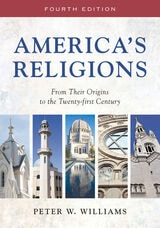
America's Religions
From Their Origins to the Twenty-first CenturyPeter W. Williams
University of Illinois Press, 2015
America's Spiritual Capital
Nicholas N. Capaldi
St. Augustine's Press, 2012
America's Teilhard
Susan Kassman Sack
Catholic University of America Press, 2019

America's Theologian
Father Richard McBride of Notre DameTodd Hartch
Catholic University of America Press, 2027
American Catholic Hospitals
A Century of Changing Markets and MissionsWall, Barbra Mann
Rutgers University Press, 2016
In American Catholic Hospitals, Barbra Mann Wall chronicles changes in Catholic hospitals during the twentieth century, many of which are emblematic of trends in the American healthcare system.
Wall explores the Church's struggle to safeguard its religious values. As hospital leaders reacted to increased political, economic, and societal secularization, they extended their religious principles in the areas of universal health care and adherence to the Ethical and Religious Values in Catholic Hospitals, leading to tensions between the Church, government, and society. The book also examines the power of women--as administrators, Catholic sisters wielded significant authority--as well as the gender disparity in these institutions which came to be run, for the most part, by men. Wall also situates these critical transformations within the context of the changing Church policy during the 1960s. She undertakes unprecedented analyses of the gendered politics of post-Second Vatican Council Catholic hospitals, as well as the effect of social movements on the practice of medicine.
American Catholicism
John Tracy Ellis
University of Chicago Press, 1969
The author gives an updated historical account of the part played by Catholics in both the American Revolution and the Civil War, and of the difficulties within the Church that came with the clash of national interests among Irish, French, and Germans in the nineteenth century. He regards immigration as the key to the increasingly important role of American Catholicism in the nation after 1820. For contemporary America, the author counts among the signs of the mature Church an increase in Church membership, the presence of nine Americans in the College of Cardinals in May, 1967, and the expansion of American effort in Catholic missions throughout the world.
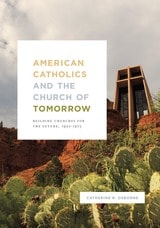
American Catholics and the Church of Tomorrow
Building Churches for the Future, 1925–1975Catherine R. Osborne
University of Chicago Press, 2018
Catherine R. Osborne’s innovative new book finds the answer: the alignment between postwar advancements in technology and design and evolutionary thought within the burgeoning American Catholic community. A new, visibly contemporary approach to design, church leaders thought, could lead to the rebirth of the church community of the future. As Osborne explains, the engineering breakthroughs that made modernist churches feasible themselves raised questions that were, for many Catholics, fundamentally theological. Couldn’t technological improvements engender worship spaces that better reflected God's presence in the contemporary world? Detailing the social, architectural, and theological movements that made modern churches possible, American Catholics and the Churches of Tomorrow breaks important new ground in the history of American Catholicism, and also presents new lines of thought for scholars attracted to modern architectural and urban history.
American Christianity
The Continuing RevolutionBy Stephen Cox
University of Texas Press, 2014
Christianity takes an astonishing variety of forms in America, from churches that cherish traditional modes of worship to evangelical churches and fellowships, Pentecostal churches, social-action churches, megachurches, and apocalyptic churches—congregations ministering to believers of diverse ethnicities, social classes, and sexual orientations. Nor is this diversity a recent phenomenon, despite many Americans’ nostalgia for an undeviating “faith of our fathers” in the days of yore. Rather, as Stephen Cox argues in this thought-provoking book, American Christianity is a revolution that is always happening, and always needs to happen. The old-time religion always has to be made new, and that is what Americans have been doing throughout their history.
American Christianity is an engaging book, wide ranging and well informed, in touch with the living reality of America’s diverse traditions and with the surprising ways in which they have developed. Radical and unpredictable change, Cox argues, is one of the few dependable features of Christianity in America. He explores how both the Catholic Church and the mainline Protestant churches have evolved in ways that would make them seem alien to their adherents in past centuries. He traces the rise of uniquely American movements, from the Mormons to the Seventh-day Adventists and Jehovah’s Witnesses, and brings to life the vivid personalities—Aimee Semple McPherson, Billy Sunday, and many others—who have taken the gospel to the masses. He sheds new light on such issues as American Christians’ intense but constantly changing political involvements, their controversial revisions in the style and substance of worship, and their chronic expectation that God is about to intervene conclusively in human life. Asserting that “a church that doesn’t promise new beginnings can never prosper in America,“ Cox demonstrates that American Christianity must be seen not as a sociological phenomenon but as the ever-changing story of individual people seeking their own connections with God, constantly reinventing their religion, making it more volatile, more colorful, and more fascinating.

American Congregations, Volume 1
Portraits of Twelve Religious CommunitiesEdited by James P. Wind and James W. Lewis
University of Chicago Press, 1994
"This study refreshingly illuminates [congregations'] strengths as places where the public and private lives of their members meet in dynamic creativity and as havens of religious meaning and comfort in the midst of a secular world."—Choice
"A major contribution to how debates about American religion will be framed in the years ahead. . . . In giving us these case histories and a set of excellent interpretive essays, Wind and Lewis have reminded us that American religion must be understood in its particular, local, gathered, human forms. They remind us that congregations matter."—Nancy T. Ammerman, First Things
"Well-presented and engaging essays, by some of the foremost religious scholars working today, examining the histories of twelve diverse religious institutions. . . . A fascinating and important social history of religion."—Kirkus Reviews
"Scholarship and the religious traditions have been enriched by the labors of the Congregational History Project. Theologically, its pioneering research invites us to examine ourselves."—Gabriel Fackre, Christian Century
American Congregations, Volume 2
New Perspectives in the Study of CongregationsEdited by James P. Wind and James W. Lewis
University of Chicago Press, 1994
Published simultaneously, these two volumes combine engaging historical studies with incisive scholarsly analysis to focus attention on the central role of congregational studies in research and teaching of American religion.
"This two volume study of American congregations is of compelling importance to anyone interested in civil society, community, and belief in contemporary America. . . . Extraordinarily rich in detail."—Association for Research on Non-profit Organizations and Voluntary Action News
"[An] informative and stimulating study."—John A. Saliba, Journal of Contemporary Religion
"These congregational histories are important pieces of both social and religious history. They tell us much about the convictions and experience of a great variety of people, different styles of leadership and of how these distinctive local cultures both bear and shape the larger traditions they represent."—Gordon Harland, Studies in Religion
"Both volumes of American Congregations resulted from pioneering efforts, and they are timely and useful. They should force American religious historians to ask new questions. . . . Any American religious historian who fails to take this two-volume work seriously in the future will find his or her own scholarship terribly deficient."—Lewis V. Baldwin, Journal of American History
American Denominational History
Perspectives on the Past, Prospects for the FutureEdited by Keith Harper
University of Alabama Press, 2008
Fruitful questions that are posed by the positions and experiences of the various groups are carefully examined. American Denominational History points the way for the next decade of scholarly effort.
American Evangelicalism
Conservative Religion and the Quandary of ModernityHunter, James D
Rutgers University Press, 1983
American Evangelicalism
Embattled and ThrivingChristian Smith
University of Chicago Press, 1998
Based on a national telephone survey and more than three hundred personal interviews with evangelicals and other churchgoing Protestants, this study provides a detailed analysis of the commitments, beliefs, concerns, and practices of this thriving group. Examining how evangelicals interact with and attempt to influence secular society, this book argues that traditional, orthodox evangelicalism endures not despite, but precisely because of, the challenges and structures of our modern pluralistic environment. This work also looks beyond evangelicalism to explore more broadly the problems of traditional religious belief and practice in the modern world.
With its impressive empirical evidence, innovative theory, and substantive conclusions, American Evangelicalism will provoke lively debate over the state of religious practice in contemporary America.
American Evangelicals and the 1960s
Edited by Axel R. Schäfer
University of Wisconsin Press, 2013
American Examples, Vol 1
New Conversations about ReligionEdited by Michael J. Altman
University of Alabama Press, 2022
Rethinking Religion in America Through Contemporary Case and Conversation.
American Examples: New Conversations about Religion, Volume One is the first in a series of annual anthologies published in partnership with the Department of Religious Studies at The University of Alabama. The American Examples initiative gathers scholars from around the world for a series of workshops designed to generate big questions about the study of religion in America. Bypassing traditional white Protestant narratives in favor of new perspectives on belief, social formation, and identity, American Examples fellows offer dynamic perspectives on American faith that challenge our understandings of both America and religion as categories.
In the first volume of this exciting academic project, five topically and methodologically diverse scholars vividly reimagine the potential applications of religious history. The five chapters of this inaugural volume use case studies from America, broadly conceived, to ask larger theoretical questions that are of interest to scholars beyond the subfield of American religious history.
Prea Persaud’s chapter explores the place of Hinduism among the “creole religions” of the Caribbean, while Hannah Scheidt captures what atheist parents say to each other about value systems. Travis Warren Cooper explains how the modernist church architecture of Columbus, Indiana, became central to that city’s identity. Samah Choudhury dissects how Muslim American comedians navigate Western ideas of knowledge and self to make their jokes, and their own selves legible, and Emily D. Crews uses ethnographic fieldwork to read the female reproductive body among Nigerian Pentecostal congregations. Editor Michael J. Altman also provides a brief, rich introduction assessing the state of the discipline of religious history and how the American Examples project can lead the field forward.
Visit americanexamples.ua.edu for more information on the group and news about upcoming projects.
American Examples, Vol 2
New Conversations about ReligionEdited by Samah Choudhury, Prea Persaud, and Michael J. Altman
University of Alabama Press, 2022
Fresh new perspectives on the study of religion, ranging from SoulCycle to Mark Twain
American Examples: New Conversations about Religion, Volume Two, is the second in a series of annual anthologies produced by the American Examples workshop hosted by the Department of Religious Studies at The University of Alabama. In the latest volume from this dynamic academic project, nine scholars with diverse topics and methodologies vividly reimagine the meaning of all three words in the phrase “American religious history.” The essays use case studies from America, broadly conceived, to ask trenchant theoretical questions that are of interest to scholars and students beyond the subfield of American religious history.
Cody Musselman uses a Weberian analysis to explore questions of identity, authority, and authenticity in the world of SoulCycle while Zachary T. Smith finds commonality between the rhetoric and practices of scholarship and mixed martial arts. Erik Kline provides a new perspective on the psychedelic mysticism of the 1960s, and Brook Wilensky-Lanford takes stock of the cultural power of parody in Mark Twain’s last work of fiction. Christopher Cannon Jones examines the reciprocal relationship between religious texts and cultural contexts by comparing early Mormon missions to Hawai‘i and Jamaica and Lindsey Jackson explores what debates over circumcision can tell us about gender stereotypes and motherhood. Dana Lloyd uses the 1988 Supreme Court decision in Lyng v. Northwest Indian Cemetery Protective Association as a case study in order to consider how Indigenous religion and sovereignty have been understood and adjudicated in the American legal system. Matt Sheedy studies the identity categories of “atheist” and “ex-Muslim” and Brad Stoddard uses ethnographic fieldwork to evaluate the role of religious pluralism in regulating and policing correctional institutions. Editors Samah Choudhury and Prea Persaud provide an introduction that reconsiders the trajectory of the American Examples project in light of the siege on the US Capitol in January 2021 and the continuing COVID pandemic.
Visit americanexamples.ua.edu for more information on upcoming workshop dates and future projects.
CONTRIBUTORS
Michael J. Altman / Samah Choudhury / Lindsey Jackson / Christopher Cannon Jones / / Erik Kline / Dana Lloyd / Cody Musselman / Prea Persaud / Matt Sheedy / Zachary T. Smith / Brad Stoddard / Brook Wilensky-Lanford
American Examples, Vol 3
New Conversations about ReligionEdited by Cody Musselman, Erik Kline, Dana Lloyd, and Michael J. Altman
University of Alabama Press, 2024
American Examples: New Conversations about Religion, Volume Three, is the third in a series of annual anthologies produced by the American Examples workshop hosted by the Department of Religious Studies at the University of Alabama. In the latest volume from this innovative academic project, ten topically and methodologically diverse scholars vividly reimagine the meaning and applications of American religious history. These ten chapters use case studies from America, broadly conceived, to ask trenchant theoretical questions that are of interest to scholars and students within and beyond the subfield of American religious history.
Visit americanexamples.ua.edu for more information on upcoming workshop dates and future projects.
American Examples, Vol 4
New Conversations about ReligionEdited by Candace Lukasik, Joshua Urich, and Michael J. Altman
University of Alabama Press, 2025
Case studies that vividly reimagine the meaning and applications of American religious history
American Examples: New Conversations about Religion, Volume Four, continues the annual anthology series produced by the American Examples workshop at the University of Alabama’s Department of Religious Studies. The goal of American Examples is to examine examples of “something someone called religious, somewhere someone called America” by asking theoretical questions that exceed the boundaries of American religion or American religious history. This volume features seven essays exploring examples ranging from American Muslim headwear to online pickup artists to the connections between Dutch immigrants and Japanese students. This collection offers valuable insights for scholars and students within and beyond the field of American religious history.
Visit americanexamples.ua.edu for more information on upcoming workshop dates and future projects
American Examples, Vol 5
New Conversations about ReligionEdited by Rachel E. C. Beckley, Jacob Lassin, Andrew Klumpp, and Michael J. Altman
University of Alabama Press, 2026
Redefines American religion through bold case studies and fresh theoretical approaches
American Examples: New Conversations about Religion, Volume 5 continues the groundbreaking series from the Department of Religious Studies at the University of Alabama. Edited by Rachel E. C. Beckley, Jacob Lassin, Andrew Klumpp, and Michael J. Altman, this volume features seven innovative essays that challenge conventional understandings of religion in America.
From the sacred choreography of HBCU majorette dance to the spiritual significance of Korean American supermarket chain H Mart, and from evangelical summer camps to metaphysical theories of energy and oil, these essays explore “something someone called religion, somewhere someone called America.” Drawing on interdisciplinary methods—Black studies, queer theory, performance studies, and more—this collection reimagines how religion is practiced, embodied, and theorized across diverse American contexts. Volume 5 not only expands the boundaries of American religious history but also highlights the work of emerging scholars pushing the field forward. Accessible and thought provoking, this anthology is essential reading for students and scholars of religion, race, gender, and American culture.

American Examples, Vol 6
New Conversations about ReligionEdited by Judith Ellen Brunton, Mihee Kim-Kort, Sarah Riccardi-Swartz, and Michael J. Altman
University of Alabama Press, 2027
Redefines American religion through bold case studies and fresh theoretical approaches
American Examples: New Conversations about Religion, Volume 6, is the sixth and final annual anthology produced by the American Examples workshop hosted by the Department of Religious Studies at the University of Alabama. This volume features eight innovative essays that challenge traditional understandings of religion in America. From the conception and construction of America’s road systems to the ways in which religious pluralism developed at the turn of the twentieth century, and from pan-Indianism to megachurch discourse, these essays explore “something someone called religion, somewhere someone called America.”
Drawing on interdisciplinary methods such as Indigenous studies, acculturation studies, and political theory, this collection explores how religion is practiced, embodied, and theorized across diverse American contexts. This anthology offers valuable insights for scholars and students within and beyond the field of American religious history, including studies in race, gender, and American culture.
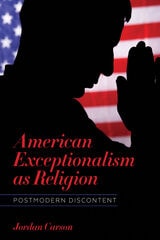
American Exceptionalism as Religion
Postmodern DiscontentJordan Carson
The Ohio State University Press, 2020
As American exceptionalism resurfaces in public discourse, Carson’s timely work invites readers to reconsider the nexus of religion, politics, and culture. Carson argues that defining religion according to secularist criteria has insulated ostensibly secular ideologies as well as traditional religion from public scrutiny. DeLillo’s, Castillo’s, Pynchon’s, Saunders’s, and Robinson’s redefinitions of religion result in a better grasp of how individuals actually live out their religious lives. More importantly, these authors help erect a framework for constructively engaging American exceptionalism and the ideas that support it.
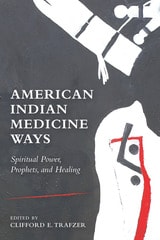
American Indian Medicine Ways
Spiritual Power, Prophets, and HealingEdited by Clifford E. Trafzer
University of Arizona Press, 2017
This groundbreaking collection provides fascinating stories of wisdom, spiritual power, and forces within tribal communities that have influenced the past and may influence the future. Through discussions of omens, prophecies, war, peace, ceremony, ritual, and cultural items such as masks, prayer sticks, sweat lodges, and peyote, this volume offers examples of the ways in which Native American beliefs in spirits have been and remain a fundamental aspect of history and culture. Drawing from written and oral sources, the book offers readers a greater understanding of creation narratives, oral histories, and songs that speak of healers, spirits, and power from tribes across the North American continent.
American Indian medicine ways and spiritual power remain vital today. With the help of spirits, people can heal the sick, protect communities from natural disasters, and mediate power of many kinds between the spiritual and corporeal worlds. As the contributors to this volume illustrate, healers are the connective cloth between the ancient past and the present, and their influence is significant for future generations.
CONTRIBUTORS
R. David Edmunds
Joseph B. Herring
Benjamin Jenkins
Troy R. Johnson
Michelle Lorimer
L. G. Moses
Richard D. Scheuerman
Al Logan Slagle
Clifford E. Trafzer
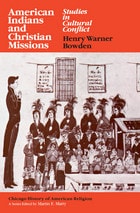
American Indians and Christian Missions
Studies in Cultural ConflictHenry Warner Bowden
University of Chicago Press, 1985
"Bowden makes a radical departure from the traditional approach. Drawing on the theories and findings of anthropologists, archaeologists, and historians, he presents Indian-missionary relations as a series of cultural encounters, the outcomes of which were determined by the content of native beliefs, the structure of native religious institutions, and external factors such as epidemic diseases and military conflicts, as well as by the missionaries' own resources and abilities. The result is a provocative, insightful historical essay that liberates a complex subject from the narrow perimeters of past discussions and accords it an appropriate richness and complexity. . . . For anyone with an interest in Indian-missionary relations, from the most casual to the most specialized, this book is the place to begin."—Neal Salisbury, Theology Today
"If one wishes to read a concise, thought-provoking ethnohistory of Indian missions, 1540-1980, this is it. Henry Warner Bowden's history, perhaps for the first time, places the sweep of Christian evangelism fully in the context of vigorous, believable, native religions."—Robert H. Keller, Jr., American Historical Review
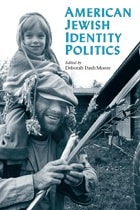
American Jewish Identity Politics
Deborah Dash Moore, editor
University of Michigan Press, 2009
"Displays the full range of informed, thoughtful opinion on the place of Jews in the American politics of identity."
---David A. Hollinger, Preston Hotchkis Professor of American History, University of California, Berkeley
"A fascinating anthology whose essays crystallize the most salient features of American Jewish life in the second half of the twentieth century."
---Beth S. Wenger, Katz Family Associate Professor of American Jewish History and Director of the Jewish Studies Program, University of Pennsylvania
"A wonderful collection of important essays, indispensable for understanding the searing conflicts over faith, familial, and political commitments marking American Jewry's journey through the paradoxes of the post-Holocaust era."
---Michael E. Staub, Professor of English, Baruch College, CUNY, and author of Torn at the Roots: The Crisis of Jewish Liberalism in Postwar America
"This provocative anthology offers fascinating essays on Jewish culture, politics, religion, feminism, and much more. It is a must-read for all those interested in the intersection of Jewish life and identity politics in the modern period."
---Joyce Antler, Samuel Lane Professor of American Jewish History and Culture, Brandeis University
"This collection of essays invites the reader to engage with some of the best writing and thinking about American Jewish life by some of the finest scholars in the field. Deborah Moore's introduction offers an important framework to understand not only the essays, but the academic and political contexts in which they are rooted."
---Riv-Ellen Prell, Professor and Chair, American Studies, University of Minnesota, and editor of Women Remaking American Judaism
American Jewish Thought Since 1934
Writings on Identity, Engagement, and BeliefEdited by Michael Marmur and David Ellenson
Brandeis University Press, 2020
In this volume, editors Michael Marmur and David Ellenson bring together the distinctive voices of those who have shaped the bold and shifting soundscape of American Jewish thought over the last few generations. The contributors tackle an array of topics including theological questions; loyalty and belonging; the significance of halakhic, spiritual, and ritual practice; secularization and its discontents; and the creative recasting of Jewish peoplehood. The editors are careful to point out how a plurality of approaches emerged in response to the fundamental ruptures and challenges of continuity posed by the Holocaust, the establishment of the state of Israel, and the civil rights movement in the twentieth century.
This volume also includes a wide swath of the most distinctive currents and movements over the last eighty years: post-Holocaust theology, secular forms of Jewish spirituality, ultra-orthodoxy, American neo-orthodoxy, neo-Hasidism, feminism and queer theory, diasporist critiques of Zionism, and Zionist militancy. This collection will serve as both a testament to the creativity of American Jewish thought so far, and as an inspiration for the new thinkers of its still unwritten future.

American Judaism
Nathan Glazer
University of Chicago Press, 1988
Glazer's new introduction describes the drift away from the popular equation of American Judaism with liberalism during the last two decades and considers the threat of divisiveness within American Judaism. Glazer also discusses tensions between American Judaism and Israel as a result of a revivified Orthodoxy and the disillusionment with liberalism.
"American Judaism has been arguably the best known and most used introduction to the study of the Jewish religion in the United States. . . . It is an inordinately clear-sighted work that can be read with much profit to this day."—American Jewish History (1987)
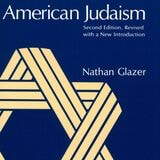
American Judaism
Nathan Glazer
University of Chicago Press, 1988
First published in 1957, Nathan Glazer's classic, historical study of Judaism in America has been described by the New York Times Book Review as "a remarkable story . . . told briefly and clearly by an objective historical mind, yet with a fine combination of sociological insight and religious sensitivity."
Glazer's new introduction describes the drift away from the popular equation of American Judaism with liberalism during the last two decades and considers the threat of divisiveness within American Judaism. Glazer also discusses tensions between American Judaism and Israel as a result of a revivified Orthodoxy and the disillusionment with liberalism.
"American Judaism has been arguably the best known and most used introduction to the study of the Jewish religion in the United States. . . . It is an inordinately clear-sighted work that can be read with much profit to this day."—American Jewish History (1987)
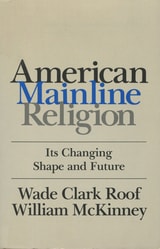
American Mainline Religion
Its Changing Shape and FutureWade Clark Roof and William McKinney
Rutgers University Press, 1987
"American Mainline Religion" provides a new "mapping" of the families of American religion and the underlying social, cultural, and demographic forces that will reshape American religion in the century to come. Going beyond the headlines in daily newspapers, Roof and McKinney document the decline of the Protestant establishment, the rise of a more assimilated and public-minded Roman Catholicism, the place of black Protestantism and Judaism, and the resurgence of conservative Protestantism as a religious and cultural force.
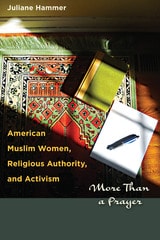
American Muslim Women, Religious Authority, and Activism
More Than a PrayerBy Juliane Hammer
University of Texas Press, 2012
Following the events of September 11, 2001, American Muslims found themselves under unprecedented scrutiny. Muslim communities in the United States suffered from negative representations of their religion, but they also experienced increased interest in aspects of their faith and cultures. They seized the opportunity to shape the intellectual contribution of American Muslims to contemporary Muslim thought as never before. Muslim women in particular—often assumed to be silenced, oppressed members of their own communities—challenged stereotypes through their writing, seeking to express what it means to be a Muslim woman in America and carrying out intra-Muslim debates about gender roles and women’s participation in society. Hammer looks at the work of significant female American Muslim writers, scholars, and activists, using their writings as a lens for a larger discussion of Muslim intellectual production in America and beyond.
Centered on the controversial women-led Friday prayer in March 2005, Hammer uses this event and its aftermath to address themes of faith, community, and public opinion. Tracing the writings of American Muslim women since 1990, the author covers an extensive list of authors, including Amina Wadud, Leila Ahmed, Asma Barlas, Riffat Hassan, Mohja Kahf, Azizah al-Hibri, Asra Normani, and Asma Gull Hasan. Hammer deftly examines each author’s writings, demonstrating that the debates that concern American Muslim women are at the heart of modern Muslim debates worldwide. While gender is the catalyst for Hammer’s study, her examination of these women’s intellectual output touches on themes central to contemporary Islam: authority, tradition, Islamic law, justice, and authenticity.
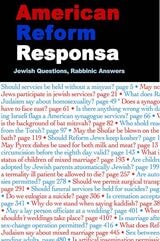
American Reform Responsa - PDF Electronic Version
Jewish Questions, Rabbinic AnswersWalter Jacob
Central Conference of American Rabbis, 1983
Originally published in 1983, this collection was edited by Rabbi Walter Jacob, then the Chair of the CCAR Responsa Committee. This collection deals with such questions as: should a remarried woman observe a deceased husband's yahrzeit? Is euthenasia ever permissible? May a shofar be sounded on Shabbat? Must an adult convert be circumcised? Should funeral services be held for suicides? May a woman wear a tallit? Responsa are rabbinic answers to actual questions of Jewish law and practice that, throughout history, have provided a guiding force in shaping Jewish life.
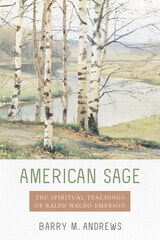
American Sage
The Spiritual Teachings of Ralph Waldo EmersonBarry M. Andrews
University of Massachusetts Press, 2021
Unitarian minister Barry M. Andrews has spent years studying Emerson, finding wisdom and guidance in his teachings and practices, and witnessing how the spiritual lives of others are enriched when they grasp the many meanings in his work. In American Sage, Andrews explores Emerson's writings, including his journals and letters, and makes them accessible to today's spiritual seekers. Written in everyday language and based on scholarship grounded in historical detail, this enlightening book considers the nineteenth-century religious and intellectual crosscurrents that shaped Emerson's worldview to reveal how his spiritual teachings remain timeless and modern, universal and uniquely American.
American Values, Religious Voices, Volume 2
Letters of Hope from People of FaithEdited by Andrea Weiss and Lisa Weinberger
University of Minnesota Press, 2022
In the aftermath of the 2016 presidential election, biblical scholar Andrea L. Weiss and graphic designer Lisa M. Weinberger teamed up to create Values & Voices, a national nonpartisan campaign that used letters and social media to highlight core American values connected to our diverse religious traditions. The result was American Values, Religious Voices: 100 Days, 100 Letters, a collection of one hundred letters written by some of America's most accomplished and thoughtful scholars of religion interspersed with original artwork during the first one hundred days of the Trump presidency.
In 2021, Weiss and Weinberger invited religious scholars and leaders to address President Biden, Vice President Harris, and members of the 117th Congress in their national letter writing and social media campaign. During the first 100 days of the Biden administration, religious leaders from across the country and from a range of religious denominations once again sent one letter a day to elected leaders in Washington. These letters bring an array of religious texts and teachings to bear on our most pressing contemporary issues. Arranged chronologically, the 2021 edition features 59 returning letter writers and 42 new scholars, new artwork, original essays, and and a new section focused on putting the letters into practice by using them for teaching, preaching, meditative practice, civic activism, and more. An alternate table of contents arranged by core values that emerged in the letters over the 100 days allows for thematic reading.
American Values, Religious Voices
100 Days. 100 LettersAndrea L. Weiss and Lisa M. Weinberger
University of Minnesota Press, 2018
American Values, Religious Voices: 100 Days, 100 Letters is a collection of letters written by some of America’s most accomplished and thoughtful scholars of religion during the first 100 days of the Trump presidency. While the letters are addressed to the president, vice president, and members of the 115th Congress and Trump administration, they speak to a broad audience of Americans looking for wisdom and encouragement at this tumultuous time in our nation’s history.
This unique volume assembles the 100 letters, plus four new supplemental essays and many of the graphic illustrations that enhanced the campaign.
Published near the midway point of the Trump presidency, this book showcases a wide range of ancient sacred texts that pertain to our most pressing contemporary issues. At a time of great division in our country, this post-election project models how people of different backgrounds can listen to and learn from one another. The letters offer insight and inspiration, reminding us of the enduring values that make our nation great.
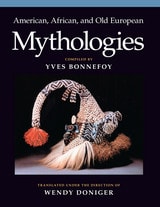
American, African, and Old European Mythologies
Edited by Yves Bonnefoy
University of Chicago Press, 1993
Almost all of Mythologies, originally published as a two-volume cloth set, is now available in four paperback volumes. These volumes reproduce the articles, introductory essays, and illustrations as they appeared in the full Mythologies set, and each includes a new Preface by Wendy Doniger.
This volume gathers eighty articles on mythologies from around the world. A section on the Americas and the South Pacific covers myths of native Americans, from the Inuit to the Mesoamericans, about such topics as the cosmos, fire, and the creation of the world. Essays on African mythology range from the 266 basic signs of West Africa to themes such as twins, the placenta, and masks. The final section, covering Celtic, Norse, and Slavic traditions opens with an overview of the Indo-Europeans and concludes with an essay on the religion and myths of Armenia.
Amy Levy
Critical EssaysLinda Hunt Beckman
Ohio University Press, 2000
Amy Levy
Critical EssaysNaomi Hetherington
Ohio University Press, 2010
Amy Levy has risen to prominence in recent years as one of the most innovative and perplexing writers of her generation. Embraced by feminist scholars for her radical experimentation with queer poetic voice and her witty journalistic pieces on female independence, she remains controversial for her representations of London Jewry that draw unmistakably on contemporary antisemitic discourse.
Amy Levy: Critical Essays brings together scholars working in the fields of Victorian cultural history, women’s poetry and fiction, and the history of Anglo-Jewry. The essays trace the social, intellectual, and political contexts of Levy’s writing and its contemporary reception. Working from close analyses of Levy’s texts, the collection aims to rethink her engagement with Jewish identity, to consider her literary and political identifications, to assess her representations of modern consumer society and popular culture, and to place her life and work within late-Victorian cultural debate.
This book is essential reading for undergraduate and postgraduate students offering both a comprehensive literature review of scholarship-to-date and a range of new critical perspectives.
Contributors:
Susan David Bernstein,University of Wisconsin-Madison
Gail Cunningham,Kingston University
Elizabeth F. Evans,Pennslyvania State University–DuBois
Emma Francis,Warwick University
Alex Goody,Oxford Brookes University
T. D. Olverson,University of Newcastle upon Tyne
Lyssa Randolph,University of Wales, Newport
Meri-Jane Rochelson,Florida International University
Amythia
Crisis in the Natural History of Western CultureLoyal D. Rue
University of Alabama Press, 1989
Amythia results when cosmology and morality are not effectively integrated by a root metaphor, and the only possibility for the future is to transpose the old Christian God as Person to a root metaphor that is even older in origin, the concept of the Covenant tradition inherited from Israel but now understood in a nonsupernaturalist manner.
Rue asserts that amythia is a critical condition within the natural history of Western culture. The argument of the book begins with a theoretical perspective on the place of human culture within the scope of natural history and proceeds to establish the conceptual foundations for a natural history of culture.
Following an overview of the natural history of Western culture to expose the origins and depth of the contemporary intellectual and moral crisis, Rue moves on to specify and justify the limits of distinctiveness and plausibility appropriate for the task of transposing Covenant tradition. Finally, an appeal is made to the mythmakers of contemporary culture to take up the challenge of amythia.
An 1860 English-Hopi Vocabulary Written in the Deseret Alphabet
Kenneth R. Beesley
University of Utah Press, 2014
The volume reproduces all 486 vocabulary entries of the original manuscript, presenting the Deseret and the modern English and Hopi translations. It explains the history of the Deseret Alphabet as well as that of the Mormon missions to the Hopi, while fleshing out the background of the two missionaries, Marion Jackson Shelton, who wrote the manuscript, and his companion, Thales Hastings Haskell. The book will be of interest to linguists, historians, ethnographers, and others who are curious about the unique combination of topics this work connects.
An Account of the Antiquities of the Indians
A New Edition, with an Introductory Study, Notes, and Appendices by José Juan ArromFray Ramon Pané
Duke University Press, 1999
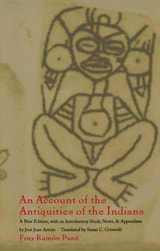
Edited by the noted Hispanist José Juan Arrom, Pané’s report is the only surviving direct source of information about the myths, ceremonies, and lives of the New World inhabitants whom Columbus first encountered. The friar’s text contains many linguistic and cultural observations, including descriptions of the Taíno people’s healing rituals and their beliefs about their souls after death. Pané provides the first known description of the use of the hallucinogen cohoba, and he recounts the use of idols in ritual ceremonies. The names, functions, and attributes of native gods; the mythological origin of the aboriginal people’s attitudes toward sex and gender; and their rich stories of creation are described as well.
An African Perspective on the Thought of Benedict XVI
Agbaw-ebai
St. Augustine's Press, 2023
An American Rabbi in Korea
A Chaplain's Journey in the Forgotten WarMilton J. Rosen, translated and edited by Stanley R. Rosen
University of Alabama Press, 2004
During the height of the Korean conflict, 1950–51, Orthodox Jewish chaplain Milton J. Rosen wrote 19 feature-length articles for Der Morgen Zhornal, a Yiddish daily in New York, documenting his wartime experiences as well as those of the servicemen under his care. An American Rabbi in Korea is an English translation of Rosen's important articles prepared by his son and annotated with background about Rosen's military service, a general introduction to the war and conflict on the Korean peninsula, and numerous maps and photographs.
Rosen was among those nearly caught in the Chinese entrapment of American and Allied forces in North Korea in late 1950, and some of his most poignant writing details the trying circumstances that faced both soldiers and civilians during that time. As chaplain, Rosen was able to offer a unique account of the American Jewish experience on the frontlines and in the United States military while also describing the impact of the American presence on Korean citizens and their culture. His interest in Korean attitudes toward Jews is also a significant theme within these articles. The sum is a readable account of war and its turmoil from an astute and compassionate observer.
An Anthropology of Vocations
Man-and-Woman, The Image of GodMarc Ouellet
Catholic University of America Press, 2026

An Archaeology of the Soul
NORTH AMERICAN INDIAN BELIEF AND RITUALRobert L. Hall
University of Illinois Press, 1997
noted, but it has never been examined so thoroughly, nor with such an
eye for the amazing interconnectedness of Indian tribal ceremonies and
practices, as in An Archaeology of the Soul. In this monumental
work, destined to become a classic in its field, Robert Hall traces the
genetic and historical relationships of the tribes of the Midwest and
Plains--including roots that extend back as far as 3,000 years.
Looking beyond regional barriers, An Archaeology of the Soul offers new depths of insight into American Indian ethnography. Hall uncovers the lineage and kinship shared by Native North Americans through the perspectives of history, archaeology, archaeoastronomy, biological anthropology, linguistics, and mythology. The wholeness and panoramic complexity of American Indian belief has never been so fully explored--or more deeply understood.