Results by title
3064 books match the query 'Social conditions' and 248 start with a

Apocalypse, Darling
Barrie Jean Borich
The Ohio State University Press, 2018
From award-winning author Barrie Jean Borich comes Apocalypse, Darling, a narrative, lyric exploration of the clash between old and new. Set in the steel mill regions of Chicago and in Northwest Indiana, the story centers on Borich’s return to a decimated landscape for a misbegotten wedding in which her spouse’s father marries his high school sweetheart. The book is a lilting journey into an ill-fated moment, where families attempt to find communion in tense gathering spaces and across their most formative disappointments. Borich tells the story of the industrial heartland that produced the steel that made American cities, but also one of the most toxic environmental sites in the world.
As concise as a poem and as sweeping as an epic novel, Apocalypse, Darling explores the intersection of American traditional and self-invented social identities and the destruction and re-greening of industrial cityscapes. Borich asks: can toxic landscapes actually be remediated and can patriarchal fathers ever really be forgiven? In a political climate where Borich is forced to daily re-enter the toxic wastelands she thought she’d long left behind, Apocalypse, Darling is an urgent collision of broken spaces, dysfunctional affections, and the reach toward familial and environmental repair.
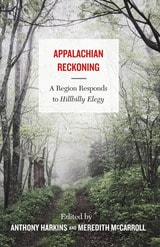
Appalachian Reckoning
A Region Responds to Hillbilly ElegyAnthony Harkins
West Virginia University Press, 2019
2020 American Book Award winner, Walter & Lillian Lowenfels Criticism Award
2019 Weatherford Award winner, nonfiction
With hundreds of thousands of copies sold, a Ron Howard movie in the works, and the rise of its author as a media personality, J. D. Vance’s Hillbilly Elegy: A Memoir of a Family and Culture in Crisis has defined Appalachia for much of the nation. What about Hillbilly Elegy accounts for this explosion of interest during this period of political turmoil? Why have its ideas raised so much controversy? And how can debates about the book catalyze new, more inclusive political agendas for the region’s future?
Appalachian Reckoning is a retort, at turns rigorous, critical, angry, and hopeful, to the long shadow Hillbilly Elegy has cast over the region and its imagining. But it also moves beyond Hillbilly Elegy to allow Appalachians from varied backgrounds to tell their own diverse and complex stories through an imaginative blend of scholarship, prose, poetry, and photography. The essays and creative work collected in Appalachian Reckoning provide a deeply personal portrait of a place that is at once culturally rich and economically distressed, unique and typically American. Complicating simplistic visions that associate the region almost exclusively with death and decay, Appalachian Reckoning makes clear Appalachia’s intellectual vitality, spiritual richness, and progressive possibilities.
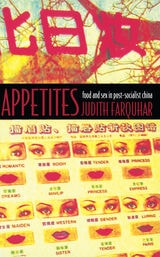
Appetites
Food and Sex in Post-Socialist ChinaJudith Farquhar
Duke University Press, 2002
From eating well in improving economic times to memories of the late 1950s famine, from the flavors of traditional Chinese medicine to modernity’s private sexual passions, this book argues that embodiment in all its forms must be invented and sustained in public reflections about personal and national life. As much at home in science studies and social theory as in the details of life in Beijing, this account uses anthropology, cultural studies, and literary criticism to read contemporary Chinese life in a materialist and reflexive mode. For both Maoist and market reform periods, this is a story of high culture in appetites, desire in collective life, and politics in the body and its dispositions.
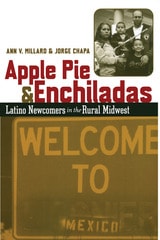
Apple Pie and Enchiladas
Latino Newcomers in the Rural MidwestBy Ann V. Millard and Jorge Chapa
University of Texas Press, 2004
The sudden influx of significant numbers of Latinos to the rural Midwest stems from the recruitment of workers by food processing plants and small factories springing up in rural areas. Mostly they work at back-breaking jobs that local residents are not willing to take because of the low wages and few benefits. The region has become the scene of dramatic change involving major issues facing our country—the intertwining of ethnic differences, prejudice, and poverty; the social impact of a low-wage workforce resulting from corporate transformations; and public policy questions dealing with economic development, taxation, and welfare payments.
In this thorough multidisciplinary study, the authors explore both sides of this ethnic divide and provide the first volume to focus comprehensively on Latinos in the region by linking demographic and qualitative analysis to describe what brings Latinos to the area and how they are being accommodated in their new communities. The fact is that many Midwestern communities would be losing population and facing a dearth of workers if not for Latino newcomers. This finding adds another layer of social and economic complexity to the region's changing place in the global economy. The authors look at how Latinos fit into an already fractured social landscape with tensions among townspeople, farmers, and others. The authors also reveal the optimism that lies in the opposition of many Anglos to ethnic prejudice and racism.
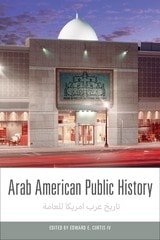
Arab American Public History
Edited by Edward E. Curtis IV
Temple University Press, 2026
Arab American Public History is an invitation to engage more deeply with Arab American communities. Chapters examine Arab Americans’ origins, ethnic identities, and efforts to belong in America through case studies of the community’s food cultures, genealogy research, cultural production, and neighborhood enclaves.
The first formal study of Arab American public history, this exciting volume charts various ways Arab Americans have interpreted their past as a source of defiant humanity, cultural enfranchisement, social solidarity, and political power.
Contributors: Reem Awad-Rashmawi, Chloe Bordewich, Richard M. Breaux, Maria F. Curtis, Lydia Harrington, Randa A. Kayyali, Matthew Jaber Stiffler, Rebecca K. Shrum, and the editor
In the series History and the Public
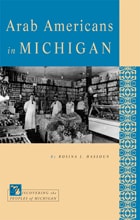
Arab Americans in Michigan
Rosina J. Hassoun
Michigan State University Press, 2003
The state of Michigan hosts one of the largest and most diverse Arab American populations in the United States. As the third largest ethnic population in the state, Arab Americans are an economically important and politically influential group. It also reflects the diversity of national origins, religions, education levels, socioeconomic levels, and degrees of acculturation. Despite their considerable presence, Arab Americans have always been a misunderstood ethnic population in Michigan, even before September 11, 2001 imposed a cloud of suspicion, fear, and uncertainty over their ethnic enclaves and the larger community. In Arab Americans in Michigan Rosina J. Hassoun outlines the origins, culture, religions, and values of a people whose influence has often exceeded their visibility in the state.
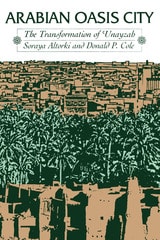
Arabian Oasis City
The Transformation of 'UnayzahBy Soraya Altorki and Donald P. Cole
University of Texas Press, 1989
Vast social change has occurred in the Middle East since the oil boom of the mid-1970s. As the first anthropological study of an urban community in Saudi Arabia since that oil boom, Arabian Oasis City is also the first to document those changes.
Based on extensive interviews and participant observation with both men and women, the authors record and analyze the transformation that has occurred in this ancient oasis city throughout the twentieth century: the creation of the present Saudi Arabian state and of a new national economy based on the export of oil and the economic boom brought about by the dramatic increases in the price of oil following the October 1973 Arab-Israeli War. In addition, the authors reveal the changes brought about by the fall in the price of oil beginning in 1982 and analyze the problems confronting ‘Unayzah in its aftermath.
By demonstrating that the area was not exclusively dominated by tribalism and Bedouin nomads, this empirical case study destroys stereotypical views about Saudi Arabia. Indeed, it proves the existence—prior to the coming of the modern Saudi Arabian state— of surplus agricultural and craft production and the full development of local, regional, and long-distance trade networks. It shows that women, although veiled, played active roles in work outside the household. The social impact of change over the years is, however, profound—especially the gradual replacement of the extended family by the nuclear family, changing patterns of husband-wife relationships, the impact of self-earned income on the status of women, and the emergence of a new middle class of employees and entrepreneurs. Because of the high degree of gender segregation in this area of research, Altorki and Cole give us a fortunate collaboration between a Saudi Arabian female scholar and an American male scholar experienced in research in the Middle East.
Arabs in America
Building a New Futureedited by Michael W. Suleiman
Temple University Press, 1999
In this volume, editor Michael Suleiman brings together 21 prominent scholars from a wide range of perspectives -- including anthropology, economics, history, law, literature and culture, political science, and sociology -- to take a close look at the status of Arabs in North America. Topics range from the career of Arab American singer, dancer, and storyteller Wadeeha Atiyeh to a historical examination of Arab Americans and Zionism. The contributors discuss in Detroit, a group of well-educated Jordanian men, and the Shi'a Muslims -- to illustrate the range of Arab emigre experience. More broadly, they examine Arab American identity, political activism, and attempts by Arab immigrants to achieve respect and recognition in their new homes. They address both the present situation for Arab Americans and prospects for their future.
Arabs in America will engage anyone interested in Arab American studies, ethnic studies, and American studies.
Arabs in the Mirror
Images and Self-Images from Pre-Islamic to Modern TimesBy Nissim Rejwan
University of Texas Press, 2008
What is an Arab? Though many in the West would answer that question with simplistic stereotypes, the reality is far more complex and interesting. Arabs themselves have been debating Arab identity since pre-Islamic times, coming to a variety of conclusions about the nature and extent of their “Arabness.” Likewise, Westerners and others have attempted to analyze Arab identity, reaching mostly negative conclusions about Arab culture and capacity for self-government.
To bring new perspectives to the question of Arab identity, Iraqi-born scholar Nissim Rejwan has assembled this fascinating collection of writings by Arab and Western intellectuals, who try to define what it means to be Arab. He begins with pre-Islamic times and continues to the last decades of the twentieth century, quoting thinkers ranging from Ibn Khaldun to modern writers such as al-Ansari, Haykal, Ahmad Amin, al-'Azm, and Said. Through their works, Rejwan shows how Arabs have grappled with such significant issues as the influence of Islam, the rise of nationalism, the quest for democracy, women's status, the younger generation, Egypt's place in the Arab world, Israel's role in Middle Eastern conflict, and the West's "cultural invasion."
By letting Arabs speak for themselves, Arabs in the Mirror refutes a prominent Western stereotype—that Arabs are incapable of self-reflection or self-government. On the contrary, it reveals a rich tradition of self-criticism and self-knowledge in the Arab world.
Archaeology below the Cliff
Race, Class, and Redlegs in Barbadian Sugar SocietyMatthew C. Reilly
University of Alabama Press, 2019
Archaeology below the Cliff: Race, Class, and Redlegs in Barbadian Sugar Society is the first archaeological study of the poor whites of Barbados, the descendants of seventeenth-century European indentured servants and small farmers. “Redlegs” is a pejorative to describe the marginalized group who remained after the island transitioned to a sugar monoculture economy dependent on the labor of enslaved Africans. A sizable portion of the “white” minority, the Redlegs largely existed on the peripheries of the plantation landscape in an area called “Below Cliff,” which was deemed unsuitable for profitable agricultural production. Just as the land on which they resided was cast as marginal, so too have the poor whites historically and contemporarily been derided as peripheral and isolated as well as idle, alcoholic, degenerate, inbred, and irrelevant to a functional island society and economy.
Using archaeological, historical, and oral sources, Matthew C. Reilly shows how the precarious existence of the Barbadian Redlegs challenged elite hypercapitalistic notions of economics, race, and class as they were developing in colonial society. Experiencing pronounced economic hardship, similar to that of the enslaved, albeit under very different circumstances, Barbadian Redlegs developed strategies to live in a harsh environment. Reilly’s investigations reveal that what developed in Below Cliff was a moral economy, based on community needs rather than free-market prices.
Reilly extensively excavated households from the tenantry area on the boundaries of the Clifton Hall Plantation, which was abandoned in the 1960s, to explore the daily lives of poor white tenants and investigate their relationships with island economic processes and networks. Despite misconceptions of strict racial isolation, evidence also highlights the importance of poor white encounters and relationships with Afro-Barbadians. Historical data are also incorporated to address how an underrepresented demographic experienced the plantation landscape. Ultimately, Reilly’s narrative situates the Redlegs within island history, privileging inclusion and embeddedness over exclusion and isolation.
Archaeology of Southern Urban Landscapes
Amy L Young
University of Alabama Press, 2000
Groundbreaking essays in urban archaeology highlight the impact of towns and cities on the southern landscape.
The rapid growth and development of urban areas in the South have resulted in an increase in the number of urban archaeology projects required by federal and state agencies. These projects provide opportunities not only to investigate marginal areas between the town and countryside but also to recover information long buried beneath the earliest urban structures. Such projects have also created a need for a one-volume update on archaeology as it is practiced in the urban areas of the southeastern United States.
Archaeology of Southern Urban Landscapes will assist practitioners and scholars in the burgeoning fields of urban and landscape archaeology by treating the South as a distinctive social, geographic, and material entity and by focusing on the urban South rather than the stereotypical South of rural plantations. The case studies in this volume span the entire southeastern United States, from Annapolis to New Orleans and from colonial times to the 19th century. The authors address questions involving the function of cities, interregional diversity, the evolution of the urban landscape, and the impact of the urban landscape on southern culture. By identifying the relationship between southern culture and the South's urban landscapes, this book will help us understand the built landscape of the past and predict future growth in the region.
Architectures of Hope
Infrastructural Citizenship and Class Mobility in Brazil's Public HousingMoisés Kopper
University of Michigan Press, 2022
Architectures of Hope examines how communal idealism, electoral politics, and low-income consumer markets made first-time homeownership a reality for millions of low-income Brazilians over the last ten years.
Drawing on a five-year-long ethnography among city planners, architects, street-level bureaucrats, politicians, market and bank representatives, community leaders, and past, present, and future beneficiaries, Moisés Kopper tells the story of how a group of grassroots housing activists rose from oblivion to build a model community. He explores the strategies set forth by housing activists as they waited and hoped for—and eventually secured—homeownership through Minha Casa Minha Vida’s public-private infrastructure. By showing how these efforts coalesced in Porto Alegre—Brazil’s once progressive hotspot—he interrogates the value systems and novel arrangements of power and market that underlie the country’s post-neoliberal project of modern and inclusive development.
By chronicling the making and remaking of material hope in the aftermath of Minha Casa Minha Vida, Architectures of Hope reopens the future as a powerful venue for ethnographic inquiry and urban development.
Archive of Tongues
An Intimate History of BrownnessMoon Charania
Duke University Press, 2023

Archives and Justice
Verne Harris
Society of American Archivists, 2007
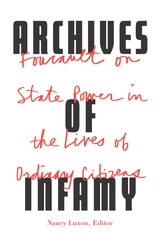
Archives of Infamy
Foucault on State Power in the Lives of Ordinary CitizensNancy Luxon
University of Minnesota Press, 2019
Expanding the insights of Arlette Farge and Michel Foucault’s Disorderly Families into policing, public order, (in)justice, and daily life
What might it mean for ordinary people to intervene in the circulation of power between police and the streets, sovereigns and their subjects? How did the police come to understand themselves as responsible for the circulation of people as much as things—and to separate law and justice from the maintenance of a newly emergent civil order? These are among the many questions addressed in the interpretive essays in Archives of Infamy.
Crisscrossing the Atlantic to bring together unpublished radio broadcasts, book reviews, and essays by historians, geographers, and political theorists, Archives of Infamy provides historical and archival contexts to the recent translation of Disorderly Families by Arlette Farge and Michel Foucault. This volume includes new translations of key texts, including a radio address Foucault gave in 1983 that explains the writing process for Disorderly Families; two essays by Foucault not readily available in English; and a previously untranslated essay by Farge that describes how historians have appropriated Foucault.
Archives of Infamy pushes past old debates between philosophers and historians to offer a new perspective on the crystallization of ideas—of the family, gender relations, and political power—into social relationships and the regimes of power they engender.
Contributors: Roger Chartier, Collège de France; Stuart Elden, U of Warwick; Arlette Farge, Centre national de recherche scientifique; Michel Foucault (1926–1984); Jean-Philippe Guinle, Catholic Institute of Paris; Michel Heurteaux; Pierre Nora, École des Hautes Études en Sciences Sociales; Michael Rey (1953–1993); Thomas Scott-Railton; Elizabeth Wingrove, U of Michigan.
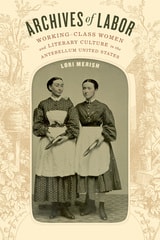
Archives of Labor
Working-Class Women and Literary Culture in the Antebellum United StatesLori Merish
Duke University Press, 2017
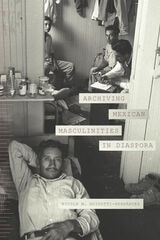
Archiving Mexican Masculinities in Diaspora
Nicole M. Guidotti-Hernández
Duke University Press, 2021

Arctic Politics
Conflict and Cooperation in the Circumpolar NorthOran R. Young
Dartmouth College Press, 1992
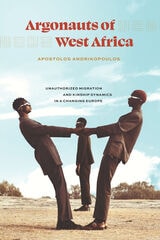
Argonauts of West Africa
Unauthorized Migration and Kinship Dynamics in a Changing EuropeApostolos Andrikopoulos
University of Chicago Press, 2023
In rapidly changing and highly precarious contexts, unauthorized African migrants turn to kinship in search of security, stability, and predictability. Through the exchange of identity documents between “siblings,” assistance in obtaining such documentation through kinship networks, and marriages that provide access to citizenship, new assemblages of kinship are continually made and remade to navigate the shifting demands of European states. These new kinship relations, however, often prove unreliable, taking on new, unexpected dynamics in the face of codependency; they become more difficult to control than those who enter into such relations can imagine. Through unusually close ethnographic work in West African migrant communities in Amsterdam, Apostolos Andrikopoulos reveals the unseen dynamics of kinship through shared papers, the tensions of race and gender that develop in mutually beneficial marriages, and the vast, informal networks of people, information, and documentation on which migrants rely. Throughout Argonauts of West Africa, Andrikopoulos demonstrates how inequality, exclusionary practices, and the changing policies of an often-violent state demand innovative ways of doing kinship to successfully navigate complex migration routes.
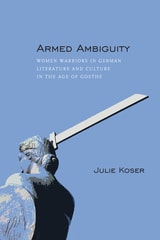
Armed Ambiguity
Women Warriors in German Literature and Culture in the Age of GoetheJulie Koser
Northwestern University Press, 2016
Armed Ambiguity is a fascinating examination of the tropes of the woman warrior constructed by print culture—including press reports, novels, dramatic works, and lyrical texts—during the decades-long conflict in Europe around 1800.
In it, Julie Koser sheds new light on how women’s bodies became a battleground for competing social, cultural, and political agendas in one of the most pivotal periods of modern history. She traces the women warriors in this work as reflections of the social and political climate in German-speaking lands, and she reveals how literary texts and cultural artifacts that highlight women’s armed insurrection perpetuated the false dichotomy of "public" versus "private" spheres along a gendered fault line. Koser illuminates how reactionary visions of "ideal femininity" competed with subversive fantasies of new femininities in the ideological battle being waged over the restructuring of German society.
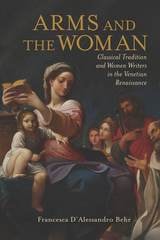
Arms and the Woman
Classical Tradition and Women Writers in the Venetian RenaissanceFrancesca D'Alessandro Behr
The Ohio State University Press, 2018
Arms and the Woman: Classical Tradition and Women Writers in the Venetian Renaissance by Francesca D’Alessandro Behr focuses on the classical reception in the works of female authors active in Venice during the Early Modern Age. Even in this relatively liberal city, women had restricted access to education and were subject to deep-seated cultural prejudices, but those who read and wrote were able, in part, to overcome those limitations.
In this study, Behr explores the work of Moderata Fonte and Lucrezia Marinella and demonstrates how they used knowledge of texts by Virgil, Ovid, and Aristotle to systematically reanalyze the biased patterns apparent both in the romance epic genre and contemporary society. Whereas these classical texts were normally used to bolster the belief in female inferiority and the status quo, Fonte and Marinella used them to envision societies structured according to new, egalitarian ethics. Reflecting on the humanist representation of virtue, Fonte and Marinella insisted on the importance of peace, mercy, and education for women. These authors took up the theme of the equality of genders and participated in the Renaissance querelle des femmes, promoting women’s capabilities and nature.
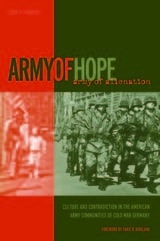
Army of Hope, Army of Alienation
Culture and Contradiction in the American Army Communities of Cold War GermanyJohn P. Hawkins
University of Alabama Press, 2004
Army life has always been known as a life of sacrifice, challenge, and frustration, yet one filled also with deep satisfactions. This is so for the soldiers’ families as much as for the soldiers themselves. Over the years, military and civilian leaders of the US Army have tried to reduce the hardships of military life by creating an array of community services designed to provide social support for soldiers and families and help them live satisfying lives in military communities.
Unfortunately, this effort has not been particularly successful, and frustration, dissatisfaction, and alienation persist among soldiers and family member in the US Army communities in Germany. Discontent continues because the underlying sources of alienation in the Army and among its families are highly complex, poorly understood, and therefore hardly addressed by the Army’s quality-of-life programs that are intended to make soldier and family life more bearable.
In Army of Hope, Army of Alienation: Culture and Contradiction in the American Army Communities of Cold War Germany, the author seeks to penetrate the logic, social structure, and daily practice of life in the American military communities that lay scattered along the frontier between East and West Germany during the final years of the Cold War. In coming to understand the life and thought of these American soldiers and families, ordinary American citizens can learn much about their military forces and about their own society and culture. In addition, a greater understanding about how people work and live around an institution that is at once so important and yet tasked with a mission so different from that of ordinary pursuits can stimulate social scientists and concerned citizens to think differently about culture, society, and behavior in general.
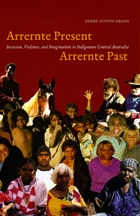
Arrernte Present, Arrernte Past
Invasion, Violence, and Imagination in Indigenous Central AustraliaDiane J. Austin-Broos
University of Chicago Press, 2008
Employing ethnographic and archival research, Diane Austin-Broos traces the history of the Arrernte as they have transitioned from a society of hunter-gatherers to members of the Hermannsburg Mission community to their present, marginalized position in the modern Australian economy. While she concludes that these wrenching structural shifts led to the violence that now marks Arrernte communities, she also brings to light the powerful acts of imagination that have sustained a continuing sense of Arrernte identity.

Artifactual
Forensic and Documentary KnowingElizabeth Anne Davis
Duke University Press, 2023
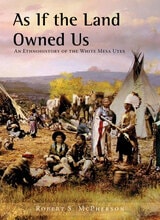
As If the Land Owned Us
An Ethnohistory of the White Mesa UtesRobert S. McPherson
University of Utah Press, 2011
The Ute people of White Mesa have a long, colorful, but neglected history in the Four Corners region. Although they ranged into the Great Basin, Southwest, and parts of the Rocky Mountains as hunters, gatherers, and warriors, southeastern Utah was home. There they adapted culturally and physically to the austere environment while participating in many of the well-known events of their times.
In As If the Land Owned Us, Robert McPherson has gathered the wisdom of White Mesa elders as they imparted knowledge about their land—place names, uses, teachings, and historic events tied to specific sites—providing a fresh insight into the lives of these little-known people. While there have been few published studies about the Southern Utes, this ethnohistory is the first to mix cultural and historic events. The book illustrates the life and times of the White Mesa Utes as they faced multiple changes to their lifeways. It is time for their history to be told in their terms.
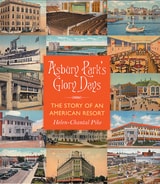
Asbury Park's Glory Days
The Story of an American ResortPike, Helen-Chantal
Rutgers University Press, 2007
In Asbury Park's Glory Days, award-winning author Helen-Chantal Pike chronicles the city's heyday-the ninety-year period between 1890 and 1980. Pike illuminates the historical conditions contributing to the town's cycle of booms and recessions. She investigates the factors that influenced these peaks, such as location, lodging, dining, nightlife, merchandising, and immigration, and how and why millions of people spent their leisure time within this one-square-mile boundary on the northern coast of the state. Pike also includes an epilogue describing recent attempts to resurrect this once-vibrant city.

Asegi Stories
Cherokee Queer and Two-Spirit MemoryQwo-Li Driskill
University of Arizona Press, 2016
As the first full-length work of scholarship to develop a tribally specific Indigenous Queer or Two-Spirit critique, Asegi Stories examines gender and sexuality in Cherokee cultural memory, how they shape the present, and how they can influence the future.
The theoretical and methodological underpinnings of Asegi Stories derive from activist, artistic, and intellectual genealogies, referred to as “dissent lines” by Maori scholar Linda Tuhiwai Smith. Driskill intertwines Cherokee and other Indigenous traditions, women of color feminisms, grassroots activisms, queer and Trans studies and politics, rhetoric, Native studies, and decolonial politics. Drawing from oral histories and archival documents in order to articulate Cherokee-centered Two-Spirit critiques, Driskill contributes to the larger intertribal movements for social justice.
Asian America
Forming New Communities, Expanding BoundariesLing, Huping
Rutgers University Press, 2009
Asian America is the first comprehensive look at post-1960s Asian American communities in the United States and Canada. From Chinese Americans in Chicagoland to Vietnamese Americans in Orange County, this multi-disciplinary collection spans a wide comparative and panoramic scope. Contributors from an array of academic fields focus on global views of Asian American communities as well as on territorial and cultural boundaries.
Presenting groundbreaking perspectives, Asian America revises worn assumptions and examines current challenges Asian American communities face in the twenty-first century.
Asian American Studies Now
A Critical ReaderWu, Jean Yu-Wen Shen
Rutgers University Press, 2010
Jean Yu-wen Shen Wu and Thomas C. Chen have selected essays for the significance of their contribution to the field and their clarity, brevity, and accessibility to readers with little to no prior knowledge of Asian American studies. Featuring both reprints of seminal articles and groundbreaking texts, as well as bold new scholarship, Asian American Studies Now addresses the new circumstances, new communities, and new concerns that are reconstituting Asian America.

Asian American Studies
A ReaderEdited by Jean Yu-Wen Shen Wu and Min Song
Rutgers University Press, 2000
The reader is organized into two parts: "The Documented Past" and "Social Issues and Literature." Within these broad divisions, the subjects covered include Chinatown stories, nativist reactions, exclusionism, citizenship, immigration, community growth, Asia American ethnicities, racial discourse and the Civil Rights movement, transnationalism, gender, refugees, anti-Asian American violence, legal battles, class polarization, and many more.
Among the contributors are such noted scholars as Gary Okihiro, Michael Omi, Yen Le Espiritu, Lisa Lowe, and Ronald Takaki; writers such as Sui Sin Far, Bienvenido Santos, Sigrid Nunez, and R. Zamora Linmark, as well as younger, emerging scholars in the field.

Asian American X
An Intersection of Twenty-First Century Asian American VoicesArar Han and John Y. Hsu, Editors
University of Michigan Press, 2004
-Eric Liu, author of The Accidental Asian
"There's fury, dignity, and self-awareness in these essays. I found the voices to be energetic and the ideas exciting."
-Diana Son, playwright (Stop Kiss) and co-producer (Law & Order: Criminal Intent)
This refreshing and timely collection of coming-of-age essays, edited and written by young Asian Americans, powerfully captures the joys and struggles of their evolving identities as one of the fastest-growing groups in the nation and poignantly depicts the many oft-conflicting ties they feel to both American and Asian cultures. The essays also highlight the vast cultural diversity within the category of Asian American, yet ultimately reveal how these young people are truly American in their ideals and dreams.
Asian American X is more than a book on identity; it is required reading both for young Asian Americans who seek to understand themselves and their social group, and for all who are interested in keeping abreast of the changing American social terrain.
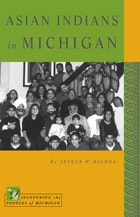
Asian Indians in Michigan
Arthur W. Helweg
Michigan State University Press, 2002
Since 1970, a growing number of Asian Indians have called Michigan home. Representative of the “new immigration,” Asian Indians come from a democratic country, are well-educated, and come from middle- and upper-class families. Unlike older immigrant groups, Asian Indians do not form urban ethnic enclaves or found their own communities to meet the challenges of living in a new society. As Arthur W. Helweg shows, Asian Indians contribute to the richness and diversity of Michigan’s culture through active participation in local institutions, while maintaining a strong ethnic identity rooted in India.
Aspiring Adults Adrift
Tentative Transitions of College GraduatesRichard Arum and Josipa Roksa
University of Chicago Press, 2014
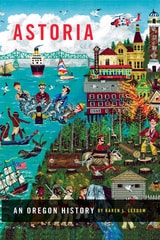
Astoria
An Oregon HistoryKaren L. Leedom
Oregon State University Press, 2021
Before Seattle, before Portland, there was Astoria.
The rest of the country is just beginning to discover Astoria, Oregon, that historic gem of a town at the mouth of the Columbia River west of Portland, and the oldest European-American settlement west of the Rockies.
The author provides a chronological look dating back to the 1500s, including European exploration, Native American life, logging, fishing, Chinese laborers in the salmon industry, a giant cheese in the Civil War, Oregon’s first female surgeon, Victorian architecture, and valiant Coast Guard rescues.
Published by Rivertide Publishing and distributed by Oregon State University Press

Asylum, Prison, and Poorhouse
The Writings and Reform Work of Dorothea Dix in IllinoisDavid L. Lightner
Southern Illinois University Press, 1999
This illustrated collection of annotated newspaper articles and memorials by Dorothea Dix provides a forum for the great mid-nineteenth-century humanitarian and reformer to speak for herself.
Dorothea Lynde Dix (1802–87) was perhaps the most famous and admired woman in America for much of the nineteenth century. Beginning in the early 1840s, she launched a personal crusade to persuade the various states to provide humane care and effective treatment for the mentally ill by funding specialized hospitals for that purpose. The appalling conditions endured by most mentally ill inmates in prisons, jails, and poorhouses led her to take an active interest also in prison reform and in efforts to ameliorate poverty.
In 1846–47 Dix brought her crusade to Illinois. She presented two lengthy memorials to the legislature, the first describing conditions at the state penitentiary at Alton and the second discussing the sufferings of the insane and urging the establishment of a state hospital for their care. She also wrote a series of newspaper articles detailing conditions in the jails and poorhouses of many Illinois communities.
These long-forgotten documents, which appear in unabridged form in this book, contain a wealth of information on the living conditions of some of the most unfortunate inhabitants of Illinois. In his preface, David L. Lightner describes some of the vivid images that emerge from Dorothea Dix's descriptions of social conditions in Illinois a century and a half ago: "A helpless maniac confined throughout the bitter cold of winter to a dark and filthy pit. Prison inmates chained in hallways and cellars because no more men can be squeezed into the dank and airless cells. Aged paupers auctioned off by county officers to whoever will maintain them at the lowest cost."
Lightner provides an introduction to every document, placing each memorial and newspaper article in its proper social and historical context. He also furnishes detailed notes, making these documents readily accessible to readers a century and a half later. In his final chapter, Lightner assesses both the immediate and the continuing impact of Dix's work.
At Home Among Strangers
Exploring the Deaf Community in the United StatesJerome D. Schein
Gallaudet University Press, 1989
At Home Among Strangers presents an engrossing portrait of the Deaf community as a complex, nationwide social network that offers unique kinship to deaf people across the country. Schein depicts in striking detail the history and culture of the Deaf community, its structural underpinnings, the intricacies of family life, issues of education and rehabilitation, economic factors, and interaction with the medical and legal professions. This book is a fascinating, provocative exploration of the Deaf community in the United States for scholars and lay people alike.

At Home in the World
Michael Jackson
Duke University Press, 1995
Something of a nomad himself, having lived in New Zealand, Sierra Leone, England, France, Australia, and the United States, Jackson is deft at capturing the ambiguities of home as a lived experience among the Warlpiri. Blending narrative ethnography, empirical research, philosophy, and poetry, he focuses on the existential meaning of being at home in the world. Here home becomes a metaphor for the intimate relationship between the part of the world a person calls "self" and the part of the world called "other." To speak of "at-homeness," Jackson suggests, implies that people everywhere try to strike a balance between closure and openness, between acting and being acted upon, between acquiescing in the given and choosing their own fate. His book is an exhilarating journey into this existential struggle, responsive at every turn to the political questions of equity and justice that such a struggle entails.
A moving depiction of an aboriginal culture at once at home and in exile, and a personal meditation on the practice of ethnography and the meaning of home in our increasingly rootless age, At Home in the World is a timely reflection on how, in defining home, we continue to define ourselves.
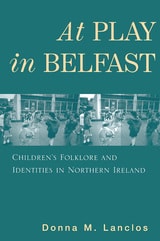
At Play in Belfast
Children's Folklore and Identities in Northern IrelandLanclos, Donna M
Rutgers University Press, 2003
For Lanclos, children's experiences stimulate discussions about culture and society. In her words, "Children's everyday lives are more than just preparation for their futures, but are life itself."
At Play in Belfast is a volume in the Rutgers Series in Childhood Studies, edited by Myra Bluebond-Langner.
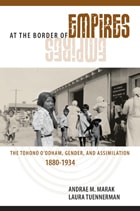
At the Border of Empires
The Tohono O'odham, Gender, and Assimilation, 1880-1934Andrae M. Marak and Laura Tuennerman
University of Arizona Press, 2013
Beginning in the 1880s, the US government implemented programs to eliminate “vice” among the Tohono O’odham and to encourage the morals of the majority culture as the basis of a process of “Americanization.” During the next fifty years, tribal norms interacted with—sometimes conflicting with and sometimes reinforcing—those of the larger society in ways that significantly shaped both government policy and tribal experience. This book examines the mediation between cultures, the officials who sometimes developed policies based on personal beliefs and gender biases, and the native people whose lives were impacted as a result. These issues are brought into useful relief by comparing the experiences of the Tohono O’odham on two sides of a border that was, from a native perspective, totally arbitrary.
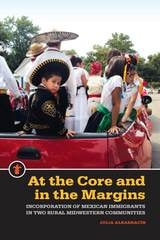
At the Core and in the Margins
Incorporation of Mexican Immigrants in Two Rural Midwestern CommunitiesJulia Albarracín
Michigan State University Press, 2016
Based on 260 surveys and 47 in-depth interviews, this study combines quantitative and qualitative research to explore the level and characteristics of immigrant incorporation in Beardstown and Monmouth. It assesses the advancement of immigrants in the immigration/ residency/citizenship process, the immigrants’ level of cultural integration (via language, their connectedness with other members of society, and their relationships with neighbors), the degree and characteristics of discrimination against immigrants in these two towns, and the extent to which immigrants participate in different social and political activities and trust government institutions.
Immigrants in new destinations are likely to be poorer, to be less educated, and to have weaker English-language skills than immigrants in traditional destinations. Studying how this population negotiates the obstacles to and opportunities for incorporation is crucial.
At the Margins
Minority Groups in Premodern ItalyStephen J. Milner
University of Minnesota Press, 2005
Atlanta Paradox
David L. Sjoquist
Russell Sage Foundation, 2000
Atrocities of the Mind
Essays on Violence and Politics in the American CenturyDwight Macdonald
University of Chicago Press, 2026
An essential collection of Dwight Macdonald’s prophetic essays on politics, art, and violence in twentieth-century America.
What does extreme violence do to human values? Does the concept of collective guilt make sense in assessing responsibility for genocide? Has modern mechanized society forever destroyed the possibility of peaceful resistance through art and civil disobedience? Atrocities of the Mind presents anew Dwight Macdonald, one of America’s foremost literary journalists and political activists, grappling with the hard questions of his time—and ours.
In this collection, Macdonald writes about major events—the Holocaust, the atomic bombing of Hiroshima, Gandhi’s assassination, the Vietnam War, and social phenomena such as mass shootings, campus protests, and police brutality—with clear-sighted and buoyant prose. He writes incisively about the cinema of Alfred Hitchcock and Roman Polanski, praises Dorothy Day’s pacifism, and reports circulating an antiwar petition in the White House Rose Garden. And not without effect: his essay “Our Invisible Poor” is said to have spurred the Johnson administration’s War on Poverty.
Norman Mailer memorably called Macdonald “a man with whom one might seldom agree but could never disrespect because he always told the truth as he saw the truth—a man therefore of the most incorruptible integrity.” In our America, reeling from political violence, Macdonald’s truth-telling reminds us how we got here and who we might still become.
Authentically Jewish
Identity, Culture, and the Struggle for RecognitionStuart Z. Charmé
Rutgers University Press, 2022
Author Stuart Z. Charmé explores how debates over authenticity and struggles for recognition are a key to understanding a wide range of controversies between Orthodox and liberal Jews, Zionist and diaspora Jews, white Jews and Jews of color, as well as the status of intermarried and messianic Jews, and the impact of Jewish genetics. In addition, it discusses how and when various cultural practices and traditions such as klezmer music, Israeli folk dance, Jewish yoga and meditation, and others are recognized as authentically Jewish, or not.

Authorized Heritage
Place, Memory, and Historic Sites in Prairie CanadaRobert Coutts
University of Manitoba Press, 2021
Averting the Apocalypse
Social Movements in India TodayArthur Bonner
Duke University Press, 1990
Bonner finds that India’s inability or refusal to address its debilitating social structure may be the precursor to an apocalyptic social upheaval unless heed is paid to the social movements that his first-hand investigation reveals.
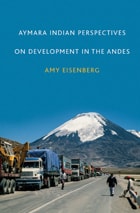
Aymara Indian Perspectives on Development in the Andes
Amy Eisenberg
University of Alabama Press, 2013
Aymara Indians are a geographically isolated, indigenous people living in the Andes Mountains near Chile’s Atacama Desert, one of the most arid regions of the world. As rapid economic growth in the area has begun to divert scarce water to hydroelectric and agricultural projects, the Aymara struggle to maintain their sustainable and traditional systems of water use, agriculture, and pastoralism.
In Aymara Indian Perspectives on Development in the Andes, Amy Eisenberg provides a detailed exploration of the ethnoecological dimensions of the tension between the Aymara, whose economic, spiritual, and social life are inextricably tied to land and water, and three major challenges: the paving of Chile Highway 11, the diversion of the Altiplano waters of the Río Lauca for irrigation and power-generation, and Chilean national park policies regarding Aymara communities, their natural resources, and cultural properties within Parque Nacional Lauca, the International Biosphere Reserve.
Pursuing collaborative research, Eisenberg performed ethnographic interviews with Aymara people in more than sixteen Andean villages, some at altitudes of 4,600 meters. Drawing upon botany, agriculture, natural history, physical and cultural geography, history, archaeology, and social and environmental impact assessment, she presents deep, multifaceted insights from the Aymara’s point of view.
Illustrated with maps and dramatic photographs by John Amato, Aymara Indian Perspectives on Development in the Andes provides an account of indigenous perspectives and concerns related to economic development that will be invaluable to scholars and policy-makers in the fields of natural and cultural resource preservation in and beyond Chile.
addicted.pregnant.poor
Kelly Ray Knight
Duke University Press, 2015