Results by title
5159 books match the query 'Biography' and 527 start with a
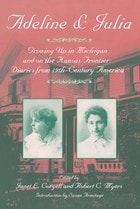
Adeline & Julia
Growing Up in Michigan and on the Kansas Frontier: Diaries from 19th-Century AmericaJanet C. Coryell
Michigan State University Press, 2000
The keeping of journals and diaries became an almost everyday pastime for many Americans in the nineteenth century. Adeline and Julia Graham, two young women from Berrien Springs, Michigan, were both drawn to this activity, writing about the daily events in their lives, as well as their 'grand adventures.' These are fascinating, deeply personal accounts that provide an insight into the thoughts and motivation of two sisters who lived more than a century ago. Adeline began keeping a diary when she was sixteen, from mid-1880 through mid-1884; through it we see a young woman coming of age in this small community in western Michigan. Paired with Adeline's account is her sister Julia's diary, which begins in 1885 when she sets out with three other young women to homestead in Greeley County, Kansas, just east of the Colorado border. It is a vivid and colorful narrative of a young woman's journey into America's western landscape.

Adolphe Gouhenant
French Revolutionary, Utopian Leader, and Texas Frontier PhotographerPaula Selzer
University of North Texas Press, 2019
Adoption Memoirs
Inside StoriesMarianne Novy
Temple University Press, 2024
Novy considers 45 memoirs, mostly from the twenty-first century, by birthmothers, adoptees, and adoptive parents, about same-race and transracial adoption. These adoptees, she recounts, wanted to learn about their ancestry and appreciated adoptive parents who helped. Birthmother Amy Seek shows why open adoption is not simple, and many other memoirs tell stories that continue past reunion.
Adoption Memoirs will enlighten readers who lack experience with adoption and help those looking for a shared experience to also understand adoption from a different standpoint.
Advances in Teaching Sign Language Interpreters
Cynthia B. Roy
Gallaudet University Press, 2005
Picking up where Innovative Practices in Teaching Sign Language Interpreters left off, this new collection presents the best new interpreter teaching techniques proven in action by the eminent contributors assembled here. In the first chapter, Dennis Cokely discusses revising curricula in the new century based upon experiences at Northeastern University. Jeffrey E. Davis delineates how to teach observation techniques to interpreters, while Elizabeth Winston and Christine Monikowski suggest how discourse mapping can be considered the Global Positioning System of translation.
In other chapters, Laurie Swabey proposes ways to handle the challenge of referring expressions for interpreting students, and Melanie Metzger describes how to learn and recognize what interpreters do in interaction. Jemina Napier contributes information on training interpreting students to identify omission potential. Robert G. Lee explains how to make the interpreting process come alive in the classroom. Mieke Van Herreweghe discusses turn-taking and turn-yielding in meetings with Deaf and hearing participants in her contribution. Anna-Lena Nilsson defines “false friends,” or how contextually incorrect use of facial expressions with certain signs in Swedish Sign Language can be detrimental influences on interpreters. The final chapter by Kyra Pollitt and Claire Haddon recommends retraining interpreters in the art of telephone interpreting, completing Advances in Teaching Sign Language Interpreters as the new authoritative volume in this vital communication profession.
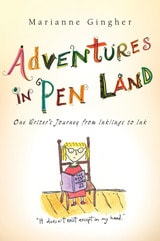
Adventures in Pen Land
One Writer's Journey from Inklings to InkMarianne Gingher
University of Missouri Press, 2008
Featuring guest appearances by other writers such as Fred Chappell, Max Steele, and Annie Dillard plus cameos by the likes of Patty Hearst, Richard Nixon, and Bon Jovi, Adventures in Pen Land celebrates writing as a form of play that Gingher has never outgrown. The lighthearted illustrations by novelist Daniel Wallace (author of Big Fish) serve to reinforce this refreshing message as they depict one writer and her imagination growing up together.
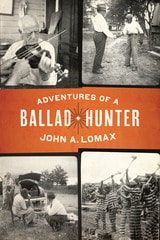
Adventures of a Ballad Hunter
By John A. Lomax, foreword by John Lomax III, John Nova Lomax, and Anna Lomax Wood
University of Texas Press, 2017
Growing up beside the Chisholm Trail, captivated by the songs of passing cowboys and his bosom friend, an African American farmhand, John A. Lomax developed a passion for American folk songs that ultimately made him one of the foremost authorities on this fundamental aspect of Americana. Across many decades and throughout the country, Lomax and his informants created over five thousand recordings of America’s musical heritage, including ballads, blues, children’s songs, fiddle tunes, field hollers, lullabies, play-party songs, religious dramas, spirituals, and work songs. He acted as honorary curator of the Archive of American Folk Song at the Library of Congress, directed the Slave Narrative Project of the WPA, and cofounded the Texas Folklore Society. Lomax’s books include Cowboy Songs and Other Frontier Ballads, American Ballads and Folk Songs, Negro Folk Songs as Sung by Leadbelly, and Our Singing Country, the last three coauthored with his son Alan Lomax.
Adventures of a Ballad Hunter is a memoir of Lomax’s eventful life. It recalls his early years and the fruitful decades he spent on the road collecting folk songs, on his own and later with son Alan and second wife Ruby Terrill Lomax. Vibrant, amusing, often haunting stories of the people he met and recorded are the gems of this book, which also gives lyrics for dozens of songs. Adventures of a Ballad Hunter illuminates vital traditions in American popular culture and the labor that has gone into their preservation.
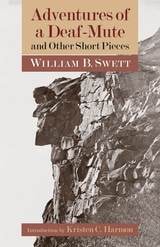
Adventures of a Deaf-Mute and Other Short Pieces
William B. Swett
Gallaudet University Press, 2017
Confident in his identity as a Deaf “mute,” he notes with wry humor the varied perceptions of deafness that he encounters. As a signing Deaf person from a prominent multigenerational Deaf family, he counters negative stereotypes with generosity and a smart wit. He takes pride in his physical abilities, which he showcases through various stunts and arduous treks in the wilderness. However, Swett’s writing also reveals a deep awareness of the fragility and precariousness of life. This is a portrait of a man testing his physical and emotional limits, written from the vantage point of someone who is no longer a young man but is still very much in the prime of his life.
This collection also includes “Mr. Swett and His Diorama,” an article from 1859 in which Swett describes his miniature recreation of the Battle of Lexington, as well as Manual Alphabets, a pamphlet published in 1875 on the history of manual alphabets that includes short biographies of Thomas Hopkins Gallaudet and Laurent Clerc, two pioneers of Deaf education in the United States. The work is accompanied by a new introduction that offers a reflection on Swett’s life and the time in which he lived.
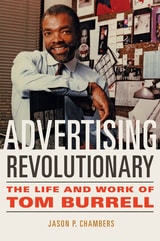
Advertising Revolutionary
The Life and Work of Tom BurrellJason P. Chambers
University of Illinois Press, 2024
Over a forty-year career, Chicagoan Tom Burrell changed the face of advertising and revolutionized the industry’s approach to African Americans as human beings and consumers. Jason P. Chambers offers a biography of the groundbreaking creator and entrepreneur that explores Burrell’s role in building brands like McDonald’s and Coca-Cola within a deeply felt vision of folding positive images of Black people into mainstream American life. While detailing Burrell’s successes, Chambers tells a parallel story of what Burrell tried to do that sheds light on the motivations of advertising creators who viewed their work as being about more than just selling. Chambers also highlights how Burrell used his entrepreneurial gifts to build an agency that opened the door for Black artists, copywriters, directors, and other professionals to earn livings, build careers, and become leaders within the industry.
Compelling and multidimensional, Advertising Revolutionary combines archival research and interviews with Burrell and his colleagues to provide a long overdue portrait of an advertising industry legend and his times.
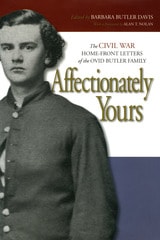
Affectionately Yours
The Civil War Home-Front Letters of the Ovid Butler FamilyBarbara Butler Davis
Indiana Historical Society Press, 2004
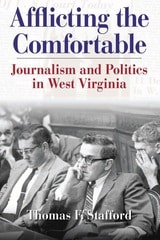
Afflicting the Comfortable
Journalism and Politics in West VirginiaThomas F. Stafford
West Virginia University Press, 2011
"Government corruption was not invented in West Virginia. But there are people who contend that West Virginia officials have done more than their share over the years to develop state-of-the-art techniques in vote theft, contract kickbacks, influence peddling and good old-fashioned bribery, extortion, fraud, tax evasion and outright stealing." New York Times
While investigating the Invest Right scandal, Thomas Stafford, a former journalist for the Charleston Gazette, found himself in a very precarious position. As a reporter he felt obligated to tell the whole truth, and he believed in the need to serve the public and those West Virginians who were being abused by a political machine. In Afflicting the Comfortable, Stafford relates such tales of the responsibility of journalism and politics in coordination with scandals that have unsettled the Mountain State over the past few decades. His probing would take him from the halls of Charleston to the center of our nation's ruling elite. Guided by his senses of duty, right, and fairness, he plunged head first into the misdeeds of West Virginia's politicians. His investigations would preface the downfall of a governor and an adminstration that robbed the state and the citizens of West Virginia for many years.
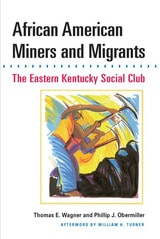
African American Miners and Migrants
THE EASTERN KENTUCKY SOCIAL CLUBThomas E. Wagner and Phillip J. Obermiller; Afterword by William H. Turner
University of Illinois Press, 2004
Bound together by segregation, the inherent dangers of mining, and coal company paternalism, it might seem that black miners and mountaineers would be eager to forget their past. Instead, members of the EKSC have chosen to celebrate their Harlan County roots. African American Miners and Migrants uses historical and archival research and extensive personal interviews to explore their reasons and the ties that still bind them to eastern Kentucky. The book also examines life in the model coal towns of Benham and Lynch in the context of Progressive Era policies, the practice of welfare capitalism, and the contemporary national trend of building corporate towns and planned communities.
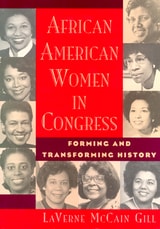
African American Women in Congress
Gill, LaVerne McCain
Rutgers University Press, 1997
African American Women in Congress details the life and career histories of Shirley Chisholm, Barbara Jordan, Yvonne Burke, Cardiss Collins, Katie Hall, Eleanor Holmes Norton, Maxine Waters, Barbara-Rose Collins, Carol Moseley-Braun, Corinne Brown, Carrie Meek, Cynthia McKinney, Eva Clayton, Eddie Bernice Johnson, and Sheila Jackson-Lee. Each profile contains a picture of its subject, interview material, and resumés. Arranged chronologically, the book introduces the reader to issues of vital importance to the Black community—Reconstruction, enfranchisement, lynchings and harassment, civil rights struggles, the founding of advocacy groups, the power of the Congressional Black Caucus, the creation of majority minority districts that allowed greater representation in Congress, the struggle of largely Black Washington, D.C., for representation, and the recent dismantling of past gains by a Republican majority. Gill also describes the uphill battles for social justice and the rights of women that the fifteen women had to wage even within their own political parties, political organizations, and districts.
For general readers, high school and college students, and anyone interested in the political process, this book is illuminating and inspiring reading.
African Meditations
Felwine Sarr
University of Minnesota Press, 2022
An influential thinker’s fascinating reflections and meditations on reacclimating to his native Senegal as a young academic after years of study abroad
The call to morning prayer. A group run at daybreak along the Corniche in Dakar. A young woman shedding tears on a beach as her friends take a boat to Europe. In African Meditations, paths to enlightenment collide with tales of loss and ruminations, musical gatherings, and the everyday sights and sounds of life in West Africa as a young philosopher and creative writer seeks to establish himself as a teacher upon his return to Senegal, his homeland, after years of study abroad.
A unique contemporary portrait of an influential, multicultural thinker on a spiritual quest across continents—reflecting on his multiple literary influences along with French, African Francophone, and Senegalese tribal cultural roots in a homeland with a predominantly Muslim culture—African Meditations is a seamless blend of autobiography, journal entries, and fiction; aphorisms and brief narrative sketches; humor and Zen reflections.
Taking us from Saint-Louis to Dakar, Felwine Sarr encounters the rhythms of everyday life as well as its disruptions such as teachers’ strikes and power outages while traversing a semi-surrealistic landscape. As he reacclimates to his native country after a life in France, we get candid glimpses, both vibrant and hopeful, sublime and mundane, into his Zen journey to resecure a foothold in his roots and to navigate academia, even while gleaning something of the good life, of joy, amid the struggles of life in Senegal.
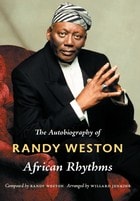
African Rhythms
The Autobiography of Randy WestonRandy Weston
Duke University Press, 2010
Africa is at the core of Weston’s music and spirituality. He has traversed the continent on a continuous quest to learn about its musical traditions, produced its first major jazz festival, and lived for years in Morocco, where he opened a popular jazz club, the African Rhythms Club, in Tangier. Weston’s narrative is replete with tales of the people he has met and befriended, and with whom he has worked. He describes his unique partnerships with Langston Hughes, the musician and arranger Melba Liston, and the jazz scholar Marshall Stearns, as well as his friendships and collaborations with Duke Ellington, Dizzy Gillespie, Coleman Hawkins, Thelonious Monk, Billy Strayhorn, Max Roach, Charlie Parker, Miles Davis, the novelist Paul Bowles, the Cuban percussionist Candido Camero, the Ghanaian jazz artist Kofi Ghanaba, the Gnawa musicians of Morocco, and many others. With African Rhythms, an international jazz virtuoso continues to create cultural history.
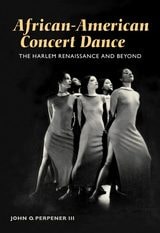
African-American Concert Dance
THE HARLEM RENAISSANCE AND BEYONDJohn O. Perpener III
University of Illinois Press, 2001
Perpener begins with Hemsley Winfield, a versatile performer and director whose company, the New Negro Art Theatre, launched the careers of Edna Guy, Randolph Sawyer, and Ollie Burgoyne, among many others. Also profiled are Charles Williams, who directed the Hampton Creative Dance Group at the Hampton Institute in Virginia, and Asadata Dafora Horton, a native African who established himself as the preeminent purveyor of African dance and culture in America during the 1930s. Dafora's African Dance Troupe, which at one point came under the umbrella of the WPA Federal Theatre Project, was a focal point of the famous "voodoo" Macbeth, an all-black production set in Haiti and directed by the young Orson Welles.
Stepping onto the path cleared by these early innovators, two important artists combined dance with anthropology to expand the reach and scope of African-American dance. Katherine Dunham and Pearl Primus both studied anthropology and engaged in extensive fieldwork that infused their dances with Caribbean and African influences. Dunham founded two ambitious training schools, one in New York and one in East St. Louis, while Primus's projects included an African Arts Center in Monrovia, Liberia, dedicated to collecting dance material, teaching, and organizing professional performances.
Perpener examines the politics of racial and cultural difference and their impact on these early African-American dance leaders. In particular he documents the critical reception of their work, detailing the rigid preconceptions of African-American dance that white critics imposed on black artists. He also surveys important black dancers and choreographers since 1950, including Talley Beatty, Donald McKayle, Alvin Ailey, Eleo Pomare, Rod Rodgers, and Dianne McIntyre, and discusses how they have extended and diverged from traditions established by their predecessors.
After Effects
A Memoir of Complicated GriefAndrea Gilats
University of Minnesota Press, 2021
An intensely moving and revelatory memoir of enduring and emerging from exceptional grief
To grieve after a profound loss is perfectly natural and healthy. To be debilitated by grief for more than a decade, as Andrea Gilats was, is something else. In her candid, deeply moving, and ultimately helpful memoir of breaking free of death’s relentless grip on her life, Gilats tells her story of living with prolonged, or “complicated,” grief and offers insight, hope, and guidance to others who suffer as she did.
Thomas Dayton, Andrea Gilats’s husband of twenty years, died at 52 after a five-month battle with cancer. In After Effects Gilats describes the desolation that followed and the slow and torturous twenty-year journey that brought her back to life. In the two years immediately following his death, Gilats wrote Tom daily letters, desperately trying to maintain the twenty-year conversation of their marriage. Excerpts from these letters reveal the depth of her despair but also the glimmer of an awakening as they also trace a different, more typical course of the grief experienced by one of Gilats's colleagues, also widowed. Gilats’s struggle to rescue herself takes her through the temptation of suicide, the threat of deadly illness, the overwhelming challenges of work, and the rigor of learning and eventually teaching yoga, to a moment of reckoning and, finally, reconciliation to a life without her beloved partner. Her story is informed by the lessons she learned about complicated grief as a disorder that, while intensely personal, can be defined, grappled with, and overcome.
Though complicated grief affects as many as one in seven of those stricken by the loss of a close loved one, it is little known outside professional circles. After Effects points toward a path of recuperation and provides solace along the way—a service and a comfort that is all the more timely and necessary in our pandemic-ravaged world of loss and isolation.

After The Fire
A Writer Finds His PlacePaul Zimmer
University of Minnesota Press, 2002
Looking back at a lifetime of rich experience from Wisconsin’s driftless hills
We all dream of finding the place we can be most ourselves, the landscape that seems to have been crafted just for us. The poet Paul Zimmer has found his: a farm in the driftless hills of southwestern Wisconsin, a region of rolling land and crooked rivers, "driftless" because here the great glaciers of the Patrician ice sheet split widely, leaving behind a heart-shaped area untouched by crushing ice. After the Fire is the story of Zimmer’s journey from his boyhood in the factory town of Canton, Ohio, and his days as a soldier during atomic tests in the Nevada desert, to his many years in the book business as a writer and publisher, and the rural tranquillity of his present life.
Zimmer juxtaposes timeless rustic subjects (tending the land, country people and their ways, the ever-changing beauty of his natural surroundings) with flashbacks to key moments: his first and only boxing match, hearing Count Basie play and discovering his lifelong love of jazz, his return to the France of his ancestors, his painful departure from the publishing world after forty years. These stories are full of humor and pathos, keen insights and poignant meditations, but the real center of the book is the abiding beauty of the driftless hills, the silence and peace that is the source of and reward for Zimmer’s hard-won wisdom. Above all, it is a meditation on the ways that nature provides deep meaning and solace, and a consideration of the importance of finding the right place.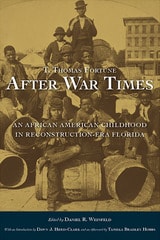
After War Times
An African American Childhood in Reconstruction-Era FloridaT. Thomas Fortune
University of Alabama Press, 2014
A firsthand account of African American childhood, freedom, and resilience in Reconstruction-era Florida.
T. Thomas Fortune was a leading African American publisher, editor, and journalist of the late nineteenth and early twentieth centuries, who was born a slave in antebellum Florida, lived through emancipation, and rose to become a literary lion of his generation. In T. Thomas Fortune's “After War Times,” Daniel R. Weinfeld brings together a series of twenty-three autobiographical articles Fortune wrote about his formative childhood during Reconstruction and subsequent move to Washington, DC.
By 1890, Fortune had founded a predecessor organization to the National Association for the Advancement of Colored People, known as the National Afro-American League, but his voice found its most powerful expression and influence in poetry, prose, and journalism. It was as a journalist that Fortune stirred national controversy by issuing a passionate appeal to African American southerners: “I propose to start a crusade,” he proclaimed in June 1900, “to have the negroes of the South leave that section and to come north or go elsewhere. It is useless to remain in the South and cry Peace! Peace! When there is no peace.” The movement he helped propel became known as “the Great Migration.”
By focusing on Thomas’s ruminations about his disillusion with post–Civil War Florida, Weinfeld highlights the sources of Fortune’s deep disenchantment with the South, which intensified when the Reconstruction order gave way to Jim Crow–era racial discrimination and violence. Decades after he left the South, Fortune’s vivid memories of incidents and personalities in his past informed his political opinions and writings. Scholars and readers interested in Southern history in the aftermath of the Civil War, especially the experiences of African Americans, will find much of interest in this vital collection of primary writings.
Afterimage
Film, Trauma And The HolocaustJoshua Hirsch
Temple University Press, 2003
Joshua Hirsch explores the changes in documentary brought about by cinema verite, culminating in Shoah. He then turns to teh appearance of a fictional posttraumatic cinema, tracing its development through the vivid flashbacks in Resnais' Hiroshima, mon amour to the portrayal of pain and memory in Pawnbroker. He excavates a posttraumatic autobiography in three early films by the Hungarian Istvan Szabo. Finally, Hirsch examines the effects of postmodernism on posttraumatic cinema, looking at Schindler's List and a work about a different form of historical trauma, History and Memory, a videotape dealing with the internment of Japanese Americans during the Second World War.
Sweeping in its scope, Afterimage presents a new way of thinking about film and history, trauma and its representation.

Afterwords
Letters on the Death of Virginia WoolfOldfield, Sybil
Rutgers University Press, 2005
On 28 March, 1941, at the height of Hitler's victories during the Second World War, Virginia Woolf filled her pockets with stones and drowned herself in the River Ouse near her home in Sussex. At the time of her death some voices in the press attacked her for showing cowardice in the face of the enemy and for setting a bad example to the general population. Woolf's suicide has been the subject of controversy for the media, for literary scholars, and for her biographers ever since.
Just when it may seem that nothing else could be said about Virginia Woolf and the ambiguous details of her suicide, Afterwords provides an entirely fresh perspective. It makes available to a wide readership for the first time letters sent to Leonard Woolf and Vanessa Bell (Virginia Woolf's sister) in the aftermath of the event. This unique volume brings together over two hundred letters from T. S. Eliot, H. G. Wells, May Sarton, Vita Sackville-West, Edith Sitwell, E. M. Forster, Radclyffe Hall, and many others, including political figures and religious leaders. In addition, informative annotations reveal the identities of many unexpected condolence-letter writers from among the general public.
In her introduction, editor Sybil Oldfield confronts the contemporary controversy over Woolf's suicide note, arguing that no one who knew Woolf or her work believed that she had deserted Britain. The ensuing collection of letters supports Oldfield's assertion. In elegant prose that rises to the stature of the occasion, these writers share remembrances of Virginia Woolf in life, comment on the quality of her work and her antifascist values, and reveal previously unknown facets of her capacity for friendship.
A richly deserved tribute to the life of an extraordinary woman as well as a testimony to the human capacity for sympathy, Afterwords is essential reading for anyone interested in the life, death, and enduring impact of Virginia Woolf.
Against the Grain
Colonel Henry M. Lazelle and the U.S. ArmyJames Carson
University of North Texas Press, 2015
Agatha Tiegel Hanson
Our Places in the SunKathy Jankowski
Gallaudet University Press, 2023
Throughout her life, Agatha Tiegel Hanson worked to advance the rights of Deaf people and women, and she was a passionate advocate of sign language rights. Her contributions include creative written works as well as influential treatises. She served in leadership positions at several Deaf organizations and, along with her husband, noted Deaf architect Olof Hanson, she played a vital role in the Deaf cultural life of the time. In Agatha Tiegel Hanson: Our Places in the Sun, author Kathy Jankowski presents a portrait of this trailblazer, and celebrates her impact on the Deaf community and beyond. This biography will be of interest to those already familiar with Tiegel Hanson’s legacy as well as to readers who are discovering her extraordinary life for the first time.
Agent of Change
Adela Sloss-Vento, Mexican American Civil Rights Activist and Texas FeministBy Cynthia E. Orozco
University of Texas Press, 2020
Liz Carpenter Award for Research in the History of Women, Texas State Historical Association
The essayist Adela Sloss-Vento (1901–1998) was a powerhouse of activism in South Texas’s Lower Rio Grande Valley throughout the Mexican American civil rights movement beginning in 1920 and the subsequent Chicano movement of the 1960s and 1970s. At last presenting the full story of Sloss-Vento’s achievements, Agent of Change revives a forgotten history of a major female Latina leader.
Bringing to light the economic and political transformations that swept through South Texas in the 1920s as ranching declined and agribusiness proliferated, Cynthia E. Orozco situates Sloss-Vento’s early years within the context of the Jim Crow/Juan Crow era. Recounting Sloss-Vento’s rise to prominence as a public intellectual, Orozco highlights a partnership with Alonso S. Perales, the principal founder of the League of United Latin American Citizens. Agent of Change explores such contradictions as Sloss-Vento’s tolerance of LULAC’s gender-segregated chapters, even though the activist was an outspoken critic of male privilege in the home and a decidedly progressive wife and mother. Inspiring and illuminating, this is a complete portrait of a savvy, brazen critic who demanded reform on both sides of the US-Mexico border.
Ain't But a Few of Us
Black Music Writers Tell Their StoryWillard Jenkins, editor
Duke University Press, 2022
Contributors
Eric Arnold, Bridget Arnwine, Angelika Beener, Playthell Benjamin, Herb Boyd, Bill Brower, Jo Ann Cheatham, Karen Chilton, Janine Coveney, Marc Crawford, Stanley Crouch, Anthony Dean-Harris, Jordannah Elizabeth, Lofton Emenari III, Bill Francis, Barbara Gardner, Farah Jasmine Griffin, Jim Harrison, Eugene Holley Jr., Haybert Houston, Robin James, Willard Jenkins, Martin Johnson, LeRoi Jones, Robin D. G. Kelley, Tammy Kernodle, Steve Monroe, Rahsaan Clark Morris, John Murph, Herbie Nichols, Don Palmer, Bill Quinn, Guthrie P. Ramsey Jr., Ron Scott, Gene Seymour, Archie Shepp, Wayne Shorter, A. B. Spellman, Rex Stewart, Greg Tate, Billy Taylor, Greg Thomas, Robin Washington, Ron Welburn, Hollie West, K. Leander Williams, Ron Wynn
Ain't Nothin' But a Winner
Bear Bryant, The Goal Line Stand, and a Chance of a LifetimeBarry Krauss and Joe M. Moore With a Foreword by Don Shula
University of Alabama Press, 2006
No university has won more football championships than Alabama, and Barry Krauss played a key role in one of them. The linebacker’s fourth down stop of Penn State’s Mike Guman in the Sugar Bowl on January 1, 1979, was recently named by ESPN as one of the ten most important plays of the 20th century.
The Goal Line Stand, as the play became known, immortalized Krauss among legions of fans. More than twenty-five years later, people still tell him exactly what they were doing and how they felt when he collided in mid-air with Guman that New Year’s Day—and almost never mention his twelve-year career in the NFL.
In this entertaining and well-illustrated memoir, Krauss tells of scrimmaging on front lawns with friends as a kid in Pompano Beach, Florida, and of his childhood dream to play for Don Shula. He acknowledges how Coach Bear Bryant tamed his free spirit and shaped him into the football player—and the man—he became. In addition, he emphasizes the importance of team, weaving together the personal stories of his Alabama teammates on the field during the Goal Line Stand, and acknowledges their significant roles in winning the game and the championship.
Ain’t Nothin’ But a Winner offers an insider’s look at how a team is built, tested, and becomes a national champion—and how that process sometimes calls upon an individual to rise to the challenge presented by his own personal gut check.
Air Officer Commanding
Hugh Dowding, Architect of the Battle of BritainJohn T. LaSaine
University Press of New England, 2018
Alabama Afternoons
Profiles and ConversationsRoy Hoffman
University of Alabama Press, 2011
Alabama Afternoons is a collection of portraits of many notable Alabamians, famous and obscure, profiled by award-winning journalist and novelist Roy Hoffman. Written as Sunday feature stories for the Mobile Press-Register with additional pieces from the New York Times, Preservation, and Garden & Gun, these profiles preserve the individual stories—and the individual voices within the stories—that help to define one of the most distinctive states in the union.
Hoffman recounts his personal visits with writer Mary Ward Brown in her library in Hamburg, with photographer William Christenberry in a field in Newbern, and with storyteller Kathryn Tucker Windham and folk artist Charlie “Tin Man” Lucas at their neighboring houses in Selma. Also highlighted are the lives of numerous alumni of The University of Alabama—among them Mel Allen, the “Voice of the Yankees” from 1939 to 1964; Forrest Gump author Winston Groom; and Vivian Malone and James Hood, the two students who entered the schoolhouse door in 1963. Hoffman profiles distinguished Auburn University alumni as well, including Eugene Sledge, renowned World War II veteran and memoirist, and Neil Davis, the outspoken, nationally visible editor of the Lee County Bulletin.
Hoffman also profiles major and minor players in the civil rights movement, from Johnnie Carr, raised in segregated Montgomery and later president of the Montgomery Improvement Association; and George Wallace Jr., son of the four-time governor; to Theresa Burroughs, a Greensboro beautician trampled in the march over the Edmund Pettus Bridge; and Diane McWhorter, whose award- winning book explores the trouble- filled Birmingham civil rights experience. Juxtaposed with these are accounts of lesser-known individuals, such as Sarah Hamm, who attempts to preserve the fading Jewish culture in Eufaula; Edward Carl, who was butler and chauffeur to Bellingrath Gardens founder Walter Bellingrath in Theodore; and cousins William Bolton and Herbert Henson, caretakers of the coon dog cemetery in Russellville.
Hoffman’s compilation of life stories creates an engaging and compelling look into what it means to be from, and shaped by, Alabama. “Alabama Afternoons,” he writes in the introduction, “is a small part of the even bigger question of what it means to be an American.”
Read an article about domestic lives by Roy Hoffman in the New York Times here: http://www.nytimes.com/2010/11/25/garden/25Domestic.html
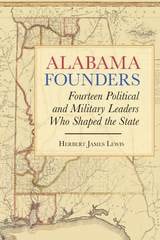
Alabama Founders
Fourteen Political and Military Leaders Who Shaped the StateHerbert James Lewis
University of Alabama Press, 2018
While much has been written about the significant events in the history of early Alabama, there has been little information available about the people who participated in those events. In Alabama Founders:Fourteen Political and Military Leaders Who Shaped the State Herbert James Lewis provides an important examination of the lives of fourteen political and military leaders. These were the men who opened Alabama for settlement, secured Alabama’s status as a territory in 1817 and as a state in 1819, and helped lay the foundation for the political and economic infrastructure of Alabama in its early years as a state.
While well researched and thorough, this book does not purport to be a definitive history of Alabama’s founding. Lewis has instead narrowed his focus to only those he believes to be key figures—in clearing the territory for settlement, serving in the territorial government, working to achieve statehood, playing a key role at the Constitutional Convention of 1819, or being elected to important offices in the first years of statehood.
The founders who readied the Alabama Territory for statehood include Judge Harry Toulmin, Henry Hitchcock, and Reuben Saffold II. William Wyatt Bibb and his brother Thomas Bibb respectively served as the first two governors of the state, and Charles Tait, known as the “Patron of Alabama,” shepherded Alabama’s admission bill through the US Senate. Military figures who played roles in surveying and clearing the territory for further settlement and development include General John Coffee, Andrew Jackson’s aide and land surveyor, and Samuel Dale, frontiersman and hero of the “Canoe Fight.” Those who were instrumental to the outcome of the Constitutional Convention of 1819 and served the state well in its early days include John W. Walker, Clement Comer Clay, Gabriel Moore, Israel Pickens, and William Rufus King.
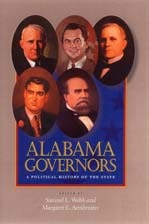
Alabama Governors
A Political History of the StateSamuel L. Webb
University of Alabama Press, 2001
The story of Alabama's governors has been often bizarre, occasionally inspiring, but never dull. Several of the state's early governors fought duels; one killed his wife's lover. A Reconstruction era-governor barricaded himself in his administrative office and refused to give it up when voters failed to reelect him. A 20th-century governor, an alumnus of Yale, married his first cousin and served as an officer in the Ku Klux Klan.
This collection of biographical essays, written by 34 noted historians and political scientists, chronicles the foibles and idiosyncrasies, in and out of office, of those who have served as the state's highest elected official. It also describes their courage; their meaningful policy initiatives; their accomplishments and failures; the complex factors that led to their actions or inaction; and the enormous consequences of their choices on the state's behalf.
Taken together, the essays provide a unified history of the state, with its recurring themes of race, federal-state relations, economic development, taxation, and education. Alabama Governors is certain to become an invaluable resource for teachers, students, librarians, journalists, and anyone interested in the colorful history and politics of the state.
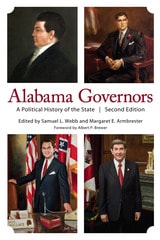
Alabama Governors
A Political History of the StateSamuel L. Webb
University of Alabama Press, 2014
This collection of biographical essays, written by thirty-four noted historians and political scientists, chronicles the times, careers, challenges, leadership, and legacies of the fifty-seven men and one woman who have served as the state's highest elected official. The book is organized chronologically into six sections that cover Alabama’s years as a US territory and its early statehood, the 1840s through the Civil War and Reconstruction, the late nineteenth-century Bourbon era, twentieth-century progressive and wartime governors, the Civil Rights era and George Wallace’s period of influence, and recent chief executives in the post-Wallace era.
The political careers of these fifty-eight individuals reflect the story of Alabama itself. Taken together, these essays provide a unified history of the state, with its recurring themes of race, federal-state relations, tensions between north and south Alabama, economic development, taxation, and education.
Alabama Governors expertly delineates the decisions and challenges of the chief executives, their policy initiatives, their accomplishments and failures, and the lasting impact of their terms. The book also includes the true and sometimes scandalous anecdotes that pepper Alabama’s storied history. Several of the state's early governors fought duels; one killed his wife's lover. A Reconstruction era-governor barricaded himself in his office and refused to give it up when voters failed to reelect him. A twentieth-century governor, an alumnus of Yale, served as an officer in the Ku Klux Klan.
This entirely updated and revised edition includes enlarged and enhanced images of each governor. Published as Alabama prepares for its sixty-fourth gubernatorial election, Alabama Governors is certain to become a valuable resource for teachers, students, librarians, journalists, and anyone interested in the colorful history of Alabama politics.
Alabama's Outlaw Sheriff, Stephen S. Renfroe
William Warren Rogers Sr.
University of Alabama Press, 2005
Among the villains, heroes, rogues and demigods who inhabit Southern folklore, Stephen S. Renfroe deserves a place. In the twentieth-century a few popular magazine and newspaper articles have been written about Renfroe, while Carl Carmer’s Stars Fell on Alabama, published in 1934, devoted several pages to him. Other than this, all is previously know about the enigmatic sheriff who because an outlaw is in the form of a legend.
In general, Renfroe appeared in the Black Belt town of Livingston, Alabama in the late 1860s and quickly became a member of the Ku Klux Klan. Allegedly playing a major role in driving out carpetbaggers and ridding Sumter County of Radical Republican rule, he was awarded with the office of sheriff. However, he reverted to a pattern of crime that earned him disgrace and ostracism.
As to his origins, his background, and the details of his career—much has been speculated but little has been documented. Although no statue commemorates Renfroe’s role as a statesman, educator, or solider (his highest military rank was that of private), a case can be made that he helped shape the course of politics in Alabama’s Black Belt.
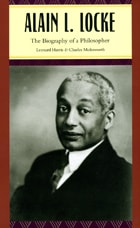
Alain L. Locke
The Biography of a PhilosopherLeonard Harris and Charles Molesworth
University of Chicago Press, 2008
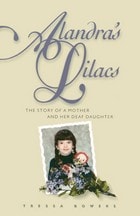
Alandra's Lilacs
The Story of a Mother and Her Deaf DaughterTressa Bowers
Gallaudet University Press, 1999
When, in 1968, 19-year-old Tressa Bowers took her baby daughter to an expert on deaf children, he pronounced that Alandra was “stone deaf,” she most likely would never be able to talk, and she probably would not get much of an education because of her communication limitations. Tressa refused to accept this stark assessment of Alandra’s prospects. Instead, she began the arduous process of starting her daughter’s education.
Economic need forced Tressa to move several times, and as a result, she and Alandra experienced a variety of learning environments: a pure oralist approach, which discouraged signing; Total Communication, in which the teachers spoke and signed simultaneously; a residential school for deaf children, where Signed English was employed; and a mainstream public school that relied upon interpreters. Changes at home added more demands, from Tressa’s divorce to her remarriage, her long work hours, and the ongoing challenge of complete communication within their family. Through it all, Tressa and Alandra never lost sight of their love for each other, and their affection rippled through the entire family. Today, Tressa can triumphantly point to her confident, educated daughter and also speak with pride of her wonderful relationship with her deaf grandchildren. Alandra’s Lilacs is a marvelous story about the resiliency and achievements of determined, loving people no matter what their circumstances might be.
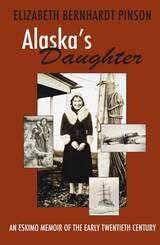
Alaska's Daughter
An Eskimo Memoir of the Early Twentieth CenturyElizabeth Pinson
Utah State University Press, 2004
Elizabeth B. Pinson shares with us her memories of Alaska's emergence into a new and modern era, bearing witness to history in the early twentieth century as she recalls it. She draws us into her world as a young girl of mixed ethnicity, with a mother whose Eskimo family had resided on the Seward Peninsula for generations and a father of German heritage. Growing up in and near the tiny village of Teller on the Bering Strait, Elizabeth at the age of six, despite a harrowing, long midwinter sled ride to rescue her, lost both her legs to frostbite when her grandparents, with whom she was spending the winter in their traditional Eskimo home, died in the 1918 influenza epidemic.
Fitted with artificial legs financed by an eastern benefactor, Elizabeth kept journals of her struggles, triumphs, and adventures, recording her impressions of the changing world around her and experiences with the motley characters she met. These included Roald Amundsen, whose dirigible landed in Teller after crossing the Arctic Circle; the ill-fated 1921 British colonists of Wrangel Island in the Arctic; trading ship captains and crews; prospectors; doomed aviators; and native reindeer herders. Elizabeth moved on to boarding school, marriage, and the state of Washington, where she compiled her records into this memoir and where, now in her 90s, she lives.
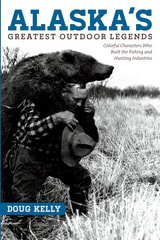
Alaska's Greatest Outdoor Legends
Colorful Characters Who Built the Fishing and Hunting IndustriesDoug Kelly
University of Alaska Press, 2016
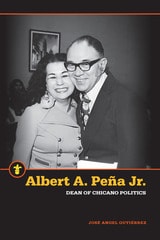
Albert A. Peña Jr.
Dean of Chicano PoliticsJosé Angel Gutiérrez
Michigan State University Press, 2017
Albert Camus, Jean Sénac, or The Rebel Son
Hamid Nacer-Khodja
Michigan State University Press, 2019
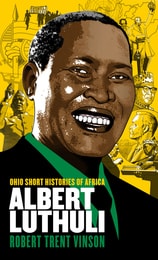
Albert Luthuli
Robert Trent Vinson
Ohio University Press, 2018
In an excellent addition to the Ohio Short Histories of Africa series, Robert Trent Vinson recovers the important but largely forgotten story of Albert Luthuli, Africa’s first Nobel Peace Prize winner and president of the African National Congress from 1952 to 1967. One of the most respected African leaders, Luthuli linked South African antiapartheid politics with other movements, becoming South Africa’s leading advocate of Mahatma Gandhi’s nonviolent civil disobedience techniques. He also framed apartheid as a crime against humanity and thus linked South African antiapartheid struggles with international human rights campaigns.
Unlike previous studies, this book places Luthuli and the South African antiapartheid struggle in new global contexts, and aspects of Luthuli’s leadership that were not previously publicly known: Vinson is the first to use new archival evidence, numerous oral interviews, and personal memoirs to reveal that Luthuli privately supported sabotage as an additional strategy to end apartheid. This multifaceted portrait will be indispensable to students of African history and politics and nonviolence movements worldwide.
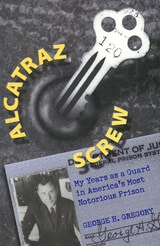
Alcatraz Screw
My Years as a Guard in America's Most Notorious PrisonGeorge H. Gregory & Intro by John W. Roberts
University of Missouri Press, 2002
Alchemical Laboratory Notebooks and Correspondence
George Starkey
University of Chicago Press, 2004
The editors present in this volume transcriptions of Starkey's texts, their translations, and valuable commentary for the modern reader. Dispelling the myth that alchemy was an irrational enterprise, this remarkable collection of laboratory notebooks and correspondence reveals the otherwise hidden methodologies of one of the seventeenth century's most influential alchemists.
Alcott in Her Own Time
A Biographical Chronicle of Her LIfe, Drawn from Recollections, Interviews, and Memoirs by Family, Friends, and AssociatesShealy, Daniel
University of Iowa Press, 2005
Many of the printed recollections in this book appeared after Alcott became famous and showcase her as a literary lion, but others focus on her teen years, when she was living the life of Jo March; these intimate glimpses into the life of the Alcott family lead the reader to one conclusion: the family was happy, fun, and entertaining, very much like the fictional Marches. The recollections about an older and wealthier Alcott show a kind and generous, albeit outspoken, woman little changed by her money and status.
From Annie Sawyer Downs’s description of life in Concord to Anna Alcott Pratt’s recollections of the Alcott sisters’ acting days to Julian Hawthorne’s neighborly portrait of the Alcotts, the thirty-six recollections in this copiously illustrated volume tell the private and public story of a remarkable life.
Aldo Leopold
His Life and WorkCurt D. Meine
University of Wisconsin Press, 2010
This biography of Aldo Leopold follows him from his childhood as a precocious naturalist to his profoundly influential role in the development of conservation and modern environmentalism in the United States. This edition includes a new preface by author Curt Meine and an appreciation by acclaimed Kentucky writer and farmer Wendell Berry.
Alec Wilder
Philip Lambert
University of Illinois Press, 2013

Aleksandr Askoldov
The CommissarMarat Grinberg
Intellect Books, 2016
This book is the first companion to the film in any language. It recounts the film’s plot and turbulent production history, and it also offers a close analysis of the artistic vision of its director, Aleksandr Askoldov, and the ways that viewers can trace in the film not only his complex aesthetics, but also the personal crises he endured in the years leading up to the film. The result is an indispensable companion to an unforgettable film.
Aleksandr Sokurov
Russian ArkBirgit Beumers
Intellect Books, 2016
This companion to Russian Ark addresses all key aspects of the film, beginning with a comprehensive synopsis, an in-depth analysis, and an account of the production history. Birgit Beumers goes on from there to discuss the work that went into the now-legendary Steadicam shot—which required two thousand actors and three orchestras—and she also offers an account of the film’s critical and public reception, showing how it helped to establish director Aleksandr Sokurov as perhaps the leading filmmaker in Russia today.
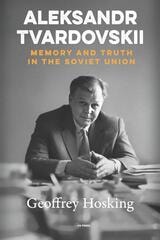
Aleksandr Tvardovskii
Memory and Truth in the Soviet UnionGeoffrey Hosking
Central European University Press, 2025
By giving a balanced account of his strengths and weaknesses, his achievements and failures, the author succeeds in giving the fullest picture available anywhere of a controversial man who turns out to be more complex than he has been portrayed so far. To understand him better is to understand why the Soviet intelligentsia changed so fundamentally in the USSR’s final decades, a change that helps to explain the rise of Gorbachev twenty years later. The study—which includes an in-depth analysis of Tvardovskii’s major works—also helps to better understand the fate of culture under an authoritarian regime and the intricacies of the struggle against censorship.

Aleksandur Stamboliiski
BulgariaRichard Crampton
Haus Publishing, 2009
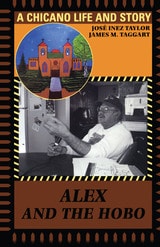
Alex and the Hobo
A Chicano Life and StoryBy José Inez Taylor and James M. Taggart
University of Texas Press, 2003
When a ten-year-old boy befriends a mysterious hobo in his southern Colorado hometown in the early 1940s, he learns about evil in his community and takes his first steps toward manhood by attempting to protect his new friend from corrupt officials. Though a fictional story, Alex and the Hobo is written out of the life experiences of its author, José Inez (Joe) Taylor, and it realistically portrays a boy's coming-of-age as a Spanish-speaking man who must carve out an honorable place for himself in a class-stratified and Anglo-dominated society.
In this innovative ethnography, anthropologist James Taggart collaborates with Joe Taylor to explore how Alex and the Hobo sprang from Taylor's life experiences and how it presents an insider's view of Mexicano culture and its constructions of manhood. They frame the story (included in its entirety) with chapters that discuss how it encapsulates notions that Taylor learned from the Chicano movement, the farmworkers' union, his community, his father, his mother, and his religion. Taggart gives the ethnography a solid theoretical underpinning by discussing how the story and Taylor's account of how he created it represent an act of resistance to the class system that Taylor perceives as destroying his native culture.
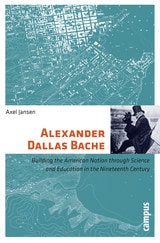
Alexander Dallas Bache
Building the American Nation through Science and Education in the Nineteenth CenturyAxel Jansen
Campus Verlag, 2011
Alexander Dallas Bache (1806–1867) was one of the leaders of American science in the nineteenth century. Driven by a vision of science as a key component of an integrated U.S. nation-state, he guided the nascent American Association for the Advancement of Science and also led what was at that point the nation’s largest scientific enterprise, the U.S. Coast Survey. In this analytical biography, Axel Jansen explains and explores Bache’s efforts to build and shape public institutions as aids to his goal of creating a national foundation for a shared culture—efforts that culminated in his work during the Civil War as one of the founders of the National Academy of Sciences, which he saw as a key symbol of the continued viability of a unified American nation.
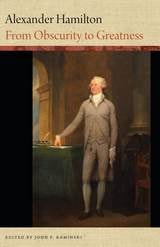
Alexander Hamilton
From Obscurity to GreatnessJohn P. Kaminski
Wisconsin Historical Society Press, 2016
Editor John P. Kaminski has gathered a remarkable collection of quotations by and about Alexander Hamilton that paint for us a nuanced portrait of a complex man. Through his own words and the words of his contemporaries -- including the man who killed him in a duel, Aaron Burr -- we can gain a better understanding of this fascinating man who rose from anonymity on a small Caribbean island to the corridors of power.