Results by title
4030 books match the query 'Language Arts & Disciplines' and 351 start with a
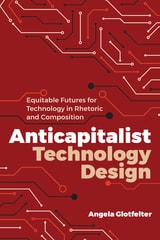
Anticapitalist Technology Design
Equitable Futures for Technology in Rhetoric and CompositionAngela Glotfelter
Utah State University Press, 2026
Under capitalism, every key we press, search we conduct, and prompt we write implicates us within a global web of exploitation that has created vast economic disparities. How, then, are we to understand and use technologies to write, think, argue, and teach about equitable futures for our world?
In response to this question, Anticapitalist Technology Design explores technology usage in writing programs as a site for equity work within a political-economic frame. Using an approach that combines classical Marxist ideas about political economy with contemporary advances in social justice theory, this book presents an intersectional approach to conducting anticapitalist work in rhetoric and composition around technology use.
Angela Glotfelter explores this work through the lens of anticapitalist technology design, a method that considers how inequitable ideologies are rhetorically encoded into new technologies and perpetuated through their usage. She applies this method to the case study of prototyping an equity dashboard for a first-year composition program, demonstrating the potential of anticapitalist technology design in practice.
Anticapitalist Technology Design brings together work from across the Marxist tradition, critical race theory, user experience, and transnational feminism, and will resonate with any one who wants to navigate new technologies in economically and socially just ways.

Anywhere Library
A Primer for the Mobile WebCourtney Greene McDonald
Assoc of College & Research Libraries, 2011
Anywhere Library
A Primer for the Mobile WebCourtney Greene McDonald
Assoc of College & Research Libraries, 2011
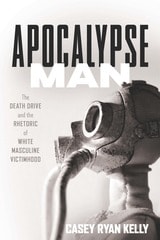
Apocalypse Man
The Death Drive and the Rhetoric of White Masculine VictimhoodCasey Ryan Kelly
The Ohio State University Press, 2020
Exemplified by President Donald J. Trump’s slogan “Make American Great Again,” white masculinity has become increasingly organized around melancholic attachments to an imagined past when white men were still atop the social hierarchy. How and why are white men increasingly identifying as victims of social, economic, and political change? Casey Ryan Kelly’s Apocalypse Man seeks to answer this question by examining textual and performative examples of white male rhetoric—as found among online misogynist and incel communities, survivalists and “doomsday preppers,” gender-motivated mass shooters, gun activists, and political demagogues. Using sources ranging from reality television and Reddit manifestos to gun culture and political rallies, Kelly ultimately argues that death, victimhood, and fatalism have come to underwrite the constitution of contemporary white masculinity.
Appalachian Englishes in the Twenty-First Century
Kirk Hazen
West Virginia University Press, 2020
A portal to the language scholarship of the last thirty years, Appalachian Englishes in the Twenty-First Century translates state-of-the-art research for a nonspecialist audience, while setting the agenda for further study of language in one of America’s most recognized regions.
Appeals in Modern Rhetoric
An Ordinary Language ApproachM. Jimmie Killingsworth
Southern Illinois University Press, 2005
Appeals in Modern Rhetoric: An Ordinary-Language Approach introduces students to current issues in rhetorical theory through an extended treatment of the rhetorical appeal, a frequently used but rarely discussed concept at the core of rhetorical analysis and criticism. Shunning the standard Aristotelian approach that treats ethos, pathos, and logos as modes of appeal, M. Jimmie Killingsworth uses common, accessible language to explain the concept of the rhetorical appeal—meaning the use of language to plead and to please. The result is a practical and innovative guide to understanding how persuasion works that is suitable for graduate and undergraduate courses yet still addresses topics of current interest to specialists.
Supplementing the volume are practical and theoretical approaches to the construction and analysis of rhetorical messages and brief and readable examples from popular culture, academic discourse, politics, and the verbal arts. Killingsworth draws on close readings of primary texts in the field, referencing theorists to clarify concepts, while he decodes many of the basic theoretical constructs common to an understanding of identification. Beginning with examples of the model of appeals in social criticism, popular film, and advertising, he covers in subsequent chapters appeals to time, place, the body, gender, and race. Additional chapters cover the use of common tropes and rhetorical narrative, and each chapter begins with definitions of key concepts.

Appetites of Empire
Food, Farming, and Fitness Rhetorics During the Obama EraDustin Greenwalt
University of Alabama Press, 2026
In Imperial Styles: Food, Farming, and Fitness Rhetorics During the Obama Era, Dustin Greenwalt examines how discussions of food, farming, and fitness became influential sites for negotiating questions of identity, citizenship, health, and economic life during the early twenty-first century.
Applied Pedagogies
Strategies for Online Writing InstructionDaniel Ruefman
Utah State University Press, 2016
This is a practical text, providing ways to employ the best instructional strategies possible for today’s diverse and dynamic digital writing courses. Organized into three sections—Course Conceptualization and Support, Fostering Student Engagement, and MOOCs—chapters explore principles of rhetorically savvy writing crossed with examples of effective digital teaching contexts and genres of digital text. Contributors consider not only pedagogy but also the demographics of online students and the special constraints of the online environments for common writing assignments.
The scope of online learning and its place within higher education is continually evolving. Applied Pedagogies offers tools for the online writing classrooms of today and anticipates the needs of students in digital contexts yet to come. This book is a valuable resource for established and emerging writing instructors as they continue to transition to the digital learning environment.
Contributors: Kristine L. Blair, Jessie C. Borgman, Mary-Lynn Chambers, Katherine Ericsson, Chris Friend, Tamara Girardi, Heidi Skurat Harris, Kimberley M. Holloway, Angela Laflen, Leni Marshall, Sean Michael Morris, Danielle Nielsen, Dani Nier-Weber, Daniel Ruefman, Abigail G. Scheg, Jesse Stommel
Applying Library Values To Emerging Technology
Pub #72Peter D. Fernandez
Assoc of College & Research Libraries, 2018
Approaches to Liaison Librarianship
Robin Canuel
Assoc of College & Research Libraries, 2021
Approaches to Lifespan Writing Research
Generating an Actionable CoherenceRyan J. Dippre
University Press of Colorado, 2020
Copublished with CSU Open Press
This edited collection builds on the three themes that emerged from the 2018 inaugural lifespan writing conference—identity, society, and theory—to further the study of writing through the lifespan. The contributors to this collection provide a framework within which the reader can develop a dynamic, interdisciplinary, multifaceted understanding of the limits and possibilities of studying lifespan writing. Recognizing that such research requires methodological rigor and flexibility as well as theoretical precision and adaptability, Approaches to Lifespan Writing Research draws on a range of methodological and theoretical approaches, from autoethnography to longitudinal structural equation modeling. This methodological and theoretical flexibility reflects the challenges inherent in studying lifespan writing—in particular, the need to develop an integrated framework that enables the “translation” of research findings for use by other lifespan writing researchers. Approaches to Lifespan Writing Research begins that process.
This book is also available as an open access ebook through the WAC Clearinghouse
Approaching Second
Second Position Clitics and Related PhenomenaArnold Zwicky
CSLI, 1996
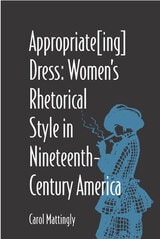
Appropriate[Ing] Dress
Women's Rhetorical Style in Nineteenth-Century AmericaCarol Mattingly
Southern Illinois University Press, 2002
Carol Mattingly examines the importance of dress and appearance for nineteenth-century women speakers and explores how women appropriated gendered conceptions of dress and appearance to define the struggle for representation and power that is rhetoric. Although crucial to women’s effectiveness as speakers, Mattingly notes, appearance has been ignored because it was taken for granted by men.
Because women rarely spoke in public before the nineteenth century, no guidelines existed regarding appropriate dress when they began to speak to audiences. Dress evoked immediate images of gender, an essential consideration for women speakers because of its strong association with place, locating women in the domestic sphere and creating a primary image that women speakers would work with—and against—throughout the century. Opposition to conspicuous change for women often necessitated the subtle transfer of comforting images when women sought to inhabit traditionally masculine spaces. The most successful women speakers carefully negotiated expectations by highlighting some conventions even as they broke others.
Appropriation and Representation
Feng Menglong and the Chinese Vernacular StoryShuhui Yang
University of Michigan Press, 1998
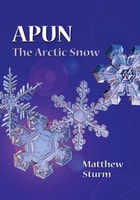
Apun
The Arctic SnowMatthew Sturm
University of Alaska Press, 2009
There are some twenty-five words for “snow” in the Inupiaq language. Each word denotes a different kind of snow—fresh powder snow, hard pack, soft snow, very wet snow, or just snow. Such fine distinction is reasonable, for over the centuries, Natives of the Arctic have had to rely on their knowledge of the snow to survive. Now Matthew Sturm has prepared an educational children’s book designed to teach a new generation of Arctic residents the importance of Arctic snow cover. Fully illustrated to demonstrate the cycle of the snow cover, Apun covers each phase of the “snow year.” Geared towards grades 3–4, this is a must read for elementary science classes.
Apun
The Arctic Snow (A Teacher's Guide)Matthew Sturm
University of Alaska Press, 2009
There are some twenty-five words for “snow” in the Inupiaq language. Each word denotes a different kind of snow—fresh powder snow, hard pack, soft snow, very wet snow, or just snow. Such fine distinction is reasonable, for over the centuries, Natives of the Arctic have had to rely on their knowledge of the snow to survive. Now Matthew Sturm has prepared an educational children’s book designed to teach a new generation of Arctic residents the importance of Arctic snow cover. Fully illustrated to demonstrate the cycle of the snow cover, Apun covers each phase of the “snow year.” Geared towards grades 3–4, this is a must read for elementary science classes.
Arabic Computational Linguistics
Edited by Ali Farghaly
CSLI, 2010
This comprehensive volume explores new Arabic machine translation systems, innovations in speech recognition and mention detection, tree banks, and linguistic corpora. Arabic Computational Linguistics will be an indispensable reference for language researchers and practitioners alike.
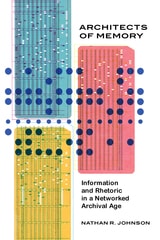
Architects of Memory
Information and Rhetoric in a Networked Archival AgeNathan R. Johnson
University of Alabama Press, 2020
Understanding the systems that shape what societies remember, archive, and forget.
We are now living in the richest age of public memory. From museums and memorials to the vast digital infrastructure of the internet, access to the past is only a click away. Even so, the methods and technologies created by scientists, espionage agencies, and information management coders and programmers have drastically delimited the ways that communities across the globe remember and forget our wealth of retrievable knowledge.
In Architects of Memory: Information and Rhetoric in a Networked Archival Age, Nathan R. Johnson charts turning points where concepts of memory became durable in new computational technologies and modern memory infrastructures took hold. He works through both familiar and esoteric memory technologies—from the card catalog to the book cart to Zatocoding and keyword indexing—as he delineates histories of librarianship and information science and provides a working vocabulary for understanding rhetoric’s role in contemporary memory practices.
This volume draws upon the twin concepts of memory infrastructure and mnemonic technê to illuminate the seemingly opaque wall of mundane algorithmic techniques that determine what is worth remembering and what should be forgotten. Each chapter highlights a conflict in the development of twentieth-century librarianship and its rapidly evolving competitor, the discipline of information science. As these two disciplines progressed, they contributed practical techniques and technologies for making sense of explosive scientific advancement in the wake of World War II. Taming postwar science became part and parcel of practices and information technologies that undergird uncountable modern communication systems, including search engines, algorithms, and databases for nearly every national clearinghouse of the twenty-first century.
Architectures, Rules, and Preferences
Variations on Themes by Joan W. BresnanEdited by Annie Zaenen
CSLI, 2007
Archival Entanglements
Edited by Puja Batra-Wells and Harmony Bench
The Ohio State University Press, 2026
Archival Entanglements arrives in the wake of the archival turn in the arts and humanities. What humanists call “the archive” has been challenged, deconstructed, and reinvented, but, as editors Puja Batra-Wells and Harmony Bench show, the conversation about the archive is far from over. In this interdisciplinary collection, contributors from digital humanities, performance studies, labor studies, race and ethnic studies, and more come together to shed new light on how objects, knowledges, environments, bodily practices, and identities are entangled with the archive. Showcasing a range of approaches from traditional essays to artistic engagements, the works in this collection complicate questions of archival memory; raise issues of accessibility, erasure, latency, and surveillance; and ask if we should forge new spaces of remembrance that reach beyond the limits of the archive. Archival Entanglements posits the archive as both a generative site of knowledge production and a constricted force of consolidation around dominant narratives—essentially, as a complex web of theories and practices with which the arts and humanities are fundamentally entangled.
Contributors:
Anurima Banerji, Franco Barchiesi, Puja Batra-Wells, Harmony Bench, Johannah Bird, Leigh Bonds, Iñaki Bonillas, Melissa Anne-Marie Curley, Eric Gonzaba, Brian Harnetty, Brian Eugenio Herrera, Kelly Kivland, Tanya Lukin Linklater, Mariah E. Marsden, Mimi ?n??ha, Martin Joseph Ponce, Rebecca Schneider, Amy Shuman, Michelle Wibbelsman, Nicole Wood

Archival Values
Essays in Honor of Mark A. GreeneChristine Weideman
American Library Association, 2019
Archival and Special Collections Facilities
Guidelines for Archivists, Librarians, Architects, and EngineersMichele F. Pacifico
American Library Association, 2010
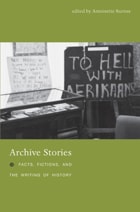
Archive Stories
Facts, Fictions, and the Writing of HistoryAntoinette Burton, ed.
Duke University Press, 2005
Archive Stories brings together ethnographies of the archival world, most of which are written by historians. Some contributors recount their own experiences. One offers a moving reflection on how the relative wealth and prestige of Western researchers can gain them entry to collections such as Uzbekistan’s newly formed Central State Archive, which severely limits the access of Uzbek researchers. Others explore the genealogies of specific archives, from one of the most influential archival institutions in the modern West, the Archives nationales in Paris, to the significant archives of the Bakunin family in Russia, which were saved largely through the efforts of one family member. Still others explore the impact of current events on the analysis of particular archives. A contributor tells of researching the 1976 Soweto riots in the politically charged atmosphere of the early 1990s, just as apartheid in South Africa was coming to an end. A number of the essays question what counts as an archive—and what counts as history—as they consider oral histories, cyberspace, fiction, and plans for streets and buildings that were never built, for histories that never materialized.
Contributors. Tony Ballantyne, Marilyn Booth, Antoinette Burton, Ann Curthoys, Peter Fritzsche, Durba Ghosh, Laura Mayhall, Jennifer S. Milligan, Kathryn J. Oberdeck, Adele Perry, Helena Pohlandt-McCormick, John Randolph, Craig Robertson, Horacio N. Roque Ramírez, Jeff Sahadeo, Reneé Sentilles
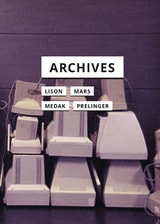
Archives
Andrew Lison
University of Minnesota Press, 2019
How digital networks and services bring the issues of archives out of the realm of institutions and into the lives of everyday users
Archives have become a nexus in the wake of the digital turn. Electronic files, search engines, video sites, and media player libraries make the concepts of “archival” and “retrieval” practically synonymous with the experience of interconnected computing. Archives today are the center of much attention but few agendas. Can archives inform the redistribution of power and resources when the concept of the public library as an institution makes knowledge and culture accessible to all members of society regardless of social or economic status? This book sets out to show that archives need our active support and continuing engagement.
This volume offers three distinct perspectives on the present status of archives that are at once in disagreement and solidarity with each other, from contributors whose backgrounds cut across the theory–practice divide. Is the increasing digital storage of knowledge pushing us toward a turning point in its democratization? Can archives fulfill their paradoxical potential as utopian sites in which the analog and the digital, the past and future, and remembrance and forgetting commingle? Is there a downside to the present-day impulse toward total preservation?
Archives & Archivists in the Information Age
Richard J. Cox
American Library Association, 2005
Archives Alive
Expanding Engagement with Public Library Archives and Special CollectionsDiantha Dow Schull
American Library Association, 2015
Archives Power
Randall C. Jimerson
American Library Association, 2009
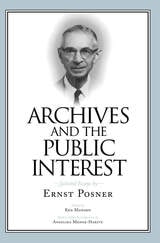
Archives and the Public Interest
Selected Essays by Ernest PosnerKen Munden
Society of American Archivists, 2006
Archives in Libraries
What Librarians and Archivists Need to Know to Work TogetherMegan Sniffin-Marinoff
American Library Association, 2017
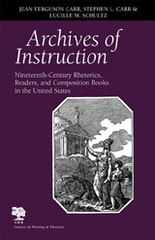
Archives of Instruction
Nineteenth-Century Rhetorics, Readers, and Composition Books in the United StatesJean Ferguson Carr, Stephen L. Carr, and Lucille M. Schultz
Southern Illinois University Press, 2005
Both a historical recovery and a critical rethinking of the functions and practices of textbooks, Archives of Instruction: Nineteenth-Century Rhetorics, Readers, and Composition Books in the United States argues for an alternative understanding of our rhetorical traditions. The authors describe how the pervasive influence of nineteenth-century literacy textbooks demonstrate the early emergence of substantive instruction in reading and writing. Tracing the histories of widespread educational practices, the authors treat the textbooks as an important means of cultural formation that restores a sense of their distinguished and unique contributions.
At the beginning of the nineteenth century, few people in the United States had access to significant school education or to the materials of instruction. By century’s end, education was a mass—though not universal—experience, and literacy textbooks were ubiquitous artifacts, used both in home and in school by a growing number of learners from diverse backgrounds. Many of the books have been forgotten, their contributions slighted or dismissed, or they are remembered through a haze of nostalgia as tokens of an idyllic form of schooling. Archives of Instruction suggests strategies for re-reading the texts and details the watersheds in the genre, providing a new perspective on the material conditions of schooling, book publication, and emerging practices of literacy instruction. The volume includes a substantial bibliography of primary and secondary works related to literacy instruction at all levels of education in the United States during the nineteenth century.

Archiving Heaven and Earth
The Historian's Office and the Making of MormonismRobin Scott Jensen
University of Illinois Press, 2027
Robin Scott Jensen explores the Church Historian’s Office against the backdrop of how writing and archiving what was written shaped the growth, faith, and identity of the nineteenth-century Latter Day Saint movement. As Jensen shows, records simultaneously created and preserved history. Journal keeping and letter writing stood alongside official documents as an essential means for Saints to understand their mission and place in American society. Over time, the Church Historian’s Office evolved into a powerful institution that guided memory and authority by deciding what to collect, copy, or destroy. Jensen tells the stories of the forgotten archivists, many of them women, who built the Church Historian’s Office, while revealing the choices and conflicts that led to Native and other voices being marginalized or erased.
Detailed and candid, Archiving Heaven and Earth provides a rare look at a foundational organization.
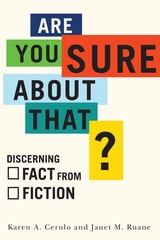
Are You Sure About That?
Discerning Fact from FictionKaren A. Cerulo
Rutgers University Press, 2027
Phone in hand, TV on, we wake up and fall asleep to endless information. There’s no escape—we are drowning in a sea of breaking news, notifications, and popular beliefs and claims. Every day, we encounter hundreds of posts and podcasts on politics, celebrities, or current events. People share links to “expert” recommendations on Instagram or Reddit. YouTube and TikTok bring us those who want to instruct us on the realities of the world or pass on longstanding conventional wisdom, all in the hopes of influencing our decisions and actions.
The information overload of the constant news and information cycle is exhausting and extremely frustrating. You may ask: Just what or whom should we believe? Are You Sure About That? Discerning Fact from Fiction helps readers navigate the perilous informational terrain of contemporary life. We provide a game plan of strategies and guidance for easily and reliably assessing the accuracy of any claim, helping readers to cut through the noise and adjust what they know.
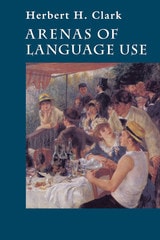
Arenas of Language Use
Herbert H. Clark
University of Chicago Press, 1993
According to Clark, in order for one person to understand another, there must be a "common ground" of knowledge between them. He shows how people infer this "common ground" from their past conversations, their immediate surroundings, and their shared cultural background. Clark also discusses the means by which speakers design their utterances for particular audiences and coordinate their use of language with other participants in a language arena. He argues that language use in conversation is a collaborative process, where speaker and listener work together to establish that the listener understands the speaker's meaning. Since people often use words to mean something quite different from the dictionary definitions of those words, Clark offers a realistic perspective on how speakers and listeners coordinate on the meanings of words.
This collection presents outstanding examples of Clark's pioneering work on the pragmatics of language use and it will interest psychologists, linguists, computer scientists, and philosophers.
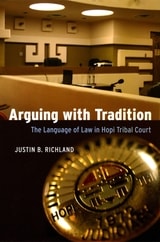
Arguing with Tradition
The Language of Law in Hopi Tribal CourtJustin B. Richland
University of Chicago Press, 2008
Like many indigenous legal institutions across North America, the Hopi Tribal Court was created in the image of Anglo-American-style law. But Richland shows that in recent years, Hopi jurists and litigants have called for their courts to develop a jurisprudence that better reflects Hopi culture and traditions. Providing unprecedented insights into the Hopi and English courtroom interactions through which this conflict plays out, Richland argues that tensions between the language of Anglo-style law and Hopi tradition both drive Hopi jurisprudence and make it unique. Ultimately, Richland’s analyses of the language of Hopi law offer a fresh approach to the cultural politics that influence indigenous legal and governmental practices worldwide.
Argument Realization
Edited by Miriam Butt and Tracy Holloway King
CSLI, 2001
Argumentation Theory and the Rhetoric of Assent
David Williams
University of Alabama Press, 1990
The eleven essays coalesce around the general question of "When, if ever, is assent justified?" And, as Professor Cox astutely notes in his introduction, such a question immediately leads into considerations of argument and power. In these considerations, many differing perspectives are represented in this volume: aesthetic and symbolist approaches, rationalistic and formalistic approaches, field theory perspectives, orientations toward various conceptualizations of a public sphere, etc.
Argumentation Theory and the Rhetoric of Assent is intended not as a primer on argument theory but rather as a look at American approaches to a philosophy of argumentation and argument criticism. As such, the essays probe the implications of both current practices and theoretical approaches: the objective is not to map the terrain argumentation theory has traversed in recent years but rather to plot a route for the direction in which argumentation studies should move. The concluding essays by James Arnt Aune and G. Thomas Goodnight confront these concerns explicitly.
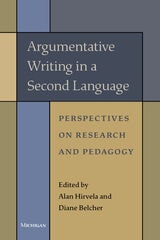
Argumentative Writing in a Second Language
Perspectives on Research and PedagogyAlan R. Hirvela and Diane D. Belcher
University of Michigan Press, 2021
Part I of the volume is topic-oriented and focuses on explorations of important issues and perspectives, while Part II features several chapters reporting classroom-based studies of a variety of instructional approaches that expand our understanding of how argumentative writing can be taught. The book will be of value to pre-service and in-service teachers in varying instructional contexts, as well as teacher educators and L2 writing scholars/researchers.

Arguments for a Non-Transformational Grammar
Richard A. Hudson
University of Chicago Press, 1976
The goal of daughter-dependency theory is the same as that of Chomskyan transformational grammar—to generate syntactic structures for all (and only) syntactically well-formed sentences that would relate to both the phonological and the semantic structures of the sentences. However, unlike transformational grammars, those based on daughter-dependency theory generate a single syntactic structure for each sentence. This structure incorporates all the kinds of information that are spread, in a transformational grammar, over to a series of structures (deep, surface, and intermediate). Instead of the combination of phrase-structure rules and transformations found in transformational grammars, daughter-dependency grammars contain rules with the following functions: classification, dependency-marking, or ordering.
Hudson's strong arguments for a non-transformational grammar stress the capacity of daughter-dependency theory to reflect the facts of language structure and to capture generalizations that transformational models miss. An important attraction of Hudson's theory is that the syntax is more concrete, with no abstract underlying elements.
In the appendixes, the author outlines a partial grammar for English and a small lexicon and distinguishes his theory from standard dependency theory. Hudson's provocative thesis is supported by his thorough knowledge of transformational grammar.
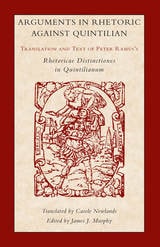
Arguments in Rhetoric Against Quintilian
Translation and Text of Peter Ramus's Rhetoricae Distinctiones in QuintilianumPeter Ramus, Translated by Carole Newlands, Edited by James J. Murphy,
Southern Illinois University Press, 2010
First published in 1986, this book offers the Latin text and English translation of a pivotal work by one of the most influential and controversial writers of early modern times. Pierre de la Ramée, better known as Peter Ramus, was a college instructor in Paris who published a number of books attacking and attempting to refute foundational texts in philosophy and rhetoric. He began in the early 1540s with books on Aristotle—which were later banned and burned—and Cicero, and later, in 1549, he published Rhetoricae Distinctiones in Quintilianum. The purpose of Ramus’s book is announced in the opening paragraph of its dedication to Charles of Lorraine: “I have a single argument, a single subject matter, that the arts of dialectic and rhetoric have been confused by Aristotle, Cicero, and Quintilian. I have previously argued against Aristotle and Cicero. What objection then is there against calling Quintilian to the same account?”
Carole Newlands’s excellent translation—the first in modern English—remains the standard English version. This volume also provides the original Latin text for comparative purposes. In addition, James J. Murphy’s insightful introduction places the text in historical perspective by discussing Ramus’s life and career, the development of his ideas, and the milieu in which his writings were produced. This edition includes an updated bibliography of works concerning Ramus, rhetoric, and related topics.
Aristote et le lexique de l'espace
Claude Vandeloise
CSLI, 2001
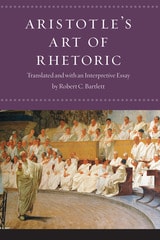
Aristotle's "Art of Rhetoric"
Aristotle
University of Chicago Press, 2019
Here Robert C. Bartlett offers a literal, yet easily readable, new translation of Aristotle’s “Art of Rhetoric,” one that takes into account important alternatives in the manuscript and is fully annotated to explain historical, literary, and other allusions. Bartlett’s translation is also accompanied by an outline of the argument of each book; copious indexes, including subjects, proper names, and literary citations; a glossary of key terms; and a substantial interpretive essay.
Aristotle's Rhetoric
An Art of CharacterEugene Garver
University of Chicago Press, 1995
Aristotle's Voice
Rhetoric, Theory, and Writing in AmericaJasper Neel
Southern Illinois University Press, 1994
In this book, Jasper Neel’s sure-to-be-controversial resituating of Aristotle centers around three questions that have been constants in his twenty-two years of teaching experience: What does itmean to teach writing? What should one know before teaching writing? And, if there is such a thing as "research in the teaching of writing," what is it?
Believing that all composition teachers are situated politically and socially, both as part of the institution in which they teach and as beings with lived histories, Neel examines his own life and the life of composition studies as a discipline in the context of Aristotle. Neel first situates the Rhetoric as a political document; he then situates the Rhetoric in the Aristotelian system and describes how professional discourse came to know itself through Aristotle’s way of studying the world; finally, he examines the operation of the Rhetoric inside itself before arguing the need to turn to Aristotle’s notion of sophistry as a way of negating his system.
By pointing out the connections among Aristotelian rhetoric, the contemporary university, and the contemporary writing teacher, Neel shows that Aristotle’s frightening social theories are as alive today as are Aristotelian notions of discourse.
Neel explains that by their very nature teachers must speak with a professional voice. It is through showing how to "hear" one’s professional voice that Neel explores the notion of professional discourse that originates with Aristotle. In maintaining that one must pay a high price in order to speak through Aristotle’s theory or to assume the role of "professional," he argues that no neutral ground exists either for pedagogy or for the analysis of pedagogy. Neel concludes this discussion by proposing that Aristotelian sophistry is both an antidote to Aristotelian racism, sexism, and bigotry and a way of allowing Aristotelian categories of discourse to remain useful.
Finally, as an Aristotelian, a teacher, and a writer, Neel responds both to Aristotle and to professionalism by rethinking the influence of the past and reviving the voice of Aristotelian sophistry.
Around the Texts of Writing Center Work
An Inquiry-Based Approach to Tutor EducationR. Mark Hall
Utah State University Press, 2017
Around the Texts of Writing Center Work reveals the conceptual frameworks found in and created by ordinary writing center documents. The values and beliefs underlying course syllabi, policy statements, website copy and comments, assessment plans, promotional flyers, and annual reports critically inform writing center practices, including the vital undertaking of tutor education.
In each chapter, author R. Mark Hall focuses on a particular document. He examines its origins, its use by writing center instructors and tutors, and its engagement with enduring disciplinary challenges in the field of composition, such as tutoring and program assessment. He then analyzes each document in the contexts of the conceptual framework at the heart of its creation and everyday application: activity theory, communities of practice, discourse analysis, reflective practice, and inquiry-based learning.
Around the Texts of Writing Center Work approaches the analysis of writing center documents with an inquiry stance—a call for curiosity and skepticism toward existing and proposed conceptual frameworks—in the hope that the theoretically conscious evaluation and revision of commonplace documents will lead to greater efficacy and more abundant research by writing center administrators and students.
Around the World in 80 Words
A Journey through the English LanguagePaul Anthony Jones
University of Chicago Press, 2018
Surprising, entertaining, and illuminating, this is essential reading for armchair travelers and word nerds. Our dictionaries are full of hidden histories, tales, and adventures from all over the world—if you know where to look.
Arranging and Describing Archives and Manuscripts
Dennis Meissner
American Library Association, 2019
Art Documentation
Journal of the Art Libraries Society of North America, volume 40 number 2 (Fall 2021)The University of Chicago Press
University of Chicago Press Journals, 2021
Art Documentation
Journal of the Art Libraries Society of North America, volume 41 number 1 (Spring 2022)The University of Chicago Press
University of Chicago Press Journals, 2022
Art Documentation
Journal of the Art Libraries Society of North America, volume 41 number 2 (Fall 2022)The University of Chicago Press
University of Chicago Press Journals, 2022
Art Documentation
Journal of the Art Libraries Society of North America, volume 42 number 1 (Spring 2023)The University of Chicago Press
University of Chicago Press Journals, 2023