Results by title
3785 books match the query 'Poetry' and 303 start with a
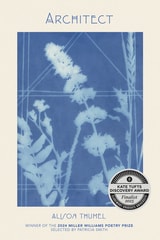
Architect
Alison Thumel
University of Arkansas Press, 2024
Finalist, 2025 Kate Tufts Discovery Award
“When he died, my brother became the architect of the rest of my life,” writes Alison Thumel in Architect, which interweaves poems, lyric essays, and visual art to great emotional effect. In this debut collection, the buildings of Frank Lloyd Wright become a blueprint for elegy, as Thumel overlays the language of architecture with the language of grief to raze and reconstruct memories, metaphors, and myths. With obsessive and exacting focus, the poet leads us through room after room in a search to answer whether it is possible to rebuild in the wake of loss. Meanwhile, the midwestern landscape beyond these rooms—the same landscape that infuses the low, horizontal forms of Wright’s Prairie Style buildings—shapes the figures in Architect as well as their fates: “For years after my brother’s death, I collected news articles on people who died young and tragically in landlocked states. Prairie Style deaths—boys sucked down into grain silos or swept up by tornadoes or fallen through a frozen pond. The boys I didn’t know, but the landscape I did. The dread of it. How many miles you can look ahead. For how long you see what is coming.”
Archive of Style
New and Selected PoemsCheryl Clarke
Northwestern University Press, 2024
Award-winning poet and essayist Cheryl Clarke’s illustrious career has spanned more than four decades and culminates in Archive of Style: New and Selected Poems, a long-awaited retrospective of the indelible work of a Black feminist, community and LGBTQ activist, and educator. This collection features carefully curated poems from Narratives: Poems in the Tradition of Black Women (1982), Living as a Lesbian (1986), The Days of Good Looks: Prose and Poetry 1980-2005 (2006), By My Precise Haircut (2016), and Targets (2019). Together these works show a brilliant thinker who has profoundly impacted generations of writers and activists.
Clarke’s poetry and essays, centered around the Black, lesbian, feminist experience, have attracted an audience around the world. Her essays, “Lesbianism: an Act of Resistance” and “The Failure to Transform: Homophobia in the Black Community” revolutionized the thinking about lesbians of color and the struggle against homophobia. Her poetry and non-fiction have been reprinted in numerous anthologies and assigned in women and sexuality courses globally. Having published since 1977, Clarke and her work have become a foundational part of LGBTQ literature and activism. Archive of Style is a celebration and homage to one of American literature’s Black Women literary warriors.
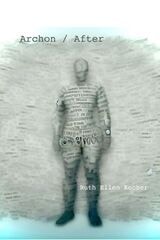
Archon / After
Ruth Ellen Kocher
Omnidawn, 2024
In Ruth Ellen Kocher’s Archon / After, the archive is revealed as both a form of violence and of memory, of site and of event. As keeper of the archive, Kocher’s archon determines what pieces of the past may be preserved, housed, documented, ordered, and reviewed. Through these poems, the archon dives deep into memories and into the mysteries of daily life, and, in governance over the future, determines what will be and should be forgotten. The act of forgetting becomes archival violence, with the archon not only serving as the guardian of what remains in the archive but also as an eradicator who decides what is purged.
The imagistic and surreal language of this collection invites us to explore a non-logical terrain as we follow the protagonist into her darkest memories and find a path for our own journey of self-discovery.
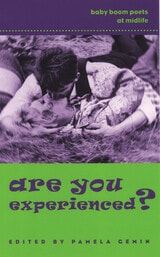
Are You Experienced? Baby Boom Poets At Midlife
Pamela Gemin
University of Iowa Press, 2003
In this timely and reflective anthology, the generation that sought to stay forever young reveals that midlife should mean more than jokes about thinning hair, creaking joints, and thickening waistlines. Midlife's insights—whether they be physical, spiritual, or emotional—are indeed startling, and who better than poets to deliver them?
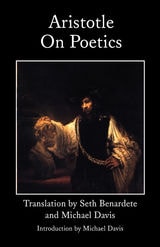
Aristotle On Poetics
Seth Benardete
St. Augustine's Press, 2002
Aristotle’s much-translated On Poetics is the earliest and arguably the best treatment that we possess of tragedy as a literary form. The late Seth Benardete and Michael Davis have translated it anew with a view to rendering Aristotle’s text into English as precisely as possible. A literal translation has long been needed, for in order to excavate the argument of On Poetics one has to attend not simply to what is said on the surface but also to the various puzzles, questions, and peculiarities that emerge only on the level of how Aristotle says what he says and thereby leads one to revise and deepen one’s initial understanding of the intent of the argument. As On Poetics is about how tragedy ought to be composed, it should not be surprising that it turns out to be a rather artful piece of literature in its own right.
Benardete and Davis supplement their edition of On Poetics with extensive notes and appendices. They explain nuances of the original that elude translation, and they provide translations of passages found elsewhere in Aristotle’s works as well as in those of other ancient authors that prove useful in thinking through the argument of On Poetics both in terms of its treatment of tragedy and in terms of its broader concerns. By following the connections Aristotle plots between On Poetics and his other works, readers will be in a position to appreciate the centrality of this little book for his thought on the whole.
In an introduction that sketches the overall interpretation of On Poetics, Davis argues that, while On Poetics is certainly about tragedy, it has a further concern extending beyond poetry to the very structure of the human soul in its relation to what is, and that Aristotle reveals in the form of his argument the true character of human action.
Ark
John Isles
University of Iowa Press, 2003
With its deft maneuvers through both a historical and an emotional landscape, Ark speaks to us with a truly contemporary voice of authoritative vulnerability while never faltering into sentimental digressions. This uncanny authority at the helm of our ark continually surprises us, unfolding its lyrical gems and treasures culled along the journey, letting us in on the inscrutable facts of this life.
Armor & Ornament
Christopher Lee Miles
University of Alaska Press, 2019
As a military veteran, Miles also centers his poetry amongst war. Through tone and voice, warfare permeates these poems, providing poetry that relies less on the traditional, Christian tension of doubt and shaken faith than on the inherent tension of a broken world. This resonant new collection melds deep-rooted spirituality with contemporary tensions, offering modern psalms for a tumultuous and uncertain age.
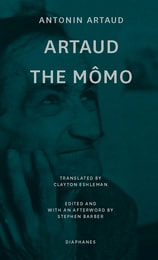
Artaud the Mômo
Antonin Artaud
Diaphanes, 2020
This edition is translated by Clayton Eshleman, the acclaimed foremost translator of Artaud’s work. This will be the first edition since the original 1947 publication to present the work in the spatial format Artaud intended. It also incorporates eight original drawings by Artaud—showing reconfigured bodies as weapons of resistance and assault—which he selected for that edition, after having initially attempted to persuade Pablo Picasso to collaborate with him. Additional critical material draws on Artaud’s previously unknown manuscript letters written between 1946 and 1948 to the book’s publisher, Pierre Bordas, which give unique insights into the work from its origins to its publication.
Articulations
The Body and Illness in PoetryJon Mukand
University of Iowa Press, 1994
In 1987 poet and physician Jon Mukand published Sutured Words, a volume of contemporary poems to help patients, their families and friends, and all health care professionals embrace the complexity of healing, illness, and death. Robert Coles called the collection “a wonderful source of inspiration and instruction for any of us who are trying to figure out what our work means”; Norman Cousins was impressed by the “discernment and high quality of the selections.” Now, in Articulations, Mukand adds more than a hundred new poems to the strongest poems from Sutured Words to give us a lyrical, enlightened understanding of the human dimensions of suffering and illness
Artifice and Indeterminacy
An Anthology of New PoeticsChristopher Beach
University of Alabama Press, 2007
Artifice and Indeterminacy gathers the strongest and most representative writings of the past two decades and shows more clearly than ever before the depth and breadth of contemporary American poetics. Collectively, these essays break with conventional interpretive frameworks and traditional generic boundaries of poetry to give fresh voice to the poetics of our time.
Neither dismissive of the aesthetic value(s) of poetry, nor reluctant to articulate the ways in which aesthetic evaluation is complicated by the mediating influences of history, culture, class, gender, race, and academic status, the writers presented in this anthology celebrate the artifice of the poetic text while also accepting as a given the indeterminacy of its inception and reception.
Individual pieces range in style and approach from theoretical writings to discussions of individual poets such as Emily Dickinson, Louis Zukofsky, and Bob Kaufman. The authors consider such critical issues as gender and the possibilities of a feminist poetics, the textual politics of race and class, and the broader implications of an avant-garde practice.
Arts of a Cold Sun
POEMSG. E. Murray
University of Illinois Press, 2003
Viewing his subjects sometimes from airplane altitude, sometimes from the intimacy of a shared restaurant table, Murray crafts “true stories about color,” narratives of dislocation and belonging that invite readers to question their own relationship to art.
Included in this volume is a long sequential poem titled “The Seconds,” which Murray composed across the second days of thirteen months. The rhythms of this diary-as-poem seize the tensions of shifting times and locales, capturing the essences of moments that are at once chosen and arbitrary.
“Codes toward an Incidental City,” the sequence that closes the book, is a confederacy of forty poems that delve into the concrete familiarities and mythologies of urban landscapes, illuminating the ecstasies of city life.
Ará’lúèbó
The Immigrant MonologuesKÁNYIN Olorunnisola
Acre Books, 2026
The Yoruba word Ará’lúèbó (/ah-rah-loo-ay-bow/), as the book tells us, means “an endearing term for a native who has gone abroad, and/or is returning” or “a person who becomes a foreigner everywhere they go.”
In his debut poetry collection, KÁNYIN Olorunnisola showcases the expansiveness of the immigrant experience through the form of the choreopoem, a non-Western style of poetry that incorporates elements of music and theater. The collection tells a multitude of stories through five people (Odunsi, beja, Levi, Sekina, and Ismaila), who, though fictional, represent the emotional truths of the lived experience of an African residing in the United States. As Ismaila says early on, “we r five fly kids hyphenated by time & / geography.”
Mixing Yoruba, Nigerian Pidgin, and English, Ará’lúèbó: The Immigrant Monologues is a blend of linguistic influences, with debts to visual art and rap music. At the center of its expression is formal experimentation; poems are structured like movie screenplays, diary entries, flowcharts, pie charts, and dictionary entries. The book encompasses a broad span of American, African, and other world history, even as it is strongly rooted in the contemporary, with references to Lauryn Hill, Kendrick Lamar, and other Black creatives. Ultimately, the book asks who is allowed to belong and paints a portrait of what it means to be American and from elsewhere.
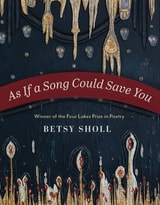
As If a Song Could Save You
Betsy Sholl
University of Wisconsin Press, 2022
As the volume carefully and slowly immerses us in the poet’s world, we gradually begin to understand that this is our journey of exploration as much as hers. Where does one find joy in the face of loss? Why does music exist in a world of grief? How long does it take love to overwhelm pain?
Through these powerful poems we learn to see past the unreliability of memory and into the depth of the present.
The child makes you a blue inch at the top of the page,
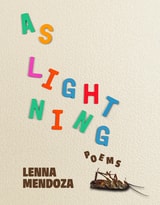
As Lightning
Lenna Mendoza
University of Wisconsin Press, 2026
Highlighting the prominent and contradictory place children occupy in Western culture, where they are at once cherished and reviled, As Lightning interrogates the nature of childhood itself. Offering multiple pathways through her own past via unexpected means—tests, riddles, word searches, rhyme, and a tour-de-force grouping of choose-your-own-adventure poems—Lenna Mendoza reveals the inherent pitfalls of imposing a narrative on a life.
In a paean to “the stuffed puppy I won’t leave,” she deftly observes, “we can hold more than we think.” This collection traces one multiracial queer girl’s experiences of identity, sexuality, trauma, race, gender, and the body itself, in vibrations and resonances that reconfigure these lenses of self-awareness and the limits of our understanding.
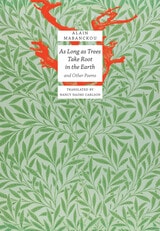
As Long As Trees Take Root in the Earth
and Other PoemsAlain Mabanckou
Seagull Books, 2025
These compelling poems by novelist and essayist Alain Mabanckou conjure nostalgia for an African childhood where the fauna, flora, sounds, and smells evoke snapshots of a life forever gone. Mabanckou’s poetry is frank and forthright, urging his compatriots to no longer be held hostage by the civil wars and political upheavals that have ravaged their country and to embrace a new era of self-determination where the village roosters can sing again.
These music-infused texts, beautifully translated by Nancy Naomi Carlson and supported by a grant from the National Endowment for the Arts, appear together in English for the first time. In these pages, Mabanckou pays tribute to his beloved mother, as well as to the regenerative power of nature, especially of trees, whose roots are a metaphor for the poet’s roots, anchored in the red earth of his birthplace. Mabanckou’s yearning for the land of his ancestors is even more poignant because he has been declared persona non grata in his homeland, now called Congo-Brazzaville, due to his biting criticism of the country’s regime. Despite these barriers, his poetry exudes hope that nature’s resilience will lead humankind on the path to redemption and reconciliation.
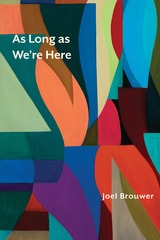
As Long as We're Here
Joel Brouwer
Four Way Books, 2026
As Long as We’re Here is an off-key anthem, a funhouse mirror held up to our dumpster fire era. Chronically online, distracted and distracting, with too many browser tabs open at once, attentive to everything and focused on nothing, Brouwer delights in the late capitalist absurdities of sleeping apps and internet dance crazes, and riffs on the argot of the group chat and the team meeting. These slippery poems both suffer from and revel in their ADD. Their shifts are as fleet as our news feeds, their serpentine sentences leap from barroom jests to high modernist splendor and back. But the book is not all fun and games. Dreamy tales of edgelords and loyalty oaths often arrive at places of surprising pathos and beauty. Mortality gnaws at the narrators of these poems, and political unrest lurks in the background. Still, a sense of solidarity—that we of the title, a recurring pronoun throughout—keeps despair at bay. Indeed, As Long as We’re Here is a book of intimacy, of the coterie. Friends and lovers people its lyrics, which often feel like late-night hang sessions with eccentric, wise-cracking pals. Full of wry wisdom and lush music, As Long as We’re Here knows what to do with a diminished thing: make it sing.
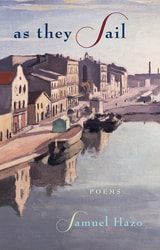
As They Sail
PoemsSamuel Hazo
University of Arkansas Press, 1999
With each new collection of poems, Samuel Hazo explores themes of mortality and love, passion and art, courage and grace in a style that is unmistakably his own. In As They Sail, he writes with equal feeling and clarity about political and artistic figures and the complex synchronicity between life and art. He is extremely interested in the wonderment and discovery that emerges in the act of writing, in the movement toward wisdom that results from expression of feeling.
Questioning is always more important in his writing than answering. Hazo has the ability to accomplish what he attributes to another poet, Charles Causley, in “When Nothing’s Happening, Everything’s Happening”: “. . . the poems borne of his pen / . . . help us to feel what we think.” He is able to achieve this “felt thought” without any trace of self-absorption or sentimentality.
Whether Hazo is writing about Nixon, Hemingway, or Brando or simply about walking in France, he finds the essence of language that gives rise to an emotional response. In a time when poetry without emotion is praised and language is said to make sense simply because it exists on the page, Hazo’s clear voice and concern with the nature of love, time, change, and the meaning of the past is uniquely refreshing.
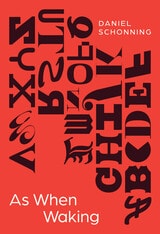
As When Waking
Daniel Schonning
University of Chicago Press, 2025
The poems of Daniel Schonning’s debut collection range from personal examinations of childhood suffering and loss of faith to deep observations of images and objects to the foreclosure of a family home, a father estranged by addiction, mallards on a frozen pond, flowering bindweed, and a door to the underworld. With all its component pieces, As When Waking aims to apprentice itself to the medium of letters, inviting readers to listen and learn from the systems and symmetries of alphabets.
Schonning employs structural paradigms to explore themes of poetic lineage. Twenty-six of the poems in this collection are abecedarians, a form where the opening letter of each line advances through the alphabet, with the lines of the first poem proceeding alphabetically from A–Z, while those of the second poem move from B–A, and then C–B, all the way to Z–A. This structure is tied to Jewish mystic texts such as the Sefer Yetzirah, which probes the relationship between the letters of the Hebrew alphabet and the world they inhabit.
As iZ
Tyrone Williams
Omnidawn, 2018
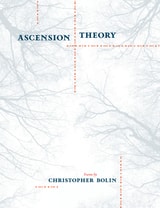
Ascension Theory
Christopher Bolin
University of Iowa Press, 2013
Bolin’s eye and mind are acutely tuned to the edges of broken objects and vistas, to the mysterious remnants out of which meaningful speech might be reconstituted. These poems unfold in a world of beautiful, crystalline absence, one that is nearly depopulated, as though encountered in the aftermath of an unnamed violence to the land and to the soul.
In poems of prodigious elegance and anxious control, Bolin evokes influences as various as Robert Frost, James Wright, Robert Hass, George Oppen, and Robert Creeley, while fashioning his own original and urgent idiom, one that both theorizes and tests the prospects of imaginative ascension, and finds “new locutions for referencing / sky.”

Ashore
Laurel Nakanishi
Tupelo Press, 2021
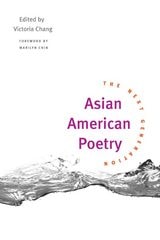
Asian American Poetry
THE NEXT GENERATIONEdited by Victoria M. Chang
University of Illinois Press, 2004
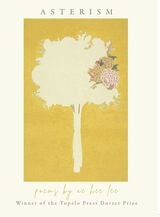
Asterism
Ae Hee Lee
Tupelo Press, 2024
At times personal, at others political, slipping back and forth between lyric and narrative and drawing on various languages and geographies, Asterism is a collection of grace and grit, the work of a mind at work—in, and on, a world that is simultaneously expanding and contracting. Both accessible and legitimately experimental, these poems invite and challenge the reader, moving between registers and modes with ease.
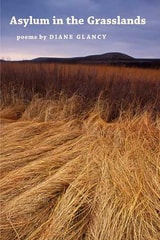
Asylum in the Grasslands
Diane Glancy
University of Arizona Press, 2007
In her new collection of poems, Glancy explores the history of loss that has marked the Cherokee community. In a voice that is as economical as it is eloquent and as sophisticated as it is exhilarating, she describes the loss of family, the loss of cultural heritage, and the loss of old worlds as new ones encroach. In one poem, a farm auction becomes an auction of culture, of heritage, of the past. In others, ancestors meet in a twenty-four-hour café, lunch is shared with a great-grandmother who has been traveling the universe, Christ appears as a cowboy in an apocalyptic vision, and Clytemnestra is discovered in a snakeskin. Some of the poems are as campy as a duck-decoy Custer in a shooting gallery. Some glitter with dime-store glue. Others speak with the reflection of sunlight off a stream. Sometimes the verse produces a shortstop language on the baseline of experience. In whatever form they take, Glancy’s poems stimulate and challenge the reader with their unfettered, unadorned, and unpretty purity. This collection is not only a spirited ride across the Great Plains, it is also an important addition to the literature of white–Native American cultural relationships.

At Every Wedding Someone Stays Home
PoemsDannye Romine Powell
University of Arkansas Press, 1994
The poems of Dannye Romine Powell take ordinary moments and transform them into rare and luminous epiphanies. These poems have the air of real places and real people who go about the perilous business of living in this world.
Powell is a poet of candor and clarity, and she has a wit that moves in surprising ways. These are poems not only to admire, but to relish and share; the pleasure they bring is closer to that of an old leather jacket than of a new pair of shoes. Powell writes like no one else, and she’s a joy to read.
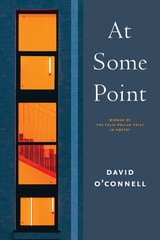
At Some Point
David O’Connell
University of Wisconsin Press, 2025
At The Drive-In Volcano
Aimee Nezhukumatathil
Tupelo Press, 2007
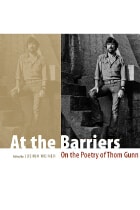
At the Barriers
On the Poetry of Thom GunnEdited by Joshua Weiner
University of Chicago Press, 2009
Maverick gay poetic icon Thom Gunn (1929–2004) and his body of work have long dared the British and American poetry establishments either to claim or disavow him. To critics in the UK and US alike, Gunn demonstrated that formal poetry could successfully include new speech rhythms and open forms and that experimental styles could still maintain technical and intellectual rigor. Along the way, Gunn’s verse captured the social upheavals of the 1960s, the existential possibilities of the late twentieth century, and the tumult of post-Stonewall gay culture.
The first book-length study of this major poet, At the Barriers surveys Gunn’s career from his youth in 1930s Britain to his final years in California, from his earliest publications to his later unpublished notebooks, bringing together some of the most important poet-critics from both sides of the Atlantic to assess his oeuvre. This landmark volume traces how Gunn, in both his life and his writings, pushed at boundaries of different kinds, be they geographic, sexual, or poetic. At the Barriers will solidify Gunn’s rightful place in the pantheon of Anglo-American letters.
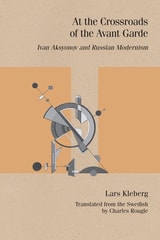
At the Crossroads of the Avant-Garde
Ivan Aksyonov and Russian ModernismLars Kleberg, Charles Rougle
Northwestern University Press, 2026
This kaleidoscopic biography offers readers a compelling microhistory of a revolutionary moment in art and politics through its portrait of an enigmatic but influential figure: Ivan Aksyonov authored the first book-length study about Pablo Picasso, translated Elizabethan drama, and was a literary adviser to Vsevolod Meyerhold, as well as a teacher of Sergei Eisenstein in Meyerhold’s institute and an important critic, before dying in 1935. Lars Kleberg traces Aksyonov’s influences, interlocutors, and creative output in multiple genres and media to bring a complicated and fascinating character back to life. Kleberg invites us to reconsider the avant-garde and to understand the political and artistic ferment of the revolutionary era and its aftermath in new, deeper ways.
At the Gate of All Wonder
Kevin McIlvoy
Tupelo Press, 2018
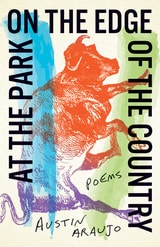
At the Park on the Edge of the Country
PoemsAustin Araujo
The Ohio State University Press, 2025
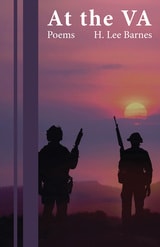
At the VA
Poemsbarnes
University of Nevada Press, 2027
At the VA offers an unflinching and deeply humane portrait of combat veterans—primarily from the Vietnam era—as they seek care within Veterans Affairs hospitals. These imagistic, lyrical pieces focus not on the battlefield but on its aftermath.
Author H. Lee Barnes, a veteran himself, addresses familiar wounds such as PTSD, moral injury, and survivor’s guilt while also bringing attention to underexamined experiences, including those of women veterans who have survived sexual assault. The collection honors sacrifice without sentimentality and resilience without oversimplifying the challenges veterans face.
At its center is a quiet irony: the VA can be frustrating and imperfect, yet to be there at all is to have survived. In that tension, Barnes finds a measured sense of hope that will resonate with readers who understand any type of trauma and recovery. Thoughtful and timely, At the VA asks what we owe our veterans long after their service ends.
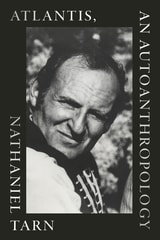
Atlantis, an Autoanthropology
Nathaniel Tarn
Duke University Press, 2022
Atlas Hour
Carol Ann Davis
Tupelo Press, 2011
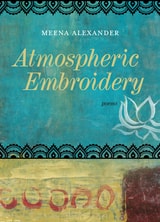
Atmospheric Embroidery
PoemsMeena Alexander
Northwestern University Press, 2018
In this haunting collection of poems we travel through zones of violence to reach the crystalline depths of words: Meena Alexander writes, "So landscape becomes us, / Also an interior space bristling with light." At the heart of this book is the poem cycle "Indian Ocean Blues," a sustained meditation on the journey of the poet as a young child from India to Sudan. There are poems inspired by the drawings of children from war-torn Darfur and others set in present-day New York City. These sensual lyrics of body, memory, and place evoke the fragile, shifting nature of dwelling in our times.
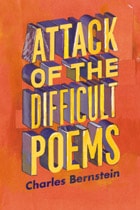
Attack of the Difficult Poems
Essays and InventionsCharles Bernstein
University of Chicago Press, 2011
Charles Bernstein is our postmodern jester of American poesy, equal part surveyor of democratic vistas and scholar of avant-garde sensibilities. In a career spanning thirty-five years and forty books, he has challenged and provoked us with writing that is decidedly unafraid of the tensions between ordinary and poetic language, and between everyday life and its adversaries. Attack of the Difficult Poems, his latest collection of essays, gathers some of his most memorably irreverent work while addressing seriously and comprehensively the state of contemporary humanities, the teaching of unconventional forms, fresh approaches to translation, the history of language media, and the connections between poetry and visual art.
Applying an array of essayistic styles, Attack of the Difficult Poems ardently engages with the promise of its title. Bernstein introduces his key theme of the difficulty of poems and defends, often in comedic ways, not just difficult poetry but poetry itself. Bernstein never loses his ingenious ability to argue or his consummate attention to detail. Along the way, he offers a wide-ranging critique of literature’s place in the academy, taking on the vexed role of innovation and approaching it from the perspective of both teacher and practitioner.
From blues artists to Tin Pan Alley song lyricists to Second Wave modernist poets, The Attack of the Difficult Poems sounds both a battle cry and a lament for the task of the language maker and the fate of invention.
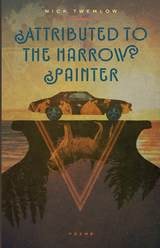
Attributed to the Harrow Painter
Nick Twemlow
University of Iowa Press, 2017
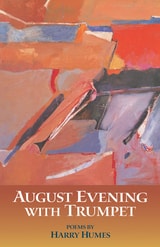
August Evening with Trumpet
PoemsHarry Humes
University of Arkansas Press, 2004
From its first poem, “String,” with its mythic overtones to the final “The Movement of Ice,” August Evening with Trumpet deals with the varieties of surprise and mystery, pain and wonder in the human experience. In constant motion, this collection ranges across a broad landscape, one in which trout swim through a house, where a coal miner father on vacation digs clams, where an old mother refuses help as she walks a narrow plank across a brook, and where in the quietly moving “Late November,” the speaker releases a raccoon from a leg-hold steel trap.
Uncluttered, clear, and direct, the poems move effortlessly and seamlessly into one another, gathering an overall pleasing unity and narrative energy. And if there is a vein of quiet sorrow and darkness running through the collection, it is balanced against courage, grace, and good humor. At the book’s center is a deep reverence for childhood, for parents, for children, for language, and for landscape, all of which Humes admirably holds up for us. Harry Humes’s work brings to mind William Blake’s “To see a World in a Grain of Sand / And a Heaven in a Wild Flower.”
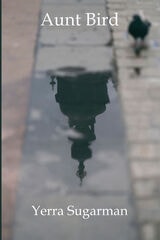
Aunt Bird
Yerra Sugarman
Four Way Books, 2022
Aunt Bird is an astonishing, hybrid poetry of witness that observes and testifies to social, political, and historical realities through the recovery of one life silenced by the past. Within these pages, poet Yerra Sugarman confronts the Holocaust as it was experienced by a young Jewish woman: the author’s twenty-three-year-old aunt, Feiga Maler, whom Sugarman never knew, and who died in the Kraków Ghetto in German-occupied Poland in 1942. In lyric poems, prose poems, and lyric essays, Aunt Bird combines documentary poetics with surrealism: sourcing from the testimonials of her kin who survived, as well as official Nazi documents about Feiga Maler, these poems imagine Sugarman’s relationship with her deceased aunt and thus recreate her life. Braiding speculation, primary sources, and the cultural knowledge-base of postmemory, Aunt Bird seeks what Eavan Boland calls “a habitable grief,” elegizing the particular loss of one woman while honoring who Feiga was, or might have been, and recognizing the time we have now.
Aurum
PoemsSantee Frazier
University of Arizona Press, 2019
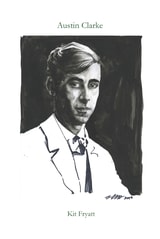
Austin Clarke
Kit Fryatt
Aberdeen University Press, 2020
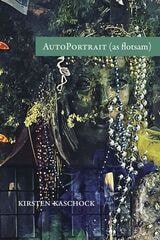
AutoPortrait (as flotsam)
Kirsten Kaschock
Tupelo Press, 2026
An investigation of identity as prompted by art and artists.
In AutoPortrait (as flotsam), Kirsten Kaschock uses the words, lives, and images of other artists as springboards into the self. Arranged almost as a gallery walk, AutoPortrait alternates between masque-like encounters with art and reflective passages engaging memory and desire. Influenced by photographers Francesca Woodman and Cindy Sherman, Kaschock walks a tightrope between vulnerability and artifice—using lines and shapes provided by the many artists referenced here (painters, musicians, and poets) to sketch an impression of a woman artist.
The struggle she chronicles is familiar to any storyteller: an effort to piece together minor episodes to create some semblance of a whole. The question is whether such a project can ever be accomplished. Can the fragments gathered on the shore of memory be tied together, brought to life? Other artists, perhaps especially the abstract expressionists, serve her as both guide and glue. The result is an intimate travelogue—the poet’s own narrow road to an interior where she finds a meditative balance between rage and regret, sorrow and joy.
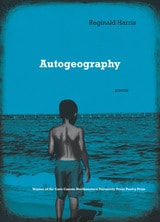
Autogeography
PoemsReginald Harris
Northwestern University Press, 2013
In his second collection of poetry, Reginald Harris traverses real and imagined landscapes, searching for answers to the question “What are you?” From Baltimore to Havana, Atlantic City to Alabama—and from the broad memories of childhood to the very specific moment of Marvin Gaye singing at the 1983 NBA All-Star Game shortly before his death—this is a travel diary of internal and external journeys exploring issues of race and sexuality. The poet traveler falls into and out of love and lust, sometimes coupled, sometimes alone. Autogeography tracks how who you are changes depending on where you are; how where you are and where you’ve been determine who you are and where you might be headed.
Autumn Rhythm
New and Selected PoemsLeon Stokesbury
University of Arkansas Press, 1996
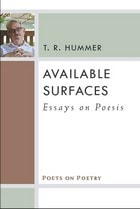
Available Surfaces
Essays on PoesisT. R. Hummer
University of Michigan Press, 2012
In Available Surfaces , T. R. Hummer explores the art of making both poetry and music, and of the concept of "making" itself. He draws on childhood experiences and experiences as an adult, as a poet, and as an explorer of unworldly spaces to examine that "something ineffable about the process of making of which the poem is the exemplary artifact."
Hummer grew up in the deep South, and spent many of his high school years playing saxophone in various rock and roll bands before he met poetry. This musical influence is visible in his work: he often discusses poetry together with music, or music with poetry, and his career has included both writing and performance.
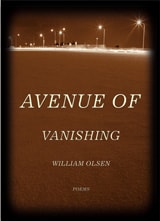
Avenue of Vanishing
William Olsen
Northwestern University Press, 2007
That’s what infinity did, contain and threaten,
until friends complied by going one by one
to resurface obligingly in memories, and it sometimes still feels
we left them at our leisure, that such choice was good
so long as a larger choice seemed to succeed it,
nor could gazing bereave us of common sense,
nor would all plenty and foison fall into penury,
nor would shame forever drop its heavy head.
Infinity felt like life, and it said so, and waited.
It even spelled our autumnal names in solid gold
leaves that an inexhaustible supply of wind
tossed for such pleasure as we had said and said
until it transformed into the profound conviction
that the right track was lost—imagine—forever,
it turned our tears into pebbles that can’t seep away,
that can’t fly away, that we don’t dare to pronounce,
yet it seemed concocted out of a clear beautiful sky,
yet it peeped out the woodshed and drank from the gutter spout,
yet it wrestled with itself and sank in eager mud
that presently it might be outwardly known
along with all the other creatures that perish,
heartbreaking idea among many heartbreaking ideas.
--from Infinity
Averroes' Middle Commentary on Aristotle's Poetics
St. Augustine's Press, 1999
Ay
Joan Houlihan
Tupelo Press, 2014
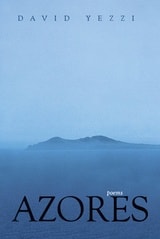
Azores
PoemsDavid Yezzi
Ohio University Press, 2008
A Slate Best Book of 2008
Included in Pushcart Prize XXXIV: Best of the Small Presses
Like a voyage to the Portuguese islands of the title, the poems in Azores arrive at their striking and hard-won destinations over the often-treacherous waters of experience—a man mourns the fact that he cannot not mourn, a father warns his daughter about harsh contingency, an unnamed visitor violently disrupts a quiet domestic scene. The ever-present and uncomfortable realities of envy, lust, and mortality haunt the book from poem to poem. Yezzi does not shy away from frank assessments of desire and human failing, the persistent difficulties of which are relieved periodically by a cautious optimism and even joy. Whether the poem’s backdrop is volcanic islands in the Mid-Atlantic or Manhattan Island at sunset, Yezzi examines the forces of change in the natural world, as w hether mundane or startlingly intimate. By turns plainspoken, caustic, evocative, and wry, these poems are, in matters of form, well-wrought and musical and, in matters of the heart, clear-eyed and always richly human.

a women
Vanessa Roveto
University of Iowa Press, 2020