Results by title
4030 books match the query 'Language Arts & Disciplines' and 351 start with a
Art Documentation
Journal of the Art Libraries Society of North America, volume 42 number 2 (Fall 2023)The University of Chicago Press
University of Chicago Press Journals, 2023

Art Documentation
Journal of the Art Libraries Society of North America, volume 43 number 1 (Spring 2024)The University of Chicago Press
University of Chicago Press Journals, 2024

Art Documentation
Journal of the Art Libraries Society of North America, volume 43 number 2 (Fall 2024)The University of Chicago Press
University of Chicago Press Journals, 2024
Art Documentation
Journal of the Art Libraries Society of North America, volume 44 number 1 (Spring 2025)The University of Chicago Press
University of Chicago Press Journals, 2025
Art Documentation
Journal of the Art Libraries Society of North America, volume 44 number 2 (Fall 2025)The University of Chicago Press
University of Chicago Press Journals, 2025
Art Documentation
Journal of the Art Libraries Society of North America, volume 45 number 1 (Spring 2026)The University of Chicago Press
University of Chicago Press Journals, 2026
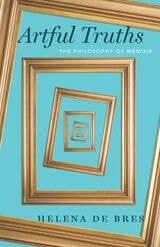
Artful Truths
The Philosophy of MemoirHelena de Bres
University of Chicago Press, 2021
Artful Truths offers a concise guide to the fundamental philosophical questions that arise when writing a literary work about your own life. Bringing a philosopher’s perspective to a general audience, Helena de Bres addresses what a memoir is, how the genre relates to fiction, memoirists’ responsibilities to their readers and subjects, and the question of why to write a memoir at all. Along the way, she delves into a wide range of philosophical issues, including the nature of the self, the limits of knowledge, the idea of truth, the obligations of friendship, the relationship between morality and art, and the question of what makes a life meaningful.
Written in a clear and conversational style, it offers a resource for those who write, teach, and study memoirs, as well as those who love to read them. With a combination of literary and philosophical knowledge, de Bres takes the many challenges directed at memoirists seriously, while ultimately standing in defense of a genre that, for all its perplexities—and maybe partly because of them—continually proves to be both beloved and valuable.
Artful Truths
The Philosophy of MemoirHelena de Bres
University of Chicago Press, 2021
Offers a philosophical perspective on the nature and value of writing a memoir.
Artful Truths offers a concise guide to the fundamental philosophical questions that arise when writing a literary work about your own life. Bringing a philosopher’s perspective to a general audience, Helena de Bres addresses what a memoir is, how the genre relates to fiction, memoirists’ responsibilities to their readers and subjects, and the question of why to write a memoir at all. Along the way, she delves into a wide range of philosophical issues, including the nature of the self, the limits of knowledge, the idea of truth, the obligations of friendship, the relationship between morality and art, and the question of what makes a life meaningful.
Written in a clear and conversational style, it offers a resource for those who write, teach, and study memoirs, as well as those who love to read them. With a combination of literary and philosophical knowledge, de Bres takes the many challenges directed at memoirists seriously, while ultimately standing in defense of a genre that, for all its perplexities—and maybe partly because of them—continually proves to be both beloved and valuable.

Arthur M. Schlesinger Jr. and the Ideological History of American Liberalism
Stephen P. Depoe
University of Alabama Press, 1994
Arthur M. Schlesinger, Jr., is a historian and political advocate whose ideas and activities have significantly influenced the shape and direction of American liberalism during the past fifty years. A central feature of Schlesinger’s ideological perspective is his belief that American history has been marked by alternating periods of conservative and liberal dominance, which he has termed the “tides of national politics.” Throughout his career, Schlesinger has used the “tides of national politics” to defend the legitimacy and superiority of active liberal government and leadership.
The study investigates how the “tides” concept has functioned in both Schlesinger’s historical scholarship and his partisan political discourse. Depoe also explores the ways in which the “tides” concept has shaped and channeled Schlesinger’s political thought over time, leading him toward certain definitions of situations and away from others. Finally, Depoe offers Schlesinger’s life and work as a case study of the highs and lows of postwar American liberalism. By tracing Schlesinger’s responses to Eisenhower-era conservatism, Kennedy’s New Frontier, and the problems of Vietnam and violence during the 1960s, and the gradual delegitimation of liberalism from the 1970s to the present, this book offers a road map that can guide the reader toward a better understanding of the past, present, and future of liberalism in America.
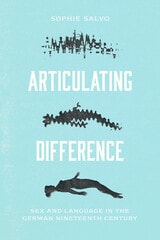
Articulating Difference
Sex and Language in the German Nineteenth CenturySophie Salvo
University of Chicago Press, 2024
Drawing on a wide range of texts, from understudied ethnographic and scientific works to canonical literature and philosophy, Sophie Salvo uncovers the prehistory of the inextricability of gender and language. Taking German discourses on language as her focus, she argues that we are not the inventors but, rather, the inheritors and adapters of the notion that gender and language are interrelated. Particularly during the long nineteenth century, ideas about sexual differences shaped how language was understood, classified, and analyzed. As Salvo explains, philosophers asserted the patriarchal origins of language, linguists investigated “women’s languages” and grammatical gender, and literary Modernists imagined “feminine” sign systems, and in doing so they not only deemed sex-based divisions to be necessary categories of language but also produced a plethora of gendered tropes and fictions, which they used both to support their claims and delimit their disciplines.
Articulating Difference charts new territory, revealing how gendered conceptions of language make possible the misogynistic logic of exclusion that underlies arguments claiming, for example, that women cannot be great orators or writers. While Salvo focuses on how male scholars aligned language study with masculinity, she also uncovers how women responded, highlighting the contributions of understudied nineteenth-century works on language that women wrote even as they were excluded from academic opportunities.
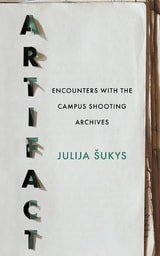
Artifact
Encounters with the Campus Shooting ArchivesJulija Šukys
West Virginia University Press, 2025
2026 IPPY Awards Bronze Medal Winner, Current Events - Social Issues/Humanitarian
2026 PROSE Award Finalist, Humanities: Literature
Artifact is about the stories we tell ourselves after mass shootings. Each college campus shooting leaves a record: archival collections, monuments to the dead, government-led inquiries, internal university investigations, and lawsuits. Artifact: Encounters with the Campus Shooting Archives seeks to understand university and college campus shootings that involve students and faculty of those institutions. The book examines the aftermaths of such attacks by moving between university archives, memorials to victims, conversations with survivors, and beyond.
Julija Šukys examines a series of five North American university and college campus shootings between 1966 and 2015: the École Polytechnique in Montreal, Concordia University in Montreal, Virginia Tech, University of Alabama–Huntsville, and Umpqua Community College in Roseburg, Oregon. These attacks involved students and faculty as both victims and perpetrators—that is, all the shooters were either faculty members or (in one case, would-be) students of the institution where the killings took place.
Šukys arrives at each site long after the killings have taken place: by now, the teddy bears, flowers, and crosses have been cleared away. Prying journalists are long gone. She sorts through myriad objects left at makeshift memorial sites. She talks for hours with a professor who survived an attack only because her colleague’s gun jammed as it was pointed at her head. She wanders and documents the reconfigured buildings made unrecognizable after the horrors that occurred within them. She reads tedious court transcripts, officious government-commissioned reports, and a troubling memoir written by a shooter’s mother and sifts through the mathematics papers that one campus shooter publishes from his prison cell.
Artifact weighs what it means to live in a place where students and their teachers are gunned down on a seemingly regular basis. It asks how we can continue to learn, teach, and live when nothing changes in response to these deaths. It attempts to speak into silence, to look at the pain of those who have come through trauma, and to meet their gazes without platitudes or triumphalism. The result is a searching book about care, memory, forgiveness, and survival.

Artsy Toddler Storytimes
A Year's Worth of Ready-To-Go ProgrammingCarol Garnett Hopkins
American Library Association, 2013
Aryan and Non-Aryan in India
Madhav M. Deshpande and Peter E. Hook, Editors
University of Michigan Press, 1979
As Sacred to Us
Simon Pokagon’s Birch Bark Stories in Their ContextsBlaire Morseau
Michigan State University Press, 2023
Ask, Listen, Empower
Grounding Your Library Work in Community EngagementSarah Ostman and Mary Davis Fournier
American Library Association, 2020
Foreword by Tracie D. Hall
Community engagement isn’t simply an important component of a successful library—it’s the foundation upon which every service, offering, and initiative rests. Working collaboratively with community members—be they library customers, residents, faculty, students or partner organizations— ensures that the library works, period. This important resource from ALA’s Public Programs Office (PPO) provides targeted guidance on how libraries can effectively engage with the public to address a range of issues for the betterment of their community, whether it is a city, neighborhood, campus, or something else. Featuring contributions by leaders active in library-led community engagement, it’s designed to be equally useful as a teaching text for LIS students and a go-to handbook for current programming, adult services, and outreach library staff. Balancing practical tools with case studies and stories from field, this collection explores such key topics as
- why libraries belong in the community engagement realm;
- getting the support of board and staff;
- how to understand your community;
- the ethics and challenges of engaging often unreached segments of the community;
- identifying and building engaged partnerships;
- collections and community engagement;
- engaged programming; and
- outcome measurement.
Aspects of English Sentence Stress
By Susan F. Schmerling
University of Texas Press, 1976
Aspects of English Sentence Stress is written within the conceptual framework of generative-transformational grammar. However, it is atheoretical in the sense that the proposals made cannot be formulated in this theory and are a challenge to many other theories. The author's concern is not with the phonetic nature of stress; rather, using a working definition of stress as subjective impression of prominence, she attempts to formulate general principles that will predict the relative prominence of different words in particular utterances—what might be called the syntax of stress. She supports her arguments with a large amount of original data and provides the basis for new ways of thinking about this area of linguistic research.
Schmerling begins with a detailed review and critique of Noam Chomsky and Morris Halle's approach to sentence stress; she shows that their cyclic analysis cannot be considered valid, even for quite simple phrases and sentences. Next, she reviews discussions of sentence stress by Joan Bresnan, George Lakoff, and Dwight Bolinger, agreeing with Bolinger's contention that there is no intimate connection between sentence stress and syntactic structure but showing that his counterproposal to the standard approach is inadequate as well. She also examines the concept of "normal stress" and demonstrates that no linguistically significant distinction can be drawn between "normal" and "special" stress contours.
In generating her own proposals concerning sentence stress, Schmerling takes the view that certain items which are stressable are taken for granted by the speaker and are eliminated from consideration by the principles governing relative prominence of words in a sentence. Then she examines the pragmatic and phonological principles pertaining to items that are not eliminated from consideration. Finally, the author contends that the standard views, which she shows to be untenable, are a result of the assumption that linguistic entities should be studied apart from questions concerning their use, in that it was adoption of this methodological assumption that forced linguists to deny the essentially pragmatic nature of sentence stress.
Accessible to anyone who is familiar with the basic concepts of generative-transformational grammar, Aspects of English Sentence Stress presents provocative ideas in the field.
Aspects of the Tonal System of Kalabari-ljo
Otelemate G. Harry
CSLI, 2004
This study determines that right-to-left association is the best method of analysis for Kalabari-ljo and also proposes that both morphosyntactic and semantic input be included in the tone system rules. Harry's innovative work provides new evidence for the morphological and semantic input in phonology theory and launches a new platform for scholarship in African language studies.
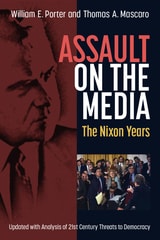
Assault on the Media
The Nixon YearsWilliam E. Porter and Thomas A. Mascaro
University of Michigan Press, 2024
Informed by a half-century of historical analyses and released documents, this expanded edition of William E. Porter’s award-winning Assault on the Media analyzes new documents of significance; synthesizes recent historical analyses; incorporates legal evaluations by journalism scholars; and traces how Nixon-era plans cultivated the divisive state of 21st-century society and amplified assaults on journalism. It also evaluates lasting concerns about the Supreme Court’s Pentagon Papers decision and journalists cited for contempt as a form of prior restraint; the currencies of power and race in protecting confidential sources; and regulatory decisions that hamper effective journalism. Assault on the Media not only documents the incidents and circumstances of governmental intimidation, harassment, and regulation of the news media during the Nixon presidency, but it offers insights into the long-term effects and their relevance today.
Assembling Critical Components
A Framework for Sustaining Technical and Professional Communication Editionedited by Joanna Schreiber and Lisa Melonçon
University Press of Colorado, 2022
Assessing Liaison Librarians
Documenting Impact ForDaniel Mack
American Library Association, 2014

Assessing Liaison Librarians
Documenting Impact for Positive ChangeDaniel C. Mack
Assoc of College & Research Libraries, 2014
Assessing Public Journalism
Edited by Edmund B. Lambeth, Philip Meyer, & Esther Thorson
University of Missouri Press, 1998
In response to increasingly negative attitudes toward journalism and its coverage of public affairs, many newspapers and television stations across the United States have experimented with novel approaches to reporting to better meet the public's demand for news. Known as "civic" or "public" journalism, this new movement seeks to improve the news media's ability to supply the information and insights needed by citizens of a democratic society. Critics of public journalism say it contradicts some principles of traditional reporting. As a result, the new movement has spurred great controversy among journalists. Assessing Public Journalism is the first book to evaluate this movement.
Public journalists use a variety of innovative methods to achieve their goals. To connect more closely with citizens, they may listen to their readers and viewers in neighborhood settings and public forums. To frame stories more accurately, they sometimes conduct focus groups and opinions polls. To maximize the reach of their work, print and electronic journalists have experimented with coordinated coverage of key elections and major public issues. Their goal is a form of journalism that improves the quality of citizen deliberation and participation in public life.
By collecting and focusing a wide range of original research and selected professional commentary, Assessing Public Journalism provides the necessary framework for examining the issues surrounding public journalism and for determining what must be done to enable it to meet its full potential. Scholars, journalists, and concerned citizens will benefit from this vital study.
Assessing Service Quality
Satisfying the Expectations of Library CustomersPeter Hernon
American Library Association, 2015
Assessing Service Quality
Satisfying the Expectations of Library CustomersAmerican Library Association, 1998
Assessing Writing, Assessing Learning
A Practical Guide for Evaluating and Reporting on Writing Instruction ProgramsDudley W. Reynolds
University of Michigan Press, 2010
The goals of this resource are broader than many standard books on writing assessment, which focus on evaluating an individual’s ability to create an effective piece of writing for a particular purpose. Assessing Writing, Assessing Learning seeks to support teachers, administrators, program directors, and funding entities who want to make the best use of the resources at their disposal to understand what students are learning and why and then take actions based on what they have learned. It also seeks to provide a common basis for communication among all the interested parties—the writing professionals, the people who identified the need for the program, and the students.
The book has sections on planning, tools (different ways of collecting data and links to instruments), and reporting (examples provided). Each section includes a discussion of issues and advice for working through the issue along with numerous examples, plus a list of resources to consult to learn more. The final chapter provides worksheets that may be reproduced and used to help those in charge of setting up and delivering a writing program to think through the issues presented. A glossary of terms is also included.
Assessing the Teaching of Writing
Twenty-First Century Trends and TechnologiesAmy E. Dayton
Utah State University Press, 2015
Although fraught with politics and other perils, teacher evaluation can contribute in important, positive ways to faculty development at both the individual and the departmental levels. Yet the logistics of creating a valid assessment are complicated. Inconsistent methods, rater bias, and overreliance on student evaluation forms have proven problematic. The essays in Assessing the Teaching of Writing demonstrate constructive ways of evaluating teacher performance, taking into consideration the immense number of variables involved.
Contributors to the volume examine a range of fundamental issues, including the political context of declining state funds in education; growing public critique of the professoriate and demands for accountability resulting from federal policy initiatives like No Child Left Behind; the increasing sophistication of assessment methods and technologies; and the continuing interest in the scholarship of teaching. The first section addresses concerns and advances in assessment methodologies, and the second takes a closer look at unique individual sites and models of assessment. Chapters collectively argue for viewing teacher assessment as a rhetorical practice.
Fostering new ways of thinking about teacher evaluation, Assessing the Teaching of Writing will be of great interest not only to writing program administrators but also to those concerned with faculty development and teacher assessment outside the writing program.
Assessment Strategies in Technical Services
Kimberley A. Edwards
American Library Association, 2019
Assessment and Advocacy
Using Project Outcome for Academic LibrariesGena Parsons-Diamond
Assoc of College & Research Libraries, 2024
In celebration of Project Outcome’s fifth anniversary, Assessment and Advocacy: Using Project Outcome for Academic Libraries collects case studies demonstrating how a variety of libraries have used Project Outcome to make improvements in their practice and highlighting the value the toolkit has brought to institutions and the academic library profession. Chapters capture ways to use Project Outcome to make small changes, like the optimal arrangement of a library’s study room furniture, to using Project Outcome data in conversation with datasets from other sources to provide greater insights into the contributions of academic libraries to student learning and success, as well as evidence that can be used in advocating for institutional, state, and federal funding.
Academic librarians know that their work makes a difference. You set students on the road to success and researchers on the road to results, providing valuable skills and access to knowledge that help our colleges and universities thrive. The challenge for libraries can be capturing meaningful data to support that story. Since 2019, the Project Outcome for Academic Libraries toolkit has helped library workers measure learning outcomes to drive change, make data-informed decisions, and demonstrate the impact and value of academic libraries. Learn how to use this data in your library, institution, and the profession with Assessment and Advocacy, all proceeds of which go to keeping Project Outcome free.
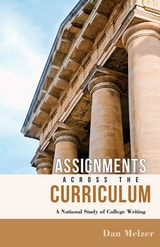
Assignments across the Curriculum
A National Study of College WritingDan Melzer
Utah State University Press, 2014
In Assignments across the Curriculum, Dan Melzer analyzes the rhetorical features and genres of writing assignments through the writing-to-learn and writing-in-the-disciplines perspectives. Presenting the results of his study of 2,101 writing assignments from undergraduate courses in the natural sciences, social sciences, business, and humanities in 100 postsecondary institutions in the United States, Assignments across the Curriculum is unique in its cross-institutional breadth and its focus on writing assignments.
The results provide a panoramic view of college writing in the United States. Melzer's framework begins with the rhetorical situations of the assignments—the purposes and audiences—and broadens to include the assignments' genres and discourse community contexts. Among his conclusions is that courses connected to a writing-across-the-curriculum (WAC) initiative ask students to write more often, in a greater variety of genres, and for a greater variety of purposes and audiences than non-WAC courses do, making a compelling case for the influence of the WAC movement.
Melzer's work also reveals patterns in the rhetorical situations, genres, and discourse communities of college writing in the United States. These larger patterns are of interest to WAC practitioners working with faculty across disciplines, to writing center coordinators and tutors working with students who bring assignments from a variety of fields, to composition program administrators, to first-year writing instructors interested in preparing students for college writing, and to high school teachers attempting to bridge the gap between high school and college writing.
Assistive Technologies in the Library
Barbara T. Mates
American Library Association, 2011
Association of University Presses Directory 2021
Edited by The Association of University Presses
AUP, 2020
Authors, booksellers, librarians, instructors, and publishing professionals across the industry will find this an invaluable resource, featuring editorial programs and publishing details for all 150+ Association members and much more.
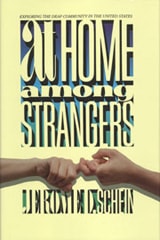
At Home Among Strangers
Exploring the Deaf Community in the United StatesJerome D. Schein
Gallaudet University Press, 1989
At Home Among Strangers presents an engrossing portrait of the Deaf community as a complex, nationwide social network that offers unique kinship to deaf people across the country. Schein depicts in striking detail the history and culture of the Deaf community, its structural underpinnings, the intricacies of family life, issues of education and rehabilitation, economic factors, and interaction with the medical and legal professions. This book is a fascinating, provocative exploration of the Deaf community in the United States for scholars and lay people alike.

At Home in the Anthropocene
Amy D. Propen
The Ohio State University Press, 2022
By employing the tenets of posthumanism, compassionate conservation, and entangled empathy—and making them accessible through storytelling and narrative—Propen offers new perspectives about how to more compassionately and productively understand ideas about home, connectivity, and coexistence across a range of places and ecosystems. Uniquely conceptualized to include narrative related to the Anthropause, as well as travel and nature writing amidst COVID-19, At Home in the Anthropocene engages with questions about home and belonging in generative ways that attempt to open up possibilities for sustainable futures in which we may productively coexist with our more-than-human kin.
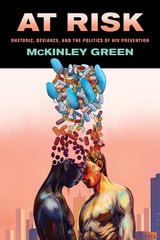
At Risk
Rhetoric, Deviance, and the Politics of HIV PreventionMcKinley Green
The Ohio State University Press, 2026
At Risk explores how young people living with HIV have developed risk-reduction practices that seem to contradict public health recommendations for HIV prevention. Putting forward a rhetoric of deviance to frame these instances, McKinley Green argues that they represent intentional healthcare decisions that help young people mitigate the health risks that are most pressing in their daily lives. While current HIV risk-reduction priorities in the US are framed around a finite spectrum of sexual behaviors and medical technologies, those living with HIV often encounter a broader spectrum of risks shaped by structural inequities like racism, housing insecurity, queer and transphobia, HIV stigma, trauma in medical settings, and addiction, all of which create conditions that increase the risk of HIV transmission and present other threats to safety and autonomy.
Drawing from more than sixty hours of interviews with young people living with HIV, frontline healthcare workers, and HIV activists, Green highlights how those living with HIV have developed agency and expertise in navigating, mitigating, and communicating about risk. In doing so, he offers alternative epistemologies of sexual health risk that point toward more patient-centered HIV prevention frameworks.
At Translation's Edge
Edited by Nataša Durovicová, Patrice Petro, and Lorena Terando
Rutgers University Press, 2019
Attitudes De Se
Linguistics, Epistemology, MetaphysicsEdited by Neil Feit and Alessandro Capone
CSLI, 2013
Attribute-Value Logic and the Theory of Grammar
Mark Johnson
CSLI, 1988
Audience Expectations and Teacher Demands
Robert Brooke and John Hendricks
Southern Illinois University Press, 1989
The audience—the community of readers who will use the texts a writer produces—must be an important influence on the writer for his or her work to be effective.
Robert Brooke and John Hendricks examine the difficult task of teaching "writing for an audience" in a classroom where students know that the teacher, not the addressed audience, assigns the grade.
The authors describe in detail a particular writing class, taught by Brooke and observed by Hendricks, that attempted to teach writing for an audience. By combining the experiences from their study with student reactions to the class, they draw some conclusions about the dynamics of teaching writing and about learning in general.
Audiobooks for Youth
A Practical Guide to Sound LiteratureMary Burkey
American Library Association, 2012
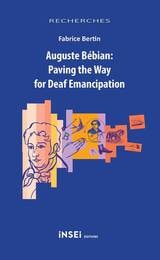
Auguste Bébian
Paving the Way for Deaf EmancipationFabrice Bertin
Gallaudet University Press, 2024
To some, he is a mythical figure; to others, he is unknown. Auguste Bébian (1789-1839) reflects society’s ambivalence toward Deaf history: sometimes recognized, often ignored. In the wake of Abbé de l’Épée, whose name is remembered in posterity and who demonstrated that the large-scale education of Deaf people was possible, Auguste Bébian was nonetheless a key player in an unprecedented upheaval, which in many ways went beyond the educational sphere. The goal of this research on Auguste Bébian, combining biographical elements and analysis of his thinking in unprecedented ways, is not to deconstruct the myth, but rather to decipher the messages it conveys, and to understand what it tells us, indirectly, about the Deaf experience.
Born in 1789 in Guadeloupe, part of the French West Indies, it was on the other side of the Atlantic Ocean, in France, that Auguste Bébian fulfilled most of his destiny. While living at the National Institution for the Deaf in Paris at the beginning of the 19th century, his daily contact with the young students made him the first known hearing person in France to achieve true mastery of sign language, the natural language of Deaf people, and a deep understanding of its inherent culture. On becoming a teacher, he constantly defended the use of sign language as a linguistic system in its own right in order to awaken the intelligence of Deaf children, to whom “we pay no more attention than to the sunlight that shines on us every day.” His numerous publications display a level of modernity rarely seen before or since. This biographical and historical study shows how the passion evinced by Auguste Bébian was a crucial link in the chain of events that led to the emancipation of Deaf people.
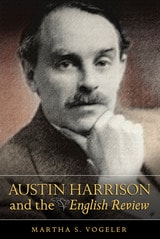
Austin Harrison and the English Review
Martha S. Vogeler
University of Missouri Press, 2008
Authoring
An Essay for the English Profession on Potentiality and SingularityJanis Haswell and Richard Haswell
Utah State University Press, 2010
Authorship in the Long Eighteenth Century
Dustin Griffin
University of Delaware Press, 2014
Published by University of Delaware Press. Distributed worldwide by Rutgers University Press.
Autobiographical Writing Across the Disciplines
A ReaderDiane P. Freedman and Olivia Frey, eds.
Duke University Press, 2003
The editors’ introduction presents a condensed history of academic writing, chronicles the origins of autobiographical criticism, and emphasizes the role of feminism in championing the value of personal narrative to disciplinary discourse. The essays are all explicitly informed by the identities of their authors, among whom are a feminist scientist, a Jewish filmmaker living in Germany, a potential carrier of Huntington’s disease, and a doctor pregnant while in medical school. Whether describing how being a professor of ethnic literature necessarily entails being an activist, how music and cooking are related, or how a theology is shaped by cultural identity, the contributors illuminate the relationship between their scholarly pursuits and personal lives and, in the process, expand the boundaries of their disciplines.
Contributors:
Kwame Anthony Appiah
Ruth Behar
Merrill Black
David Bleich
James Cone
Brenda Daly
Laura B. DeLind
Carlos L. Dews
Michael Dorris
Diane P. Freedman
Olivia Frey
Peter Hamlin
Laura Duhan Kaplan
Perri Klass
Muriel Lederman
Deborah Lefkowitz
Eunice Lipton
Robert D. Marcus
Donald Murray
Seymour Papert
Carla T. Peterson
David Richman
Sara Ruddick
Julie Tharp
Bonnie TuSmith
Alex Wexler
Naomi Weisstein
Patricia Williams
Autolexical Syntax
A Theory of Parallel Grammatical RepresentationsJerrold M. Sadock
University of Chicago Press, 1990
Sadock's principal innovation is the postulation of a uniform set of interface conditions that require the several orthogonal representations of a single natural language expression to match up in certain ways. Through a detailed application of his theory to the twin morphosyntactic problems of cliticization and incorporation, Sadock shows that very straightforward accounts are made possible by the nonderivational model. He demonstrates the empirical success of these accounts by examining more than two dozen morphosyntactic problems in almost as many languages.
Autolexical Syntax will be of interest to those in the fields of theoretical grammar, particularly concerned with the problems of morphology and syntax, as well as philosophers of language, logicians, lexicographers, psychologists of language, and computer scientists.
Automated Athens
Ancient Greek Ideals in the Early Age of AutomationMichele Kennerly
University of Chicago Press, 2026
A critical history of the recurring idea that technology will free us from work and bring about a truly democratic society.
In popular thought, ancient Athens endures as a place ahead of its time—the birthplace of democracy, a cultural center, and a model toward which modern societies should strive. In Automated Athens, Michele Kennerly examines the many and frequent appeals to this nostalgic vision of the ancient city-state throughout the early age of computerized automation. In the mid-twentieth century, people hoped that automation would free us from mindless, dehumanizing work so that we could attend to creative and communal pursuits. Proponents appealed to ancient Athens, saying automated systems and machines would stand in for the craftsmen, enslaved people, and subordinated women who performed the undesirable work that enabled that city-state’s flourishing. Automated Athens scrutinizes this appeal as it moves chronologically into present debates about the promise of automation and AI. For Kennerly, our inability to settle debates about where accelerating automation may take us, especially politically, reveals a deeper cultural indecisiveness about how to live well and live well together.
Automaton Theories of Human Sentence Comprehension
John T. Hale
CSLI, 2014
Averroes’ Middle Commentary on Aristotle’s Rhetoric
Arabic-English Translation, with Notes and IntroductionLahcen El Yazghi Ezzaher
Southern Illinois University Press, 2023
Abū al-Walīd Muḥammad ibn Aḥmad ibn Rushd (d. 1198 AD), known as Averroes in the West, wrote one of the most significant medieval Arabic commentaries on Aristotle’s famous treatise, Rhetoric. Averroes worked within a tradition that included the Muslim philosophers Al-Farabi (d. 950) and Avicenna (d. 1037), who together built an early canon introducing Aristotle’s writings to the academies of medieval Europe. Here, for the first time, Lahcen El Yazghi Ezzaher translates Averroes’ Middle Commentary into English, with analysis highlighting its shaping of philosophical thought.
Ibn Rushd was born into a prominent family living in Córdoba and Seville during the reign of the Almoḥad dynasty in the Maghreb and al-Andalus. At court, he received support to write a body of rhetorical commentaries extending the work of his Arabic-Muslim predecessors, a critical step in fostering Aristotle’s influence on European scholasticism and Western education. Ezzaher’s meticulous translation of Averroes’ Middle Commentary reflects the depth and breadth of this engagement, incorporating a discussion of the Arabic-Muslim commentary tradition and Averroes’ contribution to it. His research illuminates the complexity of Averroes’ position, articulating the challenges Muslim scholars faced in making non-Muslim texts available to their community. Through his work, we see how people at different historical moments have adapted intellectual concepts to preserve rhetoric’s vitality and relevance in new contexts.
Averroes’ Middle Commentary exemplifies the close connections between ancient Greece and medieval Muslim scholarship and the ways Muslim scholars navigated an appreciation for Aristotelian philosophy alongside a commitment to their cultural and religious systems.
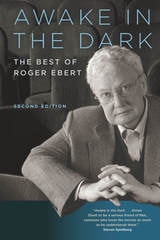
Awake in the Dark
The Best of Roger Ebert: Second EditionRoger Ebert
University of Chicago Press, 2017
Arriving fifty years after Ebert published his first film review in 1967, this second edition of Awake in the Dark collects Ebert’s essential writings into a single, irresistible volume. Featuring new Top Ten Lists and reviews of the years’ finest films through 2012, this edition allows both fans and film buffs to bask in the best of an extraordinary lifetime’s work. Including reviews from The Godfather to GoodFellas and interviews with everyone from Martin Scorsese to Meryl Streep, as well as showcasing some of Ebert’s most admired essays—among them a moving appreciation of John Cassavetes and a loving tribute to the virtues of black-and-white films—Ebert’s Awake in the Dark is a treasure trove not just for fans of this era-defining critic, but for anyone desiring a compulsively readable chronicle of the silver screen.
Stretching from the dramatic rise of rebel Hollywood and the heyday of the auteur to the triumph of blockbuster films such as Star Wars and Raiders of the Lost Ark, to the indie revolution that is still with us today, Awake in the Dark reveals a writer whose exceptional intelligence and daily bursts of insight and enthusiasm helped shape the way we think about the movies. But more than this, Awake in the Dark is a celebration of Ebert’s inimitable voice—a voice still cherished and missed.
Awful Archives
Conspiracy Theory, Rhetoric, and Acts of EvidenceJenny Rice
The Ohio State University Press, 2020
After sketching a broader framework for understanding what evidence is, Awful Archives then asks how we can practice more ethical and productive forms of debate, especially when we’re faced with arguments that feel like a dead end. Thorough, engaging, and deeply insightful, Awful Archives:Conspiracy Theory, Rhetoric, and Acts of Evidence introduces an entirely new perspective on evidence—one that will impact the field for years to come.