4743 books match the query 'Religion' and 371 start with a

cover of Appalachian Mountain Religion: A HISTORY

Appalachian Mountain Religion

A HISTORY

Deborah Vansau McCauley

University of Illinois Press, 1995

"A monumental achievement. . . . Certainly the best thing written on Appalachian Religion and one of the best works on the region itself. Deborah McCauley has made a winning argument that Appalachian religion is a true and authentic counter-stream to modern mainstream Protestant religion." -- Loyal Jones, founding director of the Appalachian Center at Berea College

Appalachian Mountain Religion is much more than a narrowly focused look at the religion of a region. Within this largest regional and widely diverse religious tradition can be found the strings that tie it to all of American religious history. The fierce drama between American Protestantism and Appalachian mountain religion has been played out for nearly two hundred years; the struggle between piety and reason, between the heart and the head, has echoes reaching back even further--from Continental Pietism and the Scots-Irish of western Scotland and Ulster to Colonial Baptist revival culture and plain-folk camp-meeting religion. Deborah Vansau McCauley places Appalachian mountain religion squarely at the center of American religious history, depicting the interaction and dramatic conflicts between it and the denominations that comprise the Protestant "mainstream." She clarifies the tradition histories and symbol systems of the area's principally oral religious culture, its worship practices and beliefs, further illuminating the clash between mountain religion and the "dominant religious culture" of the United States. This clash has helped to shape the course of American religious history.

The explorations in Appalachian Mountain Religion range from Puritan theology to liberation theology, from Calvinism to the Holiness-Pentecostal movements. Within that wide realm and in the ongoing contention over religious values, the many strains of American religious history can be heard.
 
[more]
cover of Apples and Oranges: Explorations In, On, and With Comparison

Apples and Oranges

Explorations In, On, and With Comparison

Bruce Lincoln

University of Chicago Press, 2018

Comparison is an indispensable intellectual operation that plays a crucial role in the formation of knowledge. Yet comparison often leads us to forego attention to nuance, detail, and context, perhaps leaving us bereft of an ethical obligation to take things correspondingly as they are. Examining the practice of comparison across the study of history, language, religion, and culture, distinguished scholar of religion Bruce Lincoln argues in Apples and Oranges for a comparatism of a more modest sort.

Lincoln presents critiques of recent attempts at grand comparison, and enlists numerous theoretical examples of how a more modest, cautious, and discriminating form of comparison might work and what it can accomplish. He does this through studies of shamans, werewolves, human sacrifices, apocalyptic prophecies, sacred kings, and surveys of materials as diverse and wide-ranging as Beowulf, Herodotus’s account of the Scythians, the Native American Ghost Dance, and the Spanish Civil War.

Ultimately, Lincoln argues that concentrating one's focus on a relatively small number of items that the researcher can compare closely, offering equal attention to relations of similarity and difference, not only grants dignity to all parties considered, it yields more reliable and more interesting—if less grandiose—results. Giving equal attention to the social, historical, and political contexts and subtexts of religious and literary texts also allows scholars not just to assess their content, but also to understand the forces, problems, and circumstances that motivated and shaped them.  
 
[more]
cover of Approaching the Assumption, 1863-1950: Revelation, Scripture, and the Laity in the Development of a Marian Dogma

Approaching the Assumption, 1863-1950

Revelation, Scripture, and the Laity in the Development of a Marian Dogma

Eric Lafferty

Catholic University of America Press, 2026
The Assumption of Mary refers to the ancient Christian belief that the Mother of God was taken up into Heaven, body and soul, at the end of her earthly life. For centuries, Catholics and other Christians celebrated the Assumption as a liturgical feast and meditated on the miraculous event in the Rosary. Nevertheless, its relationship to Revelation remained undefined. This changed in 1950 when Pope Pius XII declared the Assumption of Mary a dogma of the Catholic Church. In this rare exercise of papal authority, Pius XII infallibly and irrevocably taught that the Assumption was a truth revealed by God. This book explores how the definition of this Marian dogma came to fruition. After a brief history of the prior three Marian dogmas — Mother of God, Ever-Virgin, and the Immaculate Conception — this book narrates the major moments in the effort to obtain a dogmatic definition of the Assumption. The beginning of this “Assumptionist movement” can be dated to 1863 when Queen Isabel II of Spain petitioned the pope to declare the Assumption a dogma. Subsequently, petitionary efforts and scholarly inquiry increased and spread throughout the world. In addition to the narrative of this movement, this book gives special consideration to three vital aspects: debate over the Assumption’s definability as a dogma, if and how Scripture reveals the Assumption, and the contribution of the laity on a matter of doctrine. Collectively, the Assumptionist movement emerges as a critical event in the nineteenth- and twentieth-century Catholic Church. Culminating in a dogmatic definition shortly before the opening of Vatican II, it also serves as a key point of inquiry for continuity and development of doctrine. A final chapter argues that the operative beliefs pertaining to Revelation, Scripture, and the laity during the Assumptionist movement stand in continuity with the teachings of Vatican II.
[more]
cover of Aquinas and the Early Chinese Masters: Chinese Philosophy and Catholic Theology

Aquinas and the Early Chinese Masters

Chinese Philosophy and Catholic Theology

Joshua Brown

Catholic University of America Press, 2025
Aquinas and the Early Chinese Masters lays intellectual foundations for the integration of Chinese philosophy into Catholic theology. Although Catholic theology in Chinese contexts has drawn upon Chinese philosophical concepts, few have attempted to develop a rigorous, systematic approach to testing what in the Chinese philosophical traditions can be fruitful or unfruitful for Catholic theological expression. This book attempts to model such an approach by engaging classical Chinese philosophy with the mind and spirit of St. Thomas Aquinas, who read Aristotle and other pagan philosophers with both charitable appreciation and a firm, critical eye. It applies this Thomistic lens through concrete comparative engagements with three main representatives of early Chinese philosophy: Mencius (Mengzi孟子), Xunzi荀子, and Mozi墨子. In each chapter, the book presents Aquinas’ thought as an evaluative frame for perceiving how Chinese philosophical commitments and concepts do or do not seem fit for adoption into Catholic theological science. Following the general structure of the Summa theologiae, the book is comprised of six chapters touching on the doctrine of God, morality, and Christology. The first two chapters engage Confucian master Mengzi’s notion of Heaven (Tian天), and then the Mohist doctrine of Heaven’s Will (Tian zhi天志). Chapter three provides a Thomistic assessment of the two main positions in the classical Confucian debate on the goodness of man’s moral nature (renxing人性). Chapter four compares Aquinas’ account of charity and Mozi’s doctrine of “universal love” (jian ai兼愛). Chapter 5 offers a Thomistic assessment of the possibility of understanding Christ in terms of Xunzi’s “sage” (shengren聖人). Finally, Chapter 6 explores Christ as a moral teacher by putting Aquinas’ reading of Matt 8:21-22 into conversation with Confucian ethics of filial virtue.
[more]
cover of Aquinas and the Theology of the Body

Aquinas and the Theology of the Body

Thomas Petri

Catholic University of America Press, 2016

Pope John Paul's Theology of the Body catecheses has garnered tremendous popularity in theological and catechetical circles. Students of the Theology of the Body have generally interpreted it as innovative not only in its presentation of the Church's teaching on marriage and sexuality, but also as radically advancing that teaching. Aquinas and the Theology of the Body offers a somewhat different interpretation. Fr. Thomas Petri argues that the philosophy and theology of Thomas Aquinas substantially contributed to John Paul's intellectual formation, which he never abandoned. A correct interpretation of the Theology of the Body requires, therefore, a thorough understanding of Thomistic anthropology and theology, which has been mostly lacking in commentaries on the pope's important contributions on the subject of marriage and sexuality.
[more]
cover of Aquinas at 800: Commemorative Studies 1225-2025, Volume 1

Aquinas at 800

Commemorative Studies 1225-2025, Volume 1

David Cory

Catholic University of America Press, 2025
These volumes gather together the latest research from 40 of the world's most eminent Thomistic theologians and philosophers, in commemoration of the 800th anniversary of Thomas Aquinas's birth. To mark this anniversary, these scholars each prepared a chapter that is an original research study shared at a major international conference in September 2024. The volumes cover a wide range of both philosophical and theological topics, reflecting the breadth of Aquinas's own thought, and will be organized by subject matter. Together, these volumes will provide a compendium of outstanding research on the wide spectrum of Aquinas's thought, which we hope will have enduring value for the field, offering an opportunity to revisit the ongoing importance of the work of Thomas Aquinas today.
[more]
cover of Aquinas at 800: Commemorative Studies 1225-2025, Volume 2

Aquinas at 800

Commemorative Studies 1225-2025, Volume 2

David Cory

Catholic University of America Press, 2025

These volumes gather together the latest research from 40 of the world's most eminent Thomistic theologians and philosophers, in commemoration of the 800th anniversary of Thomas Aquinas's birth. To mark this anniversary, these scholars each prepared a chapter that is an original research study shared at a major international conference in September 2024. The volumes cover a wide range of both philosophical and theological topics, reflecting the breadth of Aquinas's own thought, and will be organized by subject matter. Together, these volumes will provide a compendium of outstanding research on the wide spectrum of Aquinas's thought, which we hope will have enduring value for the field, offering an opportunity to revisit the ongoing importance of the work of Thomas Aquinas today.
[more]
cover of Aquinas on Prophecy: Wisdom and Charism in the <i>Summa Theologiae</i>

Aquinas on Prophecy

Wisdom and Charism in the <i>Summa Theologiae</i>

Paul M. Rogers

Catholic University of America Press, 2023
Aquinas on Prophecy argues that a lacuna exists (especially among Anglophone scholars of Aquinas) that neglects to identify his most famous work as a prophetic witness to the transformative effect of Christian theology. Through a detailed examination of Aquinas’s treatment of prophecy in the Summa Theologiae (II-II, QQ.171-174), Paul Rogers reveals how prophetic testimony is central to the understanding of Christian revelation, faith, and theology, since it presents an initial (and historically-rooted) model for a Christian pedagogy that attempts to affect intellectual and moral transformation through communicating knowledge about God. The theologian thus conceived by Aquinas exercises analogously a prophetic, and hence social, function among Christian believers that has a special care for their spiritual and moral guidance. In contrast to readings of Aquinas that portray him as overly reliant on Aristotelian gnoseology (e.g., Jenkins 1997), Rogers lays out a reading more in line with recent ‘ressourcement’ Thomistic interpreters that identifies in his account of prophecy a creative adaptation of Arabic-Aristotelian gnoseology in the service of clarifying difficulties that had arisen in the thirteenth century surrounding the reception of a patristic (and predominantly Augustinian) tradition of prophetic illumination or vision. In the hands of Aquinas, the traditional Augustinian theory of prophetic illumination was re-envisioned and reinvigorated, which in turn allowed him to reassert confidently prophecy’s status as certain knowledge (scientia) that required its own distinct ‘light’, comparable to the light of natural reason and the lights of faith and glory. Highlighting prophecy in Aquinas’s thought helps especially to refocus today’s readers on how knowledge of the final end as revealed was for Aquinas the ultimate moral objective shared by both the prophet and theologian: a point that is best appreciated when his account of prophecy is related back to his understanding of sacred doctrine and faith as a whole—the book’s central task.
[more]
cover of Aquinas on Transubstantiation

Aquinas on Transubstantiation

Reinhard Hutter

Catholic University of America Press, 2019
Aquinas on Transubstantiation treats one of the most frequently mis-understood and mis-represented teachings of Thomas Aquinas—Eucharistic transubstantiation. The study interprets Aquinas’s teaching as an exercise of “holy teaching” (sacra doctrina) that intends to show theologically and back up philosophically the simple yet profound thesis that “transubstantiation” affirms nothing but the truth of Christ’s words at the Last Supper—“This is my body,” “This is my blood.” Yet in order to achieve a contemporary ressourcement of this simple yet profound truth, it is necessary to probe the depths of Thomas Aquinas’s philosophical interpretation of it. For Thomas Aquinas, in regarding the truth of Eucharistic conversion, it is faith that preserves the human intellect from missing or dismissing the mystery announced in Christ’s words. Faith, however, is not intellectually blind, a faith that, as is often erroneously held, is commanded by arbitrary divine dictates to which the will submits in blind obedience. Rather, Aquinas takes faith is sustained, but not constituted, by an intellectual contemplation of the proposed mystery of faith, by faith seeking understanding. Thomas Aquinas unfolds this exercise of understanding guided by faith in the medium of a metaphysical contemplation that affords a profound intellectual appreciation of this central mystery of faith—precisely as mystery. Thomas’s metaphysical contemplation of Eucharistic conversion gestures toward the blinding light of superintelligibility, experienced as the unique darkness that surrounds this sublime mystery of faith. A ressourcement in Thomas Aquinas’s doctrine of transubstantiation also affords an renewed appreciation of the Church’s affirmation of transubstantiation as the most apt term for the interpretation of the mystery of Eucharistic conversion and a greater precision of what is centrally at stake in this mystery in the ongoing ecumenical conversation of this most central Christian teaching. A doctrinally sound, ecumenically informed, and philosophically reflected contemporary Catholic theology cannot afford to ignore or dismiss Aquinas’s surpassing account of Eucharistic conversion.
[more]
cover of Aquinas the Augustinian

Aquinas the Augustinian

Michael Dauphinais

Catholic University of America Press, 2007

The book is composed of eleven essays by an international group of renowned scholars from the United States, England, Switzerland, Holland, and Italy
[more]
cover of Aquinas' Cruciform Theology of the Natural Law

Aquinas' Cruciform Theology of the Natural Law

Kevin E. O'Reilly

Catholic University of America Press, 2026
The predominant understanding of St. Thomas’s account of the natural law to date has been that it is basically philosophical in character. In Thomas Aquinas’s Cruciform Theology of the Natural Law, Kevin E. O’Reilly, OP, argues that Thomas’s construal of the natural law is, on the contrary, thoroughly theological in its inspiration. In order to establish this point the author first unpacks the significance of the scriptural quotations employed by Thomas in his very first article devoted to the natural law (ST I-II, q. 91, a. 2). Exegesis of one of those quotations, namely Ps. 4:6 – "Offer up the sacrifice of justice" – intimates that the degree to which one grasps the demands of the natural law is intimately bound up with the extent to which one is conformed to the Crucified Christ. Consideration of the notion that the natural law is the participation of the eternal law in the rational creature yields the same conclusion. Thus, while the eternal law pertains to God’s essence, it is nevertheless expressed by and therefore appropriated to the Word uttered by the Father. This Word is the divine Wisdom ultimately disclosed on the Cross. It becomes apparent that the eternal law is thus cruciform in nature. So too is the natural law as a cognitive participation therein. This cognitive participation engages the life of faith and charity as well as the Gifts of the Holy Spirit. Examination of Thomas’s account of the three degrees of charity as well as his treatment of the Gifts of the Holy Spirit and the beatitudes that are correlated with them underscores the important role that the dynamics of cruciformity play in illuminating the demands of the natural law. Cruciformity and moral illumination are intimately connected.
[more]
cover of Aquinas's <i>Summa</i> and Jesuit Ethics: A Call for Ressourcement

Aquinas's <i>Summa</i> and Jesuit Ethics

A Call for Ressourcement

Justin M. Anderson

Catholic University of America Press, 2026
This book explores how the great sixteenth- and early-seventeenth-century Jesuits read the secunda pars of the Summa theologiae. Their interpretation of Aquinas’s moral theology is shaped in part by their historical context, including the impact of the Protestant Reformation and the European discovery of the "New World," as well as new trade routes with Asia. The essays in this volume explore a wide variety of topics, including the natural desire to see God, infused moral virtues, freedom of conscience, faith and justification, doctrinal development, just war, slavery, the virtue of religion, Eucharistic sacrifice, sexual ethics, the theology of vocation, and natural law. The essays engage the thought of Francisco Suárez, Gabriel Vázquez, Luis de Molina, Francisco de Toledo, and various others. The underlying argument of the book is that this erudite, deeply Catholic and broadly Thomistic approach to ethics should be retrieved, given its Christian seriousness. Guided by divine revelation as taught in Scripture and Tradition, moral theologians in the Jesuit tradition ground themselves in Aquinas and in a rich understanding of natural law, universal moral norms, and the virtues, as well as in appreciation for spiritual interiority, conscience, and discernment.
[more]
cover of Aquinas's Summa: background, structure, & reception

Aquinas's Summa

background, structure, & reception

Jean-Pierre Torrell

Catholic University of America Press, 2005

In this concise new volume by the acclaimed author of the biography of Saint Thomas Aquinas, Jean-Pierre Torrell brings his expertise to bear on Aquinas's Summa Theologiae.
[more]
cover of Aquinas, Wittgenstein, and the Riddle of Spiritual Pedagogy

Aquinas, Wittgenstein, and the Riddle of Spiritual Pedagogy

Matthew Dunch

Catholic University of America Press, 2027
How can Paul, or you and I for that matter, speak with authority about mystery? Using the language of sacred riddles, Aquinas, Wittgenstein, and the Riddle of Spiritual Pedagogy argues that spiritual authority arises within the creative tension between the mystery of God’s will and our concrete human circumstances. Since at least the Enlightenment and increasingly in times of scandal, spiritual authority is suspect. Speaking authoritatively about mystery seems like a contradiction. Critics accuse such authorities of being at best vapid or at worst manipulative. Using a philosophical approach, Matt Dunch, SJ, defends the tradition of Christian spiritual teaching from St. Paul, through St. John Cassian and St. Ignatius Loyola, to contemporaries such as Dorothy Day. He supplements St. Thomas Aquinas’s account of prudence and counsel with Ludwig Wittgenstein’s sensitivity to the context and limits of sensible speech. Taken together, they all give us their accounts of how spiritual teaching can emerge from sacred riddles. Spiritual authority is unlike other forms of authority because the mystery or riddle of God is outside human understanding. At the same time, spiritual authority must address our concrete needs. Dunch considers how such riddles might be lived with and through, though not solved. This book will be of interest to readers who love the nature and practice of religious language, including philosophers of religion, systematic theologians, and spiritual directors. It will speak to anyone contemplating sacred mysteries.
[more]
cover of Aquinas: God and Action

Aquinas

God and Action

David B. Burrell C.S.C.

University of Scranton Press, 2008
First published 30 years ago and long out of print, Aquinas: God and Action appears here for the first time in paperback. This classic volume by eminent philosopher and theologian David Burrell argues that Aquinas’s is not the god of Greek metaphysics, but a god of both being and activity. Aquinas’s plan in the Summa Theologiae, according to Burrell, is to instruct humans how to find eternal happiness through acts of knowing and loving. Featuring a new foreword by the author, this edition will be welcomed by philosophers and theologians alike.
 
[more]
cover of Aquinas’s Neoplatonism in the Summa Theologiae on God: A Short Introduction

Aquinas’s Neoplatonism in the Summa Theologiae on God

A Short Introduction

Wayne J. Hankey

St. Augustine's Press, 2016
[more]
cover of Aramaic Incantation Bowls in Their Late Antique Jewish Contexts

Aramaic Incantation Bowls in Their Late Antique Jewish Contexts

Alexander W. Marcus

SBL Press, 2025
Outside of the Babylonian Talmud, the Aramaic incantation bowls inscribed with elaborate magical texts are the only major extant written corpus produced by Jews during the late Sasanian and early Islamic periods (ca. 500–700 CE). Contributors Siam Bhayro, Anne Burberry, Shira Eliassian, James Nathan Ford, Tal Ilan, Reuven Kiperwasser, Dan Levene, Alexander W. Marcus, Jason Sion Mokhtarian, Ortal-Paz Saar, Harriet Walker, and Daniel J. Waller approach the amulets through a variety of methodological approaches, including social history, gender studies, linguistics, and digital humanities. The volume includes an up-to-date survey, introductory essay, map of known excavation sites, and bibliographical resources for the vast and diffuse corpus of Aramaic incantation bowls that served a number of purposes, including warding off evil spirits and diseases, overturning curses from human adversaries, and achieving success in court cases, childbirth, or livelihood. The fascinating artifacts presented here transform our understanding of Jewish culture, interreligious interactions, and the varieties of Jewish identity and religion that existed during this formative era.
[more]
cover of Aramaic Literature from Egypt and the Levant

Aramaic Literature from Egypt and the Levant

Tawny L. Holm

SBL Press, 2026
In this volume, Tawny L. Holm provides bilingual editions of the majority of Aramaic literary compositions written between the fifth century BCE and first century CE. Each text is presented in transliteration and accompanied by an introduction, notes, and an English translation. The section on Egypt includes, among others, the fascinating anthology found on Papyrus Amherst 63, an Aramaic text written in the Demotic Egyptian script, as well as the Story and Proverbs of Ahiqar. The Levant section includes a selection of texts from the Dead Sea Scrolls, such as Tales from the Persian Court. These compositions cover a broad array of themes, from insights into the human condition to unique portraits of kings, heroes, and deities. The book also addresses matters of history, language, genres, poetics, and scribalism, and it offers a comprehensive collection of primary sources for use in ancient Near Eastern studies courses as well as biblical studies.
[more]
cover of Archaeology and Ancient Religion in the American Midcontinent

Archaeology and Ancient Religion in the American Midcontinent

Edited by Brad H. Koldehoff and Timothy R. Pauketat

University of Alabama Press, 2019

Analyses of big datasets signal important directions for the archaeology of religion in the Archaic to Mississippian Native North America

Across North America, huge data accumulations derived from decades of cultural resource management studies, combined with old museum collections, provide archaeologists with unparalleled opportunities to explore new questions about the lives of ancient native peoples. For many years the topics of technology, economy, and political organization have received the most research attention, while ritual, religion, and symbolic expression have largely been ignored. This was often the case because researchers considered such topics beyond reach of their methods and data.

In Archaeology and Ancient Religion in the American Midcontinent, editors Brad H. Koldehoff and Timothy R. Pauketat and their contributors demonstrate that this notion is outdated through their analyses of a series of large datasets from the midcontinent, ranging from tiny charred seeds to the cosmic alignments of mounds, they consider new questions about the religious practices and lives of native peoples. At the core of this volume are case studies that explore religious practices from the Cahokia area and surrounding Illinois uplands. Additional chapters explore these topics using data collected from sites and landscapes scattered along the Mississippi and Ohio River valleys.

This innovative work facilitates a greater appreciation for, and understanding of, ancient native religious practices, especially their seamless connections to everyday life and livelihood. The contributors do not advocate for a reduced emphasis on technology, economy, and political organization; rather, they recommend expanding the scope of such studies to include considerations of how religious practices shaped the locations of sites, the character of artifacts, and the content and arrangement of sites and features. They also highlight analytical approaches that are applicable to archaeological datasets from across the Americas and beyond.
[more]
cover of Archaeology, History, and Formation of Identity in Ancient Israel

Archaeology, History, and Formation of Identity in Ancient Israel

Filip Capek

Karolinum Press, 2023

A critical examination of the history of Israel.

When did Israel begin? The origins of ancient Israel are shrouded in mystery, and those hoping to explore the issue must utilize resources from three different fields—archaeology, epigraphy, and biblical texts—and then examine their interrelations while keeping in mind that the name Israel was not used to describe just one state but referred to numerous entities at different times.

Archaeology, History, and Formation of Identity in Ancient Israel provides a critical reading of Israel’s history. It is neither a harmonizing reading, which takes the picture painted by texts as a given fact, nor a reading supporting biblical texts with archaeological and epigraphic data; instead, it offers the reader multiple options to understand biblical narratives on a historical and theological level. In addition to presenting the main currents in the field, the book draws upon the latest discoveries from Czech-Israeli excavations to offer new hypotheses and reconstructions based on the interdisciplinary dialogue between biblical studies, archaeology, and history.
[more]
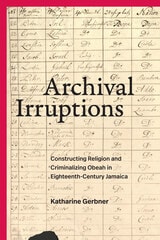
cover of Archival Irruptions: Constructing Religion and Criminalizing Obeah in Eighteenth-Century Jamaica

Archival Irruptions

Constructing Religion and Criminalizing Obeah in Eighteenth-Century Jamaica

Katharine Gerbner

Duke University Press, 2025

In 1760, following the largest slave revolt in the eighteenth-century British Empire, the Afro-Caribbean word Obeah first appeared in British colonial law. In Archival Irruptions, Katharine Gerbner traces how British authorities in Jamaica came to criminalize Obeah, a practice that was variously seen as a healing method, an Africana religion, a science, and a form of witchcraft. Gerbner shows that in the years directly preceding its criminalization, for enslaved Africans and Maroons, Obeah was a prophetic practice tied to healing and death rites. Drawing on Moravian missionary archives, Gerbner theorizes these descriptions of African religious beliefs, rituals, and concepts as “irruptions”: moments when Africana epistemologies break the narrative of a European-authored archival document. In these irruptions, we see European assertions of authority through the lens of Obeah. Moreover, we find that the modern category of religion is rooted in the histories of slavery, rebellion, and the criminalization of Black religious practices. Gerbner’s search for archival irruptions not only creates an opportunity to write an alternative narration about Obeah; it provides a new methodology for all those conducting archival research.
[more]
cover of Archiving Heaven and Earth: The Historian's Office and the Making of Mormonism

Archiving Heaven and Earth

The Historian's Office and the Making of Mormonism

Robin Scott Jensen

University of Illinois Press, 2027

From the earliest days, members of the Church of Jesus Christ of Latter-day Saints considered the keeping of records both a sacred command and a practical need.

Robin Scott Jensen explores the Church Historian’s Office against the backdrop of how writing and archiving what was written shaped the growth, faith, and identity of the nineteenth-century Latter Day Saint movement. As Jensen shows, records simultaneously created and preserved history. Journal keeping and letter writing stood alongside official documents as an essential means for Saints to understand their mission and place in American society. Over time, the Church Historian’s Office evolved into a powerful institution that guided memory and authority by deciding what to collect, copy, or destroy. Jensen tells the stories of the forgotten archivists, many of them women, who built the Church Historian’s Office, while revealing the choices and conflicts that led to Native and other voices being marginalized or erased.

Detailed and candid, Archiving Heaven and Earth provides a rare look at a foundational organization.
[more]
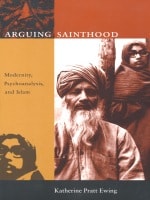
cover of Arguing Sainthood: Modernity, Psychoanalysis, and Islam

Arguing Sainthood

Modernity, Psychoanalysis, and Islam

Katherine Pratt Ewing

Duke University Press, 1997

In Arguing Sainthood, Katherine Pratt Ewing examines Sufi religious meanings and practices in Pakistan and their relation to the Westernizing influences of modernity and the shaping of the postcolonial self. Using both anthropological fieldwork and psychoanalytic theory to critically reinterpret theories of subjectivity, Ewing examines the production of identity in the context of a complex social field of conflicting ideologies and interests.
Ewing critiques Eurocentric cultural theorists and Orientalist discourse while also taking issue with expatriate postcolonial thinkers Homi Bhabha and Gayatri Spivak. She challenges the notion of a monolithic Islamic modernity in order to explore the lived realities of individuals, particularly those of Pakistani saints and their followers. By examining the continuities between current Sufi practices and earlier popular practices in the Muslim world, Ewing identifies in the Sufi tradition a reflexive, critical consciousness that has usually been associated with the modern subject. Drawing on her training in clinical and theoretical psychoanalysis as well as her anthropological fieldwork in Lahore, Pakistan, Ewing argues for the value of Lacan in anthropology as she provides the basis for retheorizing postcolonial studies.
[more]
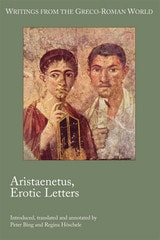
cover of Aristaenetus, Erotic Letters

Aristaenetus, Erotic Letters

Peter Bing

SBL Press, 2014

The first complete English translation of Aristaenetus in nearly three centuries

Through allusion and adaption of earlier authors, Aristaenetus recounts tales that are the stuff of comedy, erotic poetry, and ancient novel. Here we read of lovers who use every trope of erotic literature to praise their beloveds in over-the-top speeches. Aristaenetus amazes us with tales of paramours hatching complicated schemes to achieve their desires, while wily go-betweens help smooth their way. He presents us with accounts of unfaithful spouses who barely avoid capture in the midst of hair-raising and amusing infidelities. This sixth century collection is perfect for anyone interested in classical and postclassical literature.

Features:

  • English translation and Greek text on facing pages
  • Introduction with history of the text
  • Discussion of intertextual connections with Greco-Roman authors
[more]
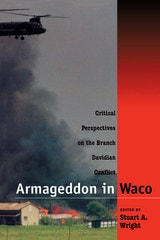
cover of Armageddon in Waco: Critical Perspectives on the Branch Davidian Conflict

Armageddon in Waco

Critical Perspectives on the Branch Davidian Conflict

Edited by Stuart A. Wright

University of Chicago Press, 1996

On February 28, 1993, the United States Bureau of Alcohol, Tobacco, and Firearms (BATF) launched the largest assault in its history against a small religious community in central Texas. One hundred agents armed with automatic and semi automatic weapons invaded the compound, purportedly to execute a single search and arrest warrant. The raid went badly; four agents were killed, and by the end of the day the settlement was surrounded by armored tanks and combat helicopters. After a fifty-one day standoff, the United States Justice Department approved a plan to use CS gas against those barricaded inside. Whether by accident or plan, tanks carrying the CS gas caused the compound to explode in fire, killing all seventy-four men, women, and children inside.

Could the tragedy have been prevented? Was it necesary for the BATF agents to do what they did? What could have been done differently? Armageddon in Waco offers the most detailed, wide-ranging analysis of events surrounding Waco. Leading scholars in sociology, history, law, and religion explore all facets of the confrontation in an attempt to understand one of the most confusing government actions in American history.

The book begins with the history of the Branch Davidians and the story of its leader, David Koresh. Chapters show how the Davidians came to trouble authorities, why the group was labeled a "cult," and how authorities used unsubstantiated allegations of child abuse to strengthen their case against the sect.

The media's role is examined next in essays that considering the effect on coverage of lack of time and resources, the orchestration of public relations by government officials, the restricted access to the site or to countervailing evidence, and the ideologies of the journalists themselves. Several contributors then explore the relation of violence to religion, comparing Waco to Jonestown.

Finally, the role played by "experts" and "consultants" in defining such conflicts is explored by two contributors who had active roles as scholarly experts during and after the siege The legal and consitutional implications of the government's actions are also analyzed in balanced, clearly written detail.
[more]
cover of Armed with the Constitution: Jehovah's Witnesses in Alabama and the U.S Supreme Court, 1939-1946

Armed with the Constitution

Jehovah's Witnesses in Alabama and the U.S Supreme Court, 1939-1946

Merlin Owen Newton

University of Alabama Press, 1995

Underscores the importance of “little people” in affecting the US government
 
Armed with the Constitution stresses the courage of a black man, Rosco Jones, and a white woman, Grace Marsh, who dared to challenge the status quo in Alabama in the early 1940s. These two Jehovah’s Witnesses helped to lay a foundation for testing the constitutionality of state and local laws, establishing precedents that the Civil Rights movement, the feminist movement, and similar forces could follow. Newton has prepared a finely woven tale of oral, legal, and social history that opens a window on the world of the Jehovah’s Witnesses in Alabama.
 
More than a legal study, this book is also a dramatic history of two powerful personalities whose total commitment to their faith enabled them to carry the Jehovah’s Witnesses’ battle from rural Alabama to the halls of the U.S. Supreme Court.
 
[more]
cover of Armenian Apocrypha Relating to Abraham

Armenian Apocrypha Relating to Abraham

Michael E. Stone

SBL Press, 2012
This volume introduces a cycle of stories about Abraham as preserved in fifteen unpublished, late medieval manuscripts in Armenian, published here in English for the first time with commentaries, annotations, and critical apparatus. The texts present embroidered Abraham stories dealing with his youth, his life in Egypt, the binding of Isaac, the story of Melchizedek, and other tales. Embedding Jewish, Christian, Islamic, and other ancient traditions, these texts demonstrate mutual borrowing and influence over centuries.
[more]
cover of Armenian Apocrypha Relating to Angels and Biblical Heroes

Armenian Apocrypha Relating to Angels and Biblical Heroes

Michael E. Stone

SBL Press, 2016

Explore how the vivid and creative Armenian spiritual tradition shaped biblical stories to serve new needs

Michael E. Stone’s latest book includes texts from Armenian manuscripts that are relevant to the development and growth of biblical themes and subjects. Most of these texts have not been published previously. Stone has collected a fascinating corpus of texts about biblical heroes, such as Joseph and Jonah, Nathan the Prophet, and Asaph the Psalmist. In addition, he has included documents illustrating particular points of the biblical story. This work reflects not just on how the Bible was interpreted in medieval times, but also how its stories and details were shaped by and served the needs of the vivid and creative Armenian spiritual tradition.

Features:

  • Expanded stories from Exodus
  • Introductions,translations, and notes
  • Insights into the Armenian "Embroidered Bible," through which many biblical incidents were known to Armenian literature, art, and thought
[more]
cover of Armenian Apocrypha Relating to Biblical Heroes

Armenian Apocrypha Relating to Biblical Heroes

Michael E. Stone

SBL Press, 2019

Explore richly embellished Armenian tales of biblical heroes

This fifth book of Michael E. Stone's English translations of stories from medieval Armenian manuscripts illustrates how authors transmitted and transformed accounts of biblical heroes. Texts focus on important figures such as Adam, Noah, Abraham, Solomon, Daniel and Susanna, and more. This collection reflects not only the richness of Armenian creativity stimulated by piety and learning but also Michael E. Stone's career-long search for reworkings of biblical traditions, stories, and persons in the Armenian tradition.

Features:

  • A rich tradition of biblical exegesis and commentary, much of it in genres of the older apocryphal and pseudepigraphical literature
  • Reflections on the roots of Armenian texts in ancient Judaism and earliest Christianity
  • Texts, translations, and a critical apparatus
[more]
cover of Armenian Apocrypha from Adam to Daniel

Armenian Apocrypha from Adam to Daniel

Michael E. Stone

SBL Press, 2021
In this collection of Armenian apocryphal texts, Michael E. Stone focuses on texts related to heaven and hell, angels and demons, and biblical figures from the Hebrew Bible and apocrypha. The texts, introductions, translations, annotations, and critical apparatus included in this volume make this collection a key resource for students and scholars of apocryphal and pseudepigraphical literature.

[more]
cover of Armenian Apocrypha: The Short Questionnaire from Adam to Moses

Armenian Apocrypha

The Short Questionnaire from Adam to Moses

Michael E. Stone

SBL Press, 2025

Short Questionnaire, an Armenian question-and-answer text that survives in a seventeenth-century manuscript, draws on Armenian parabiblical traditions to systematically explore biblical events from creation to the exodus. The volume includes Michael E. Stone’s translation, extensive commentary, and twenty-seven essays that trace the history of parabiblical concepts and events from the Second Temple and early Christian periods down to the second millennium. Including stories of Satan’s fall from the garden, the raven’s role in Abel’s murder, the burial places of Adam and Eve, and Noah’s fourth son, the book forms a dictionary of Armenian parabiblical traditions for scholars and students interested in reception history in early Judaism and Christianity.
[more]
cover of Art and Society in a Highland Maya Community: The Altarpiece of Santiago Atitlán

Art and Society in a Highland Maya Community

The Altarpiece of Santiago Atitlán

By Allen J. Christenson

University of Texas Press, 2001
A study of a major piece of modern Mayan religious art.
[more]
cover of Art, Nature, and Religion in the Central Andes: Themes and Variations from Prehistory to the Present

Art, Nature, and Religion in the Central Andes

Themes and Variations from Prehistory to the Present

By Mary Strong

University of Texas Press, 2012

From prehistory to the present, the Indigenous peoples of the Andes have used a visual symbol system—that is, art—to express their sense of the sacred and its immanence in the natural world. Many visual motifs that originated prior to the Incas still appear in Andean art today, despite the onslaught of cultural disruption that native Andeans have endured over several centuries. Indeed, art has always been a unifying power through which Andeans maintain their spirituality, pride, and culture while resisting the oppression of the dominant society.

In this book, Mary Strong takes a significantly new approach to Andean art that links prehistoric to contemporary forms through an ethnographic understanding of Indigenous Andean culture. In the first part of the book, she provides a broad historical survey of Andean art that explores how Andean religious concepts have been expressed in art and how artists have responded to cultural encounters and impositions, ranging from invasion and conquest to international labor migration and the internet. In the second part, Strong looks at eight contemporary art types—the scissors dance (danza de tijeras), home altars (retablos), carved gourds (mates), ceramics (ceramica), painted boards (tablas), weavings (textiles), tinware (hojalateria), and Huamanga stone carvings (piedra de Huamanga). She includes prehistoric and historic information about each art form, its religious meaning, the natural environment and sociopolitical processes that help to shape its expression, and how it is constructed or performed by today’s artists, many of whom are quoted in the book.
[more]
cover of Arts of Wonder: Enchanting Secularity - Walter De Maria, Diller + Scofidio, James Turrell, Andy Goldsworthy

Arts of Wonder

Enchanting Secularity - Walter De Maria, Diller + Scofidio, James Turrell, Andy Goldsworthy

Jeffrey L. Kosky

University of Chicago Press, 2012
“The fate of our times is characterized by rationalization and intellectualization and, above all, by ‘the disenchantment of the world.’” Max Weber’s statement remains a dominant interpretation of the modern condition: the increasing capabilities of knowledge and science have banished mysteries, leaving a world that can be mastered technically and intellectually. And though this idea seems empowering, many people have become disenchanted with modern disenchantment. Using intimate encounters with works of art to explore disenchantment and the possibilities of re-enchantment, Arts of Wonder addresses questions about the nature of humanity, the world, and God in the wake of Weber’s diagnosis of modernity.
 
Jeffrey L. Kosky focuses on a handful of artists—Walter De Maria, Diller + Scofidio, James Turrell, and Andy Goldsworthy—to show how they introduce spaces hospitable to mystery and wonder, redemption and revelation, and transcendence and creation. What might be thought of as religious longings, he argues, are crucial aspects of enchanting secularity when developed through encounters with these works of art. Developing a model of religion that might be significant to secular culture, Kosky shows how this model can be employed to deepen interpretation of the art we usually view as representing secular modernity. A thoughtful dialogue between philosophy and art, Arts of Wonder will catch the eye of readers of art and religion, philosophy of religion, and art criticism.
[more]
cover of Aryan Idols: Indo-European Mythology as Ideology and Science

Aryan Idols

Indo-European Mythology as Ideology and Science

Stefan Arvidsson

University of Chicago Press, 2006

Critically examining the discourse of Indo-European scholarship over the past two hundred years, Aryan Idols demonstrates how the interconnected concepts of “Indo-European” and “Aryan” as ethnic categories have been shaped by, and used for, various ideologies.
Stefan Arvidsson traces the evolution of the Aryan idea through the nineteenth century—from its roots in Bible-based classifications and William Jones’s discovery of commonalities among Sanskrit, Latin, and Greek to its use by scholars in fields such as archaeology, anthropology, folklore, comparative religion, and history. Along the way, Arvidsson maps out the changing ways in which Aryans were imagined and relates such shifts to social, historical, and political processes. Considering the developments of the twentieth century, Arvidsson focuses on the adoption of Indo-European scholarship (or pseudoscholarship) by the Nazis and by Fascist Catholics.

A wide-ranging discussion of the intellectual history of the past two centuries,  Aryan Idols links the pervasive idea of the Indo-European people to major scientific, philosophical, and political developments of the times, while raising important questions about the nature of scholarship as well.
[more]
cover of Ascensions on High in Jewish Mysticism: Pillars, Lines, Ladders

Ascensions on High in Jewish Mysticism

Pillars, Lines, Ladders

Moshe Idel

Central European University Press, 2005
Ascensions on high took many forms in Jewish mysticism and they permeated most of its history from its inception until Hasidism. The book surveys the various categories, with an emphasis on the architectural images of the ascent, like the resort to images of pillars, lines, and ladders. After surveying the variety of scholarly approaches to religion, the author also offers what he proposes as an eclectic approach, and a perspectivist one. The latter recommends to examine religious phenomena from a variety of perspectives. The author investigates the specific issue of the pillar in Jewish mysticism by comparing it to the archaic resort to pillars recurring in rural societies. Given the fact that the ascent of the soul and pillars constituted the concerns of two main Romanian scholars of religion, Ioan P. Culianu and Mircea Eliade, Idel resorts to their views, and in the Concluding Remarks analyzes the emergence of Eliade's vision of Judaism on the basis of neglected sources.
[more]
cover of Ascetical Works

Ascetical Works

Saint Basil

Catholic University of America Press, 1950
No description available
[more]
cover of Ascetical Works

Ascetical Works

Saint Gregory of Nyssa

Catholic University of America Press, 1967
No description available
[more]
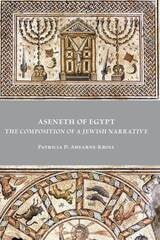
cover of Aseneth of Egypt: The Composition of a Jewish Narrative

Aseneth of Egypt

The Composition of a Jewish Narrative

Patricia D. Ahearne-Kroll

SBL Press, 2020

An exploration of Aseneth's beginnings

In Aseneth of Egypt: The Composition of a Jewish Narrative, Patricia D. Ahearne-Kroll challenges reliance on reconstructed texts in previous scholarship on the book of Joseph and Aseneth. After outlining the problems with previous prototypes of the Hellenistic narrative, she proposes a way to talk about the story in its initial setting without ignoring the manuscript evidence. Her thorough analysis of the evidence reveals how Joseph and Aseneth reflects the literary impulse of Greek-speaking Jewish writers to redescribe their identity in Egypt and Judean connections to the land of Egypt, while incorporating Ptolemaic strategies of legitimation of power. In the end, Ahearne-Kroll concludes that the base storyline preserved in all the copies of this story demonstrates that it was written for Jewish communities living in Hellenistic Egypt.

Features:

  • A focus on Hellenistic stories of heroic ancestors
  • A discussion of the possible lives of Jews in Hellenistic Egypt drawn from the narrative of Aseneth
  • An examination of the complexities involved in dating the composition of literary texts
[more]
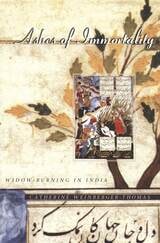
cover of Ashes of Immortality: Widow-Burning in India

Ashes of Immortality

Widow-Burning in India

Catherine Weinberger-Thomas

University of Chicago Press, 1999

"At last, she arrives at the fatal end of the plank . . . and, with her hands crossed over her chest, falls straight downward, suspended for a moment in the air before being devoured by the burning pit that awaits her. . . ." This grisly 1829 account by Pierre Dubois demonstrates the usual European response to the Hindu custom of satis sacrificing themselves on the funeral pyres of their husbands—horror and revulsion. Yet to those of the Hindu faith, not least the satis themselves, this act signals the sati's sacredness and spiritual power.

Ashes of Immortality attempts to see the satis through Hindu eyes, providing an extensive experiential and psychoanalytic account of ritual self-sacrifice and self-mutilation in South Asia. Based on fifteen years of fieldwork in northern India, where the state-banned practice of sati reemerged in the 1970s, as well as extensive textual analysis, Weinberger-Thomas constructs a radically new interpretation of satis. She shows that their self-immolation transcends gender, caste and class, region and history, representing for the Hindus a path to immortality.

[more]
cover of Asian Mythologies

Asian Mythologies

Edited by Yves Bonnefoy

University of Chicago Press, 1993

These 130 articles explore mythologies in societies from India to Japan. Among the many topics are Buddhist and Hindu symbolic systems, myth in pre-Islamic Iran, Indonesian rites of passage, Chinese cosmology and demons, and Japanese conceptions of the afterlife and the "vital spirit." The mythological traditions of Turkey, Korea, Tibet, and Mongolia are also included.

"The almost 100 contributors combine, with characteristic precision and élan, the arts of science and poetry, of analysis and translation. The result is a treasury of information, brilliant guesswork, witty asides, and revealing digressions. This is a work of genuine and enduring excitement."—Thomas D'Evelyn, Christian Science Monitor

[more]
cover of Ask the Animals: Developing a Biblical Animal Hermeneutic

Ask the Animals

Developing a Biblical Animal Hermeneutic

Arthur W. Walker-Jones

SBL Press, 2024

Ask the animals, and they will tell you.

Birds, beasts, and creeping things swarm throughout the Bible’s pages. Despite their prevalence, most biblical scholars have viewed them merely as metaphors, passive objects, or background embellishment to the human experience. This collection seeks to move beyond this traditional view of biblical animals by engaging the growing interdisciplinary field of animal studies. Contributors Peter Joshua Atkins, Jared Beverly, William P. Brown, Margaret Cohen, Jacob R. Evers, Michael J. Gilmour, William “Chip” Gruen, Dong Hyeon Jeong, Brian Fiu Kolia, Anne Létourneau, Robert R. MacKay, Suzanna R. Millar, Timothy J. Sandoval, Robert Paul Seesengood, Ken Stone, Brian James Tipton, Arthur W. Walker-Jones, and Jaime L. Waters showcase the breadth and depth of inquiry that animal studies can foster in biblical studies as well as what animal studies can gain from a more rigorous engagement with biblical texts. Together the essays offer an animal hermeneutic that supports the flourishing of all creatures.
[more]
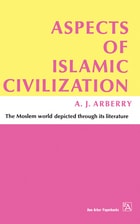
cover of Aspects of Islamic Civilization: As Depicted in the Original Texts

Aspects of Islamic Civilization

As Depicted in the Original Texts

A. J. Arberry

University of Michigan Press, 1967

Islamic literature is rich, varied, and abundant, as befits the literature of a civilization which once controlled an empire as great as that of the Romans. In Aspects of Islamic Civilization, A. J. Arberry has chosen and translated passages from the most highly regarded works of Islamic literature in order to illustrate the development of Islamic civilization from its origins in the sixth century to the present.

This anthology is made up of selections from Arabic and Persian writers who have given world renown to Islamic literature—such as Hafiz, Sa'di, Jalal al-Din Rumi, Omar Khayyam, Ibn al-Farid, Avicenna, Ibn Hazm—and from such works as the Koran, the Masnavi, and the Moorish Anthology. It is an invaluable collection of sources for anyone interested in the Moslem world and a fascinating volume to browse in.
[more]
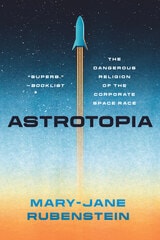
cover of Astrotopia: The Dangerous Religion of the Corporate Space Race

Astrotopia

The Dangerous Religion of the Corporate Space Race

Mary-Jane Rubenstein

University of Chicago Press, 2022

A revealing look at the parallel mythologies behind the colonization of Earth and space—and a bold vision for a more equitable, responsible future both on and beyond our planet.
 
As environmental, political, and public health crises multiply on Earth, we are also at the dawn of a new space race in which governments team up with celebrity billionaires to exploit the cosmos for human gain. The best-known of these pioneers are selling different visions of the future: while Elon Musk and SpaceX seek to establish a human presence on Mars, Jeff Bezos and Blue Origin work toward moving millions of earthlings into rotating near-Earth habitats. Despite these distinctions, these two billionaires share a core utopian project: the salvation of humanity through the exploitation of space.
 
In Astrotopia, philosopher of science and religion Mary-Jane Rubenstein pulls back the curtain on the not-so-new myths these space barons are peddling, like growth without limit, energy without guilt, and salvation in a brand-new world. As Rubenstein reveals, we have already seen the destructive effects of this frontier zealotry in the centuries-long history of European colonialism. Much like the imperial project on Earth, this renewed effort to conquer space is presented as a religious calling: in the face of a coming apocalypse, some very wealthy messiahs are offering an other-worldly escape to a chosen few. But Rubenstein does more than expose the values of capitalist technoscience as the product of bad mythologies. She offers a vision of exploring space without reproducing the atrocities of earthly colonialism, encouraging us to find and even make stories that put cosmic caretaking over profiteering.
[more]
cover of At Ansha's: Life in the Spirit Mosque of a Healer in Mozambique

At Ansha's

Life in the Spirit Mosque of a Healer in Mozambique

Daria Trentini

Rutgers University Press, 2021
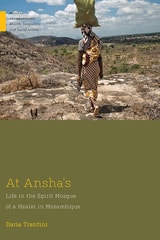
At Ansha's takes the reader inside the spirit mosque of a female healer in Nampula, northern Mozambique. It is here that Ansha, a Makonde spirit healer, heals the resisting ailments of her patients, discloses pieces of her story of affliction and healing, and engages the world outside her mosque. We come to know Ansha’s experiences as revolutionary and migrant, her religious trajectories, family, the healers who cured her, the spirits who possessed her, and her declining health. We follow Ansha’s shifts in her life and work in the mosque as these intersect with the visible and invisible borders of Mozambique and of its fraught history. Confronting events in her life and in the mosque between 2009 and 2016, Ansha invites us to make meaning with her, as we sit in her mosque, and engage with her family, spirits, friends, patients, and world.
[more]
cover of At Ease in Zion: Social History of Southern Baptists, 1865-1900

At Ease in Zion

Social History of Southern Baptists, 1865-1900

Rufus B. Spain

University of Alabama Press, 2003

Analyzes the Southern Baptist denomination’s influence on southern culture during the 19th century
 
First published in 1967, Rufus Spain’s thorough investigation into Southern Baptist attitudes set the stage for research on religion in the American South. In At Ease in Zion, Spain questions the titular “ease” with society that Southern Baptists seemed to maintain following the Civil War. His analysis of denominational newspapers, as well as reports from the Southern Baptist Convention and state conventions, paint a compelling picture of the subjects’ complacency with their social existence, even as they criticized personal and recreational ethics.

While the South faced significant social, economic, and political changes after the Civil War, religion remained the primary moral influence. As the Southern Baptist denomination made up a significant majority of the population at that time, its leaders and attitudes had a clear and undeniable impact on social norms. Rufus Spain was one of the first writers to actively demonstrate the relationship between Southern religion and Southern society, and his work displays meticulous attention to the ways in which we are affected by complacency. He asserts that Southern Baptists viewed the American South as a version of God’s ideal society; any issues they wished to address were caused by individuals (such as those who did not conform to societal norms) or external attitudes (such as those in differing religions or regions).

At Ease in Zion is a critical part of the scholarly discussion on religion in society. Spain’s research offers a bold analysis of the American South and its citizens during one of the most tumultuous times in its history while providing a basis for arguments on “social Christianity” and its ever-shifting role in the world.
 
[more]
cover of At Last She Said It: Honest Conversations About Faith, Church, and Everything in Between

At Last She Said It

Honest Conversations About Faith, Church, and Everything in Between

Susan Hinckley and Cynthia Winward

Signature Books, 2025

“Women of faith, discussing complicated things.” That’s how  authors Susan Hinckley and Cynthia Winward describe At Last She Said It, and they don’t expect the knots to untangle themselves. Even with two very different personalities and a decade or so between them, as their friendship developed they kept stumbling onto what felt like an uncanny amount of common ground in their church experiences. Often their conversations ended with, “Why isn’t anyone talking about this? Someone should do a podcast!” So they did. They had a hunch they weren’t the only women wishing they had a place to discuss the things they were thinking about, a lot of which they’d never said—or heard—out loud. That hunch was right. Their 200-and-counting recorded conversations have been downloaded some two million times. Hinckley and Winward have learned, right along with their listeners, that there’s no power quite like finding out you’re not alone. 

Their book now asks Latter-day Saints to think about old ideas in new ways. Stretching can be uncomfortable, but the willingness to consider diverse perspectives—even on the things we hold most dear—feels essential in an evolving world. So does being open to changing our minds, including how we think about ourselves. Faith is alive when it’s growing, and growing means change. Hopefully, these conversations will be the beginning of thousands more.


[more]
cover of At Last She Said It: Honest Conversations About Faith, Church, and Everything in Between

At Last She Said It

Honest Conversations About Faith, Church, and Everything in Between

Susan Hinckley and Cynthia Winward

Signature Books, 2025

“Women of faith, discussing complicated things.” That’s how  authors Susan Hinckley and Cynthia Winward describe At Last She Said It, and they don’t expect the knots to untangle themselves. Even with two very different personalities and a decade or so between them, as their friendship developed they kept stumbling onto what felt like an uncanny amount of common ground in their church experiences. Often their conversations ended with, “Why isn’t anyone talking about this? Someone should do a podcast!” So they did. They had a hunch they weren’t the only women wishing they had a place to discuss the things they were thinking about, a lot of which they’d never said—or heard—out loud. That hunch was right. Their 200-and-counting recorded conversations have been downloaded some two million times. Hinckley and Winward have learned, right along with their listeners, that there’s no power quite like finding out you’re not alone. 

Their book now asks Latter-day Saints to think about old ideas in new ways. Stretching can be uncomfortable, but the willingness to consider diverse perspectives—even on the things we hold most dear—feels essential in an evolving world. So does being open to changing our minds, including how we think about ourselves. Faith is alive when it’s growing, and growing means change. Hopefully, these conversations will be the beginning of thousands more.


[more]
cover of Athansius: A Theological Introduction

Athansius

A Theological Introduction

Thomas G. Weinandy, OFM, Cap.

Catholic University of America Press, 2018

Thomas Weinandy has done an excellent job in this book in introducing Athanasius' theology. A well-known Catholic scholar in historical theology, Weinandy has provided students of theology with a profound historiography of Athanasius' major theological writing. - Calvin Theological Journal

"A reliable, concise introduction to the theology of Athanasius." - International Journal of Systematic Theology

"A sustained and intelligent introduction to Athanasius and his literature, and will rightly appear on all undergraduate patristic bibliographies." - The Journal of Theological Studies

"A very fine theological (as its subtitle emphasizes) introduction to the Alexandrian bishop…[an] accessible, intelligent, and worthy volume, which offers the reader an overview of Athanasius's thought within the context of his full, if at times harried, ecclesiastical life." - Nova et Vetera

"Weinandy offers a summary of Athanasius' central works and a balanced assessment of his theology's merits and contemporary significance…No student of Athanasius should overlook this reliable guidebook to the little Alexandrian's great life and works." - Religious Studies Review

"Weinandy's introduction to Athanasius is an important work, familiarizing the reader with Athanasius' life, writings, and fundamental concerns. Throughout, the centrality of soteriology clearly emerges, whether the topic is the doctrine of the Trinity or the life of Antony. Hopefully this book will serve to bring Athanasius' soteriology more prominently into contemporary discussions alongside the other great masterpieces on this doctrine." - Themelios
[more]
cover of Atheism: A Philosophical Justification

Atheism

A Philosophical Justification

Michael Martin

Temple University Press, 1992

[more]