Results by title
28164 books match the query 'History' and 2536 start with a
A History of the French New Wave Cinema
Richard Neupert
University of Wisconsin Press, 2007
The French New Wave cinema is arguably the most fascinating of all film movements, famous for its exuberance, daring, and avant-garde techniques. A History of the French New Wave Cinema offers a fresh look at the social, economic, and aesthetic mechanisms that shaped French film in the 1950s, as well as detailed studies of the most important New Wave movies of the late 1950s and early 1960s.
Richard Neupert first tracks the precursors to New Wave cinema, showing how they provided blueprints for those who would follow. He then demonstrates that it was a core group of critics-turned-directors from the magazine Cahiers du Cinéma—especially François Truffaut, Claude Chabrol, and Jean-Luc Godard—who really revealed that filmmaking was changing forever. Later, their cohorts Eric Rohmer, Jacques Rivette, Jacques Doniol-Valcroze, and Pierre Kast continued in their own unique ways to expand the range and depth of the New Wave.
In an exciting new chapter, Neupert explores the subgroup of French film practice known as the Left Bank Group, which included directors such as Alain Resnais and Agnès Varda. With the addition of this new material and an updated conclusion, Neupert presents a comprehensive review of the stunning variety of movies to come out of this important era in filmmaking.

A History of the Garden in Fifty Tools
Bill Laws
University of Chicago Press, 2014
As Laws reveals, gardening tools have coevolved with human society, and the story of these fifty individual tools presents an innovative history of humans and the garden over time. Laws takes us back to the Neolithic age, when the microlith, the first “all-in-one” tool was invented. Consisting of a small sharp stone blade that was set into a handle made of wood, bone, or antler, it was a small spade that could be used to dig, clip, and cut plant material. We find out that wheelbarrows originated in China in the second century BC, and their basic form has not changed much since. He also describes how early images of a pruning knife appear in Roman art, in the form of a scythe that could cut through herbs, vegetables, fruits, and nuts and was believed to be able to tell the gardener when and what to harvest.
Organized into five thematic chapters relating to different types of gardens: the flower garden, the kitchen garden, the orchard, the lawn, and ornamental gardens, the book includes a mix of horticulture and history, in addition to stories featuring well-known characters—we learn about Henry David Thoreau’s favorite hoe, for example. A History of the Garden in Fifty Tools will be a beautiful gift for any home gardener and a reassuring reminder that gardeners have always struggled with the same quandaries.

A History of the Global Stock Market
From Ancient Rome to Silicon ValleyB. Mark Smith
University of Chicago Press, 2004
Informative, entertaining, and written for specialists and non-specialists alike, A History of the Global Stock Market is a worthy read for anyone who wants to understand the role of the stock market in the global economy.
A History of the Hal Roach Studios
Richard Lewis Ward
Southern Illinois University Press, 2006
Once labeled the “lot that laugher built,” the Hal Roach Studios launched the comedic careers of such screen icons as Harold Lloyd, Our Gang, and Laurel and Hardy. With this stable of stars, the Roach enterprise operated for forty-six years on the fringes of the Hollywood studio system during a golden age of cinema and gained notoriety as a producer of short comedies, independent features, and weekly television series. Many of its productions are better remembered today than those by its larger contemporaries. In A History of the Hal Roach Studios, Richard Lewis Ward meticulously follows the timeline of the company’s existence from its humble inception in 1914 to its close in 1960 and, through both its obscure and famous productions, traces its resilience to larger trends in the entertainment business.
In the first few decades of the twentieth century, the motion picture industry was controlled by an elite handful of powerful firms that allowed very little room for new competition outside of their established cartel. The few independents that garnered some measure of success despite their outsider status usually did so by specializing in underserved or ignored niche markets. Here, Ward chronicles how the Roach Studios, at the mercy of exclusive distribution practices, managed to repeatedly redefine itself in order to survive for nearly a half-century in a cutthroat environment.
Hal Roach’s tactic was to nurture talent rather than exhaust it, and his star players spent the prime of their careers shooting productions on his lot. Even during periods of decline or misdirection, the Roach Studios turned out genuinely original material, such as the screwball classic Topper (1937), the brutally frank Of Mice and Men (1940), and the silent experiment One Million B.C. (1940). Ward’s exploration yields insight into the production and marketing strategies of an organization on the periphery of the theatrical film industry and calls attention to the interconnected nature of the studio system during the classic era. The volume also looks to the early days of television when the prolific Roach Studios embraced the new medium to become, for a time, the premier telefilm producer.
Aided by a comprehensive filmography and twenty-seven illustrations, A History of the Hal Roach Studios recounts an overlooked chapter in American cinema, not only detailing the business operations of Roach’s productions but also exposing the intricate workings of Hollywood’s rivalrous moviemaking establishment.
A History of the Modern Fact
Problems of Knowledge in the Sciences of Wealth and SocietyMary Poovey
University of Chicago Press, 1998
Mary Poovey explores these questions in A History of the Modern Fact, ranging across an astonishing array of texts and ideas from the publication of the first British manual on double-entry bookkeeping in 1588 to the institutionalization of statistics in the 1830s. She shows how the production of systematic knowledge from descriptions of observed particulars influenced government, how numerical representation became the privileged vehicle for generating useful facts, and how belief—whether figured as credit, credibility, or credulity—remained essential to the production of knowledge.
Illuminating the epistemological conditions that have made modern social and economic knowledge possible, A History of the Modern Fact provides important contributions to the history of political thought, economics, science, and philosophy, as well as to literary and cultural criticism.
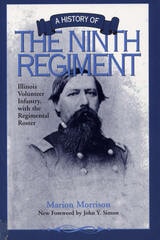
A History of the Ninth Regiment
Illinois Volunteer Infantry, with the Regimental RosterMarion Morrison. Foreword by John Y. Simon
Southern Illinois University Press, 1997
When the Civil War erupted in April 1861, many German immigrants in Illinois rushed to enlist in the Union Army. Volunteers from Illinois towns in St. Clair County—Belleville, Millstadt, Mascoutah, Lebanon, and others—marched to Springfield under the command of August Mersy, a veteran of the failed 1848 revolt in Baden, Germany.
Marion Morrison notes that when the German immigrants reached Springfield, August Mersy was rejected as commander because of his limited facility with English. Replaced by Colonel Eleazer A. Paine, an Ohioan and West Point graduate, Lieutenant Colonel Mersy fell to second in command of the Ninth Illinois Infantry Volunteers. Within a few months, however, Paine received a promotion to general that left Mersy in charge of the "Bloody Ninth."
Once Grant began his Tennessee River campaign, the Ninth found itself in the thick of battle, bearing the brunt of the Confederate attempt at Fort Donelson to break Grant’s siege lines. Less than two months later, the Ninth shored up sagging Union lines after the surprise Confederate attack at Shiloh Church, retreating only when their ammunition was gone.
Morrison’s account of the "Bloody Ninth" is one of the few histories written during the war.

A History of the Old Icelandic Commonwealth
Islendinga SagaJon Johannesson
University of Manitoba Press, 2007
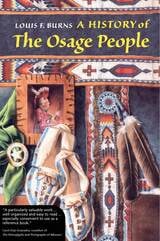
A History of the Osage People
Louis F. Burns
University of Alabama Press, 2004
Four centuries. One people. A legacy that shaped a nation.
Osage traditional lands are located in mid-continental America encompassed by the present-day states of Arkansas, Missouri, Kansas, and Oklahoma. Major waterways through these lands and the defensible terrain of the Ozark range provided the tribe a distinct advantage in prehistoric and early historic times. A warlike people, the Osage long encroached on neighboring tribal lands, especially those of the Caddo to the southwest. Yet good natural boundaries and centuries of success in warfare afforded the tribe little advantage in attempts to forestall Euro-American westward expansion. Three major routes to the West—the Missouri and Arkansas Rivers and the Continental Trail—crossed Osage land, so conflict with the newcomers was inevitable.
Louis Burns draws on ancestral oral traditions and research in a broad body of literature to tell the story of the Osage people. He writes clearly and concisely, from the Osage perspective. First published in 1989 and for many years out of print, this revised edition is augmented by a new preface and maps. Because of its masterful compilation and synthesis of the known data, A History of the Osage People continues to be the best reference for information on an important American Indian people.
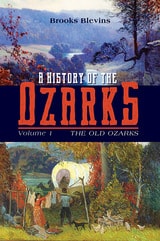
A History of the Ozarks, Volume 1
The Old OzarksBrooks Blevins
University of Illinois Press, 2020
Winner of the Arkansiana Award, from the Arkansas Library Association
Geologic forces raised the Ozarks. Myth enshrouds these hills. Human beings shaped them and were shaped by them. The Ozarks reflect the epic tableau of the American people—the native Osage and would-be colonial conquerors, the determined settlers and on-the-make speculators, the endless labors of hardscrabble farmers and capitalism of visionary entrepreneurs. The Old Ozarks is the first volume of a monumental three-part history of the region and its inhabitants. Brooks Blevins begins in deep prehistory, charting how these highlands of granite, dolomite, and limestone came to exist. From there he turns to the political and economic motivations behind the eagerness of many peoples to possess the Ozarks. Blevins places these early proto-Ozarkers within the context of larger American history and the economic, social, and political forces that drove it forward. But he also tells the varied and colorful human stories that fill the region's storied past—and contribute to the powerful myths and misunderstandings that even today distort our views of the Ozarks' places and people. A sweeping history in the grand tradition, A History of the Ozarks, Volume 1: The Old Ozarks is essential reading for anyone who cares about the highland heart of America.

A History of the Ozarks, Volume 2
The Conflicted OzarksBrooks Blevins
University of Illinois Press, 2019

A History of the Ozarks, Volume 3
The OzarkersBrooks Blevins
University of Illinois Press, 2021
Brooks Blevins tells the cultural history of the Ozarks as a regional variation of an American story. As he shows, the experiences of the Ozarkers have not diverged from the currents of mainstream life as sharply or consistently as the mythmakers would have it. If much of the region seemed to trail behind by a generation, the time lag was rooted more in poverty and geographic barriers than a conscious rejection of the modern world and its progressive spirit. In fact, the minority who clung to the old days seemed exotic largely because their anachronistic ways clashed against the backdrop of the evolving region around them. Blevins explores how these people’s disproportionate influence affected the creation of the idea of the Ozarks, and reveals the truer idea that exists at the intersection of myth and reality.
The conclusion to the acclaimed trilogy, The History of the Ozarks, Volume 3: The Ozarkers offers an authoritative appraisal of the modern Ozarks and its people.

A History of the People’s Action Party, 1985-2021
Shashi Jayakumar
National University of Singapore Press, 2020
This narrative history of the PAP follows the story through decisions made by party leaders as they sought to respond to the changing demands and expectations of the Singapore electorate over a thirty-year period that saw Singapore enter the ranks of developed nations. The focus is on change in four dimensions: in the communications methods and styles the party adopted, the mechanisms it developed for managing institutional change, the sometimes vexed question of party renewal, and the evolution of economic and social policy. Drawing on internal party documents and multiple interviews with key leaders over the course of a decade, this book provides a detailed portrait of a robust political institution and establishes a distinctive new narrative of Singapore politics.

A History of the Railroad in 100 Maps
Jeremy Black
University of Chicago Press, 2024
The first international history of railroads and railroad infrastructure told through stunningly reproduced maps.
Since their origins in eighteenth-century England, railroads have spread across the globe, changing everything in their path, from where and how people grew and made things to where and how they lived and moved. Railroads rewrote not only world geography but also the history of maps and mapping. Today, the needs of train companies and their users continue to shape the maps we consume and consult.
Featuring full-color maps primarily from the British Library's distinguished collection—many of them never before published—A History of the Railroad in 100 Maps is the first international history of railroads and railroad infrastructure told through maps. Jeremy Black includes examples from six continents, spanning a variety of uses from railroad planning and operations to guides for passengers, shippers, and tourists.
Arranged chronologically, the maps are accompanied by explanatory text that sheds light on the political, military, and urban development histories associated with the spread of railroads. A final chapter considers railroad maps from games, books, and other cultural artifacts. For anyone interested in the history of railroads or maps, A History of the Railroad in 100 Maps will offer new and unexpected insights into their intertwined global history.
A History of the Rutgers University Glee Club
David F. Chapman
Rutgers University Press, 2022
Founded in 1872, the Glee Club is Rutgers University’s oldest continuously active student organization, as well as one of the first glee clubs in the United States. For the past 150 years, it has represented the university and presented an image of the Rutgers man on a national and international stage.
This volume offers a comprehensive history of the Rutgers Glee Club, from its origins adopting traditions from the German Männerchor and British singing clubs to its current manifestation as a world-recognized ensemble. Along the way, we meet the colorful and charismatic men who have directed the group over the years, from the popular composer and minstrel performer Loren Bragdon to the classically-trained conductor Patrick Gardner. And of course, we learn what the club has meant to the generations of talented and dedicated young men who have sung in it.
A History of the Rutgers University Glee Club recounts the origins of the group’s most beloved traditions, including the composition of the alma mater’s anthem “On the Banks of the Old Raritan” and the development of the annual Christmas in Carol and Song concerts. Meticulously researched, including a complete discography of the club’s recordings, this book is a must-have for all the Rutgers Glee Club’s many fans and alumni.

A History of the Second World War in 100 Maps
Jeremy Black
University of Chicago Press, 2020
The First World War was marked by an exceptional expansion in the use and production of military cartography. But World War II took things even further, employing maps, charts, reconnaissance, and the systematic recording and processing of geographical and topographical information on an unprecedented scale. As Jeremy Black—one of the world’s leading military and cartographic historians—convincingly shows in this lavish full-color book, it is impossible to understand the events and outcomes of the Second World War without deep reference to mapping at all levels. In World War II, maps themselves became the weapons.
A History of the Second World War in 100 Maps traces how military cartography developed from simply recording and reflecting history to having a decisive impact on events of a global scale. Drawing on one hundred key maps from the unparalleled collections of the British Library and other sources—many of which have never been published in book form before--Jeremy Black takes us from the prewar mapping programs undertaken by both Germany and the United Kingdom in the mid-1930s through the conflict’s end a decade later. Black shows how the development of maps led directly to the planning of the complex and fluid maneuvers that defined the European theater in World War II: for example, aerial reconnaissance photography allowed for the charting of beach gradients and ocean depths in the runup to the D-Day landings, and the subsequent troop movements at Normandy would have been impossible without the help of situation maps and photos. In the course of the conflict, both in Europe and the Pacific, the realities of climate, terrain, and logistics—recorded on maps—overcame the Axis powers. Maps also became propaganda tools as the pages of Time outlined the directions of the campaigns and the Allies dropped maps from their aircraft.
In this thrilling and unique book, Jeremy Black blends his singular cartographic and military expertise into a captivating overview of World War II from the air, sea, and sky, making clear how fundamental maps were to every aspect of this unforgettable global conflict.
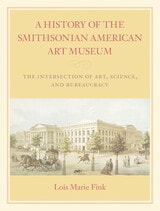
A History of the Smithsonian American Art Museum
The Intersection of Art, Science, and BureaucracyLois Marie Fink
University of Massachusetts Press, 2007
Dedicated to the art of the United States, the Smithsonian American Art Museum contains works by more than 7,000 artists and is widely regarded as an invaluable resource for the study and preservation of the nation's cultural heritage. But as Lois Marie Fink shows in this probing narrative, the history of the museum is hardly one of steady progress. Instead, it reads like a nineteenth-century melodrama, replete with villains and heroes, destruction by fire, dashed hopes, and periods of subsistence survival—all leading eventually to a happy ending.
Originating as the art gallery stipulated in the 1846 founding legislation of the Smithsonian, the museum developed within an institution that was essentially controlled by scientists. In its early years, the museum's holdings included a diverse selection of art and artifacts, mostly donated from private collections. Government support varied in response to shifting attitudes of officials and the public toward American art, ranging from avid admiration at the turn of the twentieth century to a tepid response and an almost total withdrawal of funding a generation later in favor of European masterworks. For decades the museum followed scientific organizational principles in exhibitions and collection strategies. Far into the twentieth century, accessions remained tied to nineteenth-century figurative art, reflecting the strength and influence of anthropology and biological sciences at the Smithsonian. A key breakthrough for modern art came in 1964 with the appointment of Smithsonian secretary Dillon Ripley, a scientist who strongly promoted the art side of the institution. With renewed support for expanding the collection and programs, the museum moved in 1968 to its present location in the Patent Office Building.
In recounting the history of the museum from 1846 to 1980, Fink unravels the various levels of institutional authority, power, governance, and bureaucracy and shows how people at each level influenced the fortunes of the collection. She also places changing concepts of art and museum practice in the context of national ideals and Washington realities.
A History of the Swedish People
Volume II: From Renaissance to RevolutionVilhelm Moberg
University of Minnesota Press, 2005

A History of the Twentieth Century in 100 Maps
Tim Bryars and Tom Harper
University of Chicago Press, 2014
As Bryars and Harper reveal, maps make ideal narrators, and the maps in this book tell the story of the 1900s—which saw two world wars, the Great Depression, the Swinging Sixties, the Cold War, feminism, leisure, and the Internet. Several of the maps have already gained recognition for their historical significance—for example, Harry Beck’s iconic London Underground map—but the majority of maps on these pages have rarely, if ever, been seen in print since they first appeared. There are maps that were printed on handkerchiefs and on the endpapers of books; maps that were used in advertising or propaganda; maps that were strictly official and those that were entirely commercial; maps that were printed by the thousand, and highly specialist maps issued in editions of just a few dozen; maps that were envisaged as permanent keepsakes of major events, and maps that were relevant for a matter of hours or days.
As much a pleasure to view as it is to read, A History of the Twentieth Century in 100 Maps celebrates the visual variety of twentieth century maps and the hilarious, shocking, or poignant narratives of the individuals and institutions caught up in their production and use.

A History of the University of Chicago, Founded by John D. Rockefeller
The First Quarter-CenturyThomas Wakefield Goodspeed
University of Chicago Press, 1973
As Goodspeed shows, once the main roles were cast—in the persons of John D. Rockefeller and William Rainey Harper—the University of Chicago was irrevocably headed for greatness. Without the support of both of these men it would never have become one of the nation's major universities in a mere quarter century. Although Harper died in 1906, his innovative mind and unflagging energy left an indelible mark on the university during the fifteen years of his presidency. The study provides detailed information on the founding of the university, the procurement of funds, the recruitment of faculty, the construction of buildings, student life, and the problems of continuing growth.

A History of the University of Wisconsin System
Patricia A. Brady
University of Wisconsin Press, 2020
The UW System serves as a powerful case study for how broad, national trends in higher education take shape on the ground. Brady illustrates the ways culture wars have played out on campuses and the pressures that have mounted as universities have shifted to a student-as-consumer approach. This is the essential, unvarnished story of the unique collection of institutions that serve Wisconsin and the world—and a convincing argument for why recognizing and reinvesting in the System is critically important for the economic and civic future of the state and its citizens.

A History of the Vandals
Torsten Cumberland Jacobsen
Westholme Publishing, 2012
The First General History in English of the Germanic People Who Sacked Rome in the Fifth Century AD and Established a Kingdom in North Africa
The fifth century AD was a time of great changes in the Mediterranean world. In the early 400s, the Roman Empire ranged from the lowlands of Scotland to the Upper Nile and from Portugal to the Caucasus. It was almost at its widest extent, and although ruled by two emperors—one in the West and one in the East—it was still a single empire. One hundred years later, Roman control of Western Europe and Western North Africa had been lost. In its place, a number of Germanic kingdoms had been established in these regions, with hundreds of thousands of Germanic and other peoples settling permanently inside the former borders of the Western Roman Empire.
One of the most fascinating of these tribes of late antiquity were the Vandals, who over a period of six hundred years had migrated from the woodland regions of Scandinavia across Europe and ended in the deserts of North Africa. In A History of the Vandals, the first general account in English covering the entire story of the Vandals from their emergence to the end of their kingdom, historian Torsten Cumberland Jacobsen pieces together what we know about the Vandals, sifting fact from fiction. In the middle of the fifth century the Vandals, who professed Arianism, a form of Christianity considered heretical by the Roman emperor, created the first permanent Germanic successor state in the West and were one of the deciding factors in the downfall of the Western Roman Empire. Later Christian historians described their sack of Rome in 455 and their vehement persecution of Catholics in their kingdom, accounts that were sensationalized and gave birth to the term “vandalism.”
In the mid-sixth century, the Vandals and their North African kingdom were the first target of Byzantine Emperor Justinian’s ambitious plan to reconquer the lost territories of the fallen Western Empire. In less than four months, what had been considered one of the strongest Germanic kingdoms had been defeated by a small Roman army led by the general Belisarius. Despite later rebellions, this was the end of the Germanic presence in North Africa, and in many ways the end of the Arian heresy of Christianity. For the Romans it was the incredibly successful start of the reconquest of the lost lands of the Western Empire.
A History of the World Semiconductor Industry
P.R. Morris
The Institution of Engineering and Technology, 1990
A History of the World in Sixteen Shipwrecks
Stewart Gordon
University Press of New England, 2017

A Hitler Youth in Poland
The Nazi Children's Evacuation Program During World War IIJost Hermand
Northwestern University Press, 1997
During the Nazi era, millions of German children between the ages of seven and sixteen were taken from their homes and sent to Hitler Youth paramilitary camps to be toughened up and taught how to be "German." Separated from their families and sent to the far-flung corners of Europe, these children often endured incredible abuse by the adults in charge. In this memoir, Jost Hermand, a cultural critic and historian who spent much of his youth in five different camps, writes about his experiences as a small, unathletic boy thrown into a "wolf pack" governed by brutalization, dreary routine, and sadism.
Intelligent and persuasive, A Hitler Youth in Poland should be read by anyone interested in psychology or the history of everyday life in Hitler's Germany and the mental scars of adults born during the Nazi regime.
A Hole in the Ground with a Liar at the Top
Fraud and Deceit in the Golden Age of American MiningDan Plazak
University of Utah Press, 2006
A Holocaust Controversy
The Treblinka Affair in Postwar FranceSamuel Moyn
Brandeis University Press, 2005

A Home for All Jews
Citizenship, Rights, and National Identity in the New Israeli StateOrit Rozin
Brandeis University Press, 2016
A Home in the West
Or, Emigration and Its ConsequencesRockwell, M. Emilia
University of Iowa Press, 2005
A Home of Another Kind
One Chicago Orphanage and the Tangle of Child WelfareKenneth Cmiel
University of Chicago Press, 1995
The book begins with the fascinating history of the Chicago Nursery and Half-Orphan Asylum from 1860 through 1984, when it became a full-time research institute. Founded by a group of wealthy volunteers, the asylum was a Protestant institution for Protestant children—one of dozens around the country designed as places where single parents could leave their children if they were temporarily unable to care for them.
But the asylum, which later became known as Chapin Hall, changed dramatically over the years as it tried to respond to changing policies, priorities, regulations, and theories concerning child welfare. Cmiel offers a vivid portrait of how these changes affected the day-to-day realities of group living. How did the kind of care given to the children change? What did the staff and management hope to accomplish? How did they define "family"? Who were the children who lived in the asylum? What brought them there? What were their needs? How did outside forces change what went on inside Chapin Hall?
This is much more than a richly detailed account of one institution. Cmiel shatters a number of popular myths about orphanages. Few realize that almost all children living in nineteenth-century orphanages had at least one living parent. And the austere living conditions so characteristic of the orphanage were prompted as much by health concerns as by strict Victorian morals.
A Hopi Social History
By Scott Rushforth and Steadman Upham
University of Texas Press, 1992
All anthropologists and archaeologists seek to answer basic questions about human beings and society. Why do people behave the way they do? Why do patterns in the behavior of individuals and groups sometimes persist for remarkable periods of time? Why do patterns in behavior sometimes change?
A Hopi Social History explores these basic questions in a unique way. The discussion is constructed around a historically ordered series of case studies from a single sociocultural system (the Hopi) in order to understand better the multiplicity of processes at work in any sociocultural system through time. The case studies investigate the mysterious abandonments of the Western Pueblo region in late prehistory, the initial impact of European diseases on the Hopis, Hopi resistance to European domination between 1680 and 1880, the split of Oraibi village in 1906, and some responses by the Hopis to modernization in the twentieth century.
These case studies provide a forum in which the authors examine a number of theories and conceptions of culture to determine which theories are relevant to which kinds of persistence and change. With this broad theoretical synthesis, the book will be of interest to students and scholars in the social sciences.
A Horizon of (Im)possibilities
A Chronicle of Brazil’s Conservative TurnEdited by Katerina Hatzikidi and Eduardo Dullo
University of London Press, 2021
Since the shocking 2018 presidential election in Brazil, a growing body of scholarship has attempted to understand the country’s so-called “conservative turn.” A gripping in-depth account of politics and society in Brazil today, this new volume brings together a myriad of different perspectives to help us better understand the political events that have shaken the country in recent years.
Combining ethnographic insights with political science, history, sociology, and anthropology, the interdisciplinary analyses included in A Horizon of (Im)possibilities offer a panoramic view on social and political change in Brazil, spanning temporal and spatial dimensions. Starting with the 2018 presidential election, the contributors discuss the country’s recent—and more distant—past in relation to the present. Pointing to the continuities and disruptions during those years, this volume is an invaluable guide to understanding the limits of political democracy.

A House Divided
Orthodoxy and Schism in Nineteenth-Century Central European JewryJacob Katz
University Press of New England, 2005
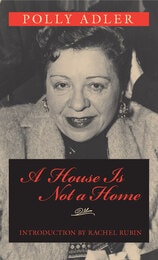
A House Is Not a Home
Polly Adler
University of Massachusetts Press, 2006
Polly Adler's “house”—the brothel that gave this best-selling 1953 autobiography its title—was a major site of New York City underworld activity from the 1920s through the 1940s. Adler's notorious Lexington Avenue house of prostitution functioned as a sort of social club for New York's gangsters and a variety of other celebrities, including Robert Benchley and his friend Dorothy Parker. According to one New York tabloid, it made Adler's name “synonymous with sin.”
This new edition of Adler's autobiography brings back into print a book that was a mass phenomenon, in both hardback and paperback, when it was first published. A self-consciously literary work, A House Is Not a Home provides an informal social history of immigrant mobility, prostitution, Jewish life in New York, police dishonesty, the “white slavery” scare of the early twentieth century, and political corruption.
Adler's story fills an important gap in the history of immigrant life, urban experience, and organized crime in New York City. While most other accounts of the New York underworld focus on the lives of men, from Herbert Asbury's Gangs of New York through more recent works on Jewish and Italian gangsters, this book brings women's lives and problems to the forefront.
A House Is Not a Home is compellingly readable and was popular enough to draw Hollywood's attention in the early 1960s—leading to a film starring Shelley Winters as Adler. The book has been largely forgotten in the ensuing decades, lost both to its initial audience of general readers and to scholars in women's studies, immigration history, and autobiography who are likely to find it a treasure trove. Now, with a new introduction by Rachel Rubin that contextualizes Adler's life and literary achievement, A House Is Not a Home is again available to the many readers who have come to understand such “marginal” life stories as a special refraction of the more typical American success narrative.

A House Is Not a Home
Polly Adler, with an Introduction by Rachel Rubin
University of Massachusetts Press, 2006
Polly Adler's “house”—the brothel that gave this best-selling 1953 autobiography its title—was a major site of New York City underworld activity from the 1920s through the 1940s. Adler's notorious Lexington Avenue house of prostitution functioned as a sort of social club for New York's gangsters and a variety of other celebrities, including Robert Benchley and his friend Dorothy Parker. According to one New York tabloid, it made Adler's name “synonymous with sin.”
This new edition of Adler's autobiography brings back into print a book that was a mass phenomenon, in both hardback and paperback, when it was first published. A self-consciously literary work, A House Is Not a Home provides an informal social history of immigrant mobility, prostitution, Jewish life in New York, police dishonesty, the “white slavery” scare of the early twentieth century, and political corruption.
Adler's story fills an important gap in the history of immigrant life, urban experience, and organized crime in New York City. While most other accounts of the New York underworld focus on the lives of men, from Herbert Asbury's Gangs of New York through more recent works on Jewish and Italian gangsters, this book brings women's lives and problems to the forefront.
A House Is Not a Home is compellingly readable and was popular enough to draw Hollywood's attention in the early 1960s—leading to a film starring Shelley Winters as Adler. The book has been largely forgotten in the ensuing decades, lost both to its initial audience of general readers and to scholars in women's studies, immigration history, and autobiography who are likely to find it a treasure trove. Now, with a new introduction by Rachel Rubin that contextualizes Adler's life and literary achievement, A House Is Not a Home is again available to the many readers who have come to understand such “marginal” life stories as a special refraction of the more typical American success narrative.

A House for the Struggle
The Black Press and the Built Environment in ChicagoE. James West
University of Illinois Press, 2022
- Winner of the 2023 Michael Nelson Prize of International Association for Media and History (IAMHIST)
- Recipient of the 2022 Jane Jacobs Urban Communication Book Award
- Winner of the 2023 American Journalism Historians Association Book of the Year
- Winner of the 2023 ULCC’s (Union League Club of Chicago) Outstanding Book on the History of Chicago Award
- Recipient of a 2023 Best of Illinois History Superior Achievement award from the Illinois State Historical Society
- Winner of the 2023 BAAS Book Prize (British Association for American Studies)
- Winner of a 2023 The Brinck Book Award and Lecture series (University of New Mexico School of Architecture + Planning)
- Honorable Mention for the 2021-22 RSAP Book Prize (Research Society for American Periodicals)
Buildings once symbolized Chicago's place as the business capital of Black America and a thriving hub for Black media. In this groundbreaking work, E. James West examines the city's Black press through its relationship with the built environment. As a house for the struggle, the buildings of publications like Ebony and the Chicago Defender embodied narratives of racial uplift and community resistance. As political hubs, gallery spaces, and public squares, they served as key sites in the ongoing Black quest for self-respect, independence, and civic identity. At the same time, factors ranging from discriminatory business practices to editorial and corporate ideology prescribed their location, use, and appearance, positioning Black press buildings as sites of both Black possibility and racial constraint.
Engaging and innovative, A House for the Struggle reconsiders the Black press's place at the crossroads where aspiration collided with life in one of America's most segregated cities.

A Hundred Acres of America
The Geography of Jewish American Literary HistoryHoberman, Michael
Rutgers University Press, 2019
Jewish writers have long had a sense of place in the United States, and interpretations of American geography have appeared in Jewish American literature from the colonial era forward. But troublingly, scholarship on Jewish American literary history often limits itself to an immigrant model, situating the Jewish American literary canon firmly and inescapably among the immigrant authors and early environments of the early twentieth century. In A Hundred Acres of America, Michael Hoberman combines literary history and geography to restore Jewish American writers to their roles as critical members of the American literary landscape from the 1850s to the present, and to argue that Jewish history, American literary history, and the inhabitation of American geography are, and always have been, contiguous entities.

A Jew in the New Germany
Henryk Broder
University of Illinois Press, 2003
This volume collects eighteen of Broder's essays, translated for the first time into English. The first was written in 1979 and the most recent deals with the post-9/11 realities of the war on terrorism, and its effects on the countries of Europe. Other essays address the debate over the construction of a Holocaust memorial in Berlin, the German response to the 1991 Gulf War, the politics of German reunification, and the rise of the new German nationalism.
Broder charts the recent evolution of German Jewish relations, using his own outsider status to hold up a mirror to the German people and point out that things have not changed for German Jews as much as non-Jews might think.

A Jewish Ceremony for Newborn Girls
The Torah’s Covenant AffirmedSharon R. Siegel
Brandeis University Press, 2014
A Jewish Family in Germany Today
An Intimate PortraitY. Michal Bodemann
Duke University Press, 2005
Among the Kalman cousins are an art gallery owner, a body builder, a radio personality, a former chief financial officer of a prominent U.S. bank, and a sculptor. They discuss Zionism, anti-Semitism, what it means to root for the German soccer team, Schindler’s List, money, success, marriage and intermarriage, and family history. They reveal their different levels of engagement with Judaism and involvement with local Jewish communities. Kalman is a pseudonym, and their anonymity allows the family members to talk with passion and candor about their relationships and their lives as Jews.

A Jewish Feminine Mystique?
Jewish Women in Postwar AmericaEdited by Hasia R. Diner, Shira Kohn, and Rachel Kranson
Rutgers University Press, 2010
As workers with or without pay, social justice activists, community builders, entertainers, and businesswomen, most Jewish women championed responsibilities outside their homes. Jewishness played a role in shaping their choices, shattering Friedan's assumptions about how middle-class women lived in the postwar years. Focusing on ordinary Jewish women as well as prominent figures such as Judy Holliday, Jennie Grossinger, and Herman Wouk's fictional Marjorie Morningstar, leading scholars explore the wide canvas upon which American Jewish women made their mark after the Second World War.
A Jewish Kapo in Auschwitz
History, Memory, and the Politics of SurvivalTuvia Friling
Brandeis University Press, 2014

A Jewish Orchestra in Nazi Germany
Musical Politics and the Berlin Jewish Culture LeagueLily E. Hirsch
University of Michigan Press, 2011
"Offers a clear introduction to a fascinating, yet little known, phenomenon in Nazi Germany, whose very existence will be a surprise to the general public and to historians. Easily blending general history with musicology, the book provides provocative yet compelling analysis of complex issues."
---Michael Meyer, author of The Politics of Music in the Third Reich
"Hirsch poses complex questions about Jewish identity and Jewish music, and she situates these against a political background vexed by the impossibility of truly viable responses to such questions. Her thorough archival research is complemented by her extensive use of interviews, which gives voice to those swept up in the Holocaust. A Jewish Orchestra in Nazi Germany is a book filled with the stories of real lives, a collective biography in modern music history that must no longer remain in silence."
---Philip V. Bohlman, author of Jewish Music and Modernity
"An engaging and downright gripping history. The project is original, the research is outstanding, and the presentation lucid."
---Karen Painter, author of Symphonic Aspirations: German Music and Politics, 1900-1945
The Jewish Culture League was created in Berlin in June 1933, the only organization in Nazi Germany in which Jews were not only allowed but encouraged to participate in music, both as performers and as audience members. Lily E. Hirsch's A Jewish Orchestra in Nazi Germany is the first book to seriously investigate and parse the complicated questions the existence of this unique organization raised, such as why the Nazis would promote Jewish music when, in the rest of Germany, it was banned. The government's insistence that the League perform only Jewish music also presented the organization's leaders and membership with perplexing conundrums: what exactly is Jewish music? Who qualifies as a Jewish composer? And, if it is true that the Nazis conceived of the League as a propaganda tool, did Jewish participation in its activities amount to collaboration?
Lily E. Hirsch is Assistant Professor of Music at Cleveland State University.

A Joint Enterprise
Indian Elites and the Making of British BombayPreeti Chopra
University of Minnesota Press, 2010
Chopra shows how the European and Indian engineers, architects, and artists worked with each other to design a city—its infrastructure, architecture, public sculpture—that was literally constructed by Indian laborers and craftsmen. Beyond the built environment, Indian philanthropists entered into partnerships with the colonial regime to found and finance institutions for the general public. Too often thought to be the product of the singular vision of a founding colonial regime, British Bombay is revealed by Chopra as an expression of native traditions meshing in complex ways with European ideas of urban planning and progress.
The result, she argues, was the creation of a new shared landscape for Bombay’s citizens that ensured that neither the colonial government nor the native elite could entirely control the city’s future.
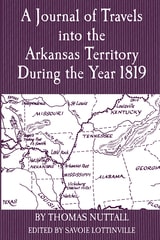
A Journal of Travels into the Arkansas Territory During the Year 1819
Thomas Nuttall
University of Arkansas Press, 1999
This is the famous naturalist Thomas Nuttall's only surviving complete journal of his American scientific explorations. Covering his travels in Arkansas and what is now Oklahoma, it is pivotal to an understanding of the Old Southwest in the early nineteenth century, when the United States was taking inventory of its acquisitions from the Louisiana Purchase.
The account follows Nuttall's route from Philadelphia to Pittsburg, down the Ohio River to its mouth, then down the Mississippi River to the Arkansas Post, and up the Arkansas River with a side trip to the Red River. It is filled with valuable details on the plants, animals, and geology of the region, as well as penetrating observations of the resident native tribes, the military establishment at Fort Smith, the arrival of the first governor of Arkansas Territory, and the beginnings of white settlement.
Originally published in 1980 by the University of Oklahoma Press, this fine edited version of Nuttall's work boasts a valuable introduction, notes, maps, and bibliography by Savoie Lottinville. The editor provided common names for those given in scientific classification and substituted modern genus and species names for the ones used originally by Nuttall. The resulting journal is a delight to read for anyone—historian, researcher, visitor, resident, or enthusiast.
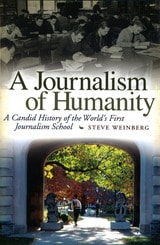
A Journalism of Humanity
A Candid History of the World's First Journalism SchoolSteve Weinberg
University of Missouri Press, 2008
It might seem unlikely that a midwestern university located far from national media centers would be home to the world’s first journalism school, but the University of Missouri holds that distinction. Now celebrating its centennial, the School of Journalism, founded by a newsman who lacked a college education, is regarded as one of the highest-rated in the world.
Steve Weinberg, an alumnus and investigative reporter who returned to teach at Missouri, now covers—and uncovers—the many-faceted history of its School of Journalism, from the days of Walter Williams through the Dean Mills era. A Journalism of Humanity balances the dynamics of the university that set the school’s course with the external forces that shaped journalism and society. True to journalism, it reveals the school’s flaws as well as its virtues.
Bringing his investigative expertise to bear, Weinberg tells the school’s complex story through thematic chapters. He draws on internal documents and correspondence to uncover the politics of the school from its founding to the present—the struggles over resources as well as the constant battle to balance scholarly ambitions with professional mission. In the course of his chronicle, he depicts an institution ahead of its time in professional education but often lagging in dealing with social issues such as race and gender.
Weinberg’s account embraces faculty and staff members, students and alumni, supporters and detractors, as it covers all professional sequences taught at the school. It captures the freewheeling debate that has been a hallmark of the school and includes the perspectives of women, blacks, and gays, who all too often were marginalized. It also incorporates a wealth of insider detail, from a typical day at the school during the Williams era to tales of the “Missouri Mafia.”
Key players, significant programs, legal and ethical battles—all are covered in a candid history that makes captivating reading for those associated with the school or for anyone interested in the development of journalism education. A Journalism of Humanity is a story as big as its subject that looks back on a trailblazing century and forward toward a continuing dedication to journalistic excellence.

A Journey in Brazil
Henry Washington Hilliard and the Brazilian Anti-Slavery SocietyDavid I. Durham and Paul M. Pruitt Jr.
University of Alabama Press, 2008
Throughout a diverse career that spanned six decades, Hilliard’s personal challenges, moderated by his faith in Divine Providence, eventually allowed him to return to his ideological roots and find a sense of redemption late in life by becoming an unlikely spokesman for the Brazilian emancipation movement through his association with Joaquim Nabuco. In A Journey in Brazil, authors David I. Durham and Paul M. Pruitt Jr. establish context for Hilliard’s beliefs, document his journey in Brazil, and offer a variety of primary documents—selections from newspapers, transcripts of letters, translations of speeches, and other documents that have never before been published.
AboutOccasional Publications of the Bounds Law Library
This collection offers a series of edited documents that contribute to an understanding of the development of legal history, culture, or doctrine. Series editors Paul M. Pruitt Jr. and David I. Durham have selected a variety of materials—a lecture, diaries, letters, speeches, a ledger, commonplace books, a code of ethics, court reports—to illustrate unique examples of legal life and thought.
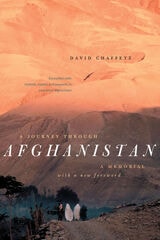
A Journey through Afghanistan
David Chaffetz
University of Chicago Press, 2002
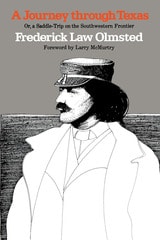
A Journey through Texas; or, a Saddle-Trip on the Southwestern Frontier
By Frederick Law Olmsted
University of Texas Press, 1978
Early in the year 1854 Frederick Law Olmsted, a young New England journalist, crossed the Louisiana border and set off on horseback into the teeth of the Texas winter. In A Journey through Texas he recounts his travels along the Old San Antonio Road through East Texas' piney woods, the dry prairies further west, the chaparral of South Texas, the coastal prairies, and the rich bottomlands around Houston and Galveston.
Olmsted does not romanticize the discomforts of his trip—the monotonous food, crude housing, wet and dry northers, rough companions—yet his book reflects a sense of limitless possibility for this new and open country. The cultured Easterner remembers in relentless detail the squalor and brutality met with in parts of East Texas, but he writes fondly of the civility and cleanliness of the German settlements around New Braunfels.
In his introductory "A Letter to a Southern Friend," omitted in earlier reprints, Olmsted sets forth his views opposing the extension of slavery into the West and promoting free-soil agriculture for frontier states.
The remarkably versatile Olmsted is best known as the founder of landscape architecture in America and for works including Central Park and Stanford University.
In his Foreword, Larry McMurtry calls A Journey through Texas an "intelligent, lively, readable book, packed with keen observation and lightened by a delicate strain of humor."

A Journey through the West
Thomas Rodney’s 1803 Journal from Delaware to the Mississippi TerritoryThomas Rodney
Ohio University Press, 1997
In A Journey through the West, Thomas Rodney writes vividly about flea-infested taverns, bad roads, drunken crew members, squatters, Indians sodden berths, food from the wild and treacherous waters. His is one of the most detailed early-nineteenth-century travel accounts.
Rodney, a Revolutionary War patriot and veteran, had been active in Delaware politics and had served in the Continental Congress. In 1803, President Thomas Jefferson appointed him as a land commissioner and a territorial judge in the newly formed Mississippi Territory. To assume his duties, Rodney and a small party traveled overland from Delaware across the length of southern Pennsylvania to Wheeling, (West) Virginia. From there, they boarded their newly constructed boat on the Ohio River and rowed, sailed, and drifted along the borders of (West) Virginia, Ohio, Indiana, Illinois, and Kentucky.
Finally they left the clear rapids of the Ohio and entered the muddy yet majestic Mississippi. They traveled southwesterly into a vast, exotic wilderness valley. The western shore of the Mississippi was still owned by Spain, and foreign soldiers were spotted. Under pressure to meet Rodney’s deadline for arrival in Mississippi Territory, the travelers were grateful for the Mississippi’s fast current. Yet in the journey’s last days they were faced with adventures and with near disaster when their boat struck a snag and partially sank.
Rodney kept a precise journal and sent letters to President Jefferson documenting his trek from the settled East through the barely chartered paths of the western wilderness. He hobnobbed with Meriwether Lewis, enjoyed the hospitality of Harman Blennerhassett, and received a tour of Cincinnati from Arthur St. Clair.
Dwight Smith and Ray Swick have compiled, edited and annotated Rodney’s story to present it in complete form for the first time. A Journey through the West is both a travel adventure and a colorful glimpse into the life of his day.
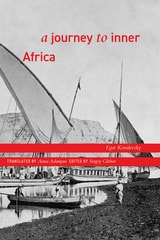
A Journey to Inner Africa
Egor Kovalevsky
Amherst College Press, 2020
Contributions by Egor Kovalevsky, Anna Aslanyan, Sergey Glebov, David Schimmelpenninck, Mukaram Hhana, and Michal Wasiucionek