Results by title
784 books match the query 'American Government' and 31 start with b
Baby Ninth Amendments
How Americans Embraced Unenumerated Rights and Why It MattersAnthony B. Sanders
University of Michigan Press, 2023
Listing every right that a constitution should protect is hard. American constitution drafters often list a few famous rights such as freedom of speech, protection against unreasonable searches and seizures, and free exercise of religion, plus a handful of others. However, we do not need to enumerate every liberty because there is another way to protect them: an "etcetera clause." It states that there are other rights beyond those specifically listed: "The enumeration in the Constitution, of certain rights, shall not be construed to deny or disparage others retained by the people." Yet scholars are divided on whether the Ninth Amendment itself actually does protect unenumerated rights, and the Supreme Court has almost entirely ignored it. Regardless of what the Ninth Amendment means, two-thirds of state constitutions have equivalent provisions, or "Baby Ninth Amendments," worded similarly to the Ninth Amendment.
This book is the story of how the "Baby Ninths" came to be and what they mean. Unlike the controversy surrounding the Ninth Amendment, the meaning of the Baby Ninths is straightforward: they protect individual rights that are not otherwise enumerated. They are an "etcetera, etcetera" at the end of a bill of rights. This book argues that state judges should do their duty and live up to their own constitutions to protect the rights "retained by the people" that these "etcetera clauses" are designed to guarantee. The fact that Americans have adopted these provisions so many times in so many states demonstrates that unenumerated rights are not only protected by state constitutions, but that they are popular. Unenumerated rights are not a weird exception to American constitutional law. They are at the center of it. We should start treating constitutions accordingly.
Baby Ninth Amendments
How Americans Embraced Unenumerated Rights and Why It MattersAnthony B. Sanders
University of Michigan Press, 2023
Listing every right that a constitution should protect is hard. American constitution drafters often list a few famous rights such as freedom of speech, protection against unreasonable searches and seizures, and free exercise of religion, plus a handful of others. However, we do not need to enumerate every liberty because there is another way to protect them: an "etcetera clause." It states that there are other rights beyond those specifically listed: "The enumeration in the Constitution, of certain rights, shall not be construed to deny or disparage others retained by the people." Yet scholars are divided on whether the Ninth Amendment itself actually does protect unenumerated rights, and the Supreme Court has almost entirely ignored it. Regardless of what the Ninth Amendment means, two-thirds of state constitutions have equivalent provisions, or "Baby Ninth Amendments," worded similarly to the Ninth Amendment.
This book is the story of how the "Baby Ninths" came to be and what they mean. Unlike the controversy surrounding the Ninth Amendment, the meaning of the Baby Ninths is straightforward: they protect individual rights that are not otherwise enumerated. They are an "etcetera, etcetera" at the end of a bill of rights. This book argues that state judges should do their duty and live up to their own constitutions to protect the rights "retained by the people" that these "etcetera clauses" are designed to guarantee. The fact that Americans have adopted these provisions so many times in so many states demonstrates that unenumerated rights are not only protected by state constitutions, but that they are popular. Unenumerated rights are not a weird exception to American constitutional law. They are at the center of it. We should start treating constitutions accordingly.
Back of the Yards
The Making of a Local DemocracyRobert A. Slayton
University of Chicago Press, 1986
Barack Obama's America
How New Conceptions of Race, Family, and Religion Ended the Reagan EraJohn Kenneth White
University of Michigan Press, 2009
"White's Barack Obama's America eloquently captures both the important nuances of the current political scene and its long-term consequences."
---Richard Wirthlin, former pollster for Ronald Reagan
"This delightfully written and accessible book is the best available account of the changes in culture, society, and politics that have given us Barack Obama's America."
---Stan Greenberg, pollster for Bill Clinton and Chairman and CEO of Greenberg Quinlan Rosner Research
"From one of the nation's foremost experts on how values shape our politics, a clear and compelling account of the dramatic shifts in social attitudes that are transforming American political culture. White's masterful blend of narrative and data illuminates the arc of electoral history from Reagan to Obama, making a powerful case for why we are entering a new progressive political era."
---Matthew R. Kerbel, Professor of Political Science, Villanova University, and author of Netroots
"John Kenneth White is bold. He asks the big questions . . . Who are we? What do we claim to believe? How do we actually live? What are our politics? John Kenneth White writes compellingly about religion and the role it played in making Barack Obama president. White's keen insight into America's many faiths clarifies why Barack Obama succeeded against all odds. It is a fascinating description of religion and politics in twenty-first-century America---a must-read."
---Kathleen Kennedy Townsend, former Lieutenant Governor of Maryland and author of Failing America's Faithful
"In Barack Obama's America, John Kenneth White has written the political equivalent of Baedeker or Michelin, the definitive guide to and through the new, uncharted political landscape of our world. White captures and explains what America means---and what it means to be an American---in the twenty-first century."
---Mark Shields, nationally syndicated columnist and political commentator for PBS NewsHour
"John White has always caught important trends in American politics that others missed. With his shrewd analysis of why Barack Obama won, he's done it again."
---E. J. Dionne, Jr., Senior Fellow, Brookings Institution, and University Professor in the Foundations of Democracy and Culture at Georgetown University
The election of Barack Obama to the presidency marks a conclusive end to the Reagan era, writes John Kenneth White in Barack Obama's America. Reagan symbolized a 1950s and 1960s America, largely white and suburban, with married couples and kids at home, who attended church more often than not.
Obama's election marks a new era, the author writes. Whites will be a minority by 2042. Marriage is at an all-time low. Cohabitation has increased from a half-million couples in 1960 to more than 5 million in 2000 to even more this year. Gay marriages and civil unions are redefining what it means to be a family. And organized religions are suffering, even as Americans continue to think of themselves as a religious people. Obama's inauguration was a defining moment in the political destiny of this country, based largely on demographic shifts, as described in Barack Obama's America.
John Kenneth White is Professor of Politics at the Catholic University of America in Washington, D.C.
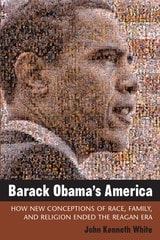
Cover image: "Out of many, we are one: Dare to Hope: Faces from 2008 Obama Rallies" by Anne C. Savage, view and buy full image at http://revolutionaryviews.com/obama_poster.html.
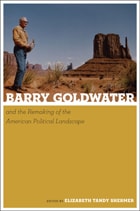
Barry Goldwater and the Remaking of the American Political Landscape
Edited by Elizabeth Tandy Shermer
University of Arizona Press, 2013
Since Goldwater’s death in 1998, politicians, pundits, and academics have been assessing his achievements and his shortcomings. The twelve essays in this volume thoroughly examine the life, times, and impact of “Mr. Conservative.” Scrutinizing the transformation of a Phoenix department store owner into a politician, de facto political philosopher, and five-time US senator, contributors highlight the importance of power, showcasing the relationship between the nascent conservative movement’s cadre of elite businessmen, newsmen, and intellectuals and their followers at the grassroots—or sagebrush—level.
Goldwater, who was born in the Arizona Territory in 1909, was deeply influenced by his Western upbringing. With his appearance on the national stage in 1964, he not only articulated a new brand of conservatism but gave a voice to many Americans who were not enamored with the social and political changes of the era. He may have lost the battle for the presidency, but he energized a coalition of journalists, publishers, women’s groups, and Southerners to band together in a movement that reshaped the nation.
Beast
Benjamin B. Lindsey
University Press of Colorado, 2009

Becoming Citizens in the Age of Television
How Americans Challenged the Media and Seized Political Initiative during the Iran-Contra DebateDavid Thelen
University of Chicago Press, 1996
Thelen argues that the self-referential world of politics and journalism during elections excludes the concerns and voices of Americans, resulting in lower voter turnouts and increased voter apathy. Televised hearings and trials, however—from O. J. Simpson to Anita Hill vs. Clarence Thomas to Oliver North and Iran-Contra—have ignited storms of controversy and public debate. Focusing upon the spontaneous, unmediated reactions of American citizens to these events, Thelen discovers a new kind of political participation in which Americans shape their interventions.
Through an analysis of a remarkable documentary collection—the correspondence sent by citizens to the House Select Committee on Iran-Contra in the wake of the Oliver North testimony—Thelen explains how Americans are reclaiming the political process. Examining more than 5,000 letters and telegrams, Thelen uncovers the anger and resolve of a vocal public insulted by the media and opinion-managers who have misrepresented them as mindless supporters of "Olliemania."
Concluding with suggestions on how citizens can reclaim their voice from the opinion managing industries, this work promises to provoke the kind of public discourse on which democracy depends.
Being Governor
The View from the OfficeThad L. Beyle and Lynn Muchmore, eds.
Duke University Press, 1983
The editors base their data on personal experience; interviews with governors, former governors, and staff; on -site visits; and responses to a series of nineteen surveys of governors and their staff conducted between 1976 and 1981. The research was undertaken by the Center for Policy Research of the National Governors' Association.
Bending the Rules
Procedural Politicking in the BureaucracyRachel Augustine Potter
University of Chicago Press, 2019
With Bending the Rules, Rachel Augustine Potter shows that rulemaking is not the rote administrative activity it is commonly imagined to be but rather an intensely political activity in its own right. Because rulemaking occurs in a separation of powers system, bureaucrats are not free to implement their preferred policies unimpeded: the president, Congress, and the courts can all get involved in the process, often at the bidding of affected interest groups. However, rather than capitulating to demands, bureaucrats routinely employ “procedural politicking,” using their deep knowledge of the process to strategically insulate their proposals from political scrutiny and interference. Tracing the rulemaking process from when an agency first begins working on a rule to when it completes that regulatory action, Potter shows how bureaucrats use procedures to resist interference from Congress, the President, and the courts at each stage of the process. This exercise reveals that unelected bureaucrats wield considerable influence over the direction of public policy in the United States.
Beyond Ideology
Politics, Principles, and Partisanship in the U. S. SenateFrances E. Lee
University of Chicago Press, 2009
The congressional agenda, Frances Lee contends, includes many issues about which liberals and conservatives generally agree. Even over these matters, though, Democratic and Republican senators tend to fight with each other. What explains this discord? Beyond Ideology argues that many partisan battles are rooted in competition for power rather than disagreement over the rightful role of government.
The first book to systematically distinguish Senate disputes centering on ideological questions from the large proportion of them that do not, this volume foregrounds the role of power struggle in partisan conflict. Presidential leadership, for example, inherently polarizes legislators who can influence public opinion of the president and his party by how they handle his agenda. Senators also exploit good government measures and floor debate to embarrass opponents and burnish their own party’s image—even when the issues involved are broadly supported or low-stakes. Moreover, Lee contends, the congressional agenda itself amplifies conflict by increasingly focusing on issues that reliably differentiate the parties. With the new president pledging to stem the tide of partisan polarization, Beyond Ideology provides a timely taxonomy of exactly what stands in his way.

Big Bill Thompson, Chicago, and the Politics of Image
Douglas Bukowski
University of Illinois Press, 1998
A brilliant chameleon of a politician, Thompson could move from pro- to anti-prohibition, from opposing the Chicago Teachers Federation to opposing a superintendent hostile to it, from being anti-Catholic to winning, in huge numbers, the Catholic vote. Shape-shifter extraordinaire, Thompson stayed in power by repeatedly altering his political image. In Big Bill Thompson, Chicago, and the Politics of Image, Douglas Bukowski captures the essence of this wily urban politico as no other biographer or historian has. Using materials accessible only thanks to the Freedom of Information Act, Bukowski has fashioned an unforgettable story of a volatile Chicago leader and his era. And he does it with such grace and in such an irresistible style that readers will yearn to visit the local speakeasy and lift a glass to colorful politicians gone by.
Big Money Unleashed
The Campaign to Deregulate Election SpendingAnn Southworth
University of Chicago Press, 2023
The story of how the First Amendment became an obstacle to campaign finance regulation—a history that began much earlier than most imagine.
Americans across party lines believe that public policy is rigged in favor of those who wield big money in elections. Yet, legislators are restricted in addressing these concerns by a series of Supreme Court decisions finding that campaign finance regulations violate the First Amendment.
Big Money Unleashed argues that our current impasse is the result of a long-term process involving many players. Naturally, the justices played critical roles—but so did the attorneys who hatched the theories necessary to support the legal doctrine, the legal advocacy groups that advanced those arguments, the wealthy patrons who financed these efforts, and the networks through which they coordinated strategy and held the Court accountable.
Drawing from interviews, public records, and archival materials, Big Money Unleashed chronicles how these players borrowed a litigation strategy pioneered by the NAACP to dismantle racial segregation and used it to advance a very different type of cause.
Bill Clinton on Stump, State, and Stage
The Rhetorical Road to the White HouseStephen A. Smith
University of Arkansas Press, 1994
Billionaires and Stealth Politics
Benjamin I. Page, Jason Seawright, and Matthew J. Lacombe
University of Chicago Press, 2018
Page, Seawright, and Lacombe argue that while political contributions offer a window onto billionaires’ influence, especially on economic policy, they do not present a full picture of policy preferences and political actions. That is because on some of the most important issues, including taxation, immigration, and Social Security, billionaires have chosen to engage in “stealth politics.” They try hard to influence public policy, making large contributions to political parties and policy-focused causes, leading policy-advocacy organizations, holding political fundraisers, and bundling others’ contributions—all while rarely talking about public policy to the media. This means that their influence is not only unequal but also largely unaccountable to and unchallengeable by the American people. Stealth politics makes it difficult for ordinary citizens to know what billionaires are doing or mobilize against it. The book closes with remedies citizens can pursue if they wish to make wealthy Americans more politically accountable, such as public financing of political campaigns and easier voting procedures, and notes the broader types of reforms, such as a more progressive income tax system, that would be needed to increase political equality and reinvigorate majoritarian democracy in the United States.
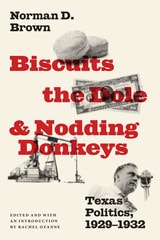
Biscuits, the Dole, and Nodding Donkeys
Texas Politics, 1929-1932By Norman D. Brown, edited and with an introduction by Rachel Ozanne
University of Texas Press, 2019
When the venerable historian Norman D. Brown published Hood, Bonnet, and Little Brown Jug in 1984, he earned national acclaim for revealing the audacious tactics at play in Texas politics during the Roaring Twenties, detailing the effects of the Ku Klux Klan, newly enfranchised women, and Prohibition. Shortly before his death in 2015, Brown completed Biscuits, the Dole, and Nodding Donkeys, which picks up just as the Democratic Party was poised for a bruising fight in the 1930 primary. Charting the governorships of Dan Moody, Ross Sterling, Miriam “Ma” Ferguson in her second term, and James V. Allred, this engrossing sequel takes its title from the notion that Texas politicians should give voters what they want (“When you cease to deliver the biscuits they will not be for you any longer,” said Jim “Pa” Ferguson) while remaining wary of federal assistance (the dole) in a state where the economy is fueled by oil pump jacks (nodding donkeys).
Taking readers to an era when a self-serving group of Texas politicians operated in a system that was closed to anyone outside the state’s white, wealthy echelons, Brown unearths a riveting, little-known history whose impact continues to ripple at the capitol.
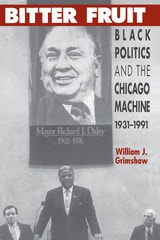
Bitter Fruit
Black Politics and the Chicago Machine, 1931-1991William J. Grimshaw
University of Chicago Press, 1992
Black Elected Officials
Study of Black Americans Holding Government OfficeJames Conyers
Russell Sage Foundation, 1976
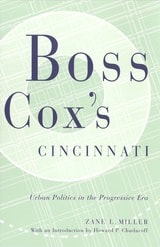
Boss Cox’s Cincinnati
Urban Politics in the Progressive EraZane L. Miller
The Ohio State University Press, 2000
In documenting the changes Cincinnati experienced during the Progressive Era, Zane L. Miller provides a clear perspective on the processes of urbanization that transformed the American city. His focus is political because politics provided continuity amid the diversity of city life. The most important aspect of political continuity in Cincinnati and in other cities was "bossism," often depicted as an example of corruption, but which was in many cities part of the quest for a new urban order. In Cincinnati, Boss George B. Cox's machine was a response to the disorder of the times; interestingly, the machine actually helped to control disorder, paving the way for later reforms. Miller carefully explores both the nature and the significance of bossism, showing how it and municipal reform were both essential components of the modern urban political system.
Originally published in 1968, Boss Cox's Cincinnati is considered a classic in the field of urban studies.
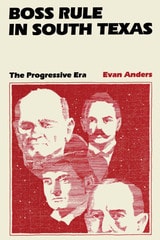
Boss Rule in South Texas
The Progressive EraBy Evan Anders
University of Texas Press, 1982
Four men played leading roles in the political drama that unfolded in South Texas during the first decades of this century:
- James B. Wells, who ruled as boss of Cameron County and served as leading conservative spokesman of the Democratic Party in Texas;
- Archer (Archie) Parr, whose ruthless tactics and misuse of public funds in Duval County established him as one of the most notoriously corrupt politicians in Texas history;
- Manuel Guerra, Mexican American rancher and merchant whose domination of Starr County mirrored the rule of his Anglo counterparts in the border region;
- John Nance Garner, who served the interests of these bosses of South Texas as he set forth on the road that would lead him to the United States vice-presidency.
Evan Anders's Boss Rule in South Texas tells the story of these men and the county rings they shaped in South Texas during the Progressive Era.
Power was the byword of the bosses of the Lower Rio Grande Valley, and Anders explores the sources of that power. These politicos did not shirk from using corrupt and even violent means to attain their goals, but Anders demonstrates that their keen sensitivity to the needs of their diverse constituency was key to their long-term success. Patronage and other political services were their lifeblood, and the allies gained by these ranged from developers and businessmen to ranchers and Mexican Americans, wealthy and poor.
Besides examining the workings of the Democratic machines of four South Texas counties, Anders explores the role of the Hispanic populace in shaping the politics of the border region, the economic development of the Lower Rio Grande Valley and its political repercussions, the emergence and nature of progressive movements at both local and state levels, and the part played by the Texas Rangers in supporting bossism in South Texas.
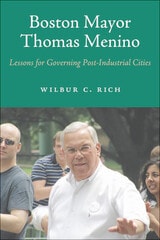
Boston Mayor Thomas Menino
Lessons for Governing Post-Industrial CitiesWilbur C. Rich
University of Massachusetts Press, 2023
Hailed as one of Boston’s most beloved mayors and its longest serving, Thomas Menino (1942–2014) deftly managed the city’s finances and transformed Boston into the hub of innovation that it is today. During his time in office, Boston embraced modern industrial growth and moved forward with noteworthy developments that altered neighborhoods, while also facing ongoing racial strife, challenges of unaffordable housing, and significant public union negotiations.
Mayors in modern American cities occupy unique positions as government leaders who need to remain active parts of their communities in addition to being tasked with fixing neighborhood issues, managing crises, and keeping schools and public infrastructure on course. Situating news coverage alongside interviews with the mayor and his administration, political scientist Wilbur C. Rich chronicles Menino’s time in office while also considering his personal and professional background, his larger-than-life personality, and his ambitions. Menino’s approach to these challenges and opportunities offers enduring lessons to anyone interested in urban government and political leadership.

Boundaries of the State in US History
Edited by James T. Sparrow, William J. Novak, and Stephen W. Sawyer
University of Chicago Press, 2015
Here, James T. Sparrow, William J. Novak, and Stephen W. Sawyer assemble definitional essays that search for explanations to account for the extraordinary growth of US power without resorting to exceptionalist narratives. Turning away from abstract, metaphysical questions about what the state is, or schematic models of how it must work, these essays focus instead on the more pragmatic, historical question of what it does. By historicizing the construction of the boundaries dividing America and the world, civil society and the state, they are able to explain the dynamism and flexibility of a government whose powers appear so natural as to be given, invisible, inevitable, and exceptional.
Braking the Special Interests
Trucking Deregulation and the Politics of Policy ReformDorothy Robyn
University of Chicago Press, 1987
Robyn focuses her analysis on four elements of strategy responsible for the deregulator's victory—elements that are essential, she argues, to any successful policy battle against entrenched special interests: the effective use of economic data and analysis to make a strong case for the merits of reform; the formation and management of a diverse lobbying coalition of firms and interest groups; presidential bargaining to gain political leverage; and transition schemes to reduce uncertainty and cushion the blow to losers.
Drawing on political and economic theory, Braking the Special Interests is an immensely rich and readable study of political strategy and skill, with general insights relevant to current political battles surrounding trade, agriculture, and tax policies. Robyn's interdisciplinary work will be of great value to scholars and practitioners of politics, economics, and public policy.
Brandishing the First Amendment
Commercial Expression in AmericaTamara R. Piety
University of Michigan Press, 2013
Over the past two decades, corporations and other commercial entities have used strategic litigation to win more expansive First Amendment protections for commercial speech—from the regulation of advertising to the role corporate interests play in the political process, most recently debated in the Supreme Court case of Citizens United v. Federal Election Commission. Tamara R. Piety, a nationally known critic of commercial and corporate speech, argues that such an expansion of First Amendment speech rights imperils public health, safety, and welfare; the reliability of commercial and consumer information; the stability of financial markets; and the global environment.
Beginning with an evaluation of commonly evoked philosophical justifications for freedom of expression, Piety determines that, while these are appropriate for the protection of an individual’s rights, they should not be applied too literally to commercial expression because the corporate person is not the moral equivalent of the human person. She then gathers evidence from public relations and marketing, behavioral economics, psychology, and cognitive studies to show how overly permissive extensions of First Amendment protections to commercial expression limit governmental power to address some of the major social, economic, and environmental challenges of our time.
“The timeliness of the topic and the provision of original positions are sure to make the book a valuable contribution that should draw much attention.”
—Kevin W. Saunders, Michigan State University
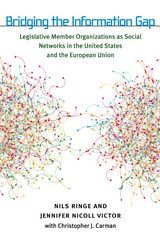
Bridging the Information Gap
Legislative Member Organizations as Social Networks in the United States and the European UnionNils Ringe and Jennifer Nicoll Victor with Christopher J. Carman
University of Michigan Press, 2013
Legislative member organizations (LMOs)—such as caucuses in the U.S. Congress and intergroups in the European Parliament—exist in lawmaking bodies around the world. Unlike parties and committees, LMOs play no obvious, predefined role in the legislative process. They provide legislators with opportunities to establish social networks with colleagues who share common interests. In turn, such networks offer valuable opportunities for the efficient exchange of policy-relevant—and sometimes otherwise unattainable—information between legislative offices. Building on classic insights from the study of social networks, the authors provide a comparative overview of LMOs across advanced, liberal democracies. In two nuanced case studies of LMOs in the European Parliament and the U.S. Congress, the authors rely on a mix of social network analysis, sophisticated statistical methods, and careful qualitative analysis of a large number of in-depth interviews.
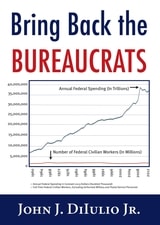
Bring Back the Bureaucrats
Why More Federal Workers Will Lead to Better (and Smaller!) GovernmentJohn DiIulio
Templeton Press, 2014
In Bring Back the Bureaucrats, John J. DiIulio Jr., one of America’s most respected political scientists and an adviser to presidents in both parties, summons the facts and statistics to show us how America’s big government works and why reforms that include adding a million more people to the federal workforce by 2035 might help to slow government’s growth while improving its performance.
Starting from the underreported reality that the size of the federal workforce hasn’t increased since the early 1960s, even though the federal budget has skyrocketed. The number of federal programs has ballooned; Bring Back the Bureaucrats tells us what our elected leaders won’t: there are not enough federal workers to work for our democracy effectively.
DiIulio reveals that the government in America is Leviathan by Proxy, a grotesque form of debt-financed big government that guarantees terrible government. Washington relies on state and local governments, for-profit firms, and nonprofit organizations to implement federal policies and programs. Big-city mayors, defense industry contractors, nonprofit executives, and other national proxies lobby incessantly for more federal spending. This proxy system chokes on chores such as cleaning up toxic waste sites, caring for hospitalized veterans, collecting taxes, handling plutonium, and policing more than $100 billion annually in “improper payments.” The lack of competent, well-trained federal civil servants resulted in the failed federal response to Hurricane Katrina and the troubled launch of Obamacare’s “health exchanges.”
Bring Back the Bureaucrats is further distinguished by the presence of E. J. Dionne Jr. and Charles Murray, two of the most astute voices from the political left and right, respectively, who offer their candid responses to DiIulio at the end of the book.
Bringing Representation Home
State Legislators among Their ConstituenciesMichael A. Smith
University of Missouri Press, 2003

Broken Government?
Edited by Iwan Morgan and Philip D. Davies
University of London Press, 2013
Broken Record
The Origins and Evolution of Recorded Voting in the U.S. CongressMichael S. Lynch & Anthony J. Madonna
University of Michigan Press, 2025
Consistent with the Founders’ skepticism of the impact of recorded voting in Congress, Broken Record shows that the contemporary roll call voting record includes far more meaningless position-taking and procedural roll call votes than it did during earlier congresses. The book argues that the removal of practical barriers to roll calls, internal changes to legislative procedures, and increased electoral competitiveness have led to more roll call votes on proposals sponsored by more extreme members. In addition to policy making being more difficult, increased roll call voting has played a substantial role in artificially increasing observed levels of polarization. This book argues that solving polarization requires a more nuanced set of solutions than simply replacing legislators; it will require increased public education about how Congress operates and specific procedural reforms.
Brother Bill
President Clinton and the Politics of Race and ClassDaryl A Carter
University of Arkansas Press, 2016
“This book is a fascinating analysis of race and class in the age of President Bill Clinton. It provides much-needed clarity in regards to the myth of the ‘First Black President.’ It contributes much to our understanding of the history that informs our present moment!”
—Cornel West
As President Barack Obama was sworn into office on January 20, 2009, the United States was abuzz with talk of the first African American president. At this historic moment, one man standing on the inaugural platform, seemingly a relic of the past, had actually been called by the moniker the “first black president” for years.
President William Jefferson Clinton had long enjoyed the support of African Americans during his political career, but the man from Hope also had a complex and tenuous relationship with this faction of his political base. Clinton stood at the nexus of intense political battles between conservatives’ demands for a return to the past and African Americans’ demands for change and fuller equality. He also struggled with the class dynamics dividing the American electorate, especially African Americans. Those with financial means seized newfound opportunities to go to college, enter the professions, pursue entrepreneurial ambitions, and engage in mainstream politics, while those without financial means were essentially left behind. The former became key to Clinton’s political success as he skillfully negotiated the African American class structure while at the same time maintaining the support of white Americans. The results were tremendously positive for some African Americans. For others, the Clinton presidency was devastating.
Brother Bill examines President Clinton’s political relationship with African Americans and illuminates the nuances of race and class at the end of the twentieth century, an era of technological, political, and social upheaval.
Building a Legislative-Centered Public Administration
Congress and the Administrative State, 1946-1999David Rosenbloom
University of Alabama Press, 2002
2001 Louis Brownlow Award from the National Academy of Public Administration
Reimagining public administration through the lens of constitutional governance and legislative intent.
Before 1946 the congressional role in public administration had been limited to authorization, funding, and review of federal administrative operations, which had grown rapidly as a result of the New Deal and the Second World War. But in passing the Administrative Procedure Act and the Legislative Reorganization Act that pivotal year, Congress self-consciously created for itself a comprehensive role in public administration. Reluctant to delegate legislative authority to federal agencies, Congress decided to treat the agencies as extensions of itself and established a framework for comprehensive regulation of the agencies' procedures. Additionally, Congress reorganized itself so it could provide continuous supervision of federal agencies.
Rosenbloom shows how these 1946 changes in the congressional role in public administration laid the groundwork for future major legislative acts, including the Freedom of Information Act (1966), Privacy Act (1974), Government in the Sunshine Act (1976), Paperwork Reduction Acts (1980, 1995), Chief Financial Officers Act (1990), and Small Business Regulatory Fairness Enforcement Act (1996). Each of these acts, and many others, has contributed to the legislative-centered public administration that Congress has formed over the past 50 years.
This first book-length study of the subject provides a comprehensive explanation of the institutional interests, values, and logic behind the contemporary role of Congress in federal administration and attempts to move the public administration field beyond condemning legislative "micromanagement" to understanding why Congress values it.
Bureaucracy in America
The Administrative State's Challenge to Constitutional GovernmentJoseph Postell
University of Missouri Press, 2023