Results by title
9 books match the query 'Gone'
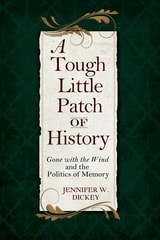
A Tough Little Patch of History
Gone with the Wind and the Politics of MemoryJennifer W. Dickey
University of Arkansas Press, 2014
More than seventy-five years after its publication, Gone with the Wind remains thoroughly embedded in American culture. Margaret Mitchell’s novel and the film produced by David O. Selznick have melded with the broader forces of southern history, southern mythology, and marketing to become, and remain, a cultural phenomenon.
A Tough Little Patch of History (the phrase was coined by a journalist in 1996 to describe the Margaret Mitchell home after it was spared from destruction by fire) explores how Gone with the Wind has remained an important component of public memory in Atlanta through an analysis of museums and historic sites that focus on this famous work of fiction. Jennifer W. Dickey explores how the book and film threw a spotlight on Atlanta, which found itself simultaneously presented as an emblem of both the Old South and the New South. Exhibitions produced by the Atlanta History Center related to Gone with the Wind are explored, along with nearby Clayton County’s claim to fame as “the Home of Gone with the Wind,” a moniker bestowed on the county by Margaret Mitchell’s estate in 1969. There’s a recounting of the saga of “the Dump,” the tiny apartment in midtown Atlanta where Margaret Mitchell wrote the book, and how this place became a symbol for all that was right and all that was wrong with Mitchell’s writing.

Gone Gone
Todd Meyers
Duke University Press, 2025
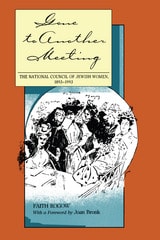
Gone to Another Meeting
The National Council of Jewish Women, 1893-1993Faith Rogow
University of Alabama Press, 1993
The first comprehensive history of the oldest national religious Jewish women's organization in the United States
Gone to Another Meeting charts the development of the National Council of Jewish Women (NCJW) and its impact on both the Jewish Community in the United States and American Society in general.
Founded in 1893 by Hannah Greenebaum Solomon, NCJW provided a conduit through which Jewish women’s voices could be heard and brought a Jewish voice to America’s women’s rights movement. NCJW would come to represent both the modernization and renewal of traditional Jewish womanhood. Through its emphasis on motherhood, its adoption of domestic feminism, and its efforts to carve a distinct Jewish niche in the late 19th-century Progressive social reform movement in the largely Christian world of women’s clubs, NCJW was instrumental in defining a uniquely American version of Jewish womanhood.
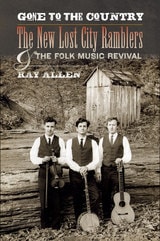
Gone to the Country
The New Lost City Ramblers and the Folk Music RevivalRay Allen
University of Illinois Press, 2010
Ray Allen interweaves biography, history, and music criticism to follow the band from its New York roots to their involvement with the commercial folk music boom. Allen details their struggle to establish themselves amid critical debates about traditionalism brought on by their brand of folk revivalism. He explores how the Ramblers ascribed notions of cultural authenticity to certain musical practices and performers and how the trio served as a link between southern folk music and northern urban audiences who had little previous exposure to rural roots styles. Highlighting the role of tradition in the social upheaval of mid-century America, Gone to the Country draws on extensive interviews and personal correspondence with band members and digs deep into the Ramblers' rich trove of recordings.
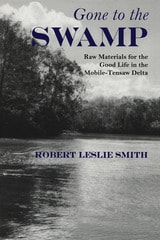
Gone to the Swamp
Raw Materials for the Good Life in the Mobile-Tensaw DeltaRobert Leslie Smith
University of Alabama Press, 2008
Normal0falsefalsefalseMicrosoftInternetExplorer4Normal0falsefalsefalseMicrosoftInternetExplorer4
To make a living here, one had to be capable, confident, clever and inventive, know a lot about survival, be able to fashion and repair tools, navigate a boat, fell a tree, treat a snakebite, make a meal from whatever was handy without asking too many questions about it, and get along with folks.
This fascinating and instructive book is the careful and unpretentious account of a man who was artful in all the skills needed to survive and raise a family in an area where most people would be lost or helpless. Smith’s story is an important record of a way of life beginning to disappear, a loss not fully yet realized. We are lucky to have a work that is both instructive and warm-hearted and that preserves so much hard-won knowledge.

Or, Gone
PoemsDeborah Flanagan
Tupelo Press, 2015
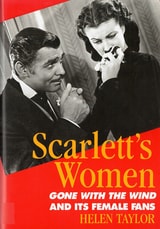
Scarlett's Women
Gone With the Wind and Its Female FansTaylor, Helen
Rutgers University Press, 1989
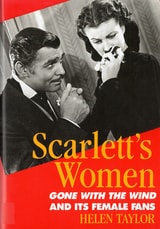
Scarlett's Women
Gone With the Wind and Its Female FansTaylor, Helen
Rutgers University Press, 1969
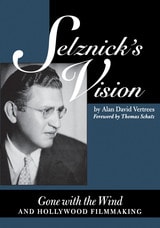
Selznick's Vision
Gone with the Wind and Hollywood FilmmakingBy Alan David Vertrees
University of Texas Press, 1997
Gone with the Wind has generated interest in every aspect of its production. Yet one crucial aspect has never been fully understood or appreciated—the vital shaping role played by executive producer David O. Selznick.
In this book, Alan David Vertrees challenges the popular image of Selznick as a megalomaniacal meddler whose hiring and firing of directors and screenwriters created a patchwork film that succeeded despite his interference. Drawing on ten years of research in the Selznick archives, and examining the screenplay's successive drafts, dramatic continuity designs and "storyboard" sketches (many of which are reproduced here), and production correspondence and memoranda, Vertrees interprets the producer's actions as manipulation, not indecision, establishing Selznick's "vision" as the guiding intelligence behind the film's success.
In his drive to create a cinematic monument, Selznick also reformed many key facets of studio filmmaking, inventing jobs such as "production designer" (inaugurated by William Cameron Menzies), which persist today. This book thus adds an important chapter to the story of classical Hollywood cinema and the making of the film that has been lauded variously as the "Sistine Chapel of movies" and the "single most beloved entertainment ever produced."