Results by title
79 books match the query 'Avant-garde (Aesthetics)' and 3 start with b
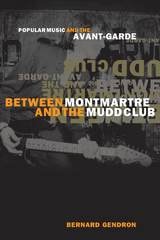
Between Montmartre and the Mudd Club
Popular Music and the Avant-GardeBernard Gendron
University of Chicago Press, 2002
During the late nineteenth and early twentieth century, popular music was considered nothing but vulgar entertainment. Today, jazz and rock music are seen as forms of art, and their practitioners are regularly accorded a status on par with the cultural and political elite. To take just one recent example, Bono, lead singer and lyricist of the rock band U2, got equal and sometimes higher billing than Pope John Paul II on their shared efforts in the Jubilee 2000 debt-relief project.
When and how did popular music earn so much cultural capital? To find out, Bernard Gendron investigates five key historical moments when popular music and avant-garde art transgressed the rigid boundaries separating high and low culture to form friendly alliances. He begins at the end of the nineteenth century in Paris's Montmartre district, where cabarets showcased popular music alongside poetry readings in spaces decorated with modernist art works. Two decades later, Parisian poets and musicians "slumming" in jazz clubs assimilated jazz's aesthetics in their performances and compositions. In the bebop revolution in mid-1940s America, jazz returned the compliment by absorbing modernist devices and postures, in effect transforming itself into an avant-garde art form. Mid-1960s rock music, under the leadership of the Beatles, went from being reviled as vulgar music to being acclaimed as a cutting-edge art form. Finally, Gendron takes us to the Mudd Club in the late 1970s, where New York punk and new wave rockers were setting the aesthetic agenda for a new generation of artists.
Between Montmartre and the Mudd Club should be on the shelves of anyone interested in the intersections between high and low culture, art and music, or history and aesthetics.
[more]
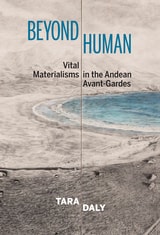
Beyond Human
Vital Materialisms in the Andean Avant-GardesDaly, Tara
Bucknell University Press, 2019
In the Andes, indigenous knowledge systems based on the relationships between different beings, both earthly and heavenly, animal and plant, have been central to the organization of knowledge since precolonial times. The legacies of colonialism and the continuance of indigenous cultures make the Andes a unique place from which to think about art and social change as ongoing, and as encompassing more than an exclusively human perspective. Beyond Human revises established readings of the avant-gardes in Peru and Bolivia as humanizing and historical. By presenting fresh readings of canonical authors like César Vallejo, José María Arguedas, and Magda Portal, and through analysis of newer artist-activists like Julieta Paredes, Mujeres Creando Comunidad, and Alejandra Dorado, Daly argues instead that avant-gardes complicate questions of agency and contribute to theoretical discussions on vital materialisms: the idea that life happens between animate and inanimate beings—human and non-human—and is made sensible through art.
Published by Bucknell University Press. Distributed worldwide by Rutgers University Press.
Published by Bucknell University Press. Distributed worldwide by Rutgers University Press.
[more]
Beyond the Sovereign Self
Aesthetic Autonomy from the Avant-Garde to Socially Engaged ArtGrant H. Kester
Duke University Press, 2024
In Beyond the Sovereign Self Grant H. Kester continues the critique of aesthetic autonomy begun in The Sovereign Self, showing how socially engaged art provides an alternative aesthetic with greater possibilities for critical practice. Instead of grounding art in its distance from the social, Kester shows how socially engaged art, developed in conjunction with forms of social or political resistance, encourages the creative capacity required for collective political transformation. Among others, Kester analyzes the work of conceptual artist Adrian Piper, experimental practices associated with the escrache tradition in Argentina, and indigenous Canadian artists such as Nadia Myre and Michèle Taïna Audette, showing how socially engaged art catalyzes forms of resistance that operate beyond the institutional art world. From the Americas and Europe to Iran and South Africa, Kester presents a historical genealogy of recent engaged art practices rooted in a deep history of cultural production, beginning with nineteenth-century political struggles and continuing into contemporary anticolonial resistance and other social movements.
[more]