Results by title
82 books match the query 'Birdwatching Guides' and 20 start with b
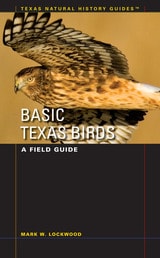
Basic Texas Birds
A Field GuideBy Mark W. Lockwood
University of Texas Press, 2007
Finding all the birds in Texas can be a lifetime pursuit. Basic Texas Birds, an easy-to-use field guide, will help you identify over 180 species of birds that are found across the state, including a selection of the rarer "Texas specialties" that draw birders to Texas from around the world. These are the birds that form the basis of a birder's life list for Texas.
Basic Texas Birds is organized by bird families to aid in identifying any bird you see in the wild. It is loaded with resources, including:
- 200 full-color, close-up photos of the birds
- State-of-the-art range maps—the most accurate of any currently available—that show each species' distribution within the state
- Up-to-date species accounts that provide a wealth of current and historical information, including each bird's appearance, habitat, status, and distribution, and that also identify similar species
- A glossary of terms used in bird identification
- A list of selected readings for learning more about birds found in Texas
- The Texas Ornithological Society's list of birds documented in Texas
Much more convenient for identifying common birds than a comprehensive state or national field guide, Basic Texas Birds is a must-have resource for both beginning and experienced birders.
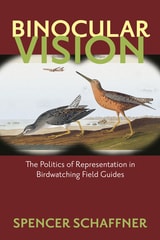
Binocular Vision
The Politics of Representation in Birdwatching Field GuidesSpencer Schaffner
University of Massachusetts Press, 2011
From meadows to marshlands, seashores to suburbs, field guides help us identify many of the things we find outdoors: plants, insects, mammals, birds. In these texts, nature is typically represented, both in words and images, as ordered, clean, and untouched by human technology and development. This preoccupation with species identification, however, has produced an increasingly narrow view of nature, a “binocular vision,” that separates the study of individual elements from a range of larger, interconnected environmental issues. In this book, Spencer Schaffner reconsiders this approach to nature study by focusing on how birds are presented in field guides.
Starting with popular books from the late nineteenth century and moving ultimately to the electronic guides of the current day, Binocular Vision contextualizes birdwatching field guides historically, culturally, and in terms of a wide range of important environmental issues. Schaffner questions the assumptions found in field guides to tease out their ideological workings. He argues that the sanitized world represented in these guides misleads readers by omitting industrial landscapes and so-called nuisance birds, leaving users of the guides disconnected from environmental degradation and its impact on bird populations.
By putting field guides into direct conversation with concerns about species conservation, environmental management, the human alteration of the environment, and the problem of toxic pollution, Binocular Vision is a field guide to field guides that takes a novel perspective on how we think about and interact with the world around us.
Bird-Witched!
How Birds Can Change a LifeBy Marjorie Valentine Adams
University of Texas Press, 2005
Birding can become an addiction. It starts when you hang a bird feeder in the backyard. Then you buy a bird book to identify the birds you see. Then, before you know it, you're keeping a life list and traveling the region, the country, perhaps even the world to catch glimpses of rare birds. Marjorie Adams's birding passion progressed through all these stages and continues today in her tenth decade. In this engaging and informative book, she looks back at her evolution into a full-fledged birder and the concurrent growth of the sport of birding, to which she contributed significantly as a founding member of the American Birding Association, a newspaper columnist on birding, and a teacher and producer of educational wildlife films with her husband and lifelong birding partner, "Red" Adams.
As one who was there from the beginning, Marjorie Adams is uniquely qualified to recount the astonishing rise of birding to a major pastime and recreational industry. She describes the founding of the American Birding Association and profiles its founder, James A. Tucker. She vividly recalls many of her and Red's birding adventures, from southern Canada to Mexico, as well as their encounters with a host of highly regarded birders, including Roger Tory Peterson, Pete Dunne, Victor Emanuel, Charles Hartshorne, and Roy Bedichek. She also explains how her and Red's love for birds led them to become conservation activists and how they produced an award-winning film on the endangered Golden-cheeked Warbler. Offering an important chapter in the story of birding in Texas and the United States, this book establishes Marjorie and Red Adams's rightful place among the leading Texas naturalists of recent decades.
Birding While Indian
A Mixed-Blood MemoirThomas C. Gannon
The Ohio State University Press, 2023
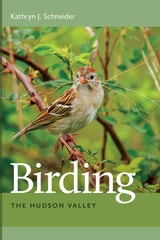
Birding the Hudson Valley
Kathryn J. Schneider
University Press of New England, 2018
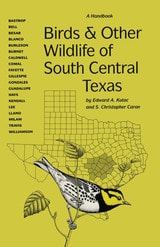
Birds and Other Wildlife of South Central Texas
A HandbookBy Edward A. Kutac and S. Christopher Caran
University of Texas Press, 1993
Nature takes a surprising turn in the heart of Texas. The flat Gulf Coastal Plains, which become the fertile Blackland Prairies in Central Texas, end abruptly at the Balcones Escarpment, one of the state’s most dramatic geological features, and the rolling, more sparsely vegetated Hill Country begins. The animal life varies as dramatically as the land. More than 400 species of birds alone, nearly three-fourths of all Texas birds, can be spotted in the region.
This handbook offers a concise natural history of Central Texas and a complete checklist of all native and naturalized vertebrate animals, including birds, mammals, reptiles, amphibians, and fish, as well as invertebrates that include butterflies and land snails. The listings cite both scientific and common names for each species, relative abundance in the region, and preferred habitats.
A distinguishing feature of the handbook is its list of parks and recreational areas in the region, which includes the counties of Bastrop, Bell, Bexar, Blanco, Burleson, Burnet, Caldwell, Comal, Fayette, Gillespie, Gonzales, Guadalupe, Hays, Kendall, Lee, Llano, Milam, Travis, and Williamson. The authors describe the recreational facilities available in each park and list the animal species likely to be encountered there.
For birdwatchers, naturalists, visitors, and residents alike, this popular handbook will be the essential "where-to-find-it" reference.
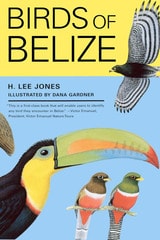
Birds of Belize
By H. Lee Jones
University of Texas Press, 2003
With nearly six hundred identified species of birds—and an average of five "new" species discovered annually—Belize is becoming a birding hotspot for amateur and professional birders from around the globe. Thousands of birders visit the country each year to enjoy Belize's amazing abundance and variety of both temperate and tropical birds in natural habitats that remain largely unspoiled. But until now, despite the growing need for an authoritative identification guide, birders have had to rely on regional field guides that offer only limited information on Belizean birds.
Birds of Belize provides the first complete guide to the identification of all currently known species—574 in all. The birds are grouped by families, with an introduction to each family that highlights its uniquely identifying characteristics and behaviors. The species accounts include all the details necessary for field identification: scientific and common names, size, plumage features, thorough voice descriptions, habitat, distribution, and status in Belize. Full color, expertly drawn illustrations by noted bird artist Dana Gardner present male and female, juvenile and adult, and basic and alternate plumages to aid visual identification throughout the year, while 234 range maps show the birds' distribution and seasonality in Belize. A comprehensive bibliography completes the volume.
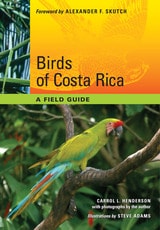
Birds of Costa Rica
A Field GuideText and photographs by Carrol L. Henderson
University of Texas Press, 2010
At the biological crossroads of the Americas, Costa Rica hosts an astonishing array of plants and animals—over half a million species! Ecotourists, birders, and biologists come from around the world, drawn by the likelihood of seeing more than three or four hundred species of birds and other animals during even a short stay. To help all of these visitors, as well as local residents, identify and enjoy the wildlife of Costa Rica, Carrol Henderson published Field Guide to the Wildlife of Costa Rica in 2002, and it became the instant and indispensable guide.
Now Henderson has created a dedicated field guide to the birds that travelers are most likely to see, as well as to the unique or endemic species that are of high interest to birders. Birds of Costa Rica covers 310 birds—an increase of 124 species from the earlier volume—with fascinating accounts of the birds' natural history, identification, and behavior gleaned from Henderson's forty years of traveling and birding in Costa Rica. All of the accounts include beautiful photographs of the birds, most of which were taken in the wild by Henderson. There are new updated distribution maps and a detailed appendix that identifies many of the country's best bird-watching locations and lodges, including contact information for trip planning purposes.
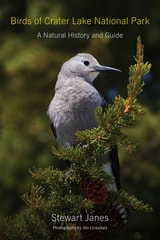
Birds of Crater Lake National Park
A Natural History and GuideStewart Janes
Oregon State University Press, 2026
From the Clark’s Nutcracker to the White-crowned Sparrow, the guide provides species accounts of the most characteristic birds found in the park. Accompanied by detailed color photographs, each entry also includes the scientific name, description, and distribution along with a short narrative.
With essays focusing on the history, climate, geology, and geography of the region, this guide offers a strong foundation to greater understanding of the birds of Crater Lake. Plus, chapters like “Birds Beyond Crater Lake National Park” and “Some Places to Bird in Crater Lake National Park,” along with a birding checklist, offer invaluable resources to beginner and skilled birders alike.
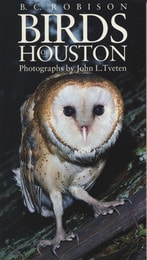
Birds of Houston
By B. C. Robison
University of Texas Press, 1997
No matter where you see birds in the city—in parks or woodlands, on power lines or in parking lots—they are the natural soul of the urban landscape. They enhance the city and the lives of those who watch them.
Nature writer B. C. Robison and wildlife photographer John Tveten have teamed up to produce this field guide for birders who want to identify the birds most commonly seen in Houston. Fifty-five species are included, ranging from such well-known favorites as the mockingbird and cardinal to the more exotic yellow-crowned night heron.
A full-color photograph for each bird appears alongside warm and often witty description. For quick reference, a summary of the primary field marks of the adult bird is also provided. This summary includes not only identifying features of the bird but also its habitats, the time of year it can be found, and its distinctive behavioral traits.
Aimed at the beginning birder, the guide also gives tips on buying binoculars and on attracting birds to your yard.
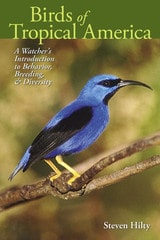
Birds of Tropical America
A Watcher's Introduction to Behavior, Breeding, and DiversityBy Steven Hilty
University of Texas Press, 2005
The guide to neotropical bird behavior that picks up where field guides leave off.
Why are tropical birds like parrots and quetzals so much more colorful than those in more temperate climates? How can a vulture soaring thousands of feet above the canopy spot a dead rodent no bigger than a mouse on the rainforest floor? What permits sparrow-sized antbirds to not only survive but to thrive among relentless hordes of army ants that devour every other living thing in their path?
Steven Hilty has led birding tours to the American Tropics for decades. By providing answers to the hundreds of questions asked by participants of these expeditions, Hilty has produced a natural history of the bird life of the New World Tropics that is at once practical, accurate, and as endlessly fascinating as the species whose lives it reveals.
Birds of Tropical America was published by Chapters Publishing in 1994 and went out of print in 1997. UT Press is pleased to reissue it with a new epilogue and updated references.
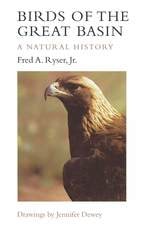
Birds of the Great Basin
A Natural HistoryFred A. Ryser
University of Nevada Press, 1985
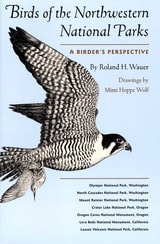
Birds of the Northwestern National Parks
A Birder's PerspectiveBy Roland H. Wauer
University of Texas Press, 2000
From the bald eagle to the pileolated woodpecker, the varied and abundant birdlife of the northwestern national parks is as impressive as the parks' dramatic scenery. To help both beginning and advanced birders make the most of their visits to these parks, Roland Wauer has written this finding guide, which introduces the most common birds and the most likely places to see them.
The book opens with practical advice on getting started in birding—choosing binoculars, bird identification, proper field techniques, etc. Then after a concise discussion of the national parks as "islands" of bird habitat, the succeeding chapters fully describe each park, including its plant and animal communities and the facilities and interpretive activities available to visitors. Wauer takes readers on "walks" through each park's most popular and accessible places, where he explains the identification and behavior of the birds that visitors are most likely to see. He closes each account with a review of the park's bird life and a list of key species. Pen-and-ink drawings illustrate many of the birds.
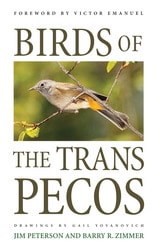
Birds of the Trans-Pecos
By Jim Peterson and Barry R. Zimmer
University of Texas Press, 1998
The Trans-Pecos, that huge region of Texas west of the Pecos River, is richer in recorded bird species than all but three of the United States. Hundreds of birders come here each year in search of species such as the Colima Warbler which are rarely if ever spotted in other parts of the country. Yet, until now, there was no comprehensive birding guide devoted to the entire region.
Designed for intermediate to advanced birders, Birds of the Trans-Pecos provides an annotated checklist of all 482 species found in the region. The species accounts include seasonal distribution, documentation of nesting, most likely habitat, and the bird's status as a "Texas Review Species." The authors also describe the geography and bird habitats of the Trans-Pecos; federal and state parklands in the area (including Big Bend and Guadalupe Mountains), with the species that occur in each; and the mountain-breeding birds and species of special interest.
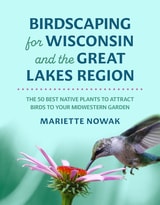
Birdscaping for Wisconsin and the Great Lakes Region
The 50 Best Native Plants to Attract Birds to Your Midwestern GardenMariette Nowak
University of Wisconsin Press, 2025
The book explains the value of particular plants for birds and other wildlife, not only as food sources but as nesting sites and cover. Each plant is described in depth, with details on color, height, blooming time, light requirements, and soil preferences, along with planting tips and suggested companion plants. Nowak offers closer looks at the intriguing features of these diverse plant species and their intertwined relationships with birds, complemented by more than 150 color photos that showcase the beauty of the plants and birds together. Novice gardeners will also find essential information on birdscaping basics, site preparation, management guidelines, and safeguarding songbirds.
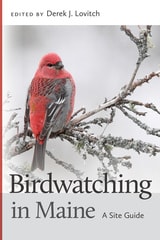
Birdwatching in Maine
A Site GuideEdited by Derek J. Lovitch
University Press of New England, 2017
Birdwatching in Maine
The Complete Site GuideDerek J. Lovitch
Brandeis University Press, 2024
With over 470 species of birds recorded, Maine offers an abundance of birding opportunities for people of all levels of interest and experience, from those looking beyond their backyards for the first time to knowledgeable visitors looking to plug a hole in their list of sightings. The state’s wealth of undeveloped land and its extensive coastline, countless islands, and varied habitat combine to host an impressive diversity of birds at all times of the year. Birders travel to Maine from near and far to seek hard-to-find species, from the only Atlantic puffins breeding in the United States on offshore islands to Bicknell’s thrushes high in the mountains.
This book fills an important niche for the birdwatching community by offering comprehensive entries detailing the best locations for finding birds throughout the state for enthusiasts of all levels of skill and interest. It contains descriptions of 202 birding sites in Maine, with explicit directions on how to get there, for all sixteen of the state’s counties, several as large as other New England states! Each chapter features a county map, a brief overview by Derek J. Lovitch, numerous specific site guides, and a list of rarities. The book also contains a detailed and useful species accounts guide for finding the most sought-after birds.
Lavishly illustrated in color throughout, Birdwatching in Maine is the best available resource for finding birds in the largest of the New England states. This updated edition features a new introduction, as well as new birding sites and maps.
Birdwatching in New Hampshire
Eric A. Masterson
University Press of New England, 2013
Birdwatching in New York City and on Long Island
Deborah Rivel and Kellye Rosenheim
University Press of New England, 2016
This easy-to-use guide gives seasonal information for both popular birding sites and those off the beaten path. Precise directions to the best viewing locations within the region’s diverse habitats enable birdwatchers to efficiently explore urban and wild birding hotspots. Over 500 species of birds can be seen in New York City’s five boroughs and on Long Island, one of the most densely populated and urbanized regions in North America, which also happens to be situated directly on the Atlantic Flyway. In this fragmented environment of scarce resources, birds concentrate on what’s available. This means that high numbers of birds are found in small spaces. In fact, Central Park alone attracts over 225 species of birds, which birders from around the world flock to see during spring and fall migration. Beyond Central Park, the five boroughs and Long Island have numerous wildlife refuges of extraordinary scenic beauty where resident and migratory birds inhabit forests, wetlands, grasslands, and beaches. These special places present an opportunity to see a wide array of songbirds, endangered nesting shorebirds, raptors, and an unprecedented number and variety of waterfowl. Including the latest information on the seasonal status and distribution of more than 400 species, with 39 maps and over 50 photographs, this full-color guide features information essential to planning a birding visit. It will become the go-to book for both the region’s longtime birders and those exploring the area for the first time.
Birdwatching in New York City and on Long Island
Second EditionDeborah Rivel and Kellye Rosenheim
Brandeis University Press, 2025
Over five hundred species of birds can be seen in New York City’s five boroughs and on Long Island, one of the most densely populated and urbanized regions in North America, which also happens to be situated directly on the Atlantic Flyway. In this fragmented environment where resources are scarce, birds congregate in small spaces—Central Park alone attracts over 225 species of birds (not to mention birders from around the world who flock to the park during spring and fall migration). Beyond Central Park, the five boroughs and Long Island boast numerous wildlife refuges of extraordinary scenic beauty where resident and migratory birds inhabit forests, wetlands, grasslands, and beaches. These places present a unique opportunity to see a wide array of songbirds, endangered nesting shorebirds, raptors, and an unprecedented number and variety of waterfowl.
The fully updated edition of this easy-to-use guide provides year-round information for both popular birding sites as well as those off the beaten path. Precise directions to the best viewing locations within the region’s diverse habitats enable birdwatchers to explore urban and wild birding hot spots. Including the latest information on the seasonal status and distribution of more than four hundred species, and featuring thirty-nine maps and over fifty photographs, this full-color guide offers information essential to locals and visitors alike. This is the go-to book for both longtime birders and those exploring the area for the first time.