Results by title
63 books match the query 'Bolivia' and 8 start with b

Basques and Vicuñas at the Mouth of Hell
A Documentary History of Potosí in the Early 1620sKris Lane
University of Nevada Press, 2024
As mines flooded and Indigenous workers died or fled, the city descended into a maelstrom of swordfights, gun battles, ambushes, sniper attacks, and summary executions. Though its roots were economic, the Basque-Vicuña conflict strained the sinews of Habsburg global governance even as it exposed festering local tensions, only some of which were unique to Potosí.
This rich collection of original sources, all of them archival documents housed in Bolivia, Spain, the United Kingdom, and the United States, consists of contemporary eyewitness accounts from several perspectives, allowing readers to play historian. All sources have been expertly translated and carefully annotated in a manner that will engage students and scholars alike. Basques and Vicuñas at the Mouth of Hell includes an extensive introduction, seven vital documents in translation, and appendices on everyday life in 1620s Potosí and on the historiography of this watershed episode of colonial violence.
Between the Andes and the Amazon
Language and Social Meaning in BoliviaAnna M. Babel
University of Arizona Press, 2018
Between the Andes and the Amazon is ethnography in storytelling form, a rigorous yet sensitive exploration of how people understand themselves and others as members of social groups through the words and languages they use.
Drawing on fifteen years of ethnographic research, Babel offers a close examination of how people produce oppositions, even as they might position themselves “in between” those categories. These oppositions form the raw material of the social system that people accept as “normal” or “the way things are.” Meaning-making happens through language use and language play, Babel explains, and the practice of using Spanish versus Quechua is a claim to an identity or a social position. Babel gives personal perspectives on what it is like to live in this community, focusing on her own experiences and those of her key consultants. Between the Andes and the Amazon opens new ways of thinking about what it means to be a speaker of an indigenous or colonial language—or a mix of both.
Beyond Indigeneity
Coca Growing and the Emergence of a New Middle Class in BoliviaAlessandra Pellegrini Calderón
University of Arizona Press, 2016
Beyond Indigeneity offers new analysis into indigenous identity and social mobility that changes the discourse in Latin American social anthropology. Author Alessandra Pellegrini Calderón points out that Morales’s presidency has led to heightened publicity of coca issues and an intensification of indigeneity discourse, echoing a global trend of increased recognition of indigenous peoples’ claims. The “living well” attitude (vivir bien) enshrined in the new political constitution is generally represented as an indigenous way of life, one based on harmony and reciprocity, in sharp contrast to the capitalist logic of “living better” that is based on accumulation and expansion.
In this ethnography, Pellegrini explores the positioning of coca growers in Bolivia and their reluctance to embrace the politics of indigeneity by rejecting the “indigenous peoples’ slot,” even while they emerge as a new middle class. By staying in a space between ethnic categories and also between social classes, the coca growers break with the traditional model of social mobility in Latin America and create new forms of political positioning that challenge the dominant culturalist framework about indigeneity and peasants.
Blood of the Earth
Resource Nationalism, Revolution, and Empire in BoliviaBy Kevin A. Young
University of Texas Press, 2017
Conflicts over subterranean resources, particularly tin, oil, and natural gas, have driven Bolivian politics for nearly a century. “Resource nationalism”—the conviction that resource wealth should be used for the benefit of the “nation”—has often united otherwise disparate groups, including mineworkers, urban workers, students, war veterans, and middle-class professionals, and propelled an indigenous union leader, Evo Morales, into the presidency in 2006. Blood of the Earth reexamines the Bolivian mobilization around resource nationalism that began in the 1920s, crystallized with the 1952 revolution, and continues into the twenty-first century.
Drawing on a wide array of Bolivian and US sources, Kevin A. Young reveals that Bolivia became a key site in a global battle among economic models, with grassroots coalitions demanding nationalist and egalitarian alternatives to market capitalism. While US-supported moderates within the revolutionary regime were able to defeat more radical forces, Young shows how the political culture of resource nationalism, though often comprising contradictory elements, constrained government actions and galvanized mobilizations against neoliberalism in later decades. His transnational and multilevel approach to the 1952 revolution illuminates the struggles among Bolivian popular sectors, government officials, and foreign powers, as well as the competing currents and visions within Bolivia’s popular political cultures. Offering a fresh appraisal of the Bolivian Revolution, resource nationalism, and the Cold War in Latin America, Blood of the Earth is an ideal case study for understanding the challenges shared by countries across the Global South.
Bolivia in the Age of Gas
Bret Gustafson
Duke University Press, 2020
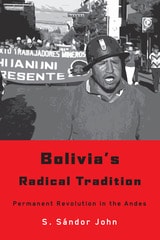
Bolivia's Radical Tradition
Permanent Revolution in the AndesS. Sándor John
University of Arizona Press, 2012

Bolivia
Refounding the NationKepa Artaraz
Pluto Press, 2012
The election of the Movimiento al Socialismo (MAS, movement towards socialism) to power in Bolivia in 2006 marked a historic break from centuries of foreign domination and indigenous marginalisation. Evo Morales, leader of the MAS, became the first indigenous president of Bolivia.
Kepa Artaraz looks at the attempt to 'refound the nation' which the new government has made as its goal. He shows how the mix of Marxism, indigenous liberation politics, anti-imperialism and environmentalism has made Bolivia one of the most interesting and unique political experiments of Latin America's 'red decade'.
As the historic left-turn in Latin America reaches a crossroads, Bolivia: Refounding the Nation guides us through the politics and ideas which have animated this popular movement, drawing out important lessons for progressive politics everywhere.

Bolivia
Revolution and the Power of History in the PresentJames Dunkerley
University of London Press, 2007