Results by title
171 books match the query 'Books & Reading' and 11 start with b
Bad Books
Rétif de la Bretonne, Sexuality, and PornographyAmy S. Wyngaard
University of Delaware Press, 2013
Published by University of Delaware Press. Distributed worldwide by Rutgers University Press.
Between Pen and Pixel
Comics, Materiality, and the Book of the FutureAaron Jacob Kashtan
The Ohio State University Press, 2018
In Between Pen and Pixel: Comics, Materiality, and the Book of the Future, Aaron Kashtan argues that paying attention to comics helps us understand the future of the book. Debates over the future of the book tend to focus on text-based literature, particularly fiction. However, because comics make the effects of materiality visible, they offer a clearer demonstration than prose fiction of how the rise of digital reading platforms transforms the reading experience. Comics help us see the effects of alterations in features such as publication design and typography, whereas in print literature, such transformations often go unnoticed.
With case studies of the work of Alison Bechdel, Matt Kindt, Lynda Barry, Carla Speed McNeil, Chris Ware, and Randall Munroe, Kashtan examines print comics that critique digital technology, comics that are remediated from print to digital and vice versa, and comics that combine print and digital functionality. Kashtan argues that comics are adapting to the rise of digital reading technologies more effectively than print literature has yet done. Therefore, looking at comics gives us a preview of what the future of the book looks like. Ultimately, Between Pen and Pixel argues that as print literature becomes more sensitive to issues of materiality and mediacy, print books will increasingly start to resemble to comic books.
Beyond the White Negro
Empathy and Anti-Racist ReadingKimberly Chabot Davis
University of Illinois Press, 2014
Davis analyzes how white engagement with African American novels, film narratives, and hip-hop can help form anti-racist attitudes that may catalyze social change and racial justice. Though acknowledging past failures to establish cross-racial empathy, she focuses on examples that show avenues for future progress and change. Her study of ethnographic data from book clubs and college classrooms shows how engagement with African American culture and pedagogical support can lead to the kinds of white self-examination that make empathy possible. The result is a groundbreaking text that challenges the trend of focusing on society's failures in achieving cross-racial empathy and instead explores possible avenues for change.
Biographical Passages
Essays on Victorian and Modernist BiographyEdited by Joe Law & Linda K. Hughes
University of Missouri Press, 2000
In the last two decades, biographies have grown in popularity, often eclipsing the novel in sales and accessibility to specialists and the general public alike. Widely regarded as a distinctly modern form, today's biographies are marked by their willingness to "tell all" or to pursue overt political aims. But how new, how unprecedented, are today's biographies? Biographical Passages addresses this important question by juxtaposing Victorian and Modernist biography from diverse perspectives.
Challenging the view that modern biographies are radically different from the straitlaced and ponderous Victorian tomes, Joe Law and Linda K. Hughes illustrate that continuities in biographical practice do exist, proving, for example, that the "tell-all" biography is not the exclusive preserve of the twentieth century. Enlisting the talents of such acclaimed biographers and scholars as P. N. Furbank and Michael Holroyd, Biographical Passages is a true exploration of the art and craft of biography. Essays on the usefulness of biography in approaching late Victorian artists provide a detailed scrutiny of modern biography across disciplines and from a rich array of vantage points. Additional essays on E. M. Forster and the relations between England and India analyze the role of cultural difference in biography.
Law and Hughes conclude Biographical Passages with an epilogue in tribute to a scholar whose work is closely connected to all the essays in this collection—Mary Lago. Widely known for her important contributions to studies of late Victorian and Edwardian literature, art, music, and Anglo-Indian relations, Lago is the author of biographies of Christina Herringham and E. M. Forster.
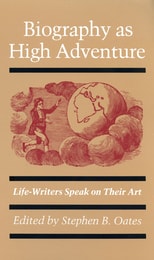
Biography as High Adventure
Life-Writers Speak on Their ArtStephen B. Oates
University of Massachusetts Press, 1986
Biography as High Adventure: Life-Writers Speak on Their Art is a collection of essays that explores the art and craft of biographical writing. Edited by acclaimed historian and biographer Stephen B. Oates this volume features contributions from prominent life-writers and historians who discuss their experiences, methods, and philosophies regarding the biographical form.
Through essays and reflections from accomplished biographers and historians, this collection examines biography as both an art form and a scholarly discipline, exploring what draws writers to biographical subjects and how they navigate the intersection of historical accuracy and narrative storytelling. What culminates is a diverse perspective on how face down the challenges of historical research and achieve the creative and intellectual dimensions of writing lives.
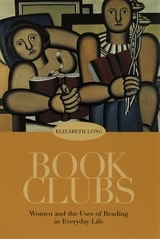
Book Clubs
Women and the Uses of Reading in Everyday LifeElizabeth Long
University of Chicago Press, 2003
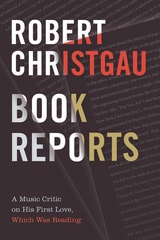
Book Reports
A Music Critic on His First Love, Which Was ReadingRobert Christgau
Duke University Press, 2019

Books, Readers and Libraries in Fiction
Edited by Karen Attar and Andrew Nash
University of London Press, 2024
Books and libraries appear in fiction from the earliest times onwards, in works for all age groups, in canonical literature, and in books that form part of popular culture. Fiction enables writers to teach readers how to read, but it can also portray subversive acts of reading that engage with contemporary cultural anxieties or moral debates. The reading material of fictional personae is part of their characterization; we are often reading readers.
Drawing on approaches from literary studies, book history, library history, and theories and histories of reading, Books, Readers and Libraries in Fiction examines what fictional representations of reading tell us about changing cultural attitudes to different reading practices, and the use (and abuse) of books beyond actual reading, both in the context of specific works and about the reception of books more widely. Through detailed case studies from primarily British fiction that address common themes such as gender, genre, and the relation between reading and writing itself, this collection catalogs the ways in which authors of fiction mediate and interpret books, libraries, and the act of reading to their own readers.
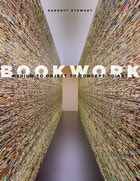
Bookwork
Medium to Object to Concept to ArtGarrett Stewart
University of Chicago Press, 2011
“There they rest, inert, impertinent, in gallery space—those book forms either imitated or mutilated, replicas of reading matter or its vestiges. Strange, after its long and robust career, for the book to take early retirement in a museum, not as rare manuscript but as functionless sculpture. Readymade or constructed, such book shapes are canceled as text when deposited as gallery objects, shut off from their normal reading when not, in some yet more drastic way, dismembered or reassembled.” So begins Bookwork, which follows our passion for books to its logical extreme in artists who employ found or simulated books as a sculptural medium. Investigating the conceptual labor behind this proliferating international art practice, Garrett Stewart looks at hundreds of book-like objects, alone or as part of gallery installations, in this original account of works that force attention upon a book’s material identity and cultural resonance.
Less an inquiry into the artist’s book than an exploration of the book form’s contemporary objecthood, Stewart’s interdisciplinary approach traces the lineage of these aggressive artifacts from the 1919 Unhappy Readymade of Marcel Duchamp down to the current crisis of paper-based media in the digital era. Bookwork surveys and illustrates a stunning variety of appropriated and fabricated books alike, ranging from hacksawed discards to the giant lead folios of Anselm Kiefer. The unreadable books Stewart engages with in this timely study are found, again and again, to generate graphic metaphors for the textual experience they preclude, becoming in this sense legible after all.
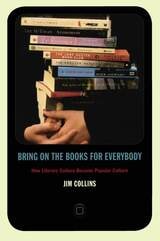
Bring on the Books for Everybody
How Literary Culture Became Popular CultureJim Collins
Duke University Press, 2010
Collins explores how digital technologies and the convergence of literary, visual, and consumer cultures have changed what counts as a “literary experience” in phenomena ranging from lush film adaptations such as The English Patient and Shakespeare in Love to the customer communities at Amazon. Central to Collins’s analysis and, he argues, to contemporary literary culture, is the notion that refined taste is now easily acquired; it is just a matter of knowing where to access it and whose advice to trust. Using recent novels, he shows that the redefined literary landscape has affected not just how books are being read, but also what sort of novels are being written for these passionate readers. Collins connects literary bestsellers from The Jane Austen Book Club and Literacy and Longing in L.A. to Saturday and The Line of Beauty, highlighting their depictions of fictional worlds filled with avid readers and their equations of reading with cultivated consumer taste.
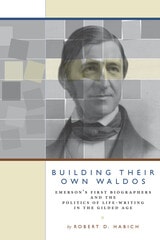
Building Their Own Waldos
Emerson’s First Biographers and the Politics of Life-Writing in the Gilded AgeRobert D. Habich
University of Iowa Press, 2011
@font-face { font-family: "Calibri";}p.MsoNormal, li.MsoNormal, div.MsoNormal { margin: 0in 0in 0.0001pt; font-size: 12pt; font-family: "Times New Roman"; }h4 { margin: 12pt 0in 3pt; page-break-after: avoid; font-size: 14pt; font-family: "Times New Roman"; }span.Heading4Char { font-family: Calibri; font-weight: bold; }div.Section1 { page: Section1; }
By the end of the nineteenth century, Ralph Waldo Emerson was well on his way to becoming the “Wisest American” and the “Sage of Concord,” a literary celebrity and a national icon. With that fame came what Robert Habich describes as a blandly sanctified version of Emerson held widely by the reading public. Building Their Own Waldos sets out to understand the dilemma faced by Emerson’s early biographers: how to represent a figure whose subversive individualism had been eclipsed by his celebrity, making him less a representative of his age than a caricature of it.Drawing on never-before-published letters, diaries, drafts, business records, and private documents, Habich Emerson’s First Biographers explores the making of a cultural hero through the stories of Emerson’s first biographers—George Willis Cooke, a minister most recently from Indianapolis who considered himself a disciple; the English reformer and newspaper mogul Alexander Ireland, a friend for half a century; Moncure D. Conway, a Southern abolitionist then residing in London, who called Emerson his “spiritual father and intellectual teacher”; the poet and medical professor Oliver Wendell Holmes, with Emerson a member of Boston’s gathering of literary elite, the Saturday Club; James Elliot Cabot, the family’s authorized biographer, an architect and amateur philosopher with unlimited access to Emerson’s unpublished papers; and Emerson’s son Edward, a physician and painter whose father had passed over him as literary executor in favor of Cabot.
Just as their biographies reveal a complex, socially engaged Emerson, so too do the biographers’ own stories illustrate the real-world perils, challenges, and motives of life-writing in the late nineteenth century, when biographers were routinely vilified as ghoulish and disreputable and biography as a genre underwent a profound redefinition. Building Their Own Waldos is at once a revealing look at Emerson’s constructed reputation, a case study in the rewards and dangers of Victorian life-writing, and the story of six authors struggling amidst personal misfortunes and shifting expectations to capture the elusive character of America’s “representative man,” as they knew him and as they needed him to be.