Results by title
379 books match the query 'Botany' and 10 start with b
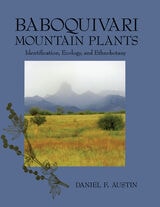
Baboquivari Mountain Plants
Identification, Ecology, and EthnobotanyDaniel F. Austin
University of Arizona Press, 2010
The term “sky island” was first used by Weldon Heald in 1967 to describe mountain ranges that are separated from each other by valleys of grassland or desert. The valleys create barriers to the spread of plant species in a way that is similar to the separation of islands in an ocean. The 70,000-square-mile Sky Islands region of southeastern Arizona, southwestern New Mexico, and northwestern Mexico is of particular interest to botanists because of its striking diversity of plant species and habitats. With more than 3,000 species of plants, the region offers a surprising range of tropical and temperate zones. Although others have written about the region, this is the first book to focus exclusively on the plant life of the Baboquivari Mountains.
The book offers an introduction to the history of the region, along with a discussion of human influences, and includes a useful appendix that lists all of the plants known to be growing in the Baboquivari Mountain chain.

Bamboos of Bhutan
C. Stapleton
Royal Botanic Gardens, Kew, 1994
Baobab - Africa's Upside-Down Tree
G. E. Wickens
Royal Botanic Gardens, Kew, 1982
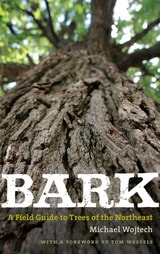
Bark
A Field Guide to Trees of the NortheastMichael Wojtech
Brandeis University Press, 2020
What kind of tree is that? Whether you’re hiking in the woods or simply sitting in your backyard, from Maine to New York you’ll never be without an answer to that question, thanks to this handy companion to the trees of the Northeast. Featuring detailed information and illustrations covering each phase of a tree’s lifecycle, this indispensable guidebook explains how to identify trees by their bark alone—no more need to wait for leaf season. Chapters on the structure and ecology of tree bark, descriptions of bark appearance, an easy-to-use identification key, and supplemental information on non-bark characteristics—all enhanced by more than 450 photographs, illustrations, and maps—will show you how to distinguish the textures, shapes, and colors of bark to recognize various tree species, and also understand why these traits evolved.
Whether you’re a professional naturalist or a parent leading a family hike, this new edition of Bark: A Field Guide to Trees of the Northeast is your essential guide to the region’s 67 native and naturalized tree species.
Bitter Roots
The Search for Healing Plants in AfricaAbena Dove Osseo-Asare
University of Chicago Press, 2013
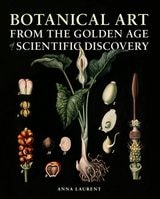
Botanical Art from the Golden Age of Scientific Discovery
Anna Laurent
University of Chicago Press, 2016
This beautifully illustrated oversized book gives the humble wall chart its due, reproducing more than two hundred of them in dazzling full color. Each wall chart is accompanied by captions that offer accessible information about the species featured, the scientists and botanical illustrators who created it, and any particularly interesting or innovative features the chart displays. And gardeners will be pleased to discover useful information about plant anatomy and morphology and species differences. We see lilies and tulips, gourds, aquatic plants, legumes, poisonous plants, and carnivorous plants, all presented in exquisite, larger-than-life detail.
A unique fusion of art, science, and education, the wall charts gathered here offer a glimpse into a wonderful scientific heritage and are sure to thrill naturalists, gardeners, and artists alike.
Botanical Companions
A Memoir of Plants and PlaceFrieda Knobloch
University of Iowa Press, 2005
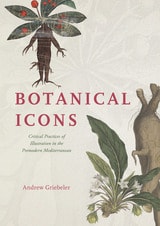
Botanical Icons
Critical Practices of Illustration in the Premodern MediterraneanAndrew Griebeler
University of Chicago Press, 2024
This book traces the history of botanical illustration in the Mediterranean from antiquity to the early modern period. By examining Greek, Latin, and Arabic botanical inquiry in this early era, Andrew Griebeler shows how diverse and sophisticated modes of plant depiction emerged and ultimately gave rise to practices now recognized as central to modern botanical illustration. The author draws on centuries of remarkable and varied documentation from across Europe and the Mediterranean.
Lavishly illustrated, Botanical Icons marshals ample evidence for a dynamic and critical tradition of botanical inquiry and nature observation in the late antique and medieval Mediterranean. The author reveals that many of the critical practices characteristic of modern botanical illustrations began in premodern manuscript culture. Consequently, he demonstrates that the distinctions between pre- and early modern botanical illustration center more on the advent of print, the expansion of collections and documentation, and the narrowing of the range of accepted forms of illustration than on the invention of critical and observational practices exclusive to modernity.
Griebeler’s emphasis on continuity, intercultural collaboration, and the gradual transformation of Mediterranean traditions of critical botanical illustration persuasively counters previously prevalent narratives of rupture and Western European exceptionalism in the histories of art and science.

Botany and Healing
Medicinal Plants of New Jersey and the RegionCecil C. Still
Rutgers University Press, 1998
Could that weed you just pulled have provided a cure for cancer? Scientists have warned that the destruction of the world’s rain forests may mean that plant species are being lost before we recognize their potential as sources of new medicines. This is equally true for the plants much closer to home. New Jersey, while heavily industrialized and densely populated, is extraordinarily rich in plant resources. Botany and Healing: Medicinal Plants of New Jersey and the Region describes nearly 500 species of plants found in the Garden State and in nearby areas that have been used medicinally.
Cecil Still lists plants by family and, within each family, by genus and species, to underscore the close relationships among medicinally valuable species. This arrangement is familiar to every botanist and easy for the amateur naturalist and herbalist to use as well. For each entry, Still discusses both the natural history and the historical and modern medicinal uses of the plant: scientific and common names, description, habitat, geographic range, and preparations and applications in Native American, European, African, and Asian herbal traditions. Most species are illustrated with Still’s line drawings. The book also contains a helpful index (with cross references by usage, common or scientific name), a glossary of terms, and a list of resources for further reading.
Botany and Healing explains the history and present status of the uses of herbal medicines, explains what makes a plant medicinal (or poisonous), how herbal medicines are prepared for use, and why they should be used only with great caution.
Bristlecone Pine in the White Mountains of California
Growth and Ring-Width CharacteristicsHarold C. Fritts
University of Arizona Press, 1969
Papers of the Laboratory of Tree-Ring Research, No. 4