Results by title
60 books match the query 'Britain' and 7 start with b

Better Times Than This
Youth Homelessness in BritainTom Hall
Pluto Press, 2003
[more]
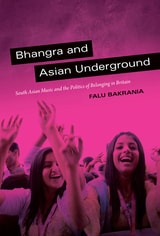
Bhangra and Asian Underground
South Asian Music and the Politics of Belonging in BritainFalu Bakrania
Duke University Press, 2013
Asian Underground music—a fusion of South Asian genres with western breakbeats created for the dance club scene by DJs and musicians of Indian, Pakistani, and Bangladeshi descent—went mainstream in the U.K. in the late 1990s. Its success was unprecedented: British bhangra, a blend of Punjabi folk music with hip-hop musical elements, was enormously popular among South Asian communities but had yet to become mainstream. For many, the widespread attention to Asian Underground music signaled the emergence of a supposedly new, tolerant, and multicultural Britain that could finally accept South Asians. Interweaving ethnography and theory, Falu Bakrania examines the social life of British Asian musical culture to reveal a more complex and contradictory story of South Asian belonging in Britain. Analyzing the production of bhangra and Asian Underground music by male artists and its consumption by female club-goers, Bakrania shows that gender, sexuality, and class intersected in ways that profoundly shaped how young people interpreted “British” and “Asian” identity and negotiated, sometimes violently, contests about ethnic authenticity, sexual morality, individual expression, and political empowerment.
[more]
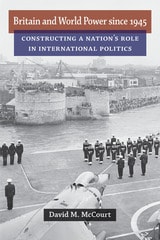
Britain and World Power since 1945
Constructing a Nation's Role in International PoliticsDavid M. McCourt
University of Michigan Press, 2014
?Though Britain’s descent from global imperial power began in World War II and continued over the subsequent decades with decolonization, military withdrawal, and integration into the European Union, its foreign policy has remained that of a Great Power. David M. McCourt maintains that the lack of a fundamental reorientation of Britain’s foreign policy cannot be explained only by material or economic factors, or even by an essential British international “identity.” Rather, he argues, the persistence of Britain’s place in world affairs can best be explained by the prominent international role that Britain assumed and into which it was thrust by other nations, notably France and the United States, over these years.
Using a role-based theory of state action in international politics based on symbolic interactionism and the work of George Herbert Mead, Britain and World Power since 1945 puts forward a novel interpretation of Britain’s engagement in four key international episodes: the Suez Crisis of 1956, the Skybolt Crisis of 1962, Britain’s second application to the European Economic Council in 1966–67, and Britain’s reinvasion of the Falklands in 1982. McCourt concludes with a discussion of international affairs since the end of the Cold War and the implications for the future of British foreign policy.
[more]
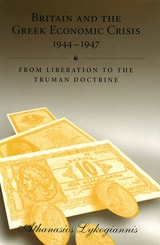
Britain and the Greek Economic Crisis, 1944-1947
From Liberation to the Truman DoctrineAthanasios Lykogiannis
University of Missouri Press, 2002
Britainand the Greek Economic Crisis, 1944–1947 concentrates on Anglo-Greek interactions in economic matters during the political and economic turmoil between the Axis occupation of Greece and the Greek civil war. By analyzing the Greek crisis primarily in economic terms, Athanasios Lykogiannis avoids the political partisanship that has colored much previous writing on the subject and throws light on many issues neglected by earlier authors. Drawing on a range of untapped British, American, and Greek archival sources, as well as extensive secondary sources, the author examines the interplay of political and economic factors, such as the ingrained polarization of Greek society and the weakness and timidity of the country’s governments, that aggravated and prolonged the crisis.
Lykogiannis critically examines Greece’s policies, and the actors behind them, and assesses the British involvement in the episode: the quality of the measures recommended to the Greeks, the constraints facing British advisers in the country, and the reasons for the ultimate failure of British intervention. He also compares the two periods of western tutelage of Greece: the British and the American, from the announcement of the Truman Doctrine to the inauguration of the European Recovery Program.
Britain and the Greek Economic Crisis, 1944–1947 argues that even if the Germans were to blame for the conditions that led to hyperinflation, the mediocre results of successive attempts to stabilize the economy were caused by internal factors such as the fiscal ineptitude of the postwar Greek governments and their ignorance of, and hostility toward, any form of economic management. Whereas many have blamed foreign intervention for prolonging the crisis, Lykogiannis makes clear that the decisions of successive Greek governments were far more significant. His book demonstrates how firmly the crisis of post-liberation Greece was rooted in the country’s political, economic, and social past.
[more]

Britain in Transition
The Twentieth CenturyAlfred F. Havighurst
University of Chicago Press, 1985
This new edition extends and brings up to date the story of political, economic, and social change among the British. An entirely new chapter covers the Thatcher years, discussing such events as the Falkland Island crisis and the General Election of 1983. Other sections have been revised to reflect information only recently available. Throughout, Havighurst has incorporated material from official documents, monographs, biographies, articles, and the press. His fascinating narrative fully captures the ongoing importance of change itself in shaping the character of Britain.
[more]
Britain in a Perilous World
The Strategic Defence and Security Review We NeedJonathan Shaw
Haus Publishing, 2014
The British government periodically publishes a Strategic Defence and Security Review, an appraisal of the armed forces that seeks to understand and prepare for the defense challenges that lie ahead. This report is often controversial—the 2010 review, for example, made headlines for all the wrong reasons, as major defense projects such as the NIMROD aircraft were discontinued at huge cost, while other projects were maintained only because they were too expensive to abandon.
In advance of the 2015 Strategic Defence and Security Review, Jonathan Shaw argues persuasively for the need to rethink how governments and Whitehall devise their strategies and reach crucial decisions. Beginning with the review’s often imprecise use of language, Shaw challenges the assumptions that underlie the British government’s current practices. Ultimately, he suggests how Whitehall can improve its approaches and, equally important, its credibility.
In advance of the 2015 Strategic Defence and Security Review, Jonathan Shaw argues persuasively for the need to rethink how governments and Whitehall devise their strategies and reach crucial decisions. Beginning with the review’s often imprecise use of language, Shaw challenges the assumptions that underlie the British government’s current practices. Ultimately, he suggests how Whitehall can improve its approaches and, equally important, its credibility.
[more]

Britain, France and the Decolonization of Africa
Future Imperfect?Edited by Andrew W.M. Smith and Chris Jeppesen
University College London, 2017
Looking at decolonization in the conditional tense, this volume teases out the complex and uncertain ends of British and French empire in Africa during the period of ‘late colonial shift’ after 1945. Rather than view decolonization as an inevitable process, the contributors together explore the crucial historical moments in which change was negotiated, compromises were made, and debates were staged. Three core themes guide the analysis: development, contingency and entanglement. The chapters consider the ways in which decolonization was governed and moderated by concerns about development and profit. A complementary focus on contingency allows deeper consideration of how colonial powers planned for ‘colonial futures’, and how divergent voices greeted the end of empire. Thinking about entanglements likewise stresses both the connections that existed between the British and French empires in Africa, and those that endured beyond the formal transfer of power.
[more]