Results by title
61 books match the query 'Business Development' and 3 start with b
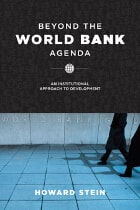
Beyond the World Bank Agenda
An Institutional Approach to DevelopmentHoward Stein
University of Chicago Press, 2008
Despite massive investment of money and research aimed at ameliorating third-world poverty, the development strategies of the international financial institutions over the past few decades have been a profound failure. Under the tutelage of the World Bank, developing countries have experienced lower growth and rising inequality compared to previous periods. In Beyond the World Bank Agenda, Howard Stein argues that the controversial institution is plagued by a myopic, neoclassical mindset that wrongly focuses on individual rationality and downplays the social and political contexts that can either facilitate or impede development.
Drawing on the examples of Africa, Asia, Latin America, and transitional European economies, this revolutionary volume proposes an alternative vision of institutional development with chapter-length applications to finance, state formation, and health care to provide a holistic, contextualized solution to the problems of developing nations. Beyond the World Bank Agenda will be essential reading for anyone concerned with forging a new strategy for sustainable development.
Drawing on the examples of Africa, Asia, Latin America, and transitional European economies, this revolutionary volume proposes an alternative vision of institutional development with chapter-length applications to finance, state formation, and health care to provide a holistic, contextualized solution to the problems of developing nations. Beyond the World Bank Agenda will be essential reading for anyone concerned with forging a new strategy for sustainable development.
[more]
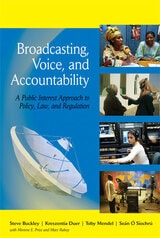
Broadcasting, Voice, and Accountability
A Public Interest Approach to Policy, Law, and RegulationSteve Buckley, Kreszentia Duer, Toby Mendel, and Seán Ó Siochrú
University of Michigan Press, 2008
Participatory development and government accountability depend in part on the existence of media that provide broad access to information from varied sources and that equip and encourage people to raise and debate issues and develop public opinion. Conducive policies, laws, and regulations are essential for media to develop that are independent and widely accessible and that enable the expression of diverse perspectives and sources of information. Broadcasting, Voice, and Accountability presents a framework to inform analysis of existing policies and support the development of a vigorous media sector, with a particular emphasis on broadcasting. It focuses on broadcasting because that is the medium with the greatest potential to reach and involve society at large, including the most disadvantaged and illiterate segments of society in developing countries. Information on good practices in broadcasting policy is in demand in countries of every region—particularly in countries that are opening their economies, democratizing, and decentralizing public service delivery.
This book provides development practitioners with a wide overview of the key policy and regulatory issues involved in supporting freedom of information and expression and enabling development of a pluralistic, independent, and robust broadcasting sector. Policy, regulation, capacity, and institutional development are important development levers that shape the ownership, content, and social impacts of broadcasting systems. The guide shows the importance of enabling a mix of ownership and uses, commonly classified in terms of commercial, public service, and community broadcasting, that serves the public interest. With the guidance of this book, broadcasting policy and regulation can be tackled as a mainstream development topic, with important consequences for government transparency, government accountability, and enabling disadvantaged constituencies to voice their concerns and press for action.
This book is the World Bank's first publication presenting good practices from around the world in media and broadcasting policy and regulation and complements existing work in governance, public sector reform, and access to information. It is a useful tool for policymakers, reform managers, development practitioners, and students alike.
"Most books on the state of broadcasting in the third world tend either to lament the lack of governance, accountability and competence, or to speak down to their readers. This book is part of a new generation that acknowledges ability and a willingness to move forward into the twenty-first century with integrity and imagination. It is not patronizing, and it is certainly not boring. It focuses on really useful approaches to setting up, sustaining, and governing broadcasting systems across the world. This is an excellent book whose combination of sound scholarship and intelligent advice will be welcomed by policymakers and broadcasters alike. It is relevant, interesting, and a jolly good read."
---Ruth Teer-Tomaselli, UNESCO Chair in Communication for Southern Africa, Culture, Communication and Media Studies, University of KwaZulu-Natal
---Ruth Teer-Tomaselli, UNESCO Chair in Communication for Southern Africa, Culture, Communication and Media Studies, University of KwaZulu-Natal
digitalculturebooks is an imprint of the University of Michigan Press and the Scholarly Publishing Office of the University of Michigan Library dedicated to publishing innovative and accessible work exploring new media and their impact on society, culture, and scholarly communication. Visit the website at www.digitalculture.org.
[more]

Brokers and Bureaucrats
Building Market Institutions in RussiaTimothy Frye
University of Michigan Press, 2000
A classic problem of social order prompts the central questions of this book: Why are some groups better able to govern themselves than others? Why do state actors sometimes delegate governing power to other bodies? How do different organizations including the state, the business community, and protection rackets come to govern different markets? Scholars have used both sociological and economic approaches to study these questions; here Timothy Frye argues for a different approach. He seeks to extend the theoretical and empirical scope of theories of self-governance beyond groups that exist in isolation from the state and suggests that social order is primarily a political problem.
Drawing on extensive interviews, surveys, and other sources, Frye addresses these question by studying five markets in contemporary Russia, including the currency futures, universal and specialized commodities, and equities markets. Using a model that depicts the effect of state policy on the prospects for self-governance, he tests theories of institutional performance and offers a political explanation for the creation of social capital, the formation of markets, and the source of legal institutions in the postcommunist world. In doing so, Frye makes a major contribution to the study of states and markets.
The book will be important reading for academic political scientists, economists (especially those who study the New Institutional Economics), legal scholars, sociologists, business-people, journalists, and students interested in transitions.
Timothy Frye is Assistant Professor of Political Science, The Ohio State University.
[more]