198 books match the query 'Campaigns' and 7 start with b
cover of Battles and Leaders of the Civil War, Volume 5

Battles and Leaders of the Civil War, Volume 5

Edited by Peter Cozzens

University of Illinois Press, 2001

Indispensable must-reads for all Civil War buffs and historians, bringing together little-known and never before gathered first-hand accounts, articles, maps, and illustrations 

The first four volumes of Battles and Leaders of the Civil War, published in the late nineteenth century, became the best-selling and most frequently cited works ever published on the Civil War. Volume 5, assembled by the acclaimed military historian Peter Cozzens, carries on the tradition of its namesake, offering a dazzling new collection of fresh material written by military and civilian leaders, North and South, on a broad array of war-related topics. Featured articles include General Grant on the second battle of Bull Run, General Beauregard on the Shiloh campaign, General Sherman on the conference at City Point, Joshua Chamberlain on the Fredericksburg campaign, and many more. Also presented are dozens of maps and more than one hundred illustrations.
[more]
cover of Battles and Leaders of the Civil War, Volume 6

Battles and Leaders of the Civil War, Volume 6

Edited by Peter Cozzens

University of Illinois Press, 2001

Sifting carefully through reports from newspapers, magazines, personal memoirs, and letters, Peter Cozzens' Volume 6 brings readers more of the best first-person accounts of marches, encampments, skirmishes, and full-blown battles, as seen by participants on both sides of the conflict. Alongside the experiences of lower-ranking officers and enlisted men are accounts from key personalities including General John Gibbon, General John C. Lee, and seven prominent generals from both sides offering views on "why the Confederacy failed." This volume includes one hundred and twenty illustrations, including sixteen previously uncollected maps of battlefields, troop movements, and fortifications.
[more]
cover of Between Tedium and Terror: A Soldier's World War II Diary, 1943-45

Between Tedium and Terror

A Soldier's World War II Diary, 1943-45

Sy M. KahnForeword by Ronald Spector

University of Illinois Press, 1993

When Sy Kahn set off to serve in the Pacific during World War II, he was a bookish, naive nineteen-year-old, the youngest in his company. Convinced he would not survive the war, Kahn kept a meticulous record of his experiences as his "foxhole of the mind," even though keeping such a journal was forbidden by military regulations. His secret diary--one soldier's "mark against oblivion"--is a rare ground-level account of the war.
 
Often writing in tents by candlelight, in foxholes, or on board ships, Kahn documents life during four campaigns and over three hundred air attacks. He describes the 244th Port Company's backbreaking work of loading and unloading ships, the suffocating heat, the debilitating tropical diseases, and the relentless, sometimes terrifying bombings, accidents, casualties, and deaths.
 His wartime odyssey also includes encounters with civilians in Australia, in the Philippines, and, as among the earliest occupation troops, in Japan. A detailed record of the daily cost of war, Kahn's journal reflects his increasing maturity and his personal coming of age, representative of thousands of young Americans who served in World War II.


[more]
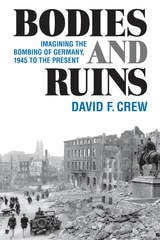
cover of Bodies and Ruins: Imagining the Bombing of Germany, 1945 to the Present

Bodies and Ruins

Imagining the Bombing of Germany, 1945 to the Present

David F. Crew

University of Michigan Press, 2017

Bodies and Ruins explores changing German memories of World War II as it analyzes the construction of narratives in the postwar period including the depiction of the bombing of individual German cities. The book offers a corrective notion rising in the late 1990s notion that discussions of the Allied bombing were long overdue, because Germans who had endured the bombings had largely been condemned to silence after 1945. David Crew shows that far from being marginalized in postwar historical consciousness, the bombing war was in fact a central strand of German memory and identity. Local narratives of the bombing war, including photographic books, had already established themselves as important “vectors of memory” in the late 1940s and early 1950s. The bombing war had allowed Germans to see themselves as victims at a time when the Allied liberation of the concentration camps and the Nuremberg trials presented Germans to the world as perpetrators or at least as accomplices. The bombing war continued to serve this function even as Germans became more and more willing directly to confront the genocide of European Jews—which by the 1960s was beginning to be referred to as the Holocaust.

Bodies and Ruins examines a range of local publications that carried photographic images of German cities destroyed in the air war, images that soon entered the visual memory of World War II. Despite its obvious importance, historians have paid very little attention to the visual representation of the bombing war. This book follows the search for what were considered to be the “right” stories and the “right” pictures of the bombing war in local publications and picture books from 1945 to the present, and is intended for historians as well as general readers interested in World War II, the Allied bombing of German cities, the Holocaust, the history of memory and photographic/visual history.
[more]
cover of Bomb Children: Life in the Former Battlefields of Laos

Bomb Children

Life in the Former Battlefields of Laos

Leah Zani

Duke University Press, 2019

Half a century after the CIA's Secret War in Laos—the largest bombing campaign in history—explosive remnants of war continue to be part of people's everyday lives. In Bomb Children Leah Zani offers a perceptive analysis of the long-term, often subtle, and unintended effects of massive air warfare. Zani traces the sociocultural impact of cluster submunitions—known in Laos as “bomb children”—through stories of explosives clearance technicians and others living and working in these old air strike zones. Zani presents her ethnography alongside poetry written in the field, crafting a startlingly beautiful analysis of state terror, authoritarian revival, rapid development, and ecological contamination. In so doing, she proposes that postwar zones are their own cultural and area studies, offering new ways to understand the parallel relationship between ongoing war violence and postwar revival.
[more]
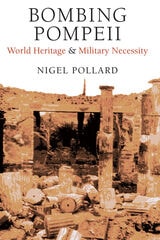
cover of Bombing Pompeii: World Heritage and Military Necessity

Bombing Pompeii

World Heritage and Military Necessity

Nigel Pollard

University of Michigan Press, 2020
Bombing Pompeii examines the circumstances under which over 160 Allied bombs hit the archaeological site of Pompeii in August and September 1943, and the wider significance of this event in the history of efforts to protect cultural heritage in conflict zones, a broader issue which is still of great importance. From detailed examinations of contemporary archival document, Nigel Pollard shows that the bomb damage to ancient Pompeii was accidental, and the bombs were aimed at road and rail routes close to the site in an urgent attempt to slow down the reinforcement and supply of German counter- attacks that threatened to defeat the Allied landings in the Gulf of Salerno. The book sets this event, along with other instances of damage and risk to cultural heritage in Italy in the Second World War, in the context of the development of the Allied Monuments, Fine Arts, and Archives – the “Monuments Men.”
[more]
cover of By the Noble Daring of Her Sons: The Florida Brigade of the Army of Tennessee

By the Noble Daring of Her Sons

The Florida Brigade of the Army of Tennessee

Jonathan C. Sheppard

University of Alabama Press, 2012

A fascinating account of Floridians who served in the Confederate army and the changes to Florida society and politics that resulted from the state's Confederate experience

Until recently Florida’s Confederate soldiers have received scant attention. This volume explores the story of Florida soldiers going to war, families left behind, a white population fighting to maintain a society built on slavery, and a state torn by political and regional strife.

Before the war Florida’s inhabitants engaged in bitter political rivalries. Sheppard argues that prior to secession Florida citizens maintained regional loyalties rather than considering themselves “Floridians.” He argues that service in Confederate armies eased tensions between political factions and fostered solidarity among white Floridians. In this illuminated account, Sheppard also addresses the practices of prisoner parole and exchange, unit consolidation and its effects on morale and unit identity, politics within the Army of Tennessee, and conscription and desertion in the Southern armies. These issues come together to demonstrate the connection between the front lines and the home front.

[more]