59 books match the query 'Caribbean' and 3 start with b
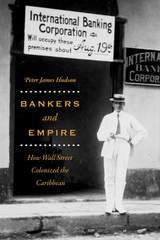
cover of Bankers and Empire: How Wall Street Colonized the Caribbean

Bankers and Empire

How Wall Street Colonized the Caribbean

Peter James Hudson

University of Chicago Press, 2017
From the end of the nineteenth century until the onset of the Great Depression, Wall Street embarked on a stunning, unprecedented, and often bloody period of international expansion in the Caribbean. A host of financial entities sought to control banking, trade, and finance in the region. In the process, they not only trampled local sovereignty, grappled with domestic banking regulation, and backed US imperialism—but they also set the model for bad behavior by banks, visible still today. In Bankers and Empire, Peter James Hudson tells the provocative story of this period, taking a close look at both the institutions and individuals who defined this era of American capitalism in the West Indies. Whether in Wall Street minstrel shows or in dubious practices across the Caribbean, the behavior of the banks was deeply conditioned by bankers’ racial views and prejudices. Drawing deeply on a broad range of sources, Hudson reveals that the banks’ experimental practices and projects in the Caribbean often led to embarrassing failure, and, eventually, literal erasure from the archives.
[more]
cover of Between Fitness and Death: Disability and Slavery in the Caribbean

Between Fitness and Death

Disability and Slavery in the Caribbean

Stefanie Hunt-Kennedy

University of Illinois Press, 2020

Long before the English became involved in the African slave trade, they imagined Africans as monstrous and deformed beings. The English drew on pre-existing European ideas about monstrosity and deformity to argue that Africans were a monstrous race, suspended between human and animal, and as such only fit for servitude. Joining blackness to disability transformed English ideas about defective bodies and minds. It also influenced understandings of race and ability even as it shaped the embodied reality of people enslaved in the British Caribbean.

Stefanie Hunt-Kennedy provides a three-pronged analysis of disability in the context of Atlantic slavery. First, she examines the connections of enslavement and representations of disability and the parallel development of English anti-black racism. From there, she moves from realms of representation to reality in order to illuminate the physical, emotional, and psychological impairments inflicted by slavery and endured by the enslaved. Finally, she looks at slave law as a system of enforced disablement.

Audacious and powerful, Between Fitness and Death is a groundbreaking journey into the entwined histories of racism and ableism.
[more]
cover of Black Women in Latin America and the Caribbean: Critical Research and Perspectives

Black Women in Latin America and the Caribbean

Critical Research and Perspectives

Melanie A. Medeiros

Rutgers University Press, 2023

Black Women in Latin America and the Caribbean: Critical Research and Perspectives employs an intersectional and interdisciplinary approach to examine Black cisgender women’s social, cultural, economic, and political experiences in Latin America and the Caribbean. It presents critical empirical research emphasizing Black women’s innovative, theoretical, and methodological approaches to activism and class-based gendered racism and Black politics. While there are a few single-authored books focused on Black women in Latin American and Caribbean, the vast majority of the scholarship on Black women in Latin America and the Caribbean has been published as theses, dissertations, articles, and book chapters. This volume situates these social and political analyses as interrelated and dialogic and contributes a transnational perspective to contemporary conversations surrounding the continued relevance of Black women as a category of social science inquiry. Many of the contributing authors are from Latin American and Caribbean countries, reflecting a commitment to representing the valuable observations and lived experiences of scholars from this region. When read together, the chapters offer a hemispheric framework for understanding the lasting legacies of colonialism, transatlantic slavery, plantation life, and persistent socio-economic and cultural violence.
[more]