Results by title
10 books match the query 'Rousseau'
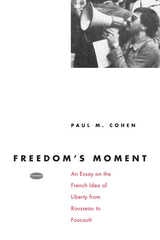
Freedom's Moment
An Essay on the French Idea of Liberty from Rousseau to FoucaultPaul M. Cohen
University of Chicago Press, 1997
What kind of freedom, and what kind of individual, has the French Revolutionary tradition sought to propagate? Paul Cohen finds a distinctly French articulation of freedom in the texts and lives of eight renowned cultural critics who lived between the eighteenth century and the present day.
Arranged not according to the lives and times of its protagonists but to the narrative themes and structures they held in common, Cohen’s study discerns a single master narrative of liberty in modern France. He captures these radicals, whose tradition bids them to resist the authority of power structures and public opinion. They denounce bourgeois and utilitarian values, the power of Church and State, and the corrupting influence of everyday politics, and they dream of a revolutionary rupture, a fleeting instant of sometimes violent but always meaningful transgression.
An eloquent and insightful work on French political culture, Freedom's Moment also helps explain how France, even as it has oscillated between political stagnation and crisis, has held onto its faith that liberty, equality, and fraternity remain within its grasp.
Examines the ideas of Rousseau, Robespierre, Stendahl, Michelet, Bergson, Peguy, Sartre, and Foucault.
[more]
Hypocrisy and Integrity
Machiavelli, Rousseau, and the Ethics of PoliticsRuth W. Grant
University of Chicago Press, 1997
Questioning the usual judgements of political ethics, Ruth W. Grant argues that hypocrisy can actually be constructive while strictly principled behavior can be destructive. Hypocrisy and Integrity offers a new conceptual framework that clarifies the differences between idealism and fanaticism while it uncovers the moral limits of compromise.
[more]
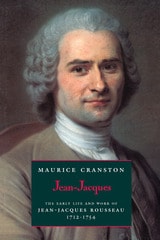
Jean-Jacques
The Early Life and Work of Jean-Jacques Rousseau, 1712-1754Maurice Cranston
University of Chicago Press, 1991
In the first volume of his trilogy, noted political philosopher Maurice Cranston draws from original manuscript sources to trace Rousseau's life from his birth in provincial obscurity in Geneva, through his youthful wanderings, to his return to Geneva in 1754 as a celebrated writer and composer.
"[An] admirable biography which is as meticulous, calm, reasonable, and judicious as its subject is passionate and tumultuous."—Keith Michael Baker, Washington Post Book World
"The definitive biography, as scholarly as it is entertaining."—The Economist
"Exceptionally fresh . . . . [Cranston] seems to know exactly what his readers need to know, and thoughtfully enriches the background—both physical and intellectual—of Rousseau's youthful peregrinations . . . . He makes the first part of Rousseau's life as absorbing as a picaresque novel. His fidelity to Rousseau's ideas and to his life as it was lived is a triumph of poise."—Naomi Bliven, The New Yorker
"The most outstanding achievement of Professor Cranston's own distinguished career."—Robert Wokler, Times Literary Supplement
Maurice Cranston (1920-1993), a distinguished scholar and recipient of the James Tait Black Memorial Prize for his biography of John Locke, was professor of political science at the London School of Economics. His numerous books include The Romantic Movement and Philosophers and Pamphleteers, and translations of Rousseau's The Social Contract and Discourse on the Origins of Inequality.
[more]
Montesquieu and Rousseau
Forerunners of SociologyEmile Durkheim
University of Michigan Press, 1960
Montesquieu & Rousseau provides, for the first time in English, two essays by Emile Durkheim on his chief eighteenth-century predecessors in the main stream of Western thought.Durkheim recognized that Montesquieu had laid down the principles of sociology long before that young science had a name and that Rousseau, too, spoke as a sociologist in The Social Contract. With his characteristic blend of reason and fervor, he enlarged upon these forerunners to create the fundamental ideas of modern sociology.The essays are valuable for what they tell us of Montesquieu and Rousseau. They are doubly important to readers who are directly concerned with political philosophy and social science. And, as Henri Peyre points out in the Foreword, they are an example of how the best minds of any age can serve each other.
[more]
Rousseau and the Spirit of Revolt
A Psychological StudyWilliam H. Blanchard
University of Michigan Press, 1967
Jean-Jacques Rousseau was one of the most influential writers of the eighteenth century, and one of the most controversial. His writings are full of the paradoxes of his personality—his quest for natural truth and his own self-deceptions, his democratic and his despotic tendencies, his imperiousness and his submissiveness, his love of society and his love of solitude.In this study William H. Blanchard, a practicing psychologist, examines the interplay between Rousseau's complex personality and his political writings. Blanchard presents the biographical facts of Rousseau's life and, with the help of Rousseau's Confessions, interprets them according to modern psychology. Blanchard believes that almost all of Rousseau's works have political implications, and he considers such diverse writings as the Letter to d'Alembert on the Theatre, The Social Contract, Emile, and Rousseau's correspondence in the light of his interpretations.One of the major paradoxes of Rousseau's work is that it has been widely used as ideological support by both democratic and despotic forces. The name of Rousseau was invoked throughout the French Revolution by both the early democrats and the later terrorists. Blanchard explores the similarity between the rebel and the tyrant in Rousseau, discusses Rousseau's "urge to suffer for truth," and comments incisively on the dangers of these tendencies, which he finds present in modern society.The author has made excellent use of original documents and sources in his study of Rousseau, and he takes the opportunity to correct various misinterpretations of Rousseau's relations with his contemporaries, particularly David Hume.
[more]
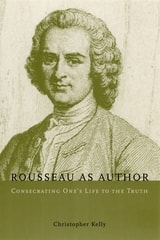
Rousseau as Author
Consecrating One's Life to the TruthChristopher Kelly
University of Chicago Press, 2002
For Rousseau, "consecrating one's life to the truth" (his personal credo) meant publicly taking responsibility for what one publishes and only publishing what would be of public benefit. Christopher Kelly argues that this commitment is central to understanding the relationship between Rousseau's writings and his political philosophy.
Unlike many other writers of his day, Rousseau refused to publish anonymously, even though he risked persecution for his writings. But Rousseau felt that authors must be self-restrained, as well as bold, and must carefully consider the potential political effects of what they might publish: sometimes seeking the good conflicts with writing the truth. Kelly shows how this understanding of public authorship played a crucial role in Rousseau's conception—and practice—of citizenship and political action.
Rousseau as Author will be a groundbreaking book not just for Rousseau scholars, but for anyone studying Enlightenment ideas about authorship and responsibility.
[more]

Rousseau, Judge of Jean-Jacques
DialoguesJean-Jacques Rousseau
Dartmouth College Press, 2012
One of Rousseau’s later and most puzzling works and never before available in English, this neglected autobiographical piece was the product of the philosopher’s old age and sense of persecution. Long viewed simply as evidence of his growing paranoia, it consists of three dialogues between a character named “Rousseau” and one identified only as “Frenchman” who discuss the bad reputation and works of an author named “Jean-Jacques.” Dialogues offers a fascinating retrospective of his literary career.
[more]
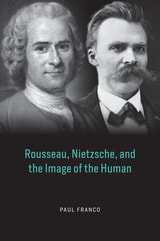
Rousseau, Nietzsche, and the Image of the Human
Paul Franco
University of Chicago Press, 2021
Rousseau and Nietzsche presented two of the most influential critiques of modern life and much can still be learned from their respective analyses of problems we still face.
In Rousseau, Nietzsche, and the Image of the Human, Paul Franco examines the relationship between Jean-Jacques Rousseau and Friedrich Nietzsche, arguably the two most influential shapers and explorers of the moral and cultural imagination of late modernity. Both thinkers leveled radical critiques of modern life, but those critiques differed in important respects. Whereas Rousseau focused on the growing inequality of modern society and the hypocrisy, self-division, and loss of civic virtue it spawned, Nietzsche decried the democratic equality he identified with Rousseau and the loss of individual and cultural greatness it entailed. Franco argues, however, that Rousseau and Nietzsche are more than mere critics; they both put forward powerful alternative visions of how we ought to live. Franco focuses specifically on their views of the self and its realization, their understandings of women and the relation between the sexes, and their speculative conceptions of politics. While there are many similarities in their positive visions, Franco argues that it is the differences between them from which we have most to learn.
In Rousseau, Nietzsche, and the Image of the Human, Paul Franco examines the relationship between Jean-Jacques Rousseau and Friedrich Nietzsche, arguably the two most influential shapers and explorers of the moral and cultural imagination of late modernity. Both thinkers leveled radical critiques of modern life, but those critiques differed in important respects. Whereas Rousseau focused on the growing inequality of modern society and the hypocrisy, self-division, and loss of civic virtue it spawned, Nietzsche decried the democratic equality he identified with Rousseau and the loss of individual and cultural greatness it entailed. Franco argues, however, that Rousseau and Nietzsche are more than mere critics; they both put forward powerful alternative visions of how we ought to live. Franco focuses specifically on their views of the self and its realization, their understandings of women and the relation between the sexes, and their speculative conceptions of politics. While there are many similarities in their positive visions, Franco argues that it is the differences between them from which we have most to learn.
[more]
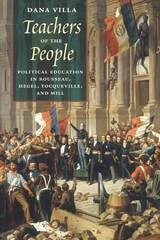
Teachers of the People
Political Education in Rousseau, Hegel, Tocqueville, and MillDana Villa
University of Chicago Press, 2017
2016 witnessed an unprecedented shock to political elites in both Europe and America. Populism was on the march, fueled by a substantial ignorance of, or contempt for, the norms, practices, and institutions of liberal democracy. It is not surprising that observers on the left and right have called for renewed efforts at civic education. For liberal democracy to survive, they argue, a form of political education aimed at “the people” is clearly imperative.
In Teachers of the People, Dana Villa takes us back to the moment in history when “the people” first appeared on the stage of modern European politics. That moment—the era just before and after the French Revolution—led many major thinkers to celebrate the dawning of a new epoch. Yet these same thinkers also worried intensely about the people’s seemingly evident lack of political knowledge, experience, and judgment. Focusing on Rousseau, Hegel, Tocqueville, and Mill, Villa shows how reformist and progressive sentiments were often undercut by skepticism concerning the political capacity of ordinary people. They therefore felt that “the people” needed to be restrained, educated, and guided—by laws and institutions and a skilled political elite. The result, Villa argues, was less the taming of democracy’s wilder impulses than a pervasive paternalism culminating in new forms of the tutorial state.
Ironically, it is the reliance upon the distinction between “teachers” and “taught” in the work of these theorists which generates civic passivity and ignorance. And this, in turn, creates conditions favorable to the emergence of an undemocratic and illiberal populism.
[more]
The Legacy of Rousseau
Edited by Clifford Orwin and Nathan Tarcov
University of Chicago Press, 1996
Few thinkers have enjoyed so pervasive an influence as Rousseau, who originated dissatisfaction with modernity. By exploring polarities articulated by Rousseau—nature versus society, self versus other, community versus individual, and compassion versus competitiveness—these fourteen original essays show how his thought continues to shape our ways of talking, feeling, thinking, and complaining.
The volume begins by taking up a central theme noted by the late Allan Bloom—Rousseau's critique of the bourgeois as the dominant modern human type and as a being fundamentally in contradiction, caught between the sentiments of nature and the demands of society. It then turns to Rousseau's crucial polarity of nature and society and to the later conceptions of history and culture it gave rise to. The third part surveys Rousseau's legacy in both domestic and international politics. Finally, the book examines Rousseau's contributions to the virtues that have become central to the current sensibility: community, sincerity, and compassion.
Contributors include Allan Bloom, François Furet, Pierre Hassner, Christopher Kelly, Roger Masters, and Arthur Melzer.
[more]