Results by title
282 books match the query 'Caribbean & West Indies' and 16 start with b
Bacchanalian Sentiments
Musical Experiences and Political Counterpoints in TrinidadKevin K. Birth
Duke University Press, 2008
Birth draws on fieldwork he conducted in one of Trinidad’s ethnically diverse rural villages to explore the relationship between music and social and political consciousness on the island. He describes how Trinidadians use the affective power of music and the physiological experience of performance to express and work through issues related to identity, ethnicity, and politics. He looks at how the performers and audience members relate to different musical traditions. Turning explicitly to politics, Birth recounts how Trinidadians used music as a means of making sense of the attempted coup d’état in 1990 and the 1995 parliamentary election, which resulted in a tie between the two major political parties. Bacchanalian Sentiments is an innovative ethnographic analysis of the significance of music, and particular musical forms, in the everyday lives of rural Trinidadians.
Bankers and Empire
How Wall Street Colonized the CaribbeanPeter James Hudson
University of Chicago Press, 2017
Becoming Creole
Nature and Race in BelizeJohnson, Melissa A.
Rutgers University Press, 2019
Before Fidel
The Cuba I RememberBy Francisco José Moreno
University of Texas Press, 2007
Before Fidel Castro seized power, Cuba was an ebullient and chaotic society in a permanent state of turmoil, combining a raucous tropical nature with the evils of arbitrary and corrupt government. Yet this fascinating period in Cuban history has been largely forgotten or misrepresented, even though it set the stage for Castro's dramatic takeover in 1959. To reclaim the Cuba that he knew—and add color and detail to the historical record—distinguished political scientist Francisco José Moreno here offers his recollections of the Cuba in which he came of age personally and politically.
Moreno takes us into the little-known world of privileged, upper-middle-class, white Cubans of the 1930s through the 1950s. His vivid depictions of life in the family and on the streets capture the distinctive rhythms of Cuban society and the dynamics between parents and children, men and women, and people of different races and classes. The heart of the book describes Moreno's political awakening, which culminated during his student years at the University of Havana. Moreno gives a detailed, insider's account of the anti-Batista movement, including the Ortodoxos and the Triple A. He recaptures the idealism and naiveté of the movement, as well as its ultimate ineffectiveness as it fell before the juggernaut of the Castro Revolution. His own disillusionment and wrenching decision to leave Cuba rather than accept a commission in Castro's army poignantly closes the book.
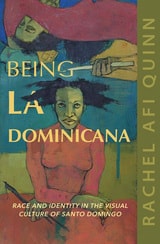
Being La Dominicana
Race and Identity in the Visual Culture of Santo DomingoRachel Afi Quinn
University of Illinois Press, 2021
Engaging and astute, Being La Dominicana reveals the little-studied world of today's young Dominican women and what their personal stories and transnational experiences can tell us about the larger neoliberal world.
Between Fitness and Death
Disability and Slavery in the CaribbeanStefanie Hunt-Kennedy
University of Illinois Press, 2020
Stefanie Hunt-Kennedy provides a three-pronged analysis of disability in the context of Atlantic slavery. First, she examines the connections of enslavement and representations of disability and the parallel development of English anti-black racism. From there, she moves from realms of representation to reality in order to illuminate the physical, emotional, and psychological impairments inflicted by slavery and endured by the enslaved. Finally, she looks at slave law as a system of enforced disablement.
Audacious and powerful, Between Fitness and Death is a groundbreaking journey into the entwined histories of racism and ableism.
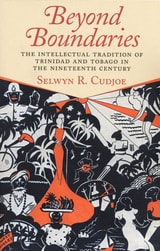
Beyond Boundaries
The Intellectual tradition of Trinidad and Tobago in the Nineteenth CenturySelwyn R. Cudjoe
University of Massachusetts Press, 2003
When V. S. Naipaul received the Nobel Prize for Literature in 2001, the award marked the culmination of a literary tradition that was almost two hundred years in the making. The island nation of Trinidad and Tobago has produced such important writers and thinkers as C. L. R. James, J. J. Thomas, Eric Williams, Oliver Cromwell Cox, Sylvester Williams, George Padmore, Earl Lovelace, Arnold Rampersad, and Merle Hodge. Yet this literary legacy is not well known, particularly with respect to works dating from the nineteenth century.
Beyond Boundaries traces the development of the country's literary and intellectual history from the “Narrative of Louisa Calderon” (1803) to Stephen Cobham's Rupert Gray: A Tale of Black and White (1907). Selwyn R. Cudjoe examines a wide range of narratives by and about the people of Trinidad and Tobago, from treatises in the natural sciences, to journals and memoirs, histories, slave narratives, travelers' accounts, poems, stories, novels, theatrical works, and writings in the popular press. Along the way, he discusses such seminal works as Jean Baptiste Philippe's Free Mulatto (1824) and Maxwell Philip's Emmanuel Appadocca (1854), the first indigenous novel. He explores books that shed light on ideological processes, such as J. J. Thomas's The Theory and Practice of Creole Grammar (1869) and Froudacity (1899). He examines how notions of savagery and civilization were deployed in the writings of the dominant class to stymie the growing self-awareness of the colonized. And he traces the rise of racial pride and nationalist sentiments among Indo- and Afro-Trinidadians.
Cudjoe demonstrates how Enlightenment concepts, English literature, African philosophy, Hindu theology, Islamic passion plays, and the culture of carnival all contributed to this body of ideas to create a vibrant literature, which in turn helped to shape a national identity.
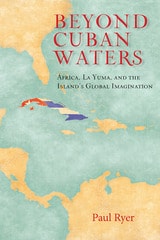
Beyond Cuban Waters
Africa, La Yuma, and the Island's Global ImaginationPaul Ryer
Vanderbilt University Press, 2016
This pursuit of Western status symbols represents a uniquely Cuban experience, set apart from other cultures pursuing the same things. In the Cuban case, this represents neither an acceptance nor rejection of the American cultural influence, but rather a co-opting or "Yumanizing" of these influences.
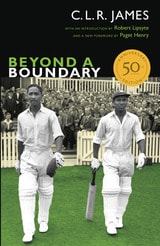
Beyond a Boundary
50th Anniversary EditionC. L .R. James
Duke University Press, 2013
Named one of the Top 50 Sports Books of All Time by Sports Illustrated
"Beyond a Boundary . . . should find its place on the team with Izaak Walton, Ivan Turgenev, A. J. Liebling, and Ernest Hemingway."—Derek Walcott, The New York Times Book Review
"As a player, James the writer was able to see in cricket a metaphor for art and politics, the collective experience providing a focus for group effort and individual performance. . . . [In] his scintillating memoir of his life in cricket, Beyond a Boundary (1963), James devoted some of his finest pages to this theme."—Edward Said, The Washington Post
"A work of double reverence—for the resilient, elegant ritualism of cricket and for the black people of the world."—Whitney Balliett, The New Yorker
"Beyond a Boundary is a book of remarkable richness and force, which vastly expands our understanding of sports as an element of popular culture in the Western and colonial world."—Mark Naison, The Nation
"Everything James has done has had the mark of originality, of his own flexible, sensitive, and deeply cultured intelligence. He conveys not a rigid doctrine but a delight and curiosity in all the manifestations of life, and the clue to everything lies in his proper appreciation of the game of cricket."—E. P. Thompson, author of The Making of the English Working Class
"Beyond a Boundary is . . . first and foremost an autobiography of a living legend—probably the greatest social theorist of our times."—Manning Marable, Journal of Sport & Social Issues
"The great triumph of Beyond a Boundary is its ability to rise above genre and in its very form explore the complex nature of colonial West Indian society."—Caryl Phillips, The New Republic

Black behind the Ears
Dominican Racial Identity from Museums to Beauty ShopsGinetta E. B. Candelario
Duke University Press, 2007
Candelario draws on her participant observation in a Dominican beauty shop in Washington Heights, a New York City neighborhood with the oldest and largest Dominican community outside the Republic, and on interviews with Dominicans in New York City, Washington, D.C., and Santo Domingo. She also analyzes museum archives and displays in the Museo del Hombre Dominicano and the Smithsonian Institution as well as nineteenth- and early-twentieth-century European and American travel narratives.
Blazing Cane
Sugar Communities, Class, and State Formation in Cuba, 1868–1959Gillian McGillivray
Duke University Press, 2009
Focusing on sugar communities in eastern and central Cuba, McGillivray recounts how farmers and workers pushed the Cuban government to move from exclusive to inclusive politics and back again. The revolutionary caudillo networks that formed between 1895 and 1898, the farmer alliances that coalesced in the 1920s, and the working-class groups of the 1930s affected both day-to-day local politics and larger state-building efforts. Not limiting her analysis to the island, McGillivray shows that twentieth-century Cuban history reflected broader trends in the Western Hemisphere, from modernity to popular nationalism to Cold War repression.
Bondmen and Rebels
A Study of Master-Slave Relations in AntiguaDavid Barry Gaspar
Duke University Press, 1985
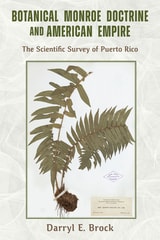
Botanical Monroe Doctrine and American Empire
The Scientific Survey of Puerto RicoDarryl E. Brock
University of Alabama Press, 2026
Explores how a US-led natural history survey of Puerto Rico served American Empire while yet catalyzing Boricua cultural nationalism
In Botanical Monroe Doctrine and American Empire, Darryl E. Brock examines the history, influence, and legacy of an ambitious effort to conduct a “physical and natural history survey of Porto [Puerto] Rico.” As founder of The New York Botanical Garden, Nathaniel Lord Britton advanced a botanical Monroe Doctrine that sought to counter British and European scientific influence in the Americas by establishing American authority over the naming and classification of species. Although initially aligned with imperial and “civilizing” aims, the Scientific Survey of Puerto Rico ultimately contributed to modernization, professionalization, and cultural preservation on the island. Its work in Taíno archaeology and jíbaro folklore helped lay the foundation for today’s Caguana Indigenous Ceremonial Park and reinforced currents of Boricua cultural nationalism. The survey also intersected with broader political and economic developments, influencing areas from bilingual education to New Deal administration in Puerto Rico.
Sponsored by the New York Academy of Sciences, the survey was conducted by The New York Botanical Garden in partnership with the American Museum of Natural History and the Yale Peabody Museum, with the final report issued in 1970. Puerto Rican scientists and intellectuals, including mycologist and future University of Puerto Rico chancellor Carlos Chardón, actively contributed to the project. Expanding to the Virgin Islands, the survey encompassed nearly two dozen expeditions, collected more than 10,000 plant specimens, and identified thirty-eight new species. Its nineteen published volumes remain among the most comprehensive multidisciplinary scientific studies of any tropical region. Brock’s groundbreaking work is essential reading for those interested in the history of science, Puerto Rico, and American empire.

Bridging Enigma
Cubans on Cuba, Volume 96Ambrosio Fornet
Duke University Press, 0
Fostered by both caution and audacity, in a climate of both trust and tension, and in the face of sustained North American hostility through nearly four decades, Cuban artists and writers have succeeded in building bridges between domestic and foreign cultural institutions, partly offsetting the profound material deprivations under which they have labored. The work collected in this volume introduces a group of writers, artists, and filmmakers who provide a window on Cuban life, illuminating this enigmatic island and bridging the troubled waters it shares with its continental neighbor to the north.
Contributors. Arturo Arango, Emilio Bejel, Rosa Ileana Boudet, Roberto Fernández Retamar, Ambrosio Fornet, Rafael Hernández, Francisco López Sacha, Humberto Manduley López, Vivian Martínez Tabares, Margarita Mateo Palmer, Miguel Mejides, Reinaldo Montero, Lisandro Otero, Graziella Pogolotti, Magda Resik, Cintio Vitier
Broadcasting Modernity
Cuban Commercial Television, 1950-1960Yeidy M. Rivero
Duke University Press, 2015
Buena Vista in the Club
Rap, Reggaetón, and Revolution in HavanaGeoffrey Baker
Duke University Press, 2011