Results by title
21 books match the query 'Accountability'
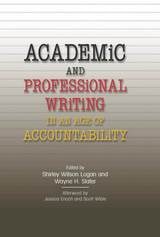
Academic and Professional Writing in an Age of Accountability
Edited by Shirley Wilson Logan and Wayne H. Slater, with an Afterword by Jessica Enoch and Scott Wible
Southern Illinois University Press, 2018
The first two essays in the book provide a history of the academic and professional writing program at the University of Maryland. Subsequent essays explore successes and challenges in the establishment and development of writing programs at four other major institutions, identify the features of language that facilitate academic and professional communication, look at the ways digital practices in academic and professional writing have shaped how writers compose and respond to texts, and examine the role of assessment in curriculum and pedagogy. An afterword by distinguished rhetoric and composition scholars Jessica Enoch and Scott Wible offers perspectives on the future of academic and professional writing.
This collection takes stock of the historical, rhetorical, linguistic, digital, and evaluative aspects of the teaching of writing in higher education. Among the critical issues addressed are how university writing programs were first established and what early challenges they faced, where writing programs were housed and who administered them, how the language backgrounds of composition students inform the way writing is taught, the ways in which current writing technologies create new digital environments, and how student learning and programmatic outcomes should be assessed.
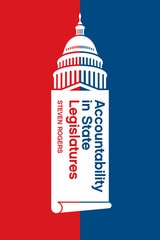
Accountability in State Legislatures
Steven Rogers
University of Chicago Press, 2023
A troubling portrait of democracy in US state legislatures.
State legislatures hold tremendous authority over key facets of our lives, ranging from healthcare to marriage to immigration policy. In theory, elections create incentives for state legislators to produce good policies. But do they?
Drawing on wide-ranging quantitative and qualitative evidence, Steven Rogers offers the most comprehensive assessment of this question to date, testing different potential mechanisms of accountability. His findings are sobering: almost ninety percent of American voters do not know who their state legislator is; over one-third of incumbent legislators run unchallenged in both primary and general elections; and election outcomes have little relationship with legislators’ own behavior.
Rogers’s analysis of state legislatures highlights the costs of our highly nationalized politics, challenging theories of democratic accountability and providing a troubling picture of democracy in the states.
An Age of Accountability
How Standardized Testing Came to Dominate American Schools and Compromise EducationJohn L. Rury
Rutgers University Press, 2024

Archives Power
Memory, Accountability, and Social JusticeRandall C. Jimerson
Society of American Archivists, 2009
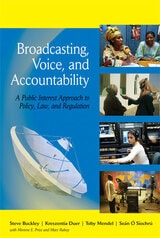
Broadcasting, Voice, and Accountability
A Public Interest Approach to Policy, Law, and RegulationSteve Buckley, Kreszentia Duer, Toby Mendel, and Seán Ó Siochrú
University of Michigan Press, 2008
---Ruth Teer-Tomaselli, UNESCO Chair in Communication for Southern Africa, Culture, Communication and Media Studies, University of KwaZulu-Natal
digitalculturebooks is an imprint of the University of Michigan Press and the Scholarly Publishing Office of the University of Michigan Library dedicated to publishing innovative and accessible work exploring new media and their impact on society, culture, and scholarly communication. Visit the website at www.digitalculture.org.

Crip Spacetime
Access, Failure, and Accountability in Academic LifeMargaret Price
Duke University Press, 2024
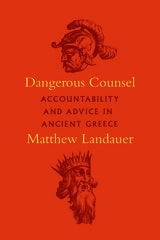
Dangerous Counsel
Accountability and Advice in Ancient GreeceMatthew Landauer
University of Chicago Press, 2019
With Dangerous Counsel, Matthew Landauer analyzes the sometimes ferocious and unpredictable politics of accountability in ancient Greece and offers novel readings of ancient history, philosophy, rhetoric, and drama. In comparing the demos to a tyrant, thinkers such as Herodotus, Plato, Isocrates, and Aristophanes were attempting to work out a theory of the badness of unaccountable power; to understand the basic logic of accountability and why it is difficult to get right; and to explore the ways in which political discourse is profoundly shaped by institutions and power relationships. In the process they created strikingly portable theories of counsel and accountability that traveled across political regime types and remain relevant to our contemporary political dilemmas.
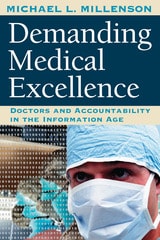
Demanding Medical Excellence
Doctors and Accountability in the Information AgeMichael L. Millenson
University of Chicago Press, 2000
"If you read only one book this year, read Demanding Medical Excellence. It's that good, and the revolution it describes is that important."—Health Affairs
"Millenson has done yeoman's work in amassing and understanding that avalanche of data that lies beneath most of the managed-care headlines. . . . What he finds is both important and well-explained: inconsistency, overlap, and inattention to quality measures in medical treatment cost more and are more dangerous than most cost-cutting measures. . . . [This book] elevates the healthcare debate to a new level and deserves a wide readership."—Library Journal
"An involving, human narrative explaining how we got to where we are today and what lies ahead."—Mark Taylor, Philadelphia Inquirer
"Read this book. It will entertain you, challenge, and strengthen you in your quest for better accountability in health care."—Alex R. Rodriguez, M.D., American Journal of Medical Quality
"Finally, a health-care book that doesn't wring its hands over the decline of medicine at the hands of money-grubbing corporations. . . . This is a readable account of what Millenson calls a 'quiet revolution' in health care, and his optimism makes for a refreshing change."—Publishers Weekly
"With meticulous detail, historical accuracy, and an uncommon understanding of the clinical field, Millenson documents our struggle to reach accountability."—Saty Satya-Murti, M.D., Journal of the American Medical Association

Elites and the Politics of Accountability in Africa
Wale Adebanwi and Rogers Orock, Editors
University of Michigan Press, 2021
Elites and the Politics of Accountability in Africa examines the ways that accountability offers an effective interpretive lens to the social, cultural, and institutional struggles of both the elites and ordinary citizens in Africa. Each chapter investigates questions of power, its public deliberation, and its negotiation in Africa by studying elites through the framework of accountability. The book enters conversations about political subjectivity and agency, especially from ongoing struggles around identities and belonging, as well as representation and legitimacy. Who speaks to whom? And on whose behalf do they speak? The contributors to this volume offer careful analyses of how such concerns are embedded in wider forms of cultural, social, and institutional discussions about transparency, collective responsibility, community, and public decision-making processes. These concerns affect prospects for democratic oversight, as well as questions of alienation, exclusivity, privilege and democratic deficit. The book situates our understanding of the emergence, meaning, and conceptual relevance of elite accountability, to study political practices in Africa. It then juxtaposes this contextualization of accountability in relation to the practices of African elites. Elites and the Politics of Accountability in Africa offers fresh, dynamic, and multifarious accounts of elites and their practices of accountability and locally plausible self-legitimation, as well as illuminating accounts of contemporary African elites in relation to their socially and historicallysituated outcomes of contingency, composition, negotiation, and compromise.
Engines of Anxiety
Academic Rankings, Reputation, and Accountabilityespeland
Russell Sage Foundation, 2016
Students and the public routinely consult various published college rankings to assess the quality of colleges and universities and easily compare different schools. However, many institutions have responded to the rankings in ways that benefit neither the schools nor their students. In Engines of Anxiety, sociologists Wendy Espeland and Michael Sauder delve deep into the mechanisms of law school rankings, which have become a top priority within legal education. Based on a wealth of observational data and over 200 in-depth interviews with law students, university deans, and other administrators, they show how the scramble for high rankings has affected the missions and practices of many law schools.
Engines of Anxiety tracks how rankings, such as those published annually by the U.S. News & World Report, permeate every aspect of legal education, beginning with the admissions process. The authors find that prospective law students not only rely heavily on such rankings to evaluate school quality, but also internalize rankings as expressions of their own abilities and flaws. For example, they often view rejections from “first-tier” schools as a sign of personal failure. The rankings also affect the decisions of admissions officers, who try to balance admitting diverse classes with preserving the school’s ranking, which is dependent on factors such as the median LSAT score of the entering class. Espeland and Sauder find that law schools face pressure to admit applicants with high test scores over lower-scoring candidates who possess other favorable credentials.
Engines of Anxiety also reveals how rankings have influenced law schools’ career service departments. Because graduates’ job placements play a major role in the rankings, many institutions have shifted their career-services resources toward tracking placements, and away from counseling and network-building. In turn, law firms regularly use school rankings to recruit and screen job candidates, perpetuating a cycle in which highly ranked schools enjoy increasing prestige. As a result, the rankings create and reinforce a rigid hierarchy that penalizes lower-tier schools that do not conform to the restrictive standards used in the rankings. The authors show that as law schools compete to improve their rankings, their programs become more homogenized and less accessible to non-traditional students.
The ranking system is considered a valuable resource for learning about more than 200 law schools. Yet, Engines of Anxiety shows that the drive to increase a school’s rankings has negative consequences for students, educators, and administrators and has implications for all educational programs that are quantified in similar ways.

High-Stakes Schooling
What We Can Learn from Japan's Experiences with Testing, Accountability, and Education ReformChristopher Bjork
University of Chicago Press, 2015
Bjork asks a variety of important questions related to testing and reform: Does testing overburden students? Does it impede innovation and encourage conformity? Can a system anchored by examination be reshaped to nurture creativity and curiosity? How should any reforms be implemented by teachers? Each chapter explores questions like these with careful attention to the actual effects policies have had on schools in Japan and other Asian settings, and each draws direct parallels to issues that US schools currently face. Offering a wake-up call for American education, Bjork ultimately cautions that the accountability-driven practice of standardized testing might very well exacerbate the precise problems it is trying to solve.
Learning While Governing
Expertise and Accountability in the Executive BranchSean Gailmard and John W. Patty
University of Chicago Press, 2013
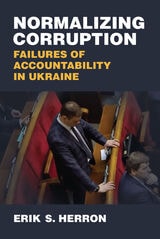
Normalizing Corruption
Failures of Accountability in UkraineErik S. Herron
University of Michigan Press, 2020
Normalizing Corruption addresses several interconnected questions: Under what circumstances do incumbents lose elections? How well do party organizations encourage cohesive behavior? Is executive authority responsive to inquiries from public organizations and other government institutions? How can citizens influence government actions? Do civil servants conduct their duties as impartial professionals, or are they beholden to other interests? The research builds upon extensive fieldwork, data collection, and data analysis that Erik S. Herron has conducted since 1999.

Power Beyond Scrutiny
Media, Justice and AccountabilityJustin Schlosberg
Pluto Press, 2013
Power Beyond Scrutiny uncovers the forces which distort and limit public debate in the media. From the misuse of politicians' expenses to recent phone hacking scandals, establishment corruption has never been more in the headlines. Yet amidst the din there have been seismic silences.
Justin Schlosberg interrogates these silences - why did a plea bargain which allowed Britain’s biggest arms company to escape bribery prosecution go almost entirely unchallenged in television news? Why did journalists routinely endorse the official explanation of how intelligence analyst David Kelly died, whilst all but ignoring mounting evidence which undermined it? Why, in 2010, did broadcasters offer an unchallenged platform to critics of Wikileaks but not its supporters?
These are some of the questions and imbalances that Schlosberg seeks to address as he explains the nature of public debate in the digital age. In doing so he uncovers a range of news blockages that are more than just accidents of a fragmented, chaotic mediascape. They are ultimately ideological forces which ensure that contestability and dissent remain within definable limits.
Presidential Campaigns and Presidential Accountability
Michele P. Claibourn
University of Illinois Press, 2011
Testing Deaf Students in an Age of Accountability
Robert C. Johnson
Gallaudet University Press, 2008
Despite the idealism represented by the No Child Left Behind law’s mandate for accountability in education, deaf students historically and on average have performed far below grade level on standardized tests. To resolve this contradiction in deaf education, this collection presents a spectrum of perspectives from a diverse corps of education experts to suggest a constructive synthesis of worthy ideals, hard realities, and pragmatic solutions. Contributors to this study include volume editors Robert C. Johnson and Ross E. Mitchell, Ed Bosso, Michael Bello, Betsy J. Case, Patrick Costello, Stephanie W. Cawthon, Joseph E. Fischgrund, Courtney Foster, Christopher Johnstone, Michael Jones, Jana Lollis, Pat Moore, Barbara Raimondo, Suzanne Recane, Richard C. Steffan, Jr., Sandra J. Thompson, Martha L. Thurlow, and Elizabeth Towles-Reeves.
These noted educators and researchers employ experiences from Massachusetts, Delaware, Maryland, North Carolina, Illinois and California to support their findings about the dilemma facing deaf students and their teachers. They assess the intent and flexibility of federal law; achievement data regarding deaf students; potential accommodations and universal design to make tests more accessible; possible alternatives for deaf student not ready for conventional assessments; accounts of varying degrees of cooperation and conflict between schools and state education departments; and the day-to-day efforts of teachers and school administrators to help deaf students measure up to the new standards. By presenting these wide-ranging insights together, Testing Deaf Students in an Age of Accountability provides a unique opportunity to create genuine means to educate deaf students for the only test that matters, that of life.
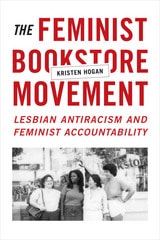
The Feminist Bookstore Movement
Lesbian Antiracism and Feminist AccountabilityKristen Hogan
Duke University Press, 2016
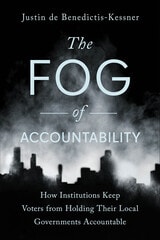
The Fog of Accountability
How Institutions Keep Voters from Holding Their Local Governments AccountableJustin de Benedictis-Kessner
University of Chicago Press, 2026
An astute, data-rich examination of the structural reasons that elections fail to hold US city officials accountable.
In the United States, hundreds of thousands of elected and appointed officials serve more than 50,000 subnational governments, making important decisions about services ranging from education to infrastructure to policing. The provision of critical city services shapes citizens’ everyday lives.
Supposedly, local politicians are the elected representatives closest to the people they serve, but are they actually accountable to their constituents? Justin de Benedictis-Kessner shows that they are not: local elections routinely fail to punish bad politicians or reward strong performers. The Fog of Accountability argues that this is because urban politics is defined by minimally effective competition, complex institutions that confuse voters, and a lack of effective media coverage. These institutional features combine to stymie even well-intentioned voters and make accountability difficult. Fixing these problems is challenging, but, as de Benedictis-Kessner shows, change is possible if we can enable citizens to reclaim and assert their political power.
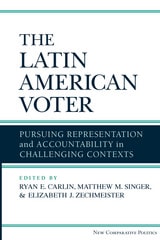
The Latin American Voter
Pursuing Representation and Accountability in Challenging ContextsRyan E. Carlin, Matthew M. Singer, and Elizabeth J. Zechmeister
University of Michigan Press, 2015

Towards Coherence Between Classroom Assessment and Accountability
Edited by Mark Wilson
University of Chicago Press, 2004
The authors of this volume emphasize that assessment, as it exists in schools today, consists mainly of the measurements that teachers themselves design, evaluate, and act upon every day. Improving the usefulness of assessment in schools primarily requires assisting and harnessing this flood of assessment information, both as a means of learning within the classroom and as the source of crucial information flowing out of classrooms.
This volume aims to encourage debate and reflection among educational researchers, professionals, and policymakers. Five source chapters describe successful classroom assessment models developed in partnership with teachers, while additional commentaries give a range of perspectives on the issues of classroom assessment, standardized testing, and accountability.

World Rule
Accountability, Legitimacy, and the Design of Global GovernanceJonathan GS Koppell
University of Chicago Press, 2010
Dilemmas from climate change to financial meltdowns make it clear that global interconnectedness is the norm in the twenty-first century. As a result, global governance organizations (GGOs)—from the World Trade Organization to the Forest Stewardship Council—have taken on prominent roles in the management of international affairs. These GGOs create and promulgate rules to address a host of pressing problems. But as World Rule reveals, they struggle to meet two challenges: building authority despite limited ability to impose sanctions and maintaining legitimacy while satisfying the demands of key constituencies whose support is essential to a global rulemaking regime.
Through a novel empirical study of twenty-five GGOs, Jonathan GS Koppell provides a clearer picture of the compromises within and the competition among these influential institutions by focusing attention on their organizational design. Analyzing four aspects of GGO organization in depth—representation and administration, the rulemaking process, adherence and enforcement, and interest group participation—Koppell describes variation systemically, identifies patterns, and offers explanations that link GGO design to the fundamental challenge of accountability in global governance.