Results by title
1566 books match the query 'Christianity' and 61 start with b
Baptism of Desire and Christian Salvation
Anthony R. Lusvardi
Catholic University of America Press, 2024
Baptist Battles
Social Change and Religious Conflict in the Southern Baptist ConventionNancy Tatom Ammerman
Rutgers University Press, 1990
Since 1979 Southern Baptists have been noisily struggling to agree on symbols, beliefs, and practices as they attempt to make sense of their changing social world. Nancy Ammerman has carefully documented their struggle. She tells the story of the Baptist reversal from a moderate to a fundamentalist outlook and speculates on the future of the denomination.
Ammerman places change among the Southern Baptists in the context of the cultural and economic changes that have transformed the South from its rural past into an urbanizing, culturally diverse region. Not only did the South change; Southern Baptists did as well. Reflecting this diversity, the Southern Baptist bureaucracy was relatively progressive. During the 1960s and 1970s, moderate sentiments prevailed, while fundamentalists remained on the margins. These two were, however, becoming increasingly divergent in what they considered important about being a Baptist, in their views about the Bible, in their attitudes on the origination of women, on Christian morals, and on national politics.
Late in the 1970s, a fundamentalist coalition emerged, followed by unsuccessful efforts by moderates to oppose it. The battles escalated until 1985, when 45,000 Baptists gathered in Dallas to decide between contending presidential candidates. That dramatic event illustrated the extent to which organized political resources were determining the course of the conflict. Ammerman studies these strategies and resources as well.
Examining how this tension affected Baptists, Ammerman begins with case studies of the change it is producing in Baptist agencies. But she also brings us back to the local churches and individual believers who are renegotiating their relationships within their denomination. She asks whether the denomination’s polity can accommodate an increasingly diverse group of Baptists, of whether the only way dissidents can have a voice is through schism.
Baring Witness
36 Mormon Women Talk Candidly about Love, Sex, and MarriageEdited by Holly Welker
University of Illinois Press, 2016
Be Fruitful and Multiply
Eugenics and Other Anglican Efforts to Control Fertility in Interwar EnglandAndrew Moeller
Rutgers University Press, 2027
Be Fruitful and Multiply examines the moral justification offered by Anglican leaders for their support for eugenic, pronatalist, and neo-Malthusian schemes in the United Kingdom during the interwar period. These religious leaders often comprehended their efforts to control fertility within the context of a broader struggle over competing conceptions of human purpose in English society, and regularly justified their efforts on the grounds that fertility-manipulation schemes served to align procreative behaviors with “Christian” conceptions of human purpose. The shared moral logic of Anglican leaders helps to explain the pervasive interest in birthrate patterns, along with the enduring appeal of fertility-manipulation schemes, amongst middle- and upper-classes during the first half of the twentieth century. This book also sheds light on how population concerns led to the liberalization of church positions on marriage and sexuality, and illuminates how Anglican leaders sought to maintain moral influence in the face of the perceived large-scale rejection of Christian moral teachings.
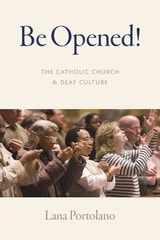
Be Opened! The Catholic Church and Deaf Culture
Lana Portolano
Catholic University of America Press, 2021
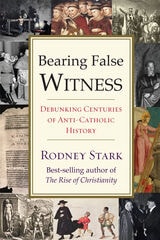
Bearing False Witness
Debunking Centuries of Anti-Catholic HistoryRodney Stark
Templeton Press, 2016
As we all know and as many of our well-established textbooks have argued for decades, the Inquisition was one of the most frightening and bloody chapters in Western history; Pope Pius XII was anti-Semitic and rightfully called “Hitler’s Pope,” the Dark Ages were stunting the progress of knowledge to be redeemed only by the secular spirit of the Enlightenment. The religious Crusades were an early example of the rapacious Western thirst for riches and power. But what if these long held beliefs were all wrong?
In this stunning, powerful, and ultimately persuasive book, Rodney Stark, one of the most highly regarded sociologists of religion and bestselling author of The Rise of Christianity (HarperSanFrancisco 1997), argues that some of our most firmly held ideas about history, ideas that paint the Catholic Church in the least favorable light are, in fact, fiction. Why have we held these wrongheaded ideas so firmly and for so long? And if our beliefs are wrong, what is the truth?
In each chapter, Stark takes on a well-established anti-Catholic myth, gives a fascinating history of how each myth became conventional wisdom and presents a startling picture of the real truth. For example, instead of the Spanish Inquisition being an anomaly of torture and murder of innocent people persecuted for “imaginary” crimes such as witchcraft and blasphemy, Stark argues that not only did the Spanish Inquisition spill very little blood, but it was a major force in support of moderation and justice.
Stark dispels the myth of Pope Pius XII being apathetic or even helpful to the Nazi movement, such as to merit the title “Hitler’s Pope,” and instead shows that the campaign to link Pope Pius XII to Hitler was initiated by the Soviet Union, presumably in hopes of neutralizing the Vatican in post-World War II affairs. Many praised Pope Pius XIIs vigorous and devoted efforts to saving Jewish lives during the war.
Instead of understanding the Dark Ages as a millennium of ignorance and backwardness inspired by the Catholic Church’s power, Stark argues that the whole notion of the “Dark Ages” was an act of pride perpetuated by anti-religious intellectuals who were determined to claim that theirs was the era of “Enlightenment.”
In the end, readers of Bearing False Witness will have a more accurate history of the Catholic Church and will also understand why it became unfairly maligned for so long. Bearing False Witness is a compelling and sobering account of how egotism and ideology often work together to give us a false truth.
Beauty and the Good
Recovering the Classical Tradition from Plato to Duns ScotusAlice M. Ramos
Catholic University of America Press, 2021
Becoming What We Are
Classical and Christian Readings of ModernityJude P. Dougherty
Catholic University of America Press, 2023
Becoming a New Self
Practices of Belief in Early Modern CatholicismMoshe Sluhovsky
University of Chicago Press, 2017
Practices such as the examination of conscience, general confession, and spiritual exercises, which until the 1400s had been restricted to monastic elites, breached the walls of monasteries in the period that followed. Thanks in large part to Franciscans and Jesuits, lay urban elites—both men and women—gained access to spiritual practices whose goal was to enhance belief and create new selves. Using Michel Foucault’s writing on the hermeneutics of the self, and the French philosopher’s intuition that the early modern period was a moment of transition in the configurations of the self, Sluhovsky offers a broad panorama of spiritual and devotional techniques of self-formation and subjectivation.
Bede the Theologian
History, Rhetoric, and SpiritualityJohn P. Bequette
Catholic University of America Press, 2022
Before Truth
Lonergan, Aquinas, and the Problem of WisdomJeremy Wilkins
Catholic University of America Press, 2018
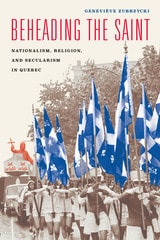
Beheading the Saint
Nationalism, Religion, and Secularism in QuebecGeneviève Zubrzycki
University of Chicago Press, 2016
In Beheading the Saint, Geneviève Zubrzycki studies that transformation through a close investigation of the annual Feast of St. John the Baptist of June 24. The celebrations of that national holiday, she shows, provided a venue for a public contesting of the dominant ethno-Catholic conception of French Canadian identity and, via the violent rejection of Catholic symbols, the articulation of a new, secular Québécois identity. From there, Zubrzycki extends her analysis to the present, looking at the role of Québécois identity in recent debates over immigration, the place of religious symbols in the public sphere, and the politics of cultural heritage—issues that also offer insight on similar debates elsewhere in the world.
Believe Not Every Spirit
Possession, Mysticism, & Discernment in Early Modern CatholicismMoshe Sluhovsky
University of Chicago Press, 2007
From 1400 through 1700, the number of reports of demonic possessions among European women was extraordinarily high. During the same period, a new type of mysticism—popular with women—emerged that greatly affected the risk of possession and, as a result, the practice of exorcism. Many feared that in moments of rapture, women, who had surrendered their souls to divine love, were not experiencing the work of angels, but rather the ravages of demons in disguise. So how then, asks Moshe Sluhovsky, were practitioners of exorcism to distinguish demonic from divine possessions?
Drawing on unexplored accounts of mystical schools and spiritual techniques, testimonies of the possessed, and exorcism manuals, Believe Not Every Spirit examines how early modern Europeans dealt with this dilemma. The personal experiences of practitioners, Sluhovsky shows, trumped theological knowledge. Worried that this could lead to a rejection of Catholic rituals, the church reshaped the meaning and practices of exorcism, transforming this healing rite into a means of spiritual interrogation. In its efforts to distinguish between good and evil, the church developed important new explanatory frameworks for the relations between body and soul, interiority and exteriority, and the natural and supernatural.

Between Church and State
The Lives of Four French Prelates in the Late Middle AgesBernard Guenée
University of Chicago Press, 1990
Guenée chooses as his frame the momentous period from the height of Saint Louis's reign in the mid-thirteenth century to the beginning of the Italian wars two hundred years later. During this time of schism in the church, of war between nascent states, and of treachery among princes, Bernard Gui (1261-1331), Gilles Le Muisit (1272-1353), Pierre D'Ailly (1351-1420), and Thomas Basin (1412-1490) all rose from modest circumstances to the dignity of office. Guenée shows us how these prelates used their talent, ambition, patrons, zeal, and experience to juggle the competing demands of obedience to church and state; to overcome competition from an upcoming new generation; and to cope with plague, war, and violence. Free of jargon yet steeped in learning, Between Church and State reveals the career patterns and politics of an era while forging a new model for points of departure in historical scholarship.
Between Dixie and Zion
Southern Baptists and Palestine before IsraelWalker Robins
University of Alabama Press, 2020
Explores the roots of evangelical Christian support for Israel through an examination of the Southern Baptist Convention
One week after the establishment of the State of Israel in 1948, delegates to the Southern Baptist Convention (SBC) repeatedly and overwhelmingly voted down resolutions congratulating fellow Southern Baptist Harry Truman on his role in Israel’s creation. From today’s perspective, this seems like a shocking result. After all, Christians—particularly the white evangelical Protestants who populate the SBC—are now the largest pro-Israel constituency in the United States. How could conservative evangelicals have been so hesitant in celebrating Israel’s birth in 1948? How did they then come to be so supportive?
Between Dixie and Zion: Southern Baptists and Palestine before Israel addresses these issues by exploring how Southern Baptists engaged what was called the “Palestine question”: whether Jews or Arabs would, or should, control the Holy Land after World War I. Walker Robins argues that, in the decades leading up to the creation of Israel, most Southern Baptists did not directly engage the Palestine question politically. Rather, they engaged it indirectly through a variety of encounters with the land, the peoples, and the politics of Palestine. Among the instrumental figures featured by Robins are tourists, foreign missionaries, Arab pastors, converts from Judaism, biblical interpreters, fundamentalist rebels, editorialists, and, of course, even a president. While all revered Palestine as the Holy Land, each approached and encountered the region according to their own priorities.
Nevertheless, Robins shows that Baptists consistently looked at the region through an Orientalist framework, broadly associating the Zionist movement with Western civilization, modernity, and progress over and against the Arabs, whom they viewed as uncivilized, premodern, and backward. He argues that such impressions were not idle—they suggested that the Zionists were bringing to fruition Baptists’ long-expressed hopes that Israel would regain the prosperity it had held in the biblical era, the Holy Land would one day be revived, and biblical prophecies preceding the return of Christ would be fulfilled.
Between Human and Divine
The Catholic Vision in Contemporary LiteratureMary Reichardt
Catholic University of America Press, 2010
Between Jesus and the Market
The Emotions that Matter in Right-Wing AmericaLinda Kintz
Duke University Press, 1997
With texts from such organizations as the Christian Coalition, the Heritage Foundation, and Concerned Women for America, and writings by Elizabeth Dole, Newt Gingrich, Pat Robertson, and Rush Limbaugh, Kintz traces the usefulness of this activism for the secular claim that conservative political economy is, in fact, simply an expression of the deepest and most admirable elements of human nature itself. The discussion of Limbaugh shows how he draws on the skepticism of contemporary culture to create a sense of absolute truth within his own media performance—its truth guaranteed by the market. Kintz also describes how conservative interpretations of the Holy Scriptures, the U.S. Constitution, and the Declaration of Independence have been used to challenge causes such as feminism, women’s reproductive rights, and gay and lesbian rights. In addition to critiquing the intellectual and political left for underestimating the power of right-wing grassroots organizing, corporate interests, and postmodern media sophistication, Between Jesus and the Market discusses the proliferation of militia groups, Christian entrepreneurship, and the explosive growth and "selling" of the Promise Keepers.
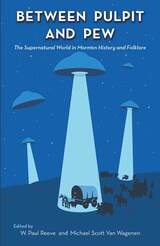
Between Pulpit and Pew
The Supernatural World in Mormon History and FolkloreW. Paul Reeve and Michael Scott Van Wagenen
Utah State University Press, 2011
Cain wanders the frontier as a Bigfoot-like hairy beast and confronts an early Mormon apostle. An evil band of murderers from Mormon scripture, known as the Gadianton robbers, provides an excuse for the failure of a desert town. Stories of children raised from the dead with decayed bodies and damaged minds help draw boundaries between the proper spheres of human and divine action. Mormons who observe UFOs in the nineteenth and twentieth centuries find ways to explain them in relation to the church’s cosmology. The millenarian dimension of that belief system induces church members to invest in the Dream Mine, a hidden treasure that a would-be heir to Joseph Smith wraps in prophecy of the end times. A Utah version of Nessie haunts a large mountain lake. Non-Mormons attempt to discredit Joseph Smith with tales that he had tried and failed to walk on water.
Mormons gave distinctive meanings to supernatural legends and events, but their narratives incorporated motifs found in many cultures. Many such historical legends and beliefs found adherents down to the present. This collection employs folklore to illuminate the cultural and religious history of a people.
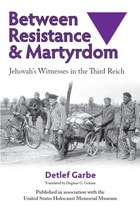
Between Resistance and Martyrdom
Jehovah's Witnesses in the Third ReichDetlef Garbe
University of Wisconsin Press, 2008
Although persecuted and banned from practicing their beliefs by the Nazi regime in 1933, the Jehovah’s Witnesses’ unified resistance has been largely forgotten. Basing his work on a wide range of sources, including documents and archives previously unconsidered as well as critical analyses of Jehovah’s Witness literature and survivor interviews, Detlef Garbe chronicles the Nazi’s relentless persecution of this religious group before and during World War II.
The English translation of this important work features a series of original photographs not published in the German edition. These striking images bring a sense of individual humanity to this story and help readers comprehend the reality of the events documented. Between Resistance and Martyrdom is an indispensable work that will introduce an English-speaking audience to this important but lesser-known part of Holocaust history.
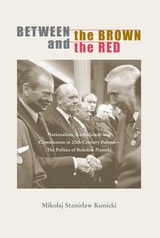
Between the Brown and the Red
Nationalism, Catholicism, and Communism in Twentieth-Century Poland—The Politics of Boleslaw PiaseckiMikolaj Stanislaw Kunicki
Ohio University Press, 2012
Between the Brown and the Red captures the multifaceted nature of church-state relations in communist Poland, relations that oscillated between mutual confrontation, accommodation, and dialogue. Ironically, under communism the bond between religion and nation in Poland grew stronger. This happened in spite of the fact that the government deployed nationalist themes in order to portray itself as more Polish than communist. Between the Brown and the Red also introduces one of the most fascinating figures in the history of twentieth-century Poland and the communist world.
In this study of the complex relationships between nationalism, communism, authoritarianism, and religion in twentieth-century Poland, Mikołaj Kunicki shows the ways in which the country’s communist rulers tried to adapt communism to local traditions, particularly ethnocentric nationalism and Catholicism. Focusing on the political career of Bolesław Piasecki, a Polish nationalist politician who began his surprising but illuminating journey as a fascist before the Second World War and ended it as a procommunist activist, Kunicki demonstrates that Polish communists reinforced an ethnocentric self-definition of Polishness and—as Piasecki’s case demonstrates—thereby prolonged the existence of Poland’s nationalist Right.
Between the Temple and the Tax Collector
The Intersection of Mormonism and the StateSamuel D. Brunson
University of Illinois Press, 2025
The founding and development of the Church of Jesus Christ of Latter-day Saints run parallel to the rise of the modern tax system and administrative state. Samuel D. Brunson looks at the relationships between the Church and various federal, state, local, and international tax regimes.
The church and its members engage with the state as taxpayers and as members of a faith exempt from taxes. As Brunson shows, LDS members and the Church have at various times enacted, enforced, and collected taxes while also challenging taxes in the courts and politics. Brunson delves into the ways LDS members used their status as taxpayers to affirm themselves as citizens and how outsiders have attacked the Church’s tax-exempt status to delegitimize it. Throughout, Brunson uses the daily interactions between the Latter-day Saints and taxation to explain important and inevitable holes in the wall between church and state.
Enlightening and informed, Between the Temple and the Tax Collector provides general readers and experts alike with a new perspective on a fundamental issue.
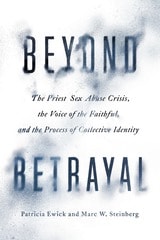
Beyond Betrayal
The Priest Sex Abuse Crisis, the Voice of the Faithful, and the Process of Collective IdentityPatricia Ewick and Marc W. Steinberg
University of Chicago Press, 2019
Beyond Betrayal charts a nationwide identity shift through the story of one chapter of Voice of the Faithful (VOTF), an organization founded in the scandal’s aftermath. VOTF had three goals: helping survivors of abuse; supporting priests who were either innocent or took risky public stands against the wrongdoers; and pursuing a broad set of structural changes in the church. Patricia Ewick and Marc W. Steinberg follow two years in the life of one of the longest-lived and most active chapters of VOTF, whose thwarted early efforts at ecclesiastical reform led them to realize that before they could change the Catholic Church, they had to change themselves. The shaping of their collective identity is at the heart of Beyond Betrayal, an ethnographic portrait of how one group reimagined their place within an institutional order and forged new ideas of faith in the wake of widespread distrust.
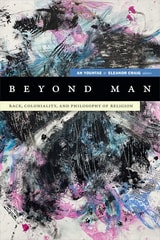
Beyond Man
Race, Coloniality, and Philosophy of ReligionYountae An and Eleanor Craig, editors
Duke University Press, 2021
Contributors. An Yountae, Ellen Armour, J. Kameron Carter, Eleanor Craig, Amy Hollywood, Vincent Lloyd, Filipe Maia, Mayra Rivera, Devin Singh, Joseph R. Winters
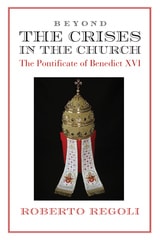
Beyond the Crises
The Pontificate of Benedict XVIRegoli
St. Augustine's Press, 2023
––Benedict XVI, General Audience, 27 February 2013
Roberto Regoli offers a keen and comprehensive preview of Pope Benedict XVI's pontificate, which will be better understood only after time has passed and more becomes available. As an historian, Regoli provides ample context to frame the theology and pastoral priorities of a pope, professor, priest, and figure of history who has been shaped by his times, and who will undoubtedly be remembered as deeply orienting the Church toward the future. The perspective and questions offered by Regoli will likewise be a key component to the scholarship surrounding Pope Benedict's pontificate for decades to come, and he significantly broadens what has already been compiled by Anglophone writers.
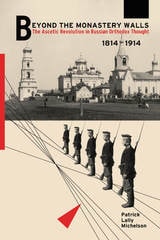
Beyond the Monastery Walls
The Ascetic Revolution in Russian Orthodox Thought, 1814–1914Patrick Lally Michelson
University of Wisconsin Press, 2017
Patrick Lally Michelson's intellectual history of asceticism in Russian Orthodox thought traces the development of these competing arguments from the early nineteenth century to the early months of World War I. He demonstrates that this discourse was an imaginative interpretation of lived Orthodoxy, primarily meant to satisfy the ideological needs of Russian thinkers and Orthodox intellectuals as they responded to the socioeconomic, political, and cultural challenges of modernity.
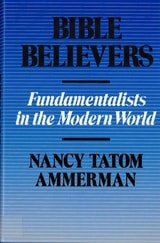
Bible Believers
Fundamentalists in the Modern WorldNancy Tatom Ammerman
Rutgers University Press, 1987
Bible believer (also Bible-believer,Bible-believing Christian,Bible-believing Church) is a self-description by conservative Christians to differentiate their teachings from others who see non- or extrabiblical tradition as higher or equal in authority.
In normal usage, "Bible believer" means an individual or organisation that believes the Christian Bible is true in some significant way. However, this combination of words is given a unique meaning in fundamentalist Protestant circles, where it is equated with the belief that the Christian Bible "contains no theological contradictions, historical discrepancies, or other such 'errors'", otherwise known as biblical inerrancy.
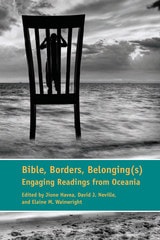
Bible, Borders, Belonging(s)
Engaging Readings from OceaniaJione Havea
SBL Press, 2014
Engaging voices crossing textual limits, race, and ethnic lines
In this collection of essays, scholars from Oceania open a new dialog regarding the vast, complex, and slippery nature of the Bible and the fluid meanings of borders and belongings. From belonging in a place, a group, or movement to belongings as material and cultural possessions, from borders of a text, discipline, or thought to borders of nations, communities, or bodies, the authors follow the currents of Oceania to the shores of Asia and beyond. Scholars contributing essays include Jeffrey W. Aernie, Merilyn Clark, Jione Havea, Gregory C. Jenks, Jeanette Mathews, Judith E. McKinlay, Monica Jyotsna Melanchthon, David J. Neville, John Painter, Kathleen P. Rushton, Ruth Sheridan, Nasili Vaka‘uta, and Elaine M. Wainwright. Michele A. Connolly, David M. Gunn, and Mark G. Brett provide responses to the essays.
Features:
- Discussion of the impacts of natural disasters and political and ecological upheavals on biblical interpretation and theological reflection
- Fourteen essays on texts in the Hebrew Bible and New Testament
- Three responses to the essays provide a range of views on the topics
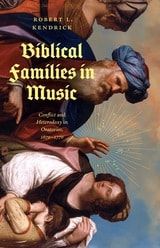
Biblical Families in Music
Conflict and Heterodoxy in Oratorios, 1670–1770Robert L. Kendrick
University of Chicago Press, 2025
Based to a great extent on the Old Testament, the largely Catholic musical-dramatic genre was popular in Italy, Austria, and southern Germany in the seventeenth and eighteenth centuries. Biblical Families in Music reveals how difficult stories of fratricide, child sacrifice, death, and forbidden love performed a didactic function in oratorios, teaching early modern audiences about piety and the rules of proper family life.
In the century after 1670, the heavily adapted tales of Abraham and Isaac, Cain and Abel, and the Egyptian slave Hagar and her son Ishmael were set to music by figures such as Alessandro Scarlatti and Antonio Sacchini and performed during Lent in churches and other sacred spaces for an audience of court nobility, clergy, and the urban patriciate. By examining the resonance of Catholic oratorios within predominantly upper-class social realities, the book broadens our cultural understanding of the early modern European family and underscores the centrality of family and familial relation to social position, devotional taste, and identity.
Biblical Religion and the Search for Ultimate Reality
Paul Tillich
University of Chicago Press, 1955
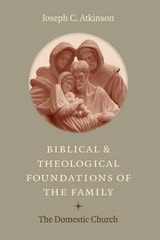
Biblical and Theological Foundation of the Family
Joseph C. Atkinson
Catholic University of America Press, 2014
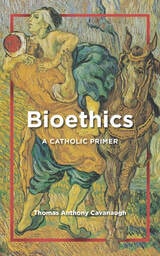
Bioethics
A Catholic PrimerThomas Cavanaugh
Catholic University of America Press, 2026
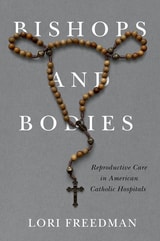
Bishops and Bodies
Reproductive Care in American Catholic HospitalsLori Freedman
Rutgers University Press, 2023
One out of every six patients in the United States is treated in a Catholic hospital that follows the policies of the U.S. Conference of Catholic Bishops. These policies prohibit abortion, sterilization, contraception, some treatments for miscarriage and gender confirmation, and other reproductive care, undermining hard-won patients’ rights to bodily autonomy and informed decision-making. Drawing on rich interviews with patients and providers, this book reveals both how the bishops’ directives operate and how people inside Catholic hospitals navigate the resulting restrictions on medical practice. In doing so, Bishops and Bodies fleshes out a vivid picture of how The Church’s stance on sex, reproduction, and “life” itself manifests in institutions that affect us all.
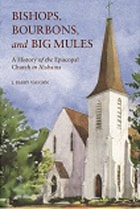
Bishops, Bourbons, and Big Mules
A History of the Episcopal Church in AlabamaJ. Barry Vaughn
University of Alabama Press, 2013
Tells the story of how the Episcopal Church gained influence over Alabama’s cultural, political, and economic arenas despite being a denominational minority in the state
The consensus of southern historians is that, since the Second Great Awakening, evangelicalism has dominated the South. This is certainly true when one considers the extent to which southern culture is dominated by evangelical rhetoric and ideas. However, in Alabama one non-evangelical group has played a significant role in shaping the state’s history. J. Barry Vaughn explains that, although the Episcopal Church has always been a small fraction (around 1 percent) of Alabama’s population, an inordinately high proportion, close to 10 percent, of Alabama’s significant leaders have belonged to this denomination. Many of these leaders came to the Episcopal Church from other denominations because they were attracted to the church’s wide degree of doctrinal latitude and laissez-faire attitude toward human frailty.
Vaughn argues that the church was able to attract many of the state’s governors, congressmen, and legislators by positioning itself as the church of conservative political elites in the state--the planters before the Civil War, the “Bourbons” after the Civil War, and the “Big Mules” during industrialization. He begins this narrative by explaining how Anglicanism came to Alabama and then highlights how Episcopal bishops and congregation members alike took active roles in key historic movements including the Civil War, Reconstruction, and the Civil Rights Movement. Bishops, Bourbons, and Big Mules closes with Vaughn’s own predictions about the fate of the Episcopal Church in twenty-first-century Alabama.
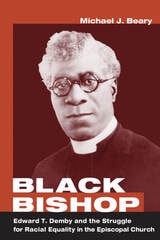
Black Bishop
Edward T. Demby and the Struggle for Racial Equality in the Episcopal ChurchMichael J. Beary
University of Illinois Press, 2001
America’s first Black bishop and his struggle to rebuild the African American presence inside the Episcopal Church
In 1918, the Right Reverend Edward T. Demby took up the reins as Suffragan (assistant) Bishop for Colored Work in Arkansas and the Province of the Southwest, an area encompassing Arkansas, Texas, Kansas, Oklahoma, Missouri, and New Mexico. Set within the context of a series of experiments in black leadership conducted by the Episcopal Diocese of Arkansas in the early decades of the twentieth century, Demby's tenure in a segregated ministry illuminates the larger American experience of segregation disguised as a social good.
Intent on demonstrating the industry and self-reliance of black Episcopalians to the church at large, Demby set about securing black priests for the diocese, baptizing and confirming communicants, and building schools and other institutions of community service. A gifted leader and a committed Episcopalian, Demby recognized that black service institutions, such as schools, hospitals, and orphanages, would be the means to draw African Americans back to the Episcopal Church, which they had abandoned in droves after emancipation as the church of their former masters.
For more than twenty years, hamstrung by white apathy, lack of funds, jurisdictional ambiguity, and the Great Depression, Demby doggedly tried to establish the credibility of a ministry that was as ill-conceived as it was well intended. Michael J. Beary skillfully narrates the shifting alliances within the Episcopal Church and shows how race was but one aspect of a more elemental struggle for power. He demonstrates how Demby's steadiness of purpose and non-confrontational manner gathered allies on both sides of the color line and how, ultimately, his judgment and the weight of his experience carried the church past its segregationist experiment.
Black and Mormon
Edited by Newell G. Bringhurst and Darron T. Smith
University of Illinois Press, 2004
This challenging collection is required reading for anyone concerned with the history of racism, discrimination, and the Latter-day Saints.
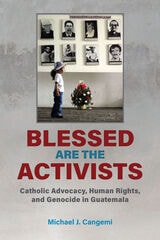
Blessed Are the Activists
Catholic Advocacy, Human Rights, and Genocide in GuatemalaMichael J. Cangemi
University of Alabama Press, 2024
Blessed Are the Activists examines US Catholic activists’ influence on US-Guatemalan relations during the Guatemalan civil war’s most violent years in the 1970s and 1980s. Cangemi argues that Catholic activists’ definition of human rights, advocacy methods, and structure caused them to act as a transnational human rights NGO that engaged Guatemalan and US government officials on human rights issues, reported on Guatemala’s human rights violations, and criticized US foreign policy decisions as a contributing factor in Guatemala’s inequality, poverty, and violence. His work foregrounds how Catholic activists emphasized dignity for Guatemala’s poorest citizens and the connections they made between justice, solidarity, and peace and brought Guatemala’s violence, poverty, and inequality to greater global attention, often at great personal risk.
Cangemi pays considerable attention to multiple facets of the strained US-Guatemala diplomatic relationship, including how and why Guatemala’s military dictatorship exposed the internal flaws within the Carter administration’s decision to link military aid to human rights and how internal foreign policy debates in the Carter and Reagan administrations helped to intensify Guatemala’s bloody civil war. He also includes interviews conducted with Guatemalan genocide survivors and refugees to provide firsthand accounts of the consequences of those policymaking decisions. Finally, he offers readers an in-depth examination of the US Catholic press’s sharp rebukes of US policies on Guatemala and all of Central America when the broader Roman Catholic Church began to move farther toward the ideological right under John Paul II.
Blessed Are the Activists offers rich, original research and a gripping narrative. With Guatemala and other countries in Latin America still experiencing human rights abuses, this book will continue to provide context. It will appeal to a broad swath of readers, from scholars to the general public and students.
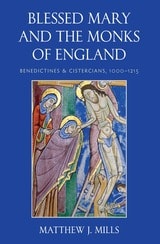
Blessed Mary and the Monks of England, 1000-1215
Matthew J. Mills
Catholic University of America Press, 2024
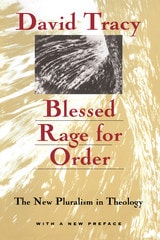
Blessed Rage for Order
The New Pluralism in TheologyDavid Tracy
University of Chicago Press, 1995
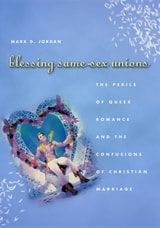
Blessing Same-Sex Unions
The Perils of Queer Romance and the Confusions of Christian MarriageMark D. Jordan
University of Chicago Press, 2005
Why then, asks noted gay commentator Mark D. Jordan, are so many churches vehemently opposed to blessing same-sex unions? In this incisive work, Jordan shows how carefully selected ideals of Christian marriage have come to dominate recent debates over same-sex unions. Opponents of gay marriage, he reveals, too often confuse simplified ideals of matrimony with historical facts. They suppose, for instance, that there has been a stable Christian tradition of marriage across millennia, when in reality Christians have quarreled among themselves for centuries about even the most basic elements of marital theology, authorizing experiments like polygamy and divorce.
Jordan also argues that no matter what the courts do, Christian churches will have to decide for themselves whether to bless same-sex unions. No civil compromise can settle the religious questions surrounding gay marriage. And queer Christians, he contends, will have to discover for themselves what they really want out of marriage. If they are not just after legal recognition as a couple or a place at the social table, do they really seek the blessing of God? Or just the garish melodrama of a white wedding? Posing trenchant questions such as these, Blessing Same-Sex Unions will be a must-read for both sides of the debate over gay marriage in America today.
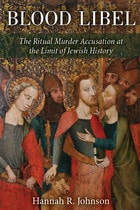
Blood Libel
The Ritual Murder Accusation at the Limit of Jewish HistoryHannah R. Johnson
University of Michigan Press, 2012
The ritual murder accusation is one of a series of myths that fall under the label blood libel, and describes the medieval legend that Jews require Christian blood for obscure religious purposes and are capable of committing murder to obtain it. This malicious myth continues to have an explosive afterlife in the public sphere, where Sarah Palin's 2011 gaffe is only the latest reminder of its power to excite controversy. Blood Libel is the first book-length study to analyze the recent historiography of the ritual murder accusation and to consider these debates in the context of intellectual and cultural history as well as methodology. Hannah R. Johnson articulates how ethics shapes methodological decisions in the study of the accusation and how questions about methodology, in turn, pose ethical problems of interpretation and understanding. Examining recent debates over the scholarship of historians such as Gavin Langmuir, Israel Yuval, and Ariel Toaff, Johnson argues that these discussions highlight an ongoing paradigm shift that seeks to reimagine questions of responsibility by deliberately refraining from a discourse of moral judgment and blame in favor of an emphasis on historical contingencies and hostile intergroup dynamics.
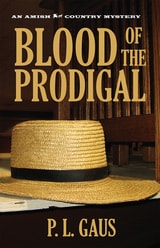
Blood of the Prodigal
An Amish Country MysteryP. L. Gaus
Ohio University Press, 1999
P. L. Gaus’s Blood of the Prodigal, a mystery in the tradition of Tony Hillerman, is back in a new edition, including an exclusive interview with the author, discussion questions for reading groups, and a detailed map and driving guide to Holmes County, Ohio, with everything one needs to visit the iconic scenes depicted in the story.
In Holmes County, Ohio—home to the largest Amish and Mennonite settlements in the world—mystery and foreboding lurk in the quiet Old Order Amish community led by Bishop Eli Miller.
The illusion of peace is shattered one early morning when a young Amish boy goes missing—abducted from his home and from Bishop Miller’s care. At first, the bishop suspects the child’s father, who was exiled from the Old Order ten years ago, but a murder soon casts doubt on the bishop’s theory. With a strong distrust of law enforcement and the modern “English” ways, the bishop must put his faith in an unlikely partnership with Professor Michael Branden before it’s too late.With the help of the peaceful pastor Cal Troyer and the reckless Sheriff Bruce Robertson, Branden plunges headlong into the closed culture to unravel the mystery of the missing child and uncover truths many would prefer to leave undisturbed.
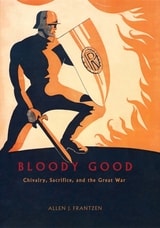
Bloody Good
Chivalry, Sacrifice, and the Great WarAllen J. Frantzen
University of Chicago Press, 2003
Here for the first time, Allen J. Frantzen traces these chivalric ideals from the Great War back to their origins in the Middle Ages and shows how they resulted in highly influential models of behavior for men in combat. Drawing on a wide selection of literature and images from the medieval period, along with photographs, memorials, postcards, war posters, and film from both sides of the front, Frantzen shows how such media shaped a chivalric ideal of male sacrifice based on the Passion of Jesus Christ. He demonstrates, for instance, how the wounded body of Christ became the inspiration for heroic male suffering in battle. For some men, the Crucifixion inspired a culture of revenge, one in which Christ's bleeding wounds were venerated as badges of valor and honor. For others, Christ's sacrifice inspired action more in line with his teachings—a daring stay of hands or reason not to visit death upon one's enemies.
Lavishly illustrated and eloquently written, Bloody Good will be must reading for anyone interested in World War I and the influence of Christian ideas on modern life.
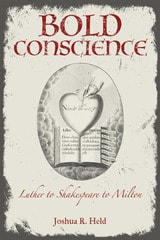
Bold Conscience
Luther to Shakespeare to MiltonJoshua R. Held
University of Alabama Press, 2023
Traces how conscience—inner moral conviction—came to shape public life, fueling martyrdom, free speech, and political revolts
Bold Conscience: Luther to Shakespeare to Milton is a sweeping, original study of how conscience became one of the most powerful ideas in early modern England. Tracing the emergence of what Joshua R. Held calls the “bold conscience,” the book shows how inner moral conviction moved from the realm of private guilt to public action, fueling debates about authority, obedience, free speech, and resistance. By placing conscience at the center of literary, religious, and political conflict, Bold Conscience reveals a vital intellectual throughline linking the Reformation to the birth of modern ideas of liberty and toleration.
The book unfolds chronologically, beginning with Martin Luther and Henry VIII and moving through Shakespeare’s Hamlet and Henry VIII, John Donne’s court sermons, and John Milton’s polemical and poetic works, including Areopagitica and Paradise Lost. Each chapter combines close literary reading with historical and theological analysis, showing how conscience operates across genres—drama, sermon, pamphlet, and epic poetry. Joshua R. Held is a distinguished scholar of early modern literature whose work bridges literary criticism, intellectual history, and religious studies, bringing clarity and narrative energy to complex debates.
Bold Conscience will appeal to scholars and students of early modern literature, Shakespeare, Milton, and Reformation history, as well as readers interested in the origins of religious freedom and political dissent. It will also engage anyone concerned with how moral conviction shapes public life then and now.
Book of Abraham Apologetics
A Review and CritiqueDan Vogel
Signature Books, 2021
Books and Readers in the Premodern World
Essays in Honor of Harry GambleKarl Shuve
SBL Press, 2018
A book about the role of books in shaping the ancient religious landscape
This collection of essays by leading scholars from a variety of academic disciplines explores the ongoing relevance of Harry Gamble’s Books and Readers in the Early Church (1995) for the study of premodern book cultures. Contributors expand the conversation of book culture to examine the role the Hebrew Bible, the New Testament, and the Qur’an played in shaping the Jewish, Christian, and Muslim religions in the ancient and medieval world. By considering books as material objects rather than as repositories for stories and texts, the essays examine how new technologies, new materials, and new cultural encounters contributed to these holy books spreading throughout territories, becoming authoritative, and profoundly shaping three global religions.
Features:
- Comparative analysis of book culture in Roman, Jewish, Christian, and Islamic contexts
- Art-historical, papyrological, philological, and historical modes of analysis
- Essays that demonstrate the vibrant, ongoing legacy of Gamble’s seminal work
Borderlands Saints
Secular Sanctity in Chicano/a and Mexican CultureMartín, Desirée A
Rutgers University Press, 2013
Winner of the 2014 Latina/o Studies Section - LASA Outstanding Book Award
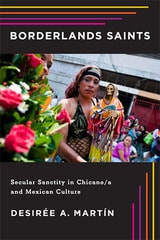
In Borderlands Saints, Desirée A. Martín examines the rise and fall of popular saints and saint-like figures in the borderlands of the United States and Mexico. Focusing specifically on Teresa Urrea (La Santa de Cabora), Pancho Villa, César Chávez, Subcomandante Marcos, and Santa Muerte, she traces the intersections of these figures, their devotees, artistic representations, and dominant institutions with an eye for the ways in which such unofficial saints mirror traditional spiritual practices and serve specific cultural needs.
Popular spirituality of this kind engages the use and exchange of relics, faith healing, pilgrimages, and spirit possession, exemplifying the contradictions between high and popular culture, human and divine, and secular and sacred. Martín focuses upon a wide range of Mexican and Chicano/a cultural works drawn from the nineteenth century to the present, covering such diverse genres as the novel, the communiqué, drama, the essay or crónica, film, and contemporary digital media. She argues that spiritual practice is often represented as narrative, while narrative—whether literary, historical, visual, or oral—may modify or even function as devotional practice.
Born Again in Brazil
The Pentecostal Boom and the Pathogens of PovertyR. Andrew Chesnut
Rutgers University Press, 1997

Born Again
The Christian Right GlobalizedJennifer S. Butler
Pluto Press, 2006
This book reveals how Christian conservative groups are able to shape policy in every corner of the world. Drawing on interviews with religious leaders, it reveals how today's most powerful Christian Right organisations are building interfaith coalitions, connecting Catholic, Mormon and Muslim allies to advance a conservative agenda.
The US under Bush Jr. has given them a significant voice in shaping US policy on issues including women's rights, reproductive health, human cloning, children's rights and AIDS.
In short, the Christian Right is globalising -- a phenomenon that promises to challenge progressive social policy on a world-wide scale - as well as transform the Christian Right itself.
Bound For the Promised Land
African American Religion and the Great MigrationMilton C. Sernett
Duke University Press, 1997
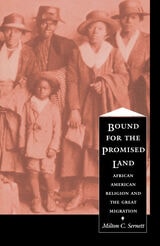
Drawing on a range of sources—interviews, government documents, church periodicals, books, pamphlets, and articles—Sernett shows how the mass migration created an institutional crisis for black religious leaders. He describes the creative tensions that resulted when the southern migrants who saw their exodus as the Second Emancipation brought their religious beliefs and practices into northern cities such as Chicago, and traces the resulting emergence of the belief that black churches ought to be more than places for "praying and preaching." Explaining how this social gospel perspective came to dominate many of the classic studies of African American religion, Bound for the Promised Land sheds new light on various components of the development of black religion, including philanthropic endeavors to "modernize" the southern black rural church. In providing a balanced and holistic understanding of black religion in post–World War I America, Bound for the Promised Land serves to reveal the challenges presently confronting this vital component of America’s religious mosaic.
Brigham Young University
A House of FaithGary James Bergera
Signature Books, 1985
The purpose of Brigham Young University: A House of Faith is to outline the struggle the Mormon church has encountered in trying to blend academics and faith and in reconciling church standards with norms at other American universites, not to produce a comprehensive, chronological history of BYU. Instead, a selective approach has been taken–a thematic introduction to events, incidents, and statements, both published and private, in selected areas where tensions between scholarship and faith, freedom and regimentation have been the most pronounced. Examples include the development of a religious curriculum, the honor code, the controversy surrounding organic evolution, politics, student life, athletics, the arts, and faculty research. We hope that this approach will help readers appreciate the religious and intellectual dilemma facing educators and church leaders, as well as the fundamental sincerity of those involved in trying to establish academic rigor within religious parameters or to prevent moral deterioration when traditional restraints are left unchecked. Whatever the particular issue under discussion, an attempt has been made to keep the presentation balanced and impartial, yet sympathetic. While some readers may question the descriptive, largely noninterpretive approach, it is hoped that most will, through this approach, at least gain a greater understanding of the complex challenges involved in successfully integrating religion and academics.
We especially hope that Brigham Young University: A House of Faith will be of use to those who appreciate more than a cursory history of Mormonism–in this case, the Mormon concept of education–and who relish the rich fabric of pluralism. Brigham Young University has an engaging past, which, we believe, deserves more than a superficial treatment. Perhaps this book can be a springboard for more thorough investigations into other areas of the school’s past. There have been so many noteworthy accomplishments, discouraging defeats, moving religious experiences, humorous accounts of human foibles, and undocumented daily routine, that much remains in describing all that has gone into making the university founded more than a century ago by Brigham Young.
In presenting the sources cited in this work, we have followed the recommendations of the 1982 edition of The Chicago Manual of Style, with slight modifications. Readers will notice, for example, our incorporation of Chicago’s “down style” approach to capitalization. In order to facilitate future research, complete source citations are included as endnotes. To avoid a cumbersome and ultimately unworkable linking of each sentence with its corresponding source and bibliographic reference, we have instead referenced each paragraph and [p. xiii]cited sources in the endnotes section in the order in which material is presented in the paragraph indicated. Where the reader would otherwise encounter difficulty in identifying the specific source of a given piece of information, or where the source is considered especially important, it is provided in the text in an abbreviated form within parentheses.