Results by title
145 books match the query 'Classical' and 24 start with b
Bach Perspectives, Volume 1
Edited by Russel Stinson
University of Illinois Press, 2025
In Volume One, Bach scholar Russell Stinson edits essays from Stephen A. Crist, Michael Marissen, David Schulenberg, and other experts. Topics range from issues of composition and improvisation to works like the Orgelbüchlein and the First Brandenburg Concerto.
Contributors: James A. Brokaw II, Eric T. Chafe, Stephen A. Crist, Michael Marissen, David Schulenberg, and Russell Stinson
Bach Perspectives, Volume 10
Bach and the OrganMatthew Dirst
University of Illinois Press, 2016
Bach Perspectives, Volume 11
J. S. Bach and His SonsEdited by Mary Oleskiewicz
University of Illinois Press, 2017
Robert L. Marshall traces how each of the sons grappled with—and at times suffocated beneath—their illustrious father’s legacy. Mary Oleskiewicz’s essay investigates the Bach family’s connections to historical keyboard instruments and musical venues at the Prussian court, while David Schulenberg looks at Carl Philipp Emanuel Bach’s diverse and innovative keyboard works. Evan Cortens digs into everything from performance materials to pay stubs to offer a detailed view of the business of Carl Philipp Emanuel Bach’s liturgical music. Finally, Christine Blanken discusses how the rediscovery of Bach family musical manuscripts in the Breitkopf archive opens up new perspectives on familiar topics.
A supplemental companion website is now available for Bach Perspectives 11. This resource features additional images, captions, and short descriptions to provide an essential supplement to the printed text.
Bach Perspectives, Volume 12
Bach and the Counterpoint of ReligionEdited by Robin A. Leaver
University of Illinois Press, 2018
Bach Perspectives, Volume 13
Bach ReworkedEdited by Laura Buch
University of Illinois Press, 2020
An insightful look at how composers build on each other's work, Bach Reworked reveals how nuanced understandings of parody procedures can fuel both musical innovation and historically informed performance.
Contributors: Stephen A. Crist, Ellen Exner, Moira Leanne Hill, Erinn E. Knyt, and Markus Zepf
Bach Perspectives, Volume 14
Bach and Mozart: Connections, Patterns, and PathwaysEdited by Paul Corneilson
University of Illinois Press, 2022
An official publication of the American Bach Society, Bach Perspectives, Volume 14 draws on a variety of approaches and a broad range of subject matter in presenting a new wave of innovative classical musical scholarship.
Contributors: Eleanor Selfridge-Field, Yoel Greenberg, Noelle M. Heber, Michael Maul, Stephen Roe, and David Schulenberg
Bach Perspectives, Volume 2
J. S. Bach, the Breitkopfs, and Eighteenth-Century Music TradeEdited by George B. Stauffer
University of Illinois Press, 2025
Launched in 1995, Bach Perspectives has become the premier English-language serial book series dedicated to cutting-edge Bach scholarship. The University of Illinois Press now offers the first four volumes in open access editions available for free to all interested readers.
From 1727 to 1787, the Bach and the Breitkopf families enjoyed close professional ties forged by the growing trade between music composers and music printers. The second volume of Bach Perspectives examines the inventive and far-flung activities of the Breitkopf firm from the vantage point of its commerce with J. S. Bach and his relatives.
Contributors: Gregory G. Butler, Robert M. Cammarota, Peggy Daub, Andreas Glöckner, George R. Hill, Yoshitake Kobayashi, Ortrun Landmann, Ernest May, Hans-Joachim Schulze, George B. Stauffer, and Neal Zaslaw
Bach Perspectives, Volume 3
Creative Responses to Bach, from Mozart to HindemithEdited by Michael Marissen.
University of Illinois Press, 2025
Launched in 1995, Bach Perspectives has become the premier English-language serial book series dedicated to cutting-edge Bach scholarship. The University of Illinois Press now offers the first four volumes in open access editions available for free to all interested readers.
The third volume of the acclaimed series features a roster of scholars analyzing the crucial influence of J. S. Bach’s music upon compositions by Mozart, Beethoven, Brahms, Hindemith, and others. Throughout, the contributors highlight Bach’s subtle presence in the history of composition and illuminate the intertwined works of Bach and his successors.
Contributors: Thomas Christensen, Ludwig Finscher, Walter Frisch, Stephen Hinton, William Kinderman, and Robert L. Marshall
Bach Perspectives, Volume 4
The Music of J. S. Bach: Analysis and InterpretationEdited by David Schulenberg
University of Illinois Press, 2025
Launched in 1995, Bach Perspectives has become the premier English-language serial book series dedicated to cutting-edge Bach scholarship. The University of Illinois Press now offers the first four volumes in open access editions available for free to all interested readers.
The fourth volume of Bach Perspectives analyzes J. S. Bach’s orchestral works, especially his concertos, and the interpretation and performance of his music in general. The diverse contributors come from the fields of performance, organology, music theory, and music history, and their expertise across multiple areas provides an interdisciplinary perspective to their chapters.
Contributors: Gregory G. Butler, John Butt, John Koster, Alfred Mann, Mary Oleskiewicz, William Renwick, David Schulenberg, Jeanne Swack, and Paul Walker
Bach Perspectives, Volume 5
Bach in AmericaEdited by Stephen A. Crist
University of Illinois Press, 2002
More than a century passed after Johann Sebastian Bach's death in 1750 before his music found an audience in the United States. Volume Five in the Bach Perspectives series tracks the composer's reputation in America from obscure artist to a cultural mainstay whose music has spread to all parts of the country.
Barbara Owen surveys Bach's early reception in America. Matthew Dirst focuses on John Sullivan Dwight's role in advocating Bach's work. Michael Broyles considers Bach's early impact in Boston while Mary J. Greer offers a counterpoint in her study of Bach's reception in New York. Hans-Joachim Schulze's essay links the American descendants of August Reinhold Bach to the composer. Christoph Wolff also focuses on Bach's descendants in America, particularly Friederica Sophia Bach, the daughter of Bach's eldest son. Peter Wollny evaluates manuscripts not included in Gerhard Herz's study of Bach Sources in America. The volume concludes with Carol K. Baron's comparison of Bach with Charles Ives while Stephen A. Crist measures Bach's influence on the jazz icon Dave Brubeck.
Bach Perspectives, Volume 6
J. S. Bach's Concerted Ensemble Music, The OuvertureEdited by Gregory Butler
University of Illinois Press, 2005
The sixth volume in the Bach Perspectives series opens with Joshua Rifkin's seminal study of the early source history of the B-minor orchestral suite. Rifkin elaborates on his discovery that the work in its present form for solo flute goes back to an earlier version in A minor, ostensibly for solo violin. He also takes the discovery as the point of departure for a wide-ranging discussion of the origins and extent of Bach's output in the area of concerted ensemble music.
In other essays, Jeanne Swack presents an enlightening comparison of Georg Phillip Telemann's and Bach's approach to the French overture as concerted movements in their church cantatas. Steven Zohn views the B-minor orchestral suite from the standpoint of the "concert en ouverture." In addition, Zohn responds to Rifkin by suggesting Bach may have scored the early version of the B-minor orchestral suite for flute.
Bach Perspectives, Volume 7
J. S. Bach's Concerted Ensemble Music: The ConcertoEdited by Gregory Butler
University of Illinois Press, 2007
Gregory Butler focuses on Bach's Concerto for Harpsichord and Strings in E Major (BWV 1053) as a pastiche created by a process of assemblage of three earlier heterogeneous movements. Pieter Dirksen delves into the source history of the Concerto for Harpsichord and Strings in F Minor (BWV 1056) and concludes it represents a transcription of an earlier violin concerto in G minor. David Schulenberg investigates the generic ambiguity of the concerto in the early eighteenth century and how it diverged from the sonata to become a distinct genre. Completing the volume is Christoph Wolff's examination of the ""Siciliano"" as a slow movement in Bach's concertos and its implications for the source history of his Concerto for Harpsichord and Strings in E Major (BWV 1053).
Bach Perspectives, Volume 8
J.S. Bach and the Oratorio TraditionEdited by Daniel R. Melamed
University of Illinois Press, 2011
Bach Perspectives, Volume 9
J.S. Bach and His Contemporaries in GermanyEdited by Andrew Talle
University of Illinois Press, 2013
In this volume, Wolfgang Hirschmann proposes an ethnographic approach that contextualizes Bach's works, addressing the aesthetic paths he took as well as those he did not pursue. Steven Zohn's essay considers Telemann's contribution to the orchestral Ouverture genre, observering how Telemann's approach to integrating the national styles of his time was quite different from, but no less rich than, Bach's. Andrew Talle compares settings and strategies of Vergnügte Ruh, beliebte Seelenlust by Bach and Graupner. Alison Dunlop presents valuable primary research on Muffat, the most commonly cited keyboard music composer in Vienna during Bach's lifetime. Finally, Michael Maul sheds new light on the Scheibe-Birnbaum controversy, contextualizing the most famous critique of J. S. Bach's compositional style by discussing the other composers that Scheibe critiqued.
Becoming What We Are
Classical and Christian Readings of ModernityJude P. Dougherty
Catholic University of America Press, 2023
Beethoven for a Later Age
Living with the String QuartetsEdward Dusinberre
University of Chicago Press, 2016
Founded in Hungary in 1975 and now based in Boulder, Colorado, the Takács is one of the world’s preeminent string quartets, and performances of Beethoven have been at the center of their work together for over forty years. Using the history of both the Takács Quartet and the Beethoven quartets as a foundation, Beethoven for a Later Age provides a backstage look at the daily life of a quartet, showing the necessary creative tension between individual and group and how four people can at the same time forge a lasting artistic connection and enjoy making music together over decades. The key, Dusinberre reveals, to a quartet crafting its own sound is in balancing continuity with change and experimentation—a theme that lies at the heart of Beethoven’s remarkable compositions. In an accessible style, suitable for novices and chamber music enthusiasts alike, Dusinberre illuminates the variety and contradictions of Beethoven's quartets, which were composed against the turbulent backdrop of the Napoleonic Wars and their aftermath, and he brings the technical aspects of the music to life.
Beethoven for a Later Age vividly shows that creative engagement with Beethoven’s radical and brilliant quartets continues to be as stimulating now as it was for its first performers and audiences. Musicians and music lovers will be intrigued by Dusinberre’s exploration of the close collaboration at the heart of any great performance.
Beethoven in Beijing
Stories from the Philadelphia Orchestra's Historic Journey to ChinaJennifer Lin
Temple University Press, 2022
In 1973, Western music was banned in the People’s Republic of China. But in a remarkable breakthrough cultural exchange, the Philadelphia Orchestra conducted a tour of closed-off China, becoming the first American orchestra to visit the communist nation. Jennifer Lin’s Beethoven in Beijing provides a fabulous photo-rich oral history of this boundary-breaking series of concerts the orchestra performed under famed conductor Eugene Ormandy.
Lin draws from interviews, personal diaries, and news accounts to give voice to the American and Chinese musicians, diplomats, journalists, and others who participated in and witnessed this historic event. Beethoven in Beijing is filled with glorious images as well as anecdotes ranging from amusing sidewalk Frisbee sessions and acupuncture treatments for sore musicians to a tense encounter involving Madame Mao dictating which symphony was to be played at a concert.
A companion volume to the film of the same name, Beethoven in Beijing shows how this 1973 tour came at the dawn of a resurgence of interest in classical music in China—now a vital source of revenue for touring orchestras.
Beethoven's Ninth
A Political HistoryEsteban Buch
University of Chicago Press, 2003
In his remarkable history of one of the most popular symphonic works of the modern period, Buch traces such complex and contradictory uses—and abuses—of Beethoven's Ninth Symphony since its premier in 1824. Buch shows that Beethoven consciously drew on the tradition of European political music, with its mix of sacred and profane, military and religious themes, when he composed his symphony. But while Beethoven obviously had his own political aspirations for the piece—he wanted it to make a statement about ideal power—he could not have had any idea of the antithetical political uses, nationalist and universalist, to which the Ninth Symphony has been put since its creation. Buch shows us how the symphony has been "deployed" throughout nearly two centuries, and in the course of this exploration offers what was described by one French reviewer as "a fundamental examination of the moral value of art." Sensitive and fascinating, this account of the tangled political existence of a symphony is a rare book that shows the life of an artwork through time, shifted and realigned with the currents of history.
Beethoven's Symphonies
Nine Approaches to Art and IdeasMartin Geck
University of Chicago Press, 2017
Martin Geck opens the book with an enthralling series of cultural, political, and musical motifs that run throughout the symphonies. A leading theme is Beethoven’s intense intellectual and emotional engagement with the figure of Napoleon, an engagement that survived even Beethoven’s disappointment with Napoleon’s decision to be crowned emperor in 1804. Geck also delves into the unique ways in which Beethoven approached beginnings and finales in his symphonies, as well as his innovative use of particular instruments. He then turns to the individual symphonies, tracing elements—a pitch, a chord, a musical theme—that offer a new way of thinking about each work and will make even the most devoted fans of Beethoven admire the symphonies anew.
Offering refreshingly inventive readings of the work of one of history’s greatest composers, this book shapes a fascinating picture of the symphonies as a cohesive oeuvre and of Beethoven as a master symphonist.
Beethoven
A Political Artist in Revolutionary TimesWilliam Kinderman
University of Chicago Press, 2021
William Kinderman presents Beethoven as a civically engaged thinker faced with severe challenges. The composer lived through many tumultuous events—the French Revolution, the rise and fall of Napoleon Bonaparte, and the Congress of Vienna among them. Previous studies of Beethoven have emphasized the importance of his personal suffering and inner struggles; Kinderman instead establishes that musical tensions in works such as the Eroica, the Appassionata, and his final piano sonata in C minor reflect Beethoven’s attitudes toward the political turbulence of the era. Written for the 250th anniversary of his birth, Beethoven takes stock of the composer’s legacy, showing how his idealism and zeal for resistance have ensured that masterpieces such as the Ninth Symphony continue to inspire activists around the globe. Kinderman considers how the Fifth Symphony helped galvanize resistance to fascism, how the Sixth has energized the environmental movement, and how Beethoven’s civic engagement continues to inspire in politically perilous times. Uncertain times call for ardent responses, and, as Kinderman convincingly affirms, Beethoven’s music is more relevant today than ever before.

Berlioz and His Century
An Introduction to the Age of RomanticismJacques Barzun
University of Chicago Press, 1982

Berlioz and His World
Edited by Francesca Brittan and Sarah Hibberd
University of Chicago Press, 2024
Hector Berlioz (1803–1869) has long been a difficult figure to place and interpret. Famously, in Richard Wagner’s estimation, he hovered as a “transient, marvelous exception,” a composer woefully and willfully isolated. In the assessment of German composer Ferdinand Hiller, he was a fleeting comet who “does not belong in our musical solar system,” the likes of whom would never be seen again. For his contemporaries, as for later critics, Berlioz was simply too strange—and too noisy, too loud, too German, too literary, too cavalier with genre and form, and too difficult to analyze. He was, in many ways, a composer without a world.
Berlioz and His World takes a deep dive into the composer’s complex legacy, tracing lines between his musical and literary output and the scientific, sociological, technological, and political influences that shaped him. Comprising nine essays covering key facets of Berlioz’s contribution and six short “object lessons” meant as conversation starters, the book reveals Berlioz as a richly intersectional figure. His very difficulty, his tendency to straddle the worlds of composer, conductor, and critic, is revealed as a strength, inviting new lines of cross-disciplinary inquiry and a fresh look at his European and American reception.
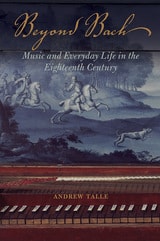
Beyond Bach
Music and Everyday Life in the Eighteenth CenturyAndrew Talle
University of Illinois Press, 2018
Eschewing the great composer style of music history, Andrew Talle takes us on a journey that looks at how ordinary people made music in Bach's Germany. Talle focuses in particular on the culture of keyboard playing as lived in public and private. As he ranges through a wealth of documents, instruments, diaries, account ledgers, and works of art, Talle brings a fascinating cast of characters to life. These individuals--amateur and professional performers, patrons, instrument builders, and listeners--inhabited a lost world, and Talle's deft expertise teases out the diverse roles music played in their lives and in their relationships with one another. At the same time, his nuanced re-creation of keyboard playing's social milieu illuminates the era's reception of Bach's immortal works.
Bound for America
Three British ComposersNicholas Temperley
University of Illinois Press, 2002