Results by title
173 books match the query 'Commerce' and 4 start with b
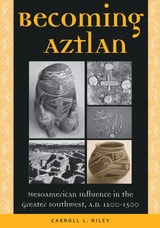
Becoming Aztlan
Mesoamerican Ingluence in the Greater Southwest, A.D. 1200-1500Carroll L Riley
University of Utah Press, 2005
In his latest book, Carroll Riley presents an ambitious overview of the continuities he sees in the geographically vast and culturally complex American Southwest and the adjacent northwest of Mexico. Aided by extensive illustrations, he argues that although the Southwest remained "southwestern" in its basic economy, there were drastic changes beginning around A.D. 1200 that transformed socio-religious life throughout the region. Riley calls this period Aztlan, a name adopted from the mythic Aztec land of origin. A Pueblo Indian in A.D. 800 would have gathered and farmed the same foods as his descendants, but by 1400 those distant relatives had a very different concept of the physical and spiritual universe.
In addition to bringing vast erudition and jargon-free prose to bear on a complex subject, Riley’s conclusions have potentially sweeping implications for the future of archaeological studies in the greater Southwest.

Black Bodies, White Gold
Art, Cotton, and Commerce in the Atlantic WorldAnna Arabindan-Kesson
Duke University Press, 2021
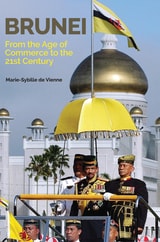
Brunei
From the Age of Commerce to the 21st CenturyMarie-Sybille de Vienne
National University of Singapore Press, 2015
Today home to some 393,000 inhabitants and comprising 5,765 square kilometers in area, Brunei first appears in the historical record at the end of the 10th century. After the Spanish attack of 1578, Brunei struggled to regain and expand its control on coastal West Borneo and to remain within the trading networks of the South China Sea. It later fell under British sway, and a residency was established in 1906, but it took the discovery of oil in Seria in 1929 before the colonial power began to establish the bases of a modern state.
Governed by an absolute monarchy, Bruneians today nonetheless enjoy a high level of social protection and rule of law. Ranking second (after Singapore) in Southeast Asia in terms of standards of living, the sultanate is implementing an Islamic penal code for the first time of its history. Focusing on Brunei’s political economy, history and geography, this book aims to understand the forces behind Brunei’s to-and-fro of tradition and modernisation.
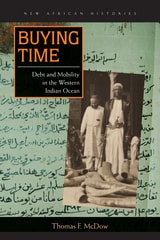
Buying Time
Debt and Mobility in the Western Indian OceanThomas F. McDow
Ohio University Press, 2018
In Buying Time, Thomas F. McDow synthesizes Indian Ocean, Middle Eastern, and East African studies as well as economic and social history to explain how, in the nineteenth century, credit, mobility, and kinship knit together a vast interconnected Indian Ocean region. That vibrant and enormously influential swath extended from the desert fringes of Arabia to Zanzibar and the Swahili coast and on to the Congo River watershed.
In the half century before European colonization, Africans and Arabs from coasts and hinterlands used newfound sources of credit to seek out opportunities, establish new outposts in distant places, and maintain families in a rapidly changing economy. They used temporizing strategies to escape drought in Oman, join ivory caravans in the African interior, and build new settlements.
The key to McDow’s analysis is a previously unstudied trove of Arabic business deeds that show complex variations on the financial transactions that underwrote the trade economy across the region. The documents list names, genealogies, statuses, and clan names of a wide variety of people—Africans, Indians, and Arabs; men and women; free and slave—who bought, sold, and mortgaged property. Through unprecedented use of these sources, McDow moves the historical analysis of the Indian Ocean beyond connected port cities to reveal the roles of previously invisible people.