Results by title
264 books match the query 'Composition' and 10 start with b
Becoming Writers
Twenty-First-Century Ways of ComposingKaren Lunsford
Utah State University Press, 2026
Becoming Writers draws on phenomenological and lifespan approaches to writing research, reframing writing as a lived process shaped by social contexts, evolving technologies, and a writer’s own sense of self and agency. It moves beyond familiar binaries and offers a more holistic account of what it means to become a writer today.
Bringing together scholars from across the fields of writing studies and rhetoric/composition to consider the ways “writing” is changing in the twenty-first century, this collection tracks how and why people talk about the various forms of writing they do. Contributors address how younger generations understand the role and place of writing in their lives, particularly amid increasing and dramatic economic, social, and political change, as well as the ever-evolving role of writing in what it means to be human.
Becoming Writers builds on the Wayfinding Project (https://thewayfindingproject.com), a multiyear study of writing development focused on college graduates. Rather than focusing solely on the classroom, Becoming Writers investigates how writing functions in people’s professional, civic, personal, and digital lives. By centering lived experiences across domains, it provides a model of the empirical depth and different methodological approaches being used by scholars interested in writing development across the lifespan.
Behind the Curtain of Scholarly Publishing
Editors in Writing StudiesGreg Giberson
Utah State University Press, 2022
Each chapter in the collection examines the unique experiences and individual contributions of its authors during their time as editors, offering advice to scholars and potential editors on how to navigate the publication process and understand editorial roles. The contributors provide multiple perspectives on the growth, transformation, and, in some cases, founding of some of the most influential publishing venues in writing studies.
The personal and historical narratives, along with the unique perspectives and insightful analyses of the individual authors in Behind the Curtain of Scholarly Publishing, offer needed transparency and context to what has historically been an opaque, yet inevitable and consequential, part of academic life. This volume will help researchers in the field understand the publishing process.
Contributors: Cheryl Ball, David Bartholomae, Charles Bazerman, Jean Ferguson Carr, Douglas Eyman, Muriel Harris, Byron Hawk, Alice Horning, Paul Kei Matsuda, Laura Micciche, Mike Palmquist, Michael Pemberton, Malea Powell, Kelly Ritter, Victor Villanueva, Victor Vitanza, Kathleen Blake Yancey
Better Practices
Exploring the Teaching of Writing in Online and Hybrid SpacesAmy Cicchino
University Press of Colorado, 2024
Beyond Conversation
Collaboration and the Production of WritingWilliam Duffy
Utah State University Press, 2020
While interrogating the institutional politics that circulate around debates about collaboration, this book offers a concise history of collaborative writing theory while proposing a new set of commonplaces for understanding the labor of coauthorship. Specifically, Beyond Conversation outlines an interactionist theory that explains collaboration as the rhetorical capacity that manifests in the discursive engagements coauthors enter into with the objects of their writing.
Drawing on new materialist philosophies, post-qualitative inquiry, and interactionist rhetorical theory, Beyond Conversation challenges writing and literacy educators to recognize the pedagogical benefits of collaborative writing in the work they do both as writers and as teachers of writing. The book will reinvigorate how teachers, scholars, and administrators advocate for the importance of collaborative writing in their work.
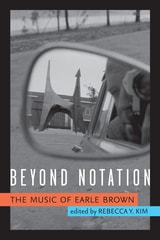
Beyond Notation
The Music of Earle BrownRebecca Y. Kim, Editor
University of Michigan Press, 2017
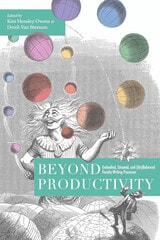
Beyond Productivity
Embodied, Situated, and (Un)Balanced Faculty Writing ProcessesKim Hensley Owens
Utah State University Press, 2023
This collection positions scholarly writers' ways of writing as a form of flexible, evolving knowledge. By exhibiting what is lost and gained through successive rounds of transformation and adaptation over time, the contributors offer a sustainable understanding and practice of process—one that looks beyond productivity as the primary measure of success. Each presents a fluid understanding of the writing process, illustrating its deeply personal nature and revealing how fragmented and disjointed methods and experiences can highlight what is precious about writing.
Beyond Productivity determines anew the use and value of scholarly writing and the processes that produce it, both within and beyond the context of the losses, constraints, and adaptations associated with the COVID-19 pandemic.
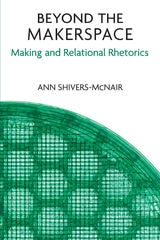
Beyond the Makerspace
Making and Relational RhetoricsAnn Shivers-McNair
University of Michigan Press, 2021
Beyond the Makerspace contributes not only to our understanding of making and makerspaces, but also to our understanding of how to study making—and meaning making, more broadly—in ways that examine and intervene in the marking of difference. Thus, the book examines what (and whose) values and practices we are taking up when we identify as makers or when we turn a writing classroom or a library space into a makerspace.
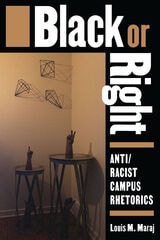
Black or Right
Anti/Racist Campus RhetoricsLouis M. Maraj
Utah State University Press, 2020
Offering four Black rhetorics as antiracist means for rhetorical reclamation—autoethnography, hashtagging, inter(con)textual reading, and reconceptualized disruption—the book uses Black feminist relationality via an African indigenous approach. Maraj examines fluid, quotidian ways Black folk engage anti/racism at historically white institutions in the United States in response to violent campus spaces, educational structures, protest movements, and policy practice. Black or Right’s experimental, creative style strives to undiscipline knowledge from academic confinement. Exercising different vantage points in each chapter—autoethnographer, digital media scholar/pedagogue, cultural rhetorician, and critical discourse analyst—Maraj challenges readers to ecologically understand shifting, multiple meanings of Blackness in knowledge-making. Black or Right’s expressive form, organization, narratives, and poetics intimately interweave with its argument that Black folk must continuously invent “otherwise” in reiterative escape from oppressive white spaces.
In centering Black experiences, Black theory, and diasporic Blackness, Black or Right mobilizes generative approaches to destabilizing institutional whiteness, as opposed to reparative attempts to “fix racism,” which often paradoxically center whiteness. It will be of interest to both academic and general readers and significant for specialists in cultural rhetorics, Black studies, and critical theory.
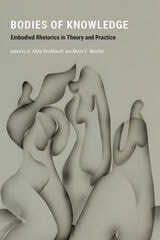
Bodies of Knowledge
Embodied Rhetorics in Theory and PracticeA. Abby Knoblauch
Utah State University Press, 2021
The pieces in Bodies of Knowledge draw explicit attention to the impact of the body on text, the impact of the body in text, the impact of the body as text, and the impact of the body upon textual production. The contributors investigate embodied rhetorics through the lenses of race and ethnicity, gender and sexuality, disability and pain, technologies and ecologies, clothing and performance, and scent, silence, and touch. In doing so, they challenge the (false) notion that academic knowledge—that is, “real” knowledge—is disembodied and therefore presumed white, middle class, cis-het, able-bodied, and male. This collection lays bare how myriad bodies invent, construct, deliver, and experience the processes of knowledge building.
Experts in the field of writing studies provide the necessary theoretical frameworks to better understand productive (and unproductive) uses of embodied rhetorics within the academy and in the larger social realm. To help meet the theoretical and pedagogical needs of the discipline, Bodies of Knowledge addresses embodied rhetorics and embodied writing more broadly though a rich, varied, and intersectional approach. These authors address larger questions around embodiment while considering the various impacts of the body on theories and practices of rhetoric and composition.
Contributors: Scot Barnett, Margaret Booker, Katherine Bridgman, Sara DiCaglio, Kristie S. Fleckenstein, Vyshali Manivannan, Temptaous Mckoy, Julie Myatt, Julie Nelson, Ruth Osorio, Kate Pantelides, Caleb Pendygraft, Nadya Pittendrigh, Kellie Sharp-Hoskins, Anthony Stagliano, Megan Strom
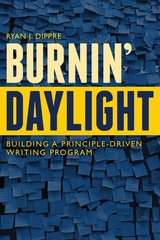
Burnin' Daylight
Building a Principle-Driven Writing ProgramRyan J. Dippre
Utah State University Press, 2024
WPAs face a range of challenges on a regular basis: organizing class schedules, leading professional learning events, conducting program assessments, responding to student needs, meeting with deans and provosts, and more. Additionally, WPAs need to learn about and direct their programs strategically when considering the kind of program they currently have, the sort of program they envision, and how they can transition from one to another. Burnin’ Daylight acts as a roadmap for IRB-approved research and provides WPAs—specifically, new and returning WPAs—with a detailed yet flexible plan for understanding the inner workings of a writing program and how to develop a future trajectory for it.
Burnin’ Daylight is for writing program administrators of all experience levels and other administrators interested in taking a “principled practices” approach to their work.