Results by title
75 books match the query 'Construction' and 11 start with b
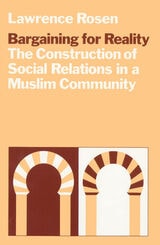
Bargaining for Reality
The Construction of Social Relations in a Muslim CommunityLawrence Rosen
University of Chicago Press, 1984
Drawing on the philosophy of speech acts as well as interpretive theory, Rosen shows how, for the people of this Muslim community, reality consists of the network of obligations formed by individuals out of a repertoire of relational possibilities whose defining terms are comprised by a set of essentially negotiable concepts. He thus demonstrates that the bonds of family, tribe, and political alliance take shape only as the bargains struck in and through the malleable terms that describe them take shape; that statements about relationship are no more true than a price mentioned in the marketplace until properly validated; that the relations between men and women, Arabs and Berbers, Muslims and Jews test the limits of interpersonal negotiation; and that the concepts of time, character, and narrative style are consonant with a view of reality as bargained-for network of obligations.
Bargaining for Reality makes an important contribution to our understanding of contemporary Middle Eastern society and to the development of powerful new interpretive strategies for a wide range of social theorists.
"[Rosen's] book is extremely useful for African and Middle Eastern historians, because he challenges some of our most basic ideas about the nature and force of kinship, tribe, ethnicity, and other large- and small-scale political ties."—Allan R. Meyers, International Journal of African Historical Studies
"The book conveys a compelling image of Moroccan social experience and is peppered with vivid anecdotes and case histories."—Stephen William Foster, American Anthropologist

Bio-Imperialism
Disease, Terror, and the Construction of National FragilityGwen Shuni D'Arcangelis
Rutgers University Press, 2021
Blockchain, Smart Contracts and Distributed Ledger Technologies in the Built Environment
Key concepts, technologies, and applicationsMohamad Kassem
The Institution of Engineering and Technology, 2025
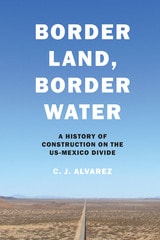
Border Land, Border Water
A History of Construction on the US-Mexico DivideBy C. J. Alvarez
University of Texas Press, 2019
Winner, Abbott Lowell Cummings Award, Vernacular Architecture Forum, 2020
Winner, Elisabeth Blair MacDougall Book Award, Society of Architectural Historians, 2021
From the boundary surveys of the 1850s to the ever-expanding fences and highway networks of the twenty-first century, Border Land, Border Water examines the history of the construction projects that have shaped the region where the United States and Mexico meet.
Tracing the accretion of ports of entry, boundary markers, transportation networks, fences and barriers, surveillance infrastructure, and dams and other river engineering projects, C. J. Alvarez advances a broad chronological narrative that captures the full life cycle of border building. He explains how initial groundbreaking in the nineteenth century transitioned to unbridled faith in the capacity to control the movement of people, goods, and water through the use of physical structures. By the 1960s, however, the built environment of the border began to display increasingly obvious systemic flaws. More often than not, Alvarez shows, federal agencies in both countries responded with more construction—“compensatory building” designed to mitigate unsustainable policies relating to immigration, black markets, and the natural world. Border Land, Border Water reframes our understanding of how the border has come to look and function as it does and is essential to current debates about the future of the US-Mexico divide.

Build With Adobe
Marcia Southwick
Ohio University Press, 1974
“What can you spend?”
“Where will you put it?”
“Who is going to build it?”
This new updated and enlarged edition includes hundreds of photographs, drawings and house plans as well as new information about passive solar heating and cooling, and specific details on construction.
Building Materials and Technology in Hong Kong, Expanded Second Edition
Wah Sang Wong, Wing Yan, Alice Chan, Chui Chi, Rosman Wai, Yee Chun, Tris Kee, Kam Lung, Franky Choi, Jingxuan, and Lila Xie
Hong Kong University Press, 2026
This book is a thorough documentation of tectonics in the Hong Kong construction industry. It looks at how buildings have been designed and built in a high-density city in a subtropical climate. Written in both Chinese and English, it covers almost all aspects of building materials and technology in Hong Kong with a succinct sequence that follows the construction process of a building project. The case studies in Chapter 3 brings together 16 local projects, which embrace a wide range of building types: from single-storey buildings to high-rise towers, from private development to public institutional construction, from office to residence, and provide invaluable information on the application of building materials and technology.
While it is intended primarily for students in architecture, surveying, and construction, Building Materials and Technology in Hong Kong is an indispensable reference for professionals and practitioners who are dealing with building design and construction. Those with a general interest in building construction will also find this highly illustrated book an interesting and engaging read.
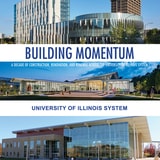
Building Momentum
A Decade of Construction, Renovation, and Renewal across the University of Illinois SystemUniversity of Illinois. Foreword by Timothy L. Killeen
University of Illinois Press, 2023
The University of Illinois System’s universities have undergone a dramatic transformation. This lavishly illustrated volume showcases the major capital projects and renovations dedicated to keeping facilities on the cutting edge while at the same time preserving history at the universities in Urbana-Champaign, Chicago, and Springfield. Fueled by an ambitious capital initiative launched in 2018, these essential and forward-looking changes include more than 500 projects valued at $4 billion over 10 years. The initiative harnesses a mix of innovative funding programs like public-private partnerships, thoughtful use of capital reserves and bonding authority, and generous state funding.
Covering completed and ongoing projects, Building Momentum offers a one- or two-page feature on each undertaking that covers its history and purpose while providing specific details about its unit, campus, architect, square footage or renovation size, budget, and LEED or other certifications. More than 100 architectural drawings and commissioned and historical photographs round out the descriptions.
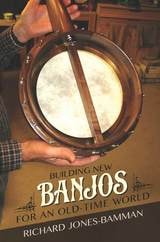
Building New Banjos for an Old-Time World
Richard Jones-Bamman
University of Illinois Press, 2017
Building a Nation
Chickasaw Museums and the Construction of History and HeritageJoshua M. Gorman
University of Alabama Press, 2011
A groundbreaking study of Indigenous museums and cultural self-representation.
The Chickasaw Nation, an American Indian nation headquartered in southeastern Oklahoma, entered into a period of substantial growth in the late 1980s. Following its successful reorganization and expansion, which was enabled by federal policies for tribal self-determination, the Nation pursued gaming and other industries to affect economic growth. From 1987 to 2009 the Nation’s budget increased exponentially as tribal investments produced increasingly large revenues for a growing Chickasaw population. Coincident to this growth, the Chickasaw Nation began acquiring and creating museums and heritage properties to interpret their own history, heritage, and culture through diverse exhibitionary representations. By 2009, the Chickasaw Nation directed representation of itself at five museum and heritage properties throughout its historic boundaries.
Josh Gorman examines the history of these sites and argues that the Chickasaw Nation is using museums and heritage sites as places to define itself as a coherent and legitimate contemporary Indian nation. In doing so, they are necessarily engaging with the shifting historiographical paradigms as well as changing articulations of how museums function and what they represent. The roles of the Chickasaw Nation’s museums and heritage sites in defining and creating discursive representations of sovereignty are examined within their historicized local contexts. The work describes the museum exhibitions’ dialogue with the historiography of the Chickasaw Nation, the literature of new museum studies, and the indigenous exhibitionary grammars emerging from indigenous museums throughout the United States and the world.
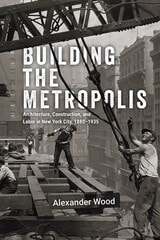
Building the Metropolis
Architecture, Construction, and Labor in New York City, 1880–1935Alexander Wood
University of Chicago Press, 2025
Between the 1880s and the 1930s, New York City experienced explosive growth as nearly a million buildings, dozens of bridges and tunnels, hundreds of miles of subway lines, and thousands of miles of streets were erected to meet the needs of an ever-swelling population. This landscape—jagged with skyscrapers, rattling with the sound of mass transit, alive with people—made the city world-famous.
Building the Metropolis offers a revelatory look at this era of urban development by asking, “Who built New York, and how?” Focusing on the work of architects, builders, and construction workers, Alexander Wood chronicles the physical process of the city’s rapid expansion. New York’s towering buildings and busy thoroughfares aren’t just stylish or structural marvels, Wood shows, but the direct result of the many colorful personalities who worked in one of the city’s largest industries. This development boom drew on the resources of the whole community and required money, political will, creative vision, entrepreneurial drive, skilled workmanship, and hard physical labor. Wood shows this to be an even larger story as well. As cities became nodes in a regional, national, and global economy, the business of construction became an important motor of economic, political, and social development. While they held drastically different views on the course of urban growth, machine politicians, reformers, and radicals alike were all committed to city building on an epic scale.
Drawing on resources that include city archives and the records of architecture firms, construction companies, and labor unions, Building the Metropolis tells the story of New York in a way that’s epic, lively, and utterly original.
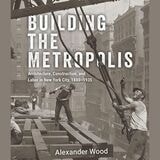
Building the Metropolis
Architecture, Construction, and Labor in New York City, 1880–1935Alexander Wood
University of Chicago Press, 2025
A sweeping history of New York that chronicles the construction of one of the world’s great cities.
Between the 1880s and the 1930s, New York City experienced explosive growth as nearly a million buildings, dozens of bridges and tunnels, hundreds of miles of subway lines, and thousands of miles of streets were erected to meet the needs of an ever-swelling population. This landscape—jagged with skyscrapers, rattling with the sound of mass transit, alive with people—made the city world-famous.
Building the Metropolis offers a revelatory look at this era of urban development by asking, “Who built New York, and how?” Focusing on the work of architects, builders, and construction workers, Alexander Wood chronicles the physical process of the city’s rapid expansion. New York’s towering buildings and busy thoroughfares aren’t just stylish or structural marvels, Wood shows, but the direct result of the many colorful personalities who worked in one of the city’s largest industries. This development boom drew on the resources of the whole community and required money, political will, creative vision, entrepreneurial drive, skilled workmanship, and hard physical labor. Wood shows this to be an even larger story as well. As cities became nodes in a regional, national, and global economy, the business of construction became an important motor of economic, political, and social development. While they held drastically different views on the course of urban growth, machine politicians, reformers, and radicals alike were all committed to city building on an epic scale.
Drawing on resources that include city archives and the records of architecture firms, construction companies, and labor unions, Building the Metropolis tells the story of New York in a way that’s epic, lively, and utterly original.