Results by title
281 books match the query 'Criticism, interpretation, etc' and 15 start with b
Beauty and the Bible
Toward a Hermeneutics of Biblical AestheticsRichard J. Bautch
SBL Press, 2013
Believing Women in Islam
A Brief IntroductionBy Asma Barlas and David Raeburn Finn
University of Texas Press, 2019
Is women’s inequality supported by the Qur’an? Do men have the exclusive right to interpret Islam’s holy scripture? In her best-selling book Believing Women in Islam: Unreading Patriarchal Interpretations of the Qur’an, Asma Barlas argues that, far from supporting male privilege, the Qur’an actually encourages the full equality of women and men. She explains why a handful of verses have been interpreted to favor men and shows how these same verses can be read in an egalitarian way that is fully supported by the text itself and compatible with the Qur’an’s message that it is complete and self-consistent.
A Brief Introduction presents the arguments of Believing Women in a simplified way that will be accessible and inviting to general readers and undergraduate students. The authors focus primarily on the Qur’an’s teachings about women and patriarchy. They show how traditional teachings about women’s inferiority are not supported by the Qur’an but were products of patriarchal societies that used it to justify their existing religious and social structures. The authors’ hope is that by understanding how patriarchal traditionalists have come to exercise so much authority in today’s Islam, as well as by rereading some of the Qur’an’s most controversial verses, adherents of the faith will learn to question patriarchal dogma and see that an egalitarian reading of the Qur’an is equally possible and, for myriad reasons, more plausible.
Beloved David—Advisor, Man of Understanding, and Writer
A Festschrift in Honor of David SternNaftali S. Cohn
SBL Press, 2024
Beyond Babel
A Handbook for Biblical Hebrew and Related LanguagesJohn Kaltner
SBL Press, 2002
Beyond Babel provides a general introduction to and overview of the languages that are significant for the study of the Hebrew Bible and ancient Israel. Included are essays on biblical and inscriptional Hebrew, Akkadian, Northwest Semitic dialects (Ammonite, Edomite, and Moabite), Arabic, Aramaic, Egyptian, Hittite, Phoenician, postbiblical Hebrew, and Ugaritic.
Each chapter in the volume shares a common format, including an overview of the language, a discussion of its significance for the Hebrew Bible, and a list of ancient sources and modern resources for further study of the language. A general introduction by John Huehnergard discusses the importance of the study of Near Eastern languages for biblical scholarship, helping to make the volume an ideal resource for persons beginning an in-depth study of the Hebrew Bible.
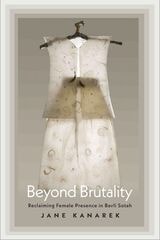
Beyond Brutality
Reclaiming Female Presence in Bavli SotahJane Kanarek
Brandeis University Press, 2025
Beyond Brutality draws on feminist analysis and gender studies to examine tractate Sotah of the Babylonian Talmud as a literary unit. By interrogating how, why, and where women are invisible within Bavli Sotah, Jane Kanarek brings to light a ubiquitous female presence throughout the text. Despite the brutality of the sotah ritual—in which the woman accused of adultery is put through a divine ordeal intended to reveal her innocence or her guilt—this book demonstrates that Bavli Sotah is not primarily concerned with describing the sotah ritual or establishing male control over women. Instead, Bavli Sotah becomes a pedagogical text in which the sotah is secondary to moral and sinning men. As the sotah herself fades into the background, the sotah ritual nevertheless overflows its boundaries and weaves its way through a range of other topics within the tractate. In the process, Bavli Sotah teaches its audience who transmits and how one transmits rabbinic culture.
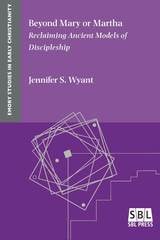
Beyond Mary or Martha
Reclaiming Ancient Models of DiscipleshipJennifer S. Wyant
SBL Press, 2019
Explore a tale of two sisters
Beyond Mary or Martha: Reclaiming Ancient Models of Discipleship dives into the complicated reception history of Mary and Martha of Bethany, who have been at the center of many debates for almost two thousand years. Jennifer S. Wyant begins her study with a close reading of the sisters’ first encounter with Jesus in Luke 10:38-42, then moves on to patristic, medieval, and modern interpretations of that narrative. Wyant tracks how Mary and Martha both became paradigms of discipleship, revealing the inherent tension within Christianity between contemplative practices and acts of service. By placing ancient debates alongside more modern ones, she argues that, contrary to discussions today within academic and religious circles, gender is not the most important aspect of their story.
Features:
- A thorough examination of the textual variants in the passage to show how variants affected interpretation throughout history
- Interpretations from medieval women and their contributions to interpretation of Mary and Martha
- A visual exegesis of the art representing the passage throughout history
Bible Trouble
Queer Reading at the Boundaries of Biblical ScholarshipTeresa J. Hornsby
SBL Press, 2011
The essays in Bible Trouble all engage queer theories for purposes of biblical interpretation, a rare effort to date within biblical scholarship. The title phrase “Bible Trouble” plays on Judith Butler's Gender Trouble, gesturing toward a primary text for contemporary queer theory. The essays consider, among others, the Lazarus story, the Ethiopian eunuch, “gender trouble” in Judges 4 and 5, the Song of Songs, and an unorthodox coupling of the books of Samuel and the film Paris Is Burning. This volume “troubles” not only the boundaries between biblical scholarship and queer theory but also the boundaries between different frameworks currently used in the analysis of biblical literature, including sexuality, gender, race, class, history, and literature. The contributors are Ellen T. Armour, Michael Joseph Brown, Sean D. Burke, Heidi Epstein, Deryn Guest, Jione Havea, Teresa J. Hornsby, Lynn R. Huber, S. Tamar Kamionkowski, Joseph A. Marchal, Jeremy Punt, Erin Runions, Ken Stone, Gillian Townsley, Jay Twomey, and Manuel Villalobos.
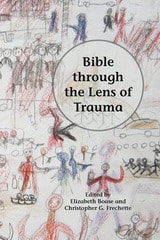
Bible through the Lens of Trauma
Elizabeth Boase
SBL Press, 2016
Explore emerging trends in trauma studies and biblical interpretation
In recent years there has been a surge of interest in trauma, trauma theory, and its application to the biblical text. This collection of essays explores the usefulness of using trauma theory as a lens through which to read the biblical texts. Each of the essays explores the concept of how trauma might be defined and applied in biblical studies. Using a range of different but intersection theories of trauma, the essays reflect on the value of trauma studies for offering new insights into the biblical text. Including contributions from biblical scholars, as well as systematic and pastoral theologians, this book provides a timely critical reflection on this emerging discussion.
Features:
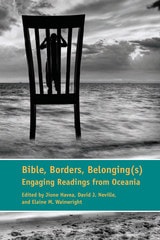
Bible, Borders, Belonging(s)
Engaging Readings from OceaniaJione Havea
SBL Press, 2014
Engaging voices crossing textual limits, race, and ethnic lines
In this collection of essays, scholars from Oceania open a new dialog regarding the vast, complex, and slippery nature of the Bible and the fluid meanings of borders and belongings. From belonging in a place, a group, or movement to belongings as material and cultural possessions, from borders of a text, discipline, or thought to borders of nations, communities, or bodies, the authors follow the currents of Oceania to the shores of Asia and beyond. Scholars contributing essays include Jeffrey W. Aernie, Merilyn Clark, Jione Havea, Gregory C. Jenks, Jeanette Mathews, Judith E. McKinlay, Monica Jyotsna Melanchthon, David J. Neville, John Painter, Kathleen P. Rushton, Ruth Sheridan, Nasili Vaka‘uta, and Elaine M. Wainwright. Michele A. Connolly, David M. Gunn, and Mark G. Brett provide responses to the essays.
Features:
- Discussion of the impacts of natural disasters and political and ecological upheavals on biblical interpretation and theological reflection
- Fourteen essays on texts in the Hebrew Bible and New Testament
- Three responses to the essays provide a range of views on the topics
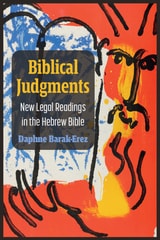
Biblical Judgments
New Legal Readings in the Hebrew BibleDaphne Barak-Erez
University of Michigan Press, 2024
Rather than offering a historical study, Barak-Erez draws upon famous court decisions from around the world to root her analysis in modern law. Organized by subject matter, Biblical Judgments analyzes how the themes of law and government, judging and judges, human rights and social justice, criminal law, private law, and family and inheritance law are presented through a number of different stories. In recounting the compelling narratives of the Hebrew Bible, Biblical Judgments exposes their inherent legal tensions and what we can learn about legal dilemmas today.
Bodies on the Verge
Queering Pauline EpistlesJoseph A. Marchal
SBL Press, 2019
A collection that resets the terms of interpreting the Pauline letters
Interpretation of Paul's letters often proves troubling, since people frequently cite them when debating controversial matters of gender and sexuality. Rather than focusing on the more common defensive responses to those expected prooftexts that supposedly address homosexuality, the essays in this collection reflect the range, rigor, vitality, and creativity of other interpretive options influenced by queer studies. Thus key concepts and practices for understanding these letters in terms of history, theology, empire, gender, race, and ethnicity, among others, are rethought through queer interventions within both ancient settings and more recent history and literature.
Features:
- New options for how to interpret and use Paul's letters, particularly in light of their use in debates about sexuality and gender
- Developing approaches in queer studies that help with understanding and using Pauline letters and interpretations differently
- Key reflections on the two "clobber passages" (Rom 1:26-27 and 1 Cor 6:9) that demonstrate the relevance of a far wider range of texts throughout the Pauline corpus
Body as Landscape, Love as Intoxication
Conceptual Metaphors in the Song of SongsBrian P. Gault
SBL Press, 2019
Explore metaphors in the exquisite and enigmatic poetry of Song of Songs
One of the chief difficulties in interpreting the Song's lyrics is the unusual imagery used to depict the lovers' bodies. Why is the maiden's hair compared to a flock of goats (4:1), the man’s cheeks likened to garden beds of spice (5:13), and the eyes of both lovers described as doves (4:1; 5:12)? While scholars speculate on the significance of these images, a systematic inquiry into the Song's body metaphors is curiously absent. Based on insights from cognitive linguistics, this study incorporates biblical and comparative data to uncover the meaning of these metaphors surveying literature in the eastern Mediterranean (and beyond) that shares a similar form (poetry) and theme (love). Gault presents an interpretation of the Song's body imagery that sheds light on the perception of beauty in Israel and its relationship to surrounding cultures.
Features
- Exploration of the Song's use of universal themes and culturally specific variations
- Discussion of the Song's literary structure and unity

Book and Verse
A Guide to Middle English Biblical LiteratureJames H. Morey
University of Illinois Press, 2000
Book and Verse is an indispensable guide to the variety and extent of biblical literature in England, exclusive of drama and the Wycliffite Bible that appeared between the twelfth and the fifteenth centuries. Entries provide detailed information on how much of what parts of the Bible appear in Middle English and where this biblical material can be found. Comprehensive indexing by name, keyword, and biblical verse allows a researcher to find, for example, all the occurrences of the Flood Story or of the encounter between Elijah and the Widow of Sarephta. An invaluable resource, Book and Verse provides the first easy access to the "popular Bible" assembled before and after John Wyclif's translation of the Vulgate into English.
Book of Abraham Apologetics
A Review and CritiqueDan Vogel
Signature Books, 2021
Bringing Down the Temple House
Engendering Tractate YomaMarjorie Lehman
Brandeis University Press, 2022
While the use of feminist analysis as a methodological lens is not new to the study of Talmudic literature or to the study of individual tractates, this book demonstrates that such an intervention with the Babylonian Talmud reveals new perspectives on the rabbis’ relationship with the temple and its priesthood. More specifically, through the relationships most commonly associated with home, such as those of husband-wife, father-son, mother-son, and brother-brother, the rabbis destabilize the temple bayit (or temple house). Moving beyond the view that the temple was replaced by the rabbinic home, and that rabbinic rites reappropriate temple practices, a feminist approach highlights the inextricable link between kinship, gender, and the body, calling attention to the ways the rabbis deconstruct the priesthood so as to reconstruct themselves.