Results by title
76 books match the query 'Cultural History' and 3 start with b

Bear With Me
A Cultural History of Famous Bears in AmericaDaniel Horowitz
Duke University Press, 2025
From teddy bears and Winnie-the-Pooh to Smokey Bear, Yogi Bear, and Cocaine Bear, American popular culture has been fascinated with real and fictional bears for more than two centuries. Bears are ubiquitous, appearing in advertisements, as logos for sports teams, and as central characters in children’s books, cartoons, movies, and video games. In Bear With Me, Daniel Horowitz presents a vibrant history of the pedestrian and celebrity bears who have captured our imaginations and infiltrated our everyday lives. He shows that bears’ ability to represent and evoke both terror and comfort makes them well-suited for their omnipresence. Today, cultural depictions of bears largely encompass examples of human-bear relationships, reciprocity, and emotional engagement. Reminders that climate change threatens the lives of polar bears engender feelings of empathy, while news of bear attacks drives us to fascinated fear. Whether examining the subculture of gay bears or the deadly consequences of anthropomorphizing animals, Horowitz charts the complexities and depth of American culture’s unique and enduring relationship with bears.
[more]
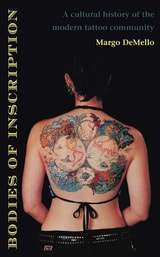
Bodies of Inscription
A Cultural History of the Modern Tattoo CommunityMargo DeMello
Duke University Press, 2004
Since the 1980s, tattooing has emerged anew in the United States as a widely appealing cultural, artistic, and social form. In Bodies of Inscription Margo DeMello explains how elite tattooists, magazine editors, and leaders of tattoo organizations have downplayed the working-class roots of tattooing in order to make it more palatable for middle-class consumption. She shows how a completely new set of meanings derived primarily from non-Western cultures has been created to give tattoos an exotic, primitive flavor.
Community publications, tattoo conventions, articles in popular magazines, and DeMello’s numerous interviews illustrate the interplay between class, culture, and history that orchestrated a shift from traditional Americana and biker tattoos to new forms using Celtic, tribal, and Japanese images. DeMello’s extensive interviews reveal the divergent yet overlapping communities formed by this class-based, American-style repackaging of the tattoo. After describing how the tattoo has moved from a mark of patriotism or rebellion to a symbol of exploration and status, the author returns to the predominantly middle-class movement that celebrates its skin art as spiritual, poetic, and self-empowering. Recognizing that the term “community” cannot capture the variations and class conflict that continue to thrive within the larger tattoo culture, DeMello finds in the discourse of tattooed people and their artists a new and particular sense of community and explores the unexpected relationship between this discourse and that of other social movements.
This ethnography of tattooing in America makes a substantive contribution to the history of tattooing in addition to relating how communities form around particular traditions and how the traditions themselves change with the introduction of new participants. Bodies of Inscription will have broad appeal and will be enjoyed by readers interested in cultural studies, American studies, sociology, popular culture, and body art.
[more]

Books, Maps, and Politics
A Cultural History of the Library of Congress, 1783-1861Carl Ostrowski
University of Massachusetts Press, 2004
Delving into the origins and development of the Library of Congress, this volume ranges from the first attempt to establish a national legislative library in 1783 to the advent of the Civil War. Carl Ostrowski shows how the growing and changing Library was influenced by—and in turn affected—major intellectual, social, historical, and political trends that occupied the sphere of public discourse in late eighteenth- and early nineteenth-century America.
The author explores the relationship between the Library and the period's expanding print culture. He identifies the books that legislators required to be placed in the Library and establishes how these volumes were used. His analysis of the earliest printed catalogs of the Library reveals that law, politics, economics, geography, and history were the subjects most assiduously collected. These books provided government officials with practical guidance in domestic legislation and foreign affairs, including disputes with European powers over territorial boundaries.
Ostrowski also discusses a number of secondary functions of the Library, one of which was to provide reading material for the entertainment and instruction of government officials and their families. As a result, the richness of America's burgeoning literary culture from the 1830s to the 1860s was amply represented on the Library's shelves. For those with access to its Capitol rooms, the Library served an important social function, providing a space for interaction and the display and appreciation of American works of art.
Ostrowski skillfully demonstrates that the history of the Library of Congress offers a lens through which we can view changing American attitudes toward books, literature, and the relationship between the federal government and the world of arts and letters.
[more]