170 books match the query 'Death, Grief, Loss' and 8 start with b
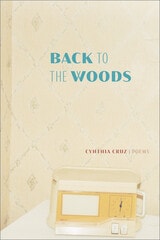
cover of Back to the Woods

Back to the Woods

Cynthia Cruz

Four Way Books, 0

National Book Critics Circle Award Winner Cynthia Cruz reevaluates the paradox of the death drive in her eighth collection of poetry, Back to the Woods. Could it be that in ceaselessly snuffing ourselves out we are, in fact, trying to survive? In “Shine,” Cruz’s speaker attests that “if [she] had a home, it would be // a still in a film / where the sound / got jammed.” This book inhabits the silence of the empty orchestra pit, facing “dread, and its many / instruments of sorrow.” The quiet asks, “Did you love this world / and did this world / not love you?” We return to the site of our suffering, we perform the symphony of all our old injuries, to master what has broken us. To make possible the future, we retreat into the past. “I don’t know / the ending. // I don’t know anything,” our speaker insists, but she follows the wind’s off-kilter song of “winter / in the pines” and “the dissonance / of siskins.” Cruz heeds the urgency of our wandering, the mandate that we must get back to the woods, not simply for the forest to devour us — she recognizes in the oblivion “flooding out / from its spiral branches” an impossible promise. At the tree line, we might vanish to begin again. 
 

[more]
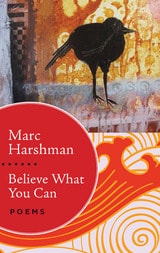
cover of Believe What You Can: Poems

Believe What You Can

Poems

Marc Harshman

West Virginia University Press, 2016

This collection of poetry by West Virginia Poet Laureate Marc Harshman explores the difficulty of living with an awareness of the eventual death of all living things. Each of its four sections suggests a coping mechanism for this inevitable predicament, from storytelling, to accepting darkness and death as a creative force, to enjoying disruption and chaos, and finally to embracing the mystery of life as the most triumphant story of all.
 
These difficulties come “not quite haphazardly” and not without a “last light”—something “beyond” and as “sweet as apples.” With these moments of grace, Harshman taps into the satisfying richness that comes from unexpected revelations, helping us rise above the fragile recesses of life and death, all while portraying the lost rural worlds of the Midwest and Appalachia in ways untouched by sentiment or nostalgia.

 
[more]
cover of Between Lakes

Between Lakes

Jeffrey Harrison

Four Way Books, 2020

How does consciousness inhabit liminal spaces? In Jeffrey Harrison’s Between Lakes, the death of the speaker’s father places him in the ever-shifting zone between the living and the dead while also sending him back into his journey to manhood. Old arguments are reimagined: What does it mean to be a man? What does it mean to be a participant in one’s life as well as a witness and recorder of the lives of others? The exploration of these questions leads to new discoveries, including the way time reshapes the vision of one’s life and alters relationships, remaking a shared history. Harrison refrains from explanation, instead offering detail after trustworthy detail—less to prove a case than to imagine a life true to the original. Whether observing nature with steadfast precision or sensing the presence of his absent father while doing chores, Harrison sings the songs of experience in late middle life.
[more]
cover of Bianca

Bianca

Eugenia Leigh

Four Way Books, 2023

“I thought I forgave you,” Eugenia Leigh tells the specter of her father in Bianca. “Then I took root and became / someone’s mother.” Leigh’s gripping second collection introduces us to a woman managing marriage, motherhood, and mental illness as her childhood abuse resurfaces in the light of “this honeyed life.” Leigh strives to reconcile the disconnect between her past and her present as she confronts the inherited violence mired in the body’s history. As she “choose[s] to be tender to [her] child—a choice / [her] mangled brain makes each day,” memories arise, asking the mother in her to tend, also, to the girl she once was. Thus, we meet her manic alter ego, whose history becomes the gospel of Bianca: “We all called her Bianca. My fever, my havoc, my tilt.” These poems recover and reconsider Leigh’s girlhood and young adulthood with the added context of PTSD and Bipolar Disorder. They document the labyrinth of a woman breaking free from the cycle of abuse, moving from anger to grief, from self-doubt to self-acceptance. Bianca is ultimately the testimony of one woman’s daily recommitment to this life. To living. “I expected to die much younger than I am now,” Leigh writes, in awe of the strangeness of now, of “every quiet and colossal joy.”
[more]
cover of Birches

Birches

Carl Adamshick

Four Way Books, 2019
Brutal and tender, Adamshick’s spare poems recount a son’s unsentimental and powerful love for his mother, while contemplating, in the wake of her death, what it is to be truly alive.
[more]
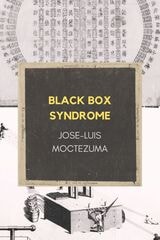
cover of Black Box Syndrome

Black Box Syndrome

Jose-Luis Moctezuma

Omnidawn, 2023

Poems that follow systems of chance and divination to counter corrosive financial systems.
 
Jose-Luis Moctezuma’s Black Box Syndrome is a series of poems—or “black boxes”—based on black hexagrams in the I Ching, an ancient Chinese divination text. Following the aleatoric tradition popularized by the surrealists and extended by the work of John Cage and Jackson Maclow, these poems cast their lenses on the hazards of the incessant financialization of everyday life. Synthesizing chance-operational aesthetics with Aztec anatomical science, conspiracy theory with systems theory, and the black box model with the concept of the “influencing machine,” Black Box Syndrome explores tensions between lyric excess and digital compaction in the age of pandemic. Over and against the corrosive world-shrinking effects of Wall Street risk management and futures trading, the black boxes in this book propose a counter-divination that distorts, deranges, and decolonizes the logic of empire.
[more]
cover of Boy

Boy

Tracy Youngblom

CavanKerry Press, 2023

A poetry collection focused on grief and the many ways it can impact a family.

The death of a youngest child. An alcoholic and distant father. A grief-stricken family. A tentative faith. These are the building blocks of Boy, a sequence of poems that explores how death and loss color memory and influence the ways family members relate to each other and to their shared history.

Inspired by the death of her own younger brother, Tracy Youngblom has written a poetry collection that serves as a companion to grief. This book is for those who love poetry and those who are intimidated by it, those interested in the way childhood experience shapes life, and those interested in the psychology of addiction.
[more]
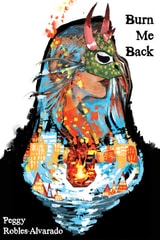
cover of Burn Me Back

Burn Me Back

Peggy Robles-Alvarado

Four Way Books, 2025

“My Spanglish,” Peggy Robles-Alvarado declares, “drops the -s and makes it ma’ o meno’,” replaces accent marks with side-eye, “has a Tía sin papeles,” and recognizes that “there is no other way to say— / Cónchole papi, you look good!” Igniting across tongues, cultures, and countries, the incendiary poems in Burn Me Back harness the incantatory power of language through hybrid forms, preserving a beloved father’s memory, enshrining the legacy of the Latino immigrant community in Washington Heights and the Bronx, reimagining the world we share, and speaking toward a hopeful multiplicity of possible futures. At the cross section of Puerto Rican and Dominican diasporas, rooted in ancestral narratives and infused with generational dislocation, this speaker refuses to abandon what resists translation, makes the space she needs, and transforms objects as she names them: “My Spanglish knows a fire escape is also a terrace.” Yes, the language here is a feat of engineering — a design shaped by the conditions of emergency, an architecture of survival, deliverance to open air. Like isolating the notes in a thunderous chord, Robles-Alvarado dexterously teases out each word’s many meanings, listening for the individual strains that created her as she archives family lore and fleshes out her personal history, writing against patriarchy while codifying working-class wisdom. She reconstructs a whole genealogy in “What They Mean by Papers,” reciting a negative litany of “papeles.” “Not the Daily News or El Diario La Prensa, / or the kind my mother read to me on Sunday / mornings,” her “throat full of / pelitos de mango,” “Not the kind Tía Weltina used to roll her tobacco with,” “conjuring / Taíno spirits she exhaled … as she tried to memorize the national anthem,” but the kind “Uncle Rito forged” while he “learned to curl the R in his name / as if writing sacred geometry,” “the kind that convinced four of my aunts to marry older / naturalized men in exchange for an acre of my grandfather’s campo” — the kind that required the rest of their lives as payment, “their bodies, / all their milk and honey, all their amber and caña dulce / sacrificed to the lust of viejos verdes, old bastards / who soured early on too much tabaco y ron and wanted to plant / their moldy seeds in supple girls who had never seen snow.” Robles-Alvarado orchestrates the fullness of her song by refusing to leave anyone out, by making room for a term’s contradictory definitions and playing through discordant combinations until the dissonance resolves. What began as an elegy composed by a daughter lost in mourning becomes an expansive arrangement sounding rupture and repair. This music travels between loss and recovery, addiction and sobriety, the cooling embers of lost childhood and the heat of the present, this very moment in which you could reach out to the people around you and ask them to be here with you for every scalding second, the warmth of your skin against theirs posing a burning question — an invitation to burn you back. 
[more]