157 books match the query 'English' and 19 start with a
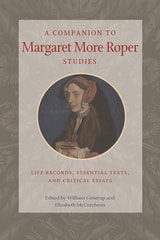
cover of A Companion to Margaret More Roper Studies: Life Records, Essential Texts, and Critical Essays

A Companion to Margaret More Roper Studies

Life Records, Essential Texts, and Critical Essays

Elizabeth McCutcheon

Catholic University of America Press, 2022

This volume is an important contribution to the field of Margaret More Roper studies, early modern women's writing, as well as Erasmian piety, Renaissance humanism, and historical and cultural studies more generally.

Margaret More Roper is the learned daughter of St. Thomas More, the Catholic martyr; their lives are closely linked to each other and to early sixteenth-century changes in politics and religion and the social upheaval and crises of conscience that they brought. Specifically, Roper's major works - her translation of Erasmus's commentary on the Lord's Prayer and the long dialogue letter between More and Roper on conscience - highlight two major preoccupations of the period: Erasmian humanism and More's last years, which led to his death and martyrdom.

Roper was one of the most learned women of her time and a prototype of the woman writer in England, and this edited volume is a tribute to her life, writings, and place among early women authors. It combines comprehensive and convenient joining of biographical, textual, historical, and critical components within a single volume for the modern reader. There is no comparable study in print, and it fills a significant gap in studies of early modern women writers.
[more]
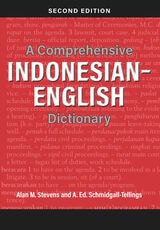
cover of A Comprehensive Indonesian–English Dictionary: Second Edition

A Comprehensive Indonesian–English Dictionary

Second Edition

Alan M. Stevens

Ohio University Press, 2010
This second edition of A Comprehensive Indonesian-English Dictionary brings the highly successful first edition up to date with hundreds of new entries in business, law, and finance, as well as specialized terminology in the fields of technology, engineering, mining, and construction. Based on five years of research, including input from users, this new edition offers readers the most current information on names of political parties, acronyms for government offices, Islamic terms, colloquial pronunciations, and abbreviated forms used in blogs and e-mail. As with the original edition, the dictionary is designed to be as user-friendly as possible. Root words, meanings, proverbs, idioms, compounds that begin with the root word, and derivatives are given. Thousands of sample sentences from primary sources illustrate meaning and usage; no sentences are invented, ensuring complete authenticity and reliability. The new edition is essential for reference libraries, as well as students and scholars of Indonesian.
[more]
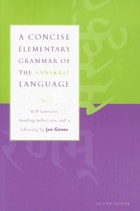
cover of A Concise Elementary Grammar of the Sanskrit Language

A Concise Elementary Grammar of the Sanskrit Language

Jan Gonda

University of Alabama Press, 2006
A standard course book for students of linguistics.
[more]
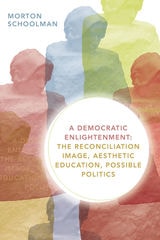
cover of A Democratic Enlightenment: The Reconciliation Image, Aesthetic Education, Possible Politics

A Democratic Enlightenment

The Reconciliation Image, Aesthetic Education, Possible Politics

Morton Schoolman

Duke University Press, 2020
In A Democratic Enlightenment Morton Schoolman proposes aesthetic education through film as a way to redress the political violence inflicted on difference that society constructs as its racialized, gendered, Semitic, and sexualized other. Drawing on Voltaire, Diderot, and Schiller, Schoolman reconstructs the genealogical history of what he calls the reconciliation image—a visual model of a democratic ideal of reconciliation he then theorizes through Whitman's prose and poetry and Adorno's aesthetic theory. Analyzing The Help (2011) and Gentleman's Agreement (1947), Schoolman shows how film produces a more advanced image of reconciliation than those originally created by modernist artworks. Each film depicts violence toward racial and ethnic difference while also displaying a reconciliation image that aesthetically educates the public about how the violence of constructing difference as otherness can be overcome. Mounting a democratic enlightenment, the reconciliation image in film illuminates a possible politics for challenging the rise of nationalism's violence toward differences in all their diversity.
[more]
cover of A Glossary of Words and Phrases in the Oral Performing and Dramatic Literatures of the Jin, Yuan, and Ming

A Glossary of Words and Phrases in the Oral Performing and Dramatic Literatures of the Jin, Yuan, and Ming

Dale R. Johnson

University of Michigan Press, 2002
For many years, the oral performing and dramatic literatures of China from 1200 to 1600 CE were considered some of the most difficult texts in the Chinese corpus. They included ballad medleys, comic farces, Yuan music dramas, Ming music dramas, and the novel Shuihu zhuan. The Japanese scholars who first dedicated themselves to study these works in the mid-twentieth century were considered daring. As late as 1981, no comprehensive dictionary or glossary for this literature existed in any language, Asian or Western.
A Glossary of Words and Phrases fills this gap for Western readers, allowing even a relative novice who has resonable command of Chinese to read, translate, and appreciate this great body of literature with an ease undreamed of even two decades ago. The Glossary is organized into approximately 8,000 entries based on the reading notes and glosses found in various dictionaries, thesauruses, glossaries, and editions of works from the period. Main entries are listed alphabetically in the pinyin romanization system. In addition to glosses, entries include symbolic annotations, guides to pronunciation, and text citations. The result is a broadly useful glossary serving the needs of students of this literature as well as scholars researching Jin and Yuan language and its usage.
[more]
cover of A Grammar and Dictionary of the Timucua Language

A Grammar and Dictionary of the Timucua Language

Julian Granberry

University of Alabama Press, 1993

Preserving the voice of a vanished people through language, history, and scholarship.

Taken from the surviving contemporary documentary sources, Julian Granberry's volume describes the grammar and lexicon for the extinct 17th-century Timucua language of Central and North Florida and traces the origins of the 17th-century Timucua speakers and their language. Originally privately published in 1987, with limited circulation, this is the only available publication on the Timucuan language. It provides full grammatical analysis and complete lexical data, and it synthesizes both linguistic and archaeological data in order to provide a coherent picture of the Timucua peoples. Granberry traces the probable historical origins of Timucua speakers to a central Amazonian homeland at approximately 2,500 B.C. and proposes that Timucua speakers were responsible for introducing ceramic wares into North America.
[more]
cover of A Greek-English Lexicon of the New Testament and Other Early Christian Literature

A Greek-English Lexicon of the New Testament and Other Early Christian Literature

Walter Bauer

University of Chicago Press, 2000

Described as an "invaluable reference work" (Classical Philology) and "a tool indispensable for the study of early Christian literature" (Religious Studies Review) in its previous edition, this new updated American edition of Walter Bauer's Wörterbuch zu den Schriften des Neuen Testaments builds on its predecessor's staggering deposit of extraordinary erudition relating to Greek literature from all periods. Including entries for many more words, the new edition also lists more than 25,000 additional references to classical, intertestamental, Early Christian, and modern literature.

In this edition, Frederick W. Danker's broad knowledge of Greco-Roman literature, as well as papyri and epigraphs, provides a more panoramic view of the world of Jesus and the New Testament. Danker has also introduced a more consistent mode of reference citation, and has provided a composite list of abbreviations to facilitate easy access to this wealth of information.

Perhaps the single most important lexical innovation of Danker's edition is its inclusion of extended definitions for Greek terms. For instance, a key meaning of "episkopos" was defined in the second American edition as overseer; Danker defines it as "one who has the responsibility of safeguarding or seeing to it that something is done in the correct way, guardian." Such extended definitions give a fuller sense of the word in question, which will help avoid both anachronisms and confusion among users of the lexicon who may not be native speakers of English.

Danker's edition of Bauer's Wörterbuch will be an indispensable guide for Biblical and classical scholars, ministers, seminarians, and translators.
[more]
cover of A Portable Latin for Gardeners: More than 1,500 Essential Plant Names and the Secrets They Contain

A Portable Latin for Gardeners

More than 1,500 Essential Plant Names and the Secrets They Contain

James Armitage

University of Chicago Press, 2017

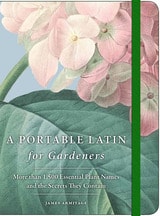
Having an understanding of botanical Latin unlocks an entirely new layer of the plant world. Gardeners deciding between a Crocus flavus and Crocus graveolens will know that one produces deep yellow flowers while the other boasts a prominent smell. They can tell whether a plant should have one (unifolius), two (diphyllus), or even nine leaves (enneaphyllus). And they can catch the nods to Sir Joseph Banks in Cordyline banksia and Queen Victoria in Agave victoriae-reginae.
A Portable Latin for Gardeners is the perfect quick reference for working in the garden, shopping for plants, or doing botanical research—and no prior knowledge of Latin is required. The 1,500 terms are grouped by categories, making it easy to describe color, size, form, habitat, scent, taste, and time. Gardeners will make new connections and discoveries in a way standard alphabetical lists simply don’t allow. Alternately, gardeners who want to look up a particular term can jump right into the alphabetical index. Each entry includes the different forms of the term, a basic pronunciation guide, the definition, and an example plant species.
Rich botanical illustrations make this guide as beautiful as it is useful, while a durable flexi-bound cover means the book can withstand both days in the garden and evenings on the nightstand.
[more]
cover of A Primer of Pastoral Spanish

A Primer of Pastoral Spanish

Michael J. McGrath

Catholic University of America Press, 2022
A Primer of Pastoral Spanish is designed to provide clergy, religious and laity alike with the tools to be pastoral among Spanish-speaking people. This primer is modeled after Madrigal’s Magic Key to Spanish (1953), whose author, Margarita Madrigal, bases her methodology on creating with the language instead of memorizing it. Previous knowledge of Spanish is not necessary, although, as you will discover, you already know thousands of words in Spanish. The vocabulary you know in English is the foundation on which you can build your knowledge of Spanish vocabulary. There are thousands of English words that become Spanish words if you can recognize the slight change that takes place from one language to the other. For example, you will learn how to conjugate a verb in Spanish to the first-person singular of the past tense by dropping a letter from its translation in English and adding an accent. There are 40 units in this primer. If you were to study each unit 30 minutes a day throughout Lent, for example, think about how far you could progress. Each unit consists of four sections: Vocabulary, Prayer or Culture, Cornerstones, and Vocabulary Review. There are four Check Your Progress units. These present more Challenges based on the grammar, vocabulary, and culture you learned in the previous units. The answers to the Challenges are at the end of these units.
[more]
cover of A Reference Grammar of Chinese Sentences with Exercises

A Reference Grammar of Chinese Sentences with Exercises

Henry Hung-Yeh Tiee

University of Arizona Press, 1986
Begins with simple single-word-subject and simple-predicate sentences and moves systematically to transformed simple sentences and finally to compound and complex sentences. Each sentence structure is not only descriptively analyzed, but also formulated in a pedagogical pattern with examples. Exercises are provided in each unit.
[more]
cover of A Sourcebook for Ancient Greek: Grammar, Poetry, and Prose

A Sourcebook for Ancient Greek

Grammar, Poetry, and Prose

John Tomarchio

Catholic University of America Press, 2022

This book was designed for students transitioning from the study of Greek grammar to translation of texts. It was developed in classroom use for classroom use, in the context of an integrated Great Books program in liberal arts and sciences. It is meant for students not only of Classics, but more, for students of Humanities interested in direct engagement of primary sources. Each Greek text offered for translation was chosen for its theoretical interest as well as the interest of its Greek. The selections of Greek literature offered in this Sourcebook are wide-ranging. The indisputable standard of excellence for classicists is of course the Attic dialect of Athens in its glory. However, this Sourcebook is meant for students of liberal arts and sciences whose interests range far more widely. Thus, it does not hesitate to extend not only backward to the archaic Greek of Homer, but also forward to the koine Greek of the Alexandrian and Roman empires. Greek works were chosen for being seminal to Western thinking today, chosen to give students of Western arts and sciences introductions to its Greek sources Naturally, Greek grammar is taught to the newcomer analytically and sequentially, but the continuing student needs to synthesize these distended enumerations of elements and principles. Accordingly, grammatical synopses are not appended as reference tables but placed front and center as objects of study. The grammar tables offer synoptic views of integral parts of Greek grammar to show the form and logic of the whole part of speech or part of a sentence. On the basis of these tables, detailed grammatical notes and commentary appended to Greek selections that follow are tailored for continuing students.
[more]
cover of A Tale of Two Colonies: What Really Happened in Virginia and Bermuda?

A Tale of Two Colonies

What Really Happened in Virginia and Bermuda?

Virginia Bernhard

University of Missouri Press, 2011
 
In 1609, two years after its English founding, colonists struggled to stay alive in a tiny fort at Jamestown.John Smith fought to keep order, battling both English and Indians. When he left, desperate colonists ate lizards, rats, and human flesh. Surviving accounts of the “Starving Time” differ, as do modern scholars’ theories.
Meanwhile, the Virginia-bound Sea Venture was shipwrecked on Bermuda, the dreaded, uninhabited “Isle of Devils.” The castaways’ journals describe the hurricane at sea as well as murders and mutinies on land. Their adventures are said to have inspired Shakespeare’s The Tempest.
A year later, in 1610, the Bermuda castaways sailed to Virginia in two small ships they had built. They arrived in Jamestown to find many people in the last stages of starvation; abandoning the colony seemed their only option. Then, in what many people thought was divine providence, three English ships sailed into Chesapeake Bay. Virginia was saved, but the colony’s troubles were far from over.
Despite glowing reports from Virginia Company officials, disease, inadequate food, and fear of Indians plagued the colony. The company poured thousands of pounds sterling and hundreds of new settlers into its venture but failed to make a profit, and many of the newcomers died. Bermuda—with plenty of food, no native population, and a balmy climate—looked much more promising, and in fact, it became England’s second New World colony in 1612.
In this fascinating tale of England’s first two New World colonies, Bernhard links Virginia and Bermuda in a series of unintended consequences resulting from natural disaster, ignorance of native cultures, diplomatic intrigue, and the fateful arrival of the first Africans in both colonies. Written for general as well as academic audiences, A Tale of Two Colonies examines the existing sources on the colonies, sets them in a transatlantic context, and weighs them against circumstantial evidence.
From diplomatic correspondence and maps in the Spanish archives to recent archaeological discoveries at Jamestown, Bernhard creates an intriguing history. To weave together the stories of the two colonies, which are fraught with missing pieces, she leaves nothing unexamined: letters written in code, adventurers’ narratives, lists of Africans in Bermuda, and the minutes of committees in London. Biographical details of mariners, diplomats, spies, Indians, Africans, and English colonists also enrich the narrative. While there are common stories about both colonies, Bernhard shakes myth free from truth and illuminates what is known—as well as what we may never know—about the first English colonies in the New World.
[more]
cover of Academic Vocabulary Building in English, Intermediate: Volume 2

Academic Vocabulary Building in English, Intermediate

Volume 2

Betsy Davis, Alan Juffs, Dawn E. McCormick, Greg Mizera, M. Christine O'Neill, Stacy Ranson, Missy Slaathaug, Dorolyn Smith

University of Michigan Press, 2015

The English Language Institute at the University of Pittsburgh is known for its popular eight-volume series Words for Students of English (University of Michigan Press). In the years since the series was first published, faculty at Pitt ELI has been considering new ways to address learners’ challenges in acquiring vocabulary. The result of the research and experience is a new five-volume series, Academic Vocabulary Building in English. This series weaves together three sets of knowledge: (1) the results of recent research from applied linguists and psycholinguists, (2) the rich classroom experience of the Institute faculty, who together have many decades of practical classroom ESL experience, and (3) the data gathered from our online student database and corpus studies that have informed us of which words students need to know more deeply.
 
Each unit contains sections that emphasize various components of word learning. First, each chapter opens with a chart of target words and their various morphological forms. The next step establishes form-meaning mappings: Each word is listed with a definition and two example sentences. The lists and definitions are followed by exercises that concentrate students’ attention on establishing form-meaning links. These exercises consist of practice opportunities that require multiple retrievals in order to promote label-to-concept links and begin awareness of derivational and inflectional variations. Follow-up exercises focus on collocations related to the unit’s theme. Each chapter closes with exercises that can be used as quizzes.  By the time students have finished a unit, they should have had both receptive and productive practice with the form, meaning, morphosyntax, and collocational properties of each lexical item.
[more]
cover of Arabic Sounds and Letters: A Beginning Programmed Course. Textbook and Manual

Arabic Sounds and Letters

A Beginning Programmed Course. Textbook and Manual

Raji M. Rammuny

University of Michigan Press, 2006

The textbook includes twenty lessons aimed at introducing Arabic sounds and writing system in a programmed method of instruction, supported by images and audio tapes*. The Manual consists of two parts. Part One includes a suggested methodology to guide teachers and students and Part Two contains basic communication needs in both Arabic script and transliteration to create a climate of enjoyable learning while students are acquiring the sounds and letters.

Raji M. Rammuny is Professor of Arabic Studies, Department of Near Eastern Studies, University of Michigan. He is the author of numerous books, including Advanced Standard Arabic through Authentic Texts and Audiovisual Materials, Parts 1 and 2, also published by the University of Michigan Press.

*The CD accompanying Arabic Sounds and Letters can be obtained from the UM Language Resource Center. Contact them by email at flacs@umich.edu or by phone at 734-764-3521.
[more]
cover of Attic Greek Prose Syntax: Revised and Expanded in English, Volume 1

Attic Greek Prose Syntax

Revised and Expanded in English, Volume 1

K. W. Kruger

University of Michigan Press, 1998

The language of classical Greek literature has been extensively studied since the Renaissance, and the most generally admired approach to Greek grammar and syntax has long been K. W. Krüger's Griechische Sprachlehre. In this translation Guy L. Cooper III accepts Krüger's simple and transparent organization, but greatly expands the substance of the earlier work by increasing the total number of citations from the original texts. Research since 1875, especially the contributions of Basil Lanneau Gildersleeve, is incorporated so as to create a reference work, in English, which covers the full range of this complex subject.

Krüger's original paragraph numbering has been maintained so that references in previously published works can be followed directly in the new work. However, every paragraph and chapter has been revised and expanded, opening up new subheadings within Krüger's format. The English has moved away from Krüger's laconic style to a more flowing, readable presentation, without jargon and unexplained technical language. A complete index of passages cited and the impressive number of citations make the work a running syntactic commentary on the whole range of Attic prose literature. The net result is a new comprehensive reference work, an essential reference for libraries and personal collections alike.

Guy L. Cooper III is Professor Emeritus of Classics, University of North Carolina at Asheville.

Volume 2
cloth ISBN 0-472-10844-1

Set of Volumes 1 & 2
cloth ISBN 0-472-10844-1
[more]
cover of Attic Greek Prose Syntax: Revised and Expanded in English, Volume 2

Attic Greek Prose Syntax

Revised and Expanded in English, Volume 2

K. W. Kruger

University of Michigan Press, 1998

The language of classical Greek literature has been extensively studied since the Renaissance, and the most generally admired approach to Greek grammar and syntax has long been K. W. Krüger's Griechische Sprachlehre. In this translation Guy L. Cooper III accepts Krüger's simple and transparent organization, but greatly expands the substance of the earlier work by increasing the total number of citations from the original texts. Research since 1875, especially the contributions of Basil Lanneau Gildersleeve, is incorporated so as to create a reference work, in English, which covers the full range of this complex subject.

Krüger's original paragraph numbering has been maintained so that references in previously published works can be followed directly in the new work. However, every paragraph and chapter has been revised and expanded, opening up new subheadings within Krüger's format. The English has moved away from Krüger's laconic style to a more flowing, readable presentation, without jargon and unexplained technical language. A complete index of passages cited and the impressive number of citations make the work a running syntactic commentary on the whole range of Attic prose literature. The net result is a new comprehensive reference work, an essential reference for libraries and personal collections alike.

Guy L. Cooper III is Professor Emeritus of Classics, University of North Carolina at Asheville.
[more]
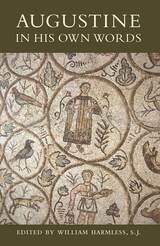
cover of Augustine in His Own Words

Augustine in His Own Words

William Harmless

Catholic University of America Press, 2010
This volume offers a comprehensive portrait--or rather, self-portrait, since its words are mostly Augustine's own--drawn from the breadth of his writings and from the long course of his career
[more]
cover of Aurrera!: A Textbook for Studying Basque, Volume 1

Aurrera!

A Textbook for Studying Basque, Volume 1

Linda White

University of Nevada Press, 2008
The Basque language is one of Europe’s most ancient, its origins as mysterious as those of the Basque people themselves. It is also the official language of Euskadi, the bustling, modern Basque Autonomous Region of Spain, and the preferred tongue of tens of thousands of Basques and their descendants living in the European Basque Country and in diaspora around the world. Aurrera! is a comprehensive text for beginning-level students who are learning Basque (the Batua form approved by the Academy of the Basque Language) in a classroom setting or on their own. Each chapter introduces an element of grammar and offers students new vocabulary, written and spoken exercises, dialogues, and other activities that demonstrate the language in action, plus Basque reading texts that will entertain while they illustrate the material covered in the chapter. The complexities of Basque grammar are explained in clear, easy-to-understand terms, and the dialogues and exercises introduce students to common idioms and the basics of social conversation. Volume 1 covers material for the first two semesters of college-level language-classroom work. It is also designed to give independent learners a sound foundation in the language that will allow them to make their own way in a Basque-speaking environment and to read basic Basque texts.
[more]
cover of Aurrera!: A Textbook for Studying Basque, Volume 2

Aurrera!

A Textbook for Studying Basque, Volume 2

Linda White

University of Nevada Press, 2010

Aurrera! is a comprehensive text for beginning-level students who are learning Basque (the Batua form approved by the Academy of the Basque Language) in a classroom setting or on their own. Each chapter introduces elements of grammar and offers students written and spoken exercises, vocabulary, dialogues, and other activities that demonstrate the language in action, plus Basque reading texts that entertain while they illustrate the points of the chapter. The complexities of Basque grammar are explained in clear, easy-to-understand terms, and the dialogues and exercises introduce students to common idioms and the basics of social conversation. Volume 1 covers material for the first two semesters of college-level language-classroom work, and volume 2 covers a third and fourth seme- ster of study, addressing more advanced grammatical structures and introducing additional vocabulary. Aurrera! offers a systematic and engaging approach to teaching Basque in a classroom. In addition, it gives independent learners a sound foundation in the language that will allow them to make their own way in a Basque-speaking environment and to read basic Basque texts.
[more]