74 books match the query 'Discourse analysis' and 5 start with b

cover of Beyond Translation: Essays toward a Modern Philology

Beyond Translation

Essays toward a Modern Philology

A. L. Becker

University of Michigan Press, 2000

"This is not only a new philology but a new American linguistic philology. . . . Becker's harvest over a lifetime will be widely welcomed and respected." -Paul Friedrich, University of Chicago
". . . a book of extraordinary quality and importance." -James Boyd White, University of Michigan
How does Ralph Waldo Emerson sound in Kawi?
In this collection of essays A. L. Becker develops a new approach to translation he calls modern philology, an approach that insists, beyond translation, on the sorting out of ambiguities and contexts of meaning. Becker describes how texts in Burmese, Javanese, and Malay differ profoundly from English in all the ways they have meaning: in the games they play, the worlds they constitute, the memories they evoke, and the silences they maintain. In each of these dimensions there are excesses and inadequacies of meaning that make a difference across languages.
Drawn from over three decades of studying, teaching, translating and writing about Southeast Asian languages and literatures, the essays collected here for the first time are particular accounts of Becker's experiences in attempting to translate into or out of Burmese, Javanese, and Malay a variety of texts. They describe such things as the building of a Javanese shadowplay, how a Sanskrit story about the language of animals has been used in Indonesia, and some of the profound semantic silences a translator faces in taking an anecdote by Gregory Bateson from English into Malay.
In linguistics, the essays emphasize important kinds of nonuniversality in all aspects of language and look toward a new theory of language grounded in American pragmatism. In anthropology, the essays demonstrate that much of culture can be described in terms of text-building strategies. And for the comparativist, whether in literature, history, rhetoric, music, or psychology, the essays provide a new array of tools of comparison across distant languages and cultures.
A. L. Becker is Professor Emeritus of Linguistics and Anthropology, University of Michigan.
[more]
cover of Beyond Words: Discourse and Critical Agency in Africa

Beyond Words

Discourse and Critical Agency in Africa

Andrew Apter

University of Chicago Press, 2007

Even within anthropology, a discipline that strives to overcome misrepresentations of peoples and cultures, colonialist depictions of the so-called Dark Continent run deep. The grand narratives, tribal tropes, distorted images, and “natural” histories that forged the foundations of discourse about Africa remain firmly entrenched. In Beyond Words, Andrew Apter explores how anthropology can come to terms with the “colonial library” and begin to develop an ethnographic practice that transcends the politics of Africa’s imperial past.

The way out of the colonial library, Apter argues, is by listening to critical discourses in Africa that reframe the social and political contexts in which they are embedded. Apter develops a model of critical agency, focusing on a variety of language genres in Africa situated in rituals that transform sociopolitical relations by self-consciously deploying the power of language itself. To break the cycle of Western illusions in discursive constructions of Africa, he shows, we must listen to African voices in ways that are culturally and locally informed. In doing so, Apter brings forth what promises to be a powerful and influential theory in contemporary anthropology.
[more]
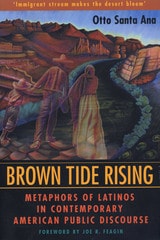
cover of Brown Tide Rising: Metaphors of Latinos in Contemporary American Public Discourse

Brown Tide Rising

Metaphors of Latinos in Contemporary American Public Discourse

By Otto Santa Ana

University of Texas Press, 2002

2002 – Best Book on Ethnic and Racial Political Ideology and/or Political Theory – Organized Section on Race, Ethnicity, and Politics of the American Political Science Association

"...awash under a brown tide...the relentless flow of immigrants..like waves on a beach, these human flows are remaking the face of America...." Since 1993, metaphorical language such as this has permeated mainstream media reporting on the United States' growing Latino population. In this groundbreaking book, Otto Santa Ana argues that far from being mere figures of speech, such metaphors produce and sustain negative public perceptions of the Latino community and its place in American society, precluding the view that Latinos are vested with the same rights and privileges as other citizens.

Applying the insights of cognitive metaphor theory to an extensive natural language data set drawn from hundreds of articles in the Los Angeles Times and other media, Santa Ana reveals how metaphorical language portrays Latinos as invaders, outsiders, burdens, parasites, diseases, animals, and weeds. He convincingly demonstrates that three anti-Latino referenda passed in California because of such imagery, particularly the infamous anti-immigrant measure, Proposition 187. Santa Ana illustrates how Proposition 209 organizers broadcast compelling new metaphors about racism to persuade an electorate that had previously supported affirmative action to ban it. He also shows how Proposition 227 supporters used antiquated metaphors for learning, school, and language to blame Latino children's speech—rather than gross structural inequity—for their schools' failure to educate them. Santa Ana concludes by calling for the creation of insurgent metaphors to contest oppressive U.S. public discourse about minority communities.
[more]
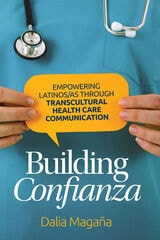
cover of Building Confianza: Empowering Latinos/as Through Transcultural Health Care Communication

Building Confianza

Empowering Latinos/as Through Transcultural Health Care Communication

Dalia Magaña

The Ohio State University Press, 2021

Dalia Magaña’s Building Confianza demonstrates that effective doctor-patient communication in Spanish requires that practitioners not only have knowledge of Spanish but also have transcultural knowledge of Latino/a values and language use. Using linguistic analysis to study real-time doctor-patient interactions, Magaña probes the role of interpersonal language and transcultural competency in improving patient-centered health care with Spanish-speaking Latino/as, highlighting successful examples of how Latino/a cultural constructs of confianza (trust), familismo (family-orientation), personalismo (friendliness), respeto (respect), and simpatía (kindness) can be deployed in medical interactions. She proposes that transcultural interactions entail knowing patients’ cultural values and being mindful about creating an interpersonal connection with patients through small talk, humor, self-disclosure, politeness, and informal language, including language switching and culturally appropriate use of colloquialisms. By explicitly articulating discourse strategies doctors can use in communicating with Spanish-speaking patients, Building Confianza will aid both students and providers in connecting to communities of Spanish speakers in health care contexts and advancing transcultural competence.
[more]
cover of Burek: A Culinary Metaphor

Burek

A Culinary Metaphor

Jernej Mlekuz

Central European University Press, 2015

“As simple as burek” is a popular phrase used by many young people in Slovenia. In this book Jernej Mlekuž maintains that the truth is just the opposite. The burek is a pie made of pastry dough filled with various fillings that is well-known in the Balkans, and also in Turkey and the Near East by other names. Whether on the plate or as a cultural artifact, it is in fact, not that simple. After a brief stroll through its innocent history, Mlekuž focuses on the present state of the burek, after parasitical ideologies had attached themselves to it and poisoned its discourses. In Slovenia, the burek has become a loaded metaphor for the Balkans and immigrants from the republics of the former Socialist Federal Republic of Yugoslavia. Without the burek it would be equally difficult to consider the jargon of Slovenian youth, the imagined world of Slovenian chauvinism and the rhetorical arsenal of advertising agents when promoting healthy foods. In this analysis, Mlekuž refers to the burek as the “metaburek.” All at the same time it is greasy, Balkan, Slovene, not-Slovene, Yugoslavian, familiar, foreign, the greatest, the worst, disturbingly unhealthy, plebeian, junk food, and finally, a cherub (burek spelled backwards is kerub, the Slovene word for cherub). And this metaburek, the protagonist of this book, is never a completely pure, innocent, unconditioned burek. It is much more. A word of warning: after consuming this text, the burek will never be the same.
[more]