Results by title
300 books match the query 'Economic Development' and 9 start with b
Banking Reform in Central Europe and the Former Soviet Union
Jacek Rostowski
Central European University Press, 1995
From Berlin to the Bering Strait, the business of banking has sprung to life. This analysis considers the impact of banking reform on macroeconomic stabilization and the suitability of universal banks, the role of banking regulation and the advantages of 'narrow banks' during transition, the cleaning up of bad debts, and the reform of the payments system.
The book assesses the lessons which can be drawn from reforms in Central Europe for the later reformers in the former Soviet Union and the Balkans. It considers the impact of banking reform on macroeconomic stabilization and the suitability of German-type universal banks; the role of banking regulation and the advantages of 'narrow banks' during transition; the cleaning-up of bad debts; bank privatization and reform of the payments system. Five chapters follow which review the experience of some of the 'second-wave' countries: Estonia, Georgia, Romania, Russia and Ukraine.
Behind the Development Banks
Washington Politics, World Poverty, and the Wealth of NationsSarah Babb
University of Chicago Press, 2009
The World Bank and other multilateral development banks (MDBs) carry out their mission to alleviate poverty and promote economic growth based on the advice of professional economists. But as Sarah Babb argues in Behind the Development Banks, these organizations have also been indelibly shaped by Washington politics—particularly by the legislative branch and its power of the purse.
Tracing American influence on MDBs over three decades, this volume assesses increased congressional activism and the perpetual “selling” of banks to Congress by the executive branch. Babb contends that congressional reluctance to fund the MDBs has enhanced the influence of the United States on them by making credible America’s threat to abandon the banks if its policy preferences are not followed. At a time when the United States’ role in world affairs is being closely scrutinized, Behind the Development Banks will be necessary reading for anyone interested in how American politics helps determine the fate of developing countries.
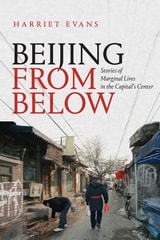
Beijing from Below
Stories of Marginal Lives in the Capital's CenterHarriet Evans
Duke University Press, 2020

Believing in Cleveland
Managing Decline in “The Best Location in the Nation”J. Mark Souther
Temple University Press, 2017
Detractors have called it "The Mistake on the Lake." It was once America’s "Comeback City." According to author J. Mark Souther, Cleveland has long sought to defeat its perceived civic malaise. Believing in Cleveland chronicles how city leaders used imagery and rhetoric to combat and, at times, accommodate urban and economic decline.
Souther explores Cleveland's downtown revitalization efforts, its neighborhood renewal and restoration projects, and its fight against deindustrialization. He shows how the city reshaped its image when it was bolstered by sports team victories. But Cleveland was not always on the upswing. Souther places the city's history in the postwar context when the city and metropolitan area were divided by uneven growth. In the 1970s, the city-suburb division was wider than ever.
Believing in Cleveland recounts the long, difficult history of a city that entered the postwar period as America's sixth largest, then lost ground during a period of robust national growth. But rather than tell a tale of decline, Souther provides a fascinating story of resilience for what some folks called "The Best Location in the Nation."

Between Field and Cooking Pot
The Political Economy of Marketwomen in Peru, Revised EditionBy Florence E. Babb
University of Texas Press, 1998
From reviews of the first edition:
"Between Field and Cooking Pot offers details of the daily lives of marketwomen in the central Andean departmental capital of Huaraz.... A welcome addition to studies of women and international development, this book contains a wealth of firsthand material, collected through informal participant-observation as well as formal interviews and analysis of statistical data.... The book encourages us to imagine how the dynamic culture of marketwomen might intersect with the construction, representation, and effects of class and gender."
—American Anthropologist
"The book has a clear and readable style, moving easily between vignettes of marketwomen's lives, descriptions of the markets themselves, and surveys of the theoretical literature. Babb's long, close involvement with the Huaraz markets is apparent. As someone who has spent a lot of time in Andean markets, I found the book pleasurable to read, because it recreated the experience of the marketplace so well."
—American Ethnologist
This revised edition of Between Field and Cooking Pot offers an updated appraisal of what neoliberal politics and economics mean in the lives of marketwomen in the nineties, based on new fieldwork conducted in 1997. Babb also reflects on how recent currents in feminist and anthropological studies have caused her to rethink some aspects of Andean marketers in Peruvian culture and society.
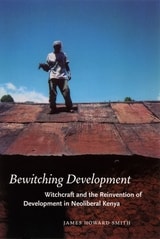
Bewitching Development
Witchcraft and the Reinvention of Development in Neoliberal KenyaJames Howard Smith
University of Chicago Press, 2008
Similar to magic, development’s promise of a better world elicits both hope and suspicion from Wataita. Smith shows that the unforeseen changes wrought by development—greater wealth for some, dashed hopes for many more—foster moral debates that Taita people express in occult terms. By carefully chronicling the beliefs and actions of this diverse community—from frustrated youths to nostalgic seniors, duplicitous preachers to thought-provoking witch doctors—BewitchingDevelopment vividly depicts the social life of formerly foreign ideas and practices in postcolonial Africa.
Beyond the World Bank Agenda
An Institutional Approach to DevelopmentHoward Stein
University of Chicago Press, 2008
Drawing on the examples of Africa, Asia, Latin America, and transitional European economies, this revolutionary volume proposes an alternative vision of institutional development with chapter-length applications to finance, state formation, and health care to provide a holistic, contextualized solution to the problems of developing nations. Beyond the World Bank Agenda will be essential reading for anyone concerned with forging a new strategy for sustainable development.
Boston and the Making of a Global City
James C. O’Connell
University of Massachusetts Press, 2025
In the late twentieth century the American and global economy shifted from manufacturing toward a knowledge industry. Following an economic low point several decades earlier, the city of Boston took advantage of the new era of globalization, fueled by dramatic advances in telecommunications, computer power, and air and sea travel, as well as its own impressive intellectual capital.
Boston and the Making of a Global City pulls together scholarship, media stories, personal interviews, and city planning documents to tell the story of Boston’s historical trajectory, as it quickly became a competitive global hub. Starting with its role as a colonial port and nineteenth-century maritime power, but moving quickly forward, the book describes how Boston capitalized on its strengths in higher education and such innovation sectors as life sciences, healthcare, information technology, and finance. Author James O’Connell traces the historical sweep of global flows—trade and supply chains, innovation and the dissemination of knowledge, investment, transportation, tourism, telecommunications, and immigration—that have shaped the city and region’s development. This volume also addresses the economic, social, and environmental challenges that Boston currently faces and how it is strategically positioned to confront them going forward.
Building Back Better in India
Development, NGOs, and Artisanal Fishers after the 2004 TsunamiRaja Swamy
University of Alabama Press, 2021
Disaster, development, and the struggle for coastal livelihoods in post-tsunami India.
Building Back Better in India: Development, NGOs, and Artisanal Fishers after the 2004 Tsunami addresses the ways in which natural disasters impact the strategies and priorities of neoliberalizing states in the contemporary era. In the light of growing scholarly and public concern over “disaster capitalism” and the tendency of states and powerful international financial institutions to view disasters as “opportunities” to “build back better,” Raja Swamy offers an ethnographically rich account of post-disaster reconstruction, its contested aims, and the mixed outcomes of state policy, humanitarian aid, and local resistance. Using the 2004 Indian Ocean tsunami as a case study, Swamy investigates the planning and implementation of a reconstruction process that sought to radically transform the geography of a coastal district in the Indian state of Tamil Nadu.
Drawing on an ethnographic study conducted in Tamil Nadu’s Nagapattinam District, Swamy shows how and why the state-led, multilaterally financed, and NGO-mediated reconstruction prioritized the displacement of coastal fisher populations. Exploring the substantive differences shaping NGO action, specifically in response to core political questions affecting the well-being of their ostensible beneficiaries, this account also centers the political agency of disaster survivors and their allies among NGOs in contesting the meanings of recovery while navigating the process of reconstruction.
If humanitarian aid brought together NGOs and fishers as givers and recipients of aid, it also revealed in its workings competing and sometimes contradictory assumptions, goals, interests, and strategies driving the fraught historical relationship between artisanal fishers and the state. Importantly, this research foregrounds the ambiguous role of NGOs involved in the distribution of aid, as well as the agency and strategic actions of the primary recipients of aid—the fishers of Nagapattinam—as they struggled with a reconstruction process that made receipt of the humanitarian gift of housing conditional on the formal abandonment of all claims to the coast. Building Back Better in India thus bridges scholarly concerns with disasters, humanitarianism, and economic development with those focused on power, agency, and resistance.