Results by title
295 books match the query 'Ecosystems & Habitats' and 13 start with b
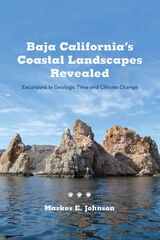
Baja California's Coastal Landscapes Revealed
Excursions in Geologic Time and Climate ChangeMarkes E. Johnson
University of Arizona Press, 2021
Johnson reveals a geologic history that is outside the temporal framework of a human lifetime and scored by violent storms. We see how hurricanes have shaped coastal landscapes all along the peninsula’s inner coast, a fascinating story only possible by disassembling the rocks that on first appraisal seem incomprehensible.
Looking closely, Johnson shows us how geology not only helps us look backward but also forward toward an uncertain future. The landscape Johnson describes may be apart from the rest of Mexico, but his expert eye reveals how it is influenced by the unfolding drama of Planet Earth’s global warming.
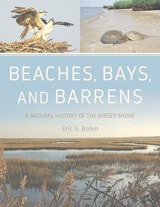
Beaches, Bays, and Barrens
A Natural History of the Jersey ShoreEric G. Bolen
Rutgers University Press, 2024
Beaches, Bays, and Barrens introduces readers to the natural wonders of the Jersey Shore, revealing its unique ecology and fascinating history. The journey begins with the contributions and discoveries of early naturalists who visited the region and an overview of endangered species and natural history, followed by chapters that explore different facets of the shore’s environments. These start with sandy beaches and dunes and culminate in the engaging Pine Barrens, the vital watershed for much of the state’s varied coastline. Along the way, readers will also learn about whaling, decoy carvers, an extinct duck, and the cultivation of wild blueberries.
Including over seventy color photographs, the book also features twenty-three infoboxes that go deep into areas of ecological or historical interest, such as the Forsythe National Wildlife Refuge or the Jaws-like shark attacks of 1916. From Cape May to Sandy Hook, biologist Eric G. Bolen takes you on a guided tour of the Jersey Shore’s rich ecological heritage.
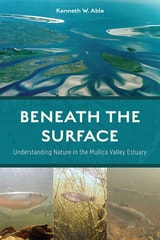
Beneath the Surface
Understanding Nature in the Mullica Valley EstuaryKenneth W. Able
Rutgers University Press, 2020
The Mullica Valley estuary and its watershed, formed over the last 10,000 years, are among the cleanest estuaries along the east coast of the United States. This 365,000-acre ecosystem benefits from a combination of protected watershed, low human population density, and general lack of extensive development. In Beneath the Surface, marine scientist Ken Able helps the reader penetrate the surface and gain insights into the kinds of habitats, animals, and plants that live there. Readers will gain a better understanding of the importance of these shallow waters; how the amount of salt in the water determines where animals and plants are found in estuaries; the day-night, seasonal, and annual variation in their occurrence; and how change is occurring as the result of climate variation. Throughout the book are insightful sidebars telling intimate stories of where various animals came from and where they are going as they travel through the estuary on their way to and from other portions of the east coast. Beneath the Surface emphasizes the kinds and importance of the animals and plants that live beneath the surface of this unique ecosystem.
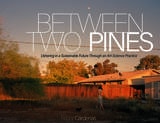
Between Two Pines
Ushering in a Sustainable Future Through an Art-Science PracticeEdgar Cardenas
Michigan Publishing Services, 2019
“I am truly thankful that Dr. Edgar Cardenas’s thoughtful research is now available in this beautiful book. I have recommended his work to more people, both in my personal and professional spheres of my life, than I can count, and I’m glad to have this provocative and elegant publication to put into people’s hands. Cardenas shows us how each of us really can make a difference.”
“Between Two Pines anticipates and leads the discussion of scholarship around questions of land and landscape. This work brilliantly and ethically refocuses our vision, from distanced scrutiny to connection and proximity, rooted in daily care-taking and ecological efforts. Thoughtfully imaged, the photographs offer an aesthetic that is based in balanced, enduring reflection, rather than on the grand view. These beautiful images reveal discoveries that bridge the arts, ecology, and sociology, and will serve to reconnect every reader with the world in their backyard and beyond.”
“Drawing from a long photographic tradition of examining the relationship between humans and their environment, Edgar Cardenas has found a voice that is as compassionate as it is poignant. Yet he is not content for his photographs to be mere observations, recording the relationship. Between Two Pines is a call to action – a platform by which we might imagine together, with all of the tools in our tool kit, a sustainable future.”
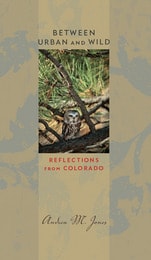
Between Urban and Wild
Reflections from ColoradoAndrea M. Jones
University of Iowa Press, 2013
Although not intended as a manual for landowners, Between Urban and Wild nonetheless offers useful and engaging perspectives on the realities of settling and living in a partially wild environment. Throughout her ongoing journey of being home, Jones’s close observations of the land and its native inhabitants are paired with the suggestion that even small landholders can act to protect the health of their properties. Her brief meditations capture and honor the subtleties of the natural world while illuminating the importance of working to safeguard it.
Probing the contradictions of a lifestyle that burdens the health of the land that she loves, Jones’s writing is permeated by her gentle, earnest conviction that living at the urban-wild interface requires us to set aside self-interest, consider compromise, and adjust our expectations and habits—to accommodate our surroundings rather than force them to accommodate us.
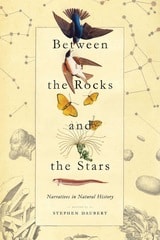
Between the Rocks and the Stars
Narratives in Natural HistoryStephen Daubert
Vanderbilt University Press, 2020
These stories take readers where they cannot go, be it out into space, back in time, deep under the ocean, down to microscopic scales, or out onto the geologic overview.
Squid turn themselves inside-out when disturbed by predators hunting through the darkness with sonar. Beneficial microbes spend their summer living in nectar and being transferred between blooms by the bees, then spend the winter living within those bees. Ecological stories are seen through the eyes of squirrels, birds, fish, ants, butterflies, and beetles.
Between the Rocks and the Stars dives deep into the relationships that shape the natural world. The book presents a collection of vignettes from the wild, each of which describes the natural advantage of a particular organism. These true-to-life accounts are then posed in particular circumstances that illustrate the principles—commensalism, speciation—that shape the place of these organisms in their living environment. Some stories cover topics in geology and cosmology, describing the physical world context in which natural history progresses across the eons.
Underlying themes in the book include the network of connections that link all these organisms together and the adaptations they make to the physical world in which they must find themselves a home.
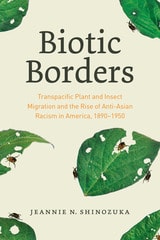
Biotic Borders
Transpacific Plant and Insect Migration and the Rise of Anti-Asian Racism in America, 1890–1950Jeannie N. Shinozuka
University of Chicago Press, 2022
In the late nineteenth century, increasing traffic of transpacific plants, insects, and peoples raised fears of a "biological yellow peril" when nursery stock and other agricultural products shipped from Japan to meet the growing demand for exotics in the United States. Over the next fifty years, these crossings transformed conceptions of race and migration, played a central role in the establishment of the US empire and its government agencies, and shaped the fields of horticulture, invasion biology, entomology, and plant pathology. In Biotic Borders, Jeannie N. Shinozuka uncovers the emergence of biological nativism that fueled American imperialism and spurred anti-Asian racism that remains with us today.
Shinozuka provides an eye-opening look at biotic exchanges that not only altered the lives of Japanese in America but transformed American society more broadly. She shows how the modern fixation on panic about foreign species created a linguistic and conceptual arsenal for anti-immigration movements that flourished in the early twentieth century. Xenophobia inspired concerns about biodiversity, prompting new categories of “native” and “invasive” species that defined groups as bio-invasions to be regulated—or annihilated. By highlighting these connections, Shinozuka shows us that this story cannot be told about humans alone—the plants and animals that crossed with them were central to Japanese American and Asian American history. The rise of economic entomology and plant pathology in concert with public health and anti-immigration movements demonstrate these entangled histories of xenophobia, racism, and species invasions.

Black Swan Lake
Life of a WetlandRod Giblett
Intellect Books, 2013
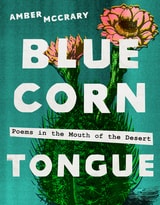
Blue Corn Tongue
Poems in the Mouth of the DesertAmber McCrary
University of Arizona Press, 2025
In a voice that is jubilant, irreverent, sometimes scouring, sometimes heartfelt, and always unmistakably her own, Amber McCrary remaps the deserts of Arizona through the blue corn story of a young Diné woman figuring out love and life with an O’odham man. Reflecting experiences of Indigenous joy, pain, and family, these shapeshifting poems celebrate the love between two Native partners, a love that flourishes alongside the traumas they face in the present and the past. From her ethereal connection with her saguaro muse, Hosh, to the intricate tapestry of her relationships with Diné relatives and her awakening to the complex world of toxic masculinity, McCrary brings together DIY zine aesthetics, life forms of juniper and mountains, and the beauty of Diné Bizaad to tell of the enduring bonds between people and place.
Journeying from the Colorado Plateau to the Sonoran Desert and back again, Blue Corn Tongue invokes the places, plants, and people of Diné Bikéyah and O’odham jeweḍ in a deeply honest exploration of love, memory, and intimacy confronting the legacy of land violence in these desert homelands.
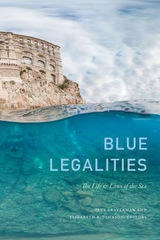
Blue Legalities
The Life and Laws of the SeaIrus Braverman and Elizabeth R. Johnson, editors
Duke University Press, 2019
Contributors. Stacy Alaimo, Amy Braun, Irus Braverman, Holly Jean Buck, Jennifer L. Gaynor, Stefan Helmreich, Elizabeth R. Johnson, Stephanie Jones, Zsofia Korosy, Berit Kristoffersen, Jessica Lehman, Astrida Neimanis, Susan Reid, Alison Rieser, Katherine G. Sammler, Astrid Schrader, Kristen L. Shake, Phil Steinberg
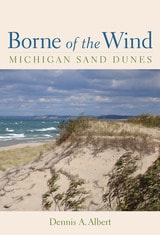
Borne of the Wind
Michigan Sand DunesDennis A. Albert
University of Michigan Press, 2006
Borne of the Wind describes the environmental factors necessary for dune creation in an easy-to-understand format, introducing readers to the rich ecology of Michigan's dunes. Each of the distinct types of dunes encountered along the Great Lakes shoreline is explained and illustrated with color photographs and line drawings, while color photographs of the plants and animals found in duneland areas complement the story of these fragile, ever-changing landscapes.
For scholars and enthusiasts alike, Borne of the Wind provides a comprehensive and colorful introduction to one of our finest yet least-understood natural features.
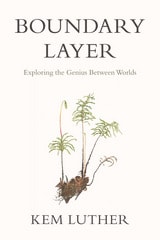
Boundary Layer
Exploring the Genius Between WorldsKem Luther
Oregon State University Press, 2016
In Boundary Layer, Luther takes a voyage of discovery through the stegnon, exploring the life forms that thrive there and introducing readers to the scientists who study them. With a keen ear for conversation and an eye for salient detail, the author brings a host of characters to life, people as unique and intriguing as the species inhabiting the stegnon.
A pair of park employees on a windswept beach shows how the violent clash of sea and land creates a sandy home for some of the world’s most endangered plants, including the almost-extinct pink sand-verbena. An expert on mosses, as ingenuous as the plants he loves, leads the author up a mountain and into a sphagnum bog. A husband and wife team, exiled by brutal repression in the wake of the Prague Spring, introduce European plant sociology to North America. A scientist, while revolutionizing the study of lichens, hides himself, hermitlike, inside one of the largest park reserves in the American West.
An exhilarating mix of natural history, botanical exploration, and philosophical speculation, Boundary Layer guides readers, in the end, into the author’s own landscape of metaphor. It will be welcomed by naturalists, botanists, outdoor adventurers, and anyone who savors good storytelling. Luther translates into luminous prose what boundary regions have to say, not only about the in-between places of nature, but also about the conceptual borderlands that lie between species and ecosystems, culture and nature, science and the humanities.
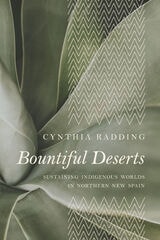
Bountiful Deserts
Sustaining Indigenous Worlds in Northern New SpainCynthia Radding
University of Arizona Press, 2022
Common understandings drawn from biblical references, literature, and art portray deserts as barren places that are far from God and spiritual sustenance. In our own time, attention focuses on the rigors of climate change in arid lands and the perils of the desert in the northern Mexican borderlands for migrants seeking shelter and a new life.
Bountiful Deserts foregrounds the knowledge of Indigenous peoples in the arid lands of northwestern Mexico, for whom the desert was anything but barren or empty. Instead, they nurtured and harvested the desert as a bountiful and sacred space. Drawing together historical texts and oral testimonies, archaeology, and natural history, author Cynthia Radding develops the relationships between people and plants and the ways that Indigenous people sustained their worlds before European contact through the changes set in motion by Spanish encounters, highlighting the long process of colonial conflicts and adaptations over more than two centuries. This work reveals the spiritual power of deserts by weaving together the cultural practices of historical peoples and contemporary living communities, centered especially on the Yaqui/Yoeme and Mayo/Yoreme.
Radding uses the tools of history, anthropology, geography, and ecology to paint an expansive picture of Indigenous worlds before and during colonial encounters. She re-creates the Indigenous worlds in both their spiritual and material realms, bringing together the analytical dimension of scientific research and the wisdom of oral traditions in its exploration of different kinds of knowledge about the natural world.
Published in cooperation with the William P. Clements Center for Southwest Studies, Southern Methodist University